written and posted by members of Lancashire Dead Good Poets' Society

Showing posts with label Cliffhangers. Show all posts

Saturday, 30 July 2022

Cliffhangers

Architects must be some of the maddest people on the planet, second only to their clients probably. For what could be more 'out there'  and living on the edge in a literal sense, than a cliffhanger of a house? Two of the examples I've picked to accompany today's blog can be found in Australia and are not for the faint-hearted. They are sited in spectacular cliff-top locations (naturally) and have been designed and built, at enormous cost one supposes and with all due regard to considerations of safety and permanence, so that their owners can thrill to exclusive and stunning sea views.


They are bold statements of man's prowess, constructs that are more suggestive of a James Bond film set than cosy nests for your average 21st century nuclear family. And presumably that is the point. A cliffhanging life is its own adrenaline charge. Even cleaning the windows requires a certain abseiling facility, the ability to dangle with a mop and bucket. I hope the seabirds are friendly. And is that a diving-board on top of the 'house' below?
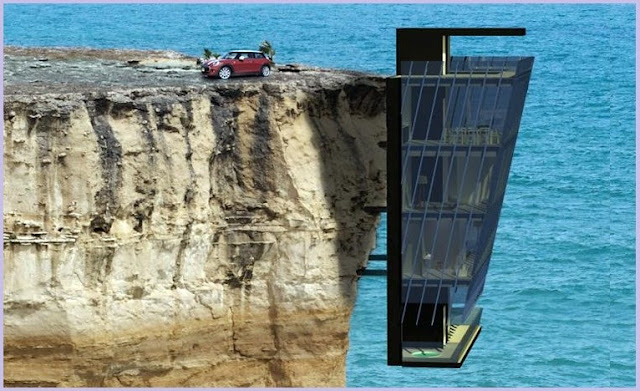

I'm presuming that earthquakes are not a feature of Australia's coastline, unlike in California, which was my first introduction to cliffhanging houses. If you've seen the Clint Eastwood thriller 'Play Misty For Me ' you'll know exactly what I'm talking about (and if you haven't, rectify asap). At intervals just a short turn off the Pacific Coast Highway can be found some of America's most breath-taking real estate, with views to match. Those stunning luxury clifftop houses hang like eyries above the shoreline from Monterey via Carmel to Big Sur, and one day when the San Andreas fault finally cracks (the 'big one' is overdue by half a century) they will all plummet into the sea.

British cliffhanging, typically, is much less spectacular, pretty low-key by comparison. And yet the coastal erosion of our relatively soft sandstone headlands has already caused many a cliffhanging home owner on Devon's 'rivièra ' to bemoan the cost of living on the edge. There's a parable for that, not to mention insurance premiums.


Climate change and the associated global rise in sea-levels is only going to exacerbate the problem and many more clifftop houses that have stood proud for generations around Britain's coastline are likely to go tumbling down to the shore in the next few decades. 

But enough of arrogance and gloom. Let me leave you with a new little poem that focuses on the positives:

Theia
divine madness in the moment
it's all about the letting go
as you fall so you rise
the sound of one cliff hanging


Thanks for reading, S ;-)

Wednesday, 27 July 2022

Cliffhanger

I write as someone who knows about the effects of cliffhangers on a person’s life. I was an Archer’s addict. How many Sunday mornings were ruined by the need to listen to the omnibus edition to find out what was happening in Ambridge. I thought of this immediately when I came to start writing this article. Then I wondered why I would think of the term cliffhanger. Where did the word come from? I think I’ve found out where the term first appeared in print but I’ll leave it until the end of the piece....

Surprisingly, the use of the technique has been around for many years. They were used as literary devices in several works of the Middle Ages. The Arabic literary work One Thousand and One Nights involves Scheherazade narrating a series of stories to King Shahryār for 1,001 nights, with each night ending on a cliffhanger in order to save herself from execution. Some medieval Chinese ballads like the Liu chih-yuan chu-kung-tiao ended each chapter on a cliffhanger to keep the audience in suspense.

Cliffhangers became prominent with the serial publication of narrative fiction, pioneered by Charles Dickens. Printed episodically in magazines, Dickens's cliffhangers triggered desperation in his readers. Writing in the New Yorker, Emily Nussbaum captured the anticipation of those waiting for the next instalment of Dickens' The Old Curiosity Shop; in 1841, Dickens fans rioted on the dock of New York Harbour, as they waited for a British ship carrying the next instalment, screaming, "Is little Nell dead?"


On Dickens’ cliffhangers - first seen with The Pickwick Papers in 1836—Leslie Howsam in The Cambridge Companion to the History of the Book (2015) writes, "It inspired a narrative that Dickens would explore and develop throughout his career. The instalments would typically culminate at a point in the plot that created reader anticipation and thus reader demand, generating a plot and sub-plot motif that would come to typify the novel structure."

With each new instalment widely anticipated with its cliffhanger ending, Dickens’ audience was enormous (his instalment format was also much more affordable and accessible to the masses, with the audience more evenly distributed across income levels than previous). The popularity of Dickens's serial publications saw the cliffhanger become a staple part of the sensation serials by the 1860s.

Thomas Hardy's A Pair of Blue Eyes (which was published in Tinsley's Magazine between September 1872 and July 1873) used the term when Henry Knight, one of the protagonists, is left hanging off a cliff.

Moving forward to the start of the film industry during the 1910s, Fort Lee, New Jersey was a centre of production, the cliffs facing New York and the Hudson River were frequently used as locations. For instance films such as The Perils of Pauline were made which would often end suddenly leaving actress Pearl White's Pauline character literally hanging from a cliff. But The Perils of Pauline would have been called a “serial” or “chapter play,” not a cliffhanger.


And here is the big reveal:
The word seems to have been first printed in the January 1931 edition of Variety according to the Oxford English Dictionary. But the Variety article certainly implies that the term cliffhanger was well known at the time. So, I suppose the question is at what point does a word become, well, a word?  I’ll have another look and if you read again next month who knows...

Another attempt at a haiku:

cliff walk past
fields of autumn gold
a gun fires

Thanks for reading, Terry Q.