written and posted by members of Lancashire Dead Good Poets' Society

Showing posts with label WB Yeats. Show all posts

Saturday, 1 July 2023

Feathers

Our favourite place for a nature walk in Blackpool is the town's award-winning* Stanley Park, over 300 acres of deciduous woodland with paths, a large lake, greensward, ornamental gardens and an art deco café. We go primarily for the bird-watching, also for the fresh air and exercise, and occasionally for lunch. It's just a shame that today is shaping up windy and wet, not the best for bird-watching, not feather weather.

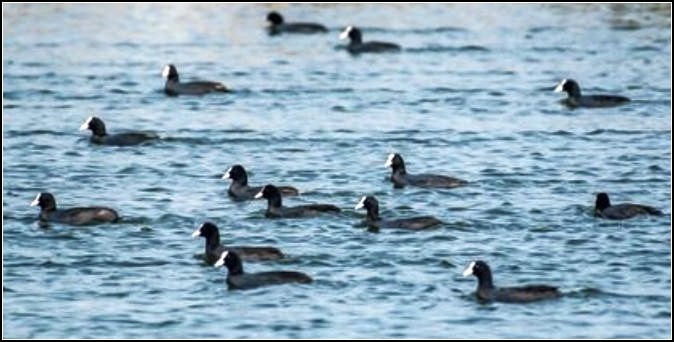
Over the last couple of years of visiting the park, I've noticed a significant increase in the number of coots, delightful water birds with their black plumage, that distinctive white 'shield' on their foreheads (giving rise to the saying "as bald as a coot") and their white bills. Sometimes there are as many as sixty or seventy of them out on the lake, where they seem to co-exist peacefully with each other and with other water fowl except at the height of the breeding season when they can get a tad territorial, beating the water with their feathers.

coot feathering
I don't recall precisely when my love for our feathered friends began but it was probably when I was about nine years old. Several things conspired. At that time (early 1960s), Chivers jellies were sold in cardboard packets with pictures of birds on the back, something like twelve in the series, collect all twelve and then send off for a large print of your favourite one. I hated jelly (still do) but my Mum used to buy it for my Dad, so I pestered her to buy specific packets, and when eventually I'd got all twelve, I sent them off for a hand-tinted print of a chaffinch. 

I'd also recently been bought my first camera, a Kodak Brownie 127. Before I'd acquired the full set of Chivers birds, I used to position the cut-outs in the privet hedge in our garden and photograph them with that Brownie camera. Weird, I know, fake bird pictures!

And then there was Arthur Ransome's 'Coot Club ', which I read at about the same time, and which made it feel cool to look out for the welfare of birds. 'Coot Club ' is a story about a group pf children living on the Norfolk Broads who have formed a vigilante gang to protect the nesting sites of coots from the townies who descend at week-ends and in the Easter holidays and who race about the waterways in motorboats with scant regard for the nesting coots or who think it acceptable to collect birds' eggs. Its pro-conservation message wrapped in an exciting adventure story was relatively ground-breaking for the time.

feet like anchovies
The coot then, readily identifiable from its white blaze, is the largest member of the Rallidae family (which also comprises moorhens, crakes and water rails), and is much bigger when seen out of the water than one might suppose, more the size of a chicken. The French indeed call it informally la poule d'eau  (water chicken), though its formal name is the foulque, derived from the Latin name fulica. There are ten species of coot worldwide and the commonest is our chap, fulica atra , the Eurasian coot. There are also various North American and South American varieties, one of which even sports a yellow shield. There was an eleventh, the Mascarene coot from Mauritius, but this followed its fellow islander the Dodo into extinction towards the end of the 17th century.

Although they are mostly black, certainly as far as plumage is concerned, they do have red eyes and strong yellow legs which end in pale blue feet with long lobed toes, resembling anchovies. They are powerful swimmers and can also run well across water and on dry land, but their short, rounded wings mean they are not the best fliers, certainly not on a par with ducks or geese.

They are omnivorous feeders, cropping on surface algae or diving for weeds, fish and water insects, but they also graze on land for seeds, fruit and small live prey. They build large, bulky nests with a neat bowl. These can be anchored to vegetation in shallow waters (logs, reeds or similar) or they can be free-floating. The female will lay between six and ten eggs at the rate of one per day over a week or so and both male and female coots take turns to incubate the eggs which hatch about three weeks after being laid. The fuzzy chicks with their smoky plumage and red heads more resemble moorhens than coots, enough so to confuse W. B. Yeats who wrote about "feathered balls of soot" in 'Meditations in Time of Civil War'. Vigilance is required, as the terrapins in Stanley Park lake are quite partial to coot and moorhen eggs, and predatory birds and pike will happily carry off a stray cootlet.

There was a time in this country when adult coots were hunted for food. I quote: "young moorhen are very good eating but I would infinitely rather have a coot." There were traditional coot shoots at several large British wetlands right up until the 1950s, and somewhere the killing goes on, for it turns out there is a trade in dead coot feathers, supplying fly-fishing anglers who like to make their own flies. I quote again: "The feathers on the front of the coot's wings can be used as hackles on a range of traditional soft-hackled wet flies such as the ever-popular 'Waterhen Bloa '" and they cost £15 from stockists of fishing supplies. No wonder coots are occasionally capable of quarrelsome and aggressive behaviour if they feel so threatened!

coot flotilla
I've often thought, when looking at the coots placidly floating on Stanley Park lake, that they are reminiscent of warships riding at anchor or sailing in formation, and I knew I'd like to write a poem exploring such an association one day. That day has come, and so here it is (potentially subject to the usual revisions). 

Coot Fleet
General synopsis Admiral Coot: mainly fair,
wind westerly, veering northwest for a time,

force two, speed approx. at four to six knots
so small wavelets, crests glassy, no breaking.

Irish Sea for you.  Cup of tea for me, maybe
with a shot of rum or piece of chocolate cake

to keep spirits up, bins trained eyes straining
to survey our fleet riding easy upon the lake

like warships in battle order, uniformly dark
drab grey all with strange white radar domes

and prows pointing into the flow, like Scapa
or Souda Bay, red-eyes alert, most definitely

not Pearl Harbour. Wild Coots at Poole  your
admirable misquote about our pleasing array

of waiting rails, no hint they'll up and away
though this brisk glorious mid-day. Strength

in numbers of course, deterrent force against
all-comers,  and my turn to be witty. Nobody

fucks with the baldies, I side-mouth, crumbs
of cake tumbling to the ground for sparrows 

to pounce on. And the wind does swing some
forty-five degrees as foretold,  whereon nine

and fifty synchronised sooty shapes re-orient
their white bills, resolute in their potent vigil.


* Stanley Park has been voted the UK's favourite park on three separate occasions, the last time being in 2022. 
Thanks for reading, S ;-)

Saturday, 6 February 2021

The Supper Party

Not some staged Mike Leigh or Harold Pinter weirdness, though I did briefly consider writing about an imaginary birthday party (given that it was my own birthday this week), to which I would invite famous people who have shared the same 4th February arrival date as myself. 

Before I knocked that idea on the head, potentially interesting invitees included one Joshua Abraham Norton (born in 1819 in London and later self-proclaimed Emperor Norton I of the United States of America - I kid you not, check it out); also Constance Markiewicz (born Constance Gore-Booth in 1868 in London, revolutionary, suffragist, Irish nationalist and the first woman elected to the UK parliament); Rosa Parks (born in 1913 in Alabama, a leading civil rights activist); Norman Wisdom (born in 1915 in London, a fine comedy actor and unofficial King of Albania); Alice Cooper (born Vincent Furnier in 1948 in Detroit, a rock musician and golfer); and Siobhan Dowd (born in 1960 in London, a brilliant children's author and winner of the Carnegie medal who died way too young in 2007).

In the end I settled for an intimate al fresco fantasy supper party with three guests; supper rather than dinner because it's less formal and - let's be honest - the conversation is more important than the food, right?

The lucky invitees would comprise these notables: Kitty Lloyd-Jones, Russell Hoban (who actually was born on 4th February) and Grace Slick. I would host, of course. Kitty jumped at the chance to return to Earth and it was for her benefit, principally, that I opted for supper under the stars. Russell at first declined on the grounds that he died in 2011, but I told him that Kitty had been dead way longer and he should come anyway so we could discuss his novels, which I have always rated and most of which are due to be republished as Penguin Modern Classics in the UK this year. No fantasy supper party of mine could not include Grace Slick, the voice that launched a thousand trips, so here we will soon be gathered in a secret garden belonging to Maxfield Parrish, your Saturday blogger plus cultural, counter-cultural and horticultural heroes. The evening is balmy, the spread is delectable - soup, osso buco, baked apples - the wine is of good vintage and there will be brandy and cigars all round later.

outdoor setting for a supper party (not in February, obviously)
Kathleen Laetitia (please call me Kitty), dressed in sensible tweeds with a pair of gardening gloves tucked into the jacket pocket just in case, is the first to arrive, puts me at my ease (it should be the other way) by inviting me to take a turn around the garden with her while we wait for the other guests to arrive. She says it seems a long time since she became the first woman to graduate with a degree in horticulture from Reading university. I observe that so it is, nearly a hundred years. But what a trail she blazed for women as the first professional horticulturist of her sex between the wars and what a legacy she has left us all at Upton House Gardens. She's pleased to note the steps made towards equality in recent decades but plays down her own role in that journey and avers that plants are more important than people anyway.

Russell, by rights, is next on the scene, a journal and fountain pen in his pockets. He says he used a computer in his later years but there's nowhere to plug them in where he lives now. I tell him how much I loved reading all his books, especially that purple run of Kleinzeit, Turtle Diary, Riddley Walker, Pilgermann and The Medusa Frequency in the 1970s and 1980s. He points out that he wrote another ten after that and I make amends by saying how pleased I am that they're all getting republished and that I shall buy and re-read every one. When I tell him that we share our birth date he doesn't seem surprised. He already knew, and that we have it in common with my friends Vassiliki and Sue. I'm impressed.

Grace is the last to arrive, dressed for 1968 in kaftan and boots, bedecked with strings of beads, reeking of patchouli and already well-lit. It's the nerves, she laughs, acid eyes sparkling. She tells Russell she loved his 'Frances' books as a child, and she has always liked beautiful gardens. Soon everyone is under her spell, listening to tales of psychedelic San Francisco, of playing morning maniac music to half a million people at Woodstock, of her campaigns to save endangered wildlife.

We've taken our places at the table under the trees, illuminated by a string of golden globes. The wine and the conversation flow. I sit slightly in shadow, happy to listen for hours enthralled, having merely to keep refilling their glasses as they rap about the trials and joys of creativity, about ecology, about favourite books and records, the peculiarities of the afterlife, how the next thing is the best thing although the here-and-now is everything. Their happy faces glow with alcohol and lamplight. They are having such a good time they hardly notice me, the perfect host. It's almost as though I'm not even there...

I offer you two poems again this week, the first by W.B. Yeats, the second my own. Yeats wrote his elegiac poem in memory of sisters (one of whom was the self-same Constance Markiewicz mentioned above), and the couplet "The innocent and the beautiful/ Have no enemy but time" has always struck me (since studying Yeats for A-level English) as particularly fine.

In Memory of Eva Gore-Booth and Con Markiewicz
The light of evening, Lissadell,
Great windows open to the south,
Two girls in silk kimonos, both
Beautiful, one a gazelle.
But a raving autumn shears
Blossom from the summer's wreath;
The older is condemned to death,
Pardoned, drags out lonely years
Conspiring among the ignorant.
I know not what the younger dreams -
Some vague Utopia - and she seems,
When withered old and skeleton-gaunt,
An image of such politics.
Many a time I think to seek
One or the other out and speak
Of that old Georgian mansion, mix
Pictures of the mind, recall
That table and the talk of youth,
Two girls in silk kimonos, both
Beautiful, one a gazelle.

Dear shadows, now you know it all,
All the folly of a fight
With a common wrong or right.
The innocent and the beautiful
Have no enemy but time;
Arise and bid me strike a match
And strike another till time catch;
Should the conflagration climb,
Run till all the sages know.
We the great gazebo built,
They convicted us of guilt;
Bid me strike a match and blow.

                                     W. B. Yeats, October 1927

My latest strange invention is an inversion of sorts of a more famous final meal, a commentary on megalomania and its just deserts. It may eventually acquire an additional verse (which I'm working on) to be inserted between the current first and second, but for now it's a three stanza poem.

The Last Supper
No one touched the electric soup for we were not
soup-drinking men, he the General, we his loyal
particulars; anyway the sight of lightning bolts
fizzing round in bowls behind our reflected eyes
unsettled. We knew where we were with great
plates of ox-meat and potatoes, the last and best
the island had to offer. And wine, plenty of that.
We gorged and drank like there was no tomorrow.

After pudding (honeyed baked apples and cream)
the mood changed at our table set out on the lawn.
Defiant celebration of blood brotherhood faltered  
when the head turned on the body as it often does,
a common flaw in a powerful cast, whose reveal
under duress is shattering. Belching, glaring, our
General rose unsteady to berate us, his disciples, 
a bunch of inebriates, lacking spine for the fight!

I think he meant invertebrates, but as we had been
drinking for hours, I wasn't going to put him right.
Instead, I stared tired-eyed into apocalyptic skies, 
while my diminished comrades finished the mints.
They wouldn't have kept anyway. As I swallowed
a last cup of coffee both hot and bitter, defeat rode
twinkling in the bay, a cock crowed, the first wave
of paratroops dropped quietly through the dawn.
 
Thanks for reading. There's washing-up to be done! S ;-)


15/02/21 Addendum: my friend Jim has kindly sent me a picture of Grace Slick from 1968. I attach it here as he was unable to add it to his comment...


Saturday, 22 October 2016

Holiday!

Imagine the dilemma. You live (maybe alone, maybe with your perfect partner) on a tropical island paradise - for instance the one pictured below - where each day is perfect in every way that perfect can be. You enjoy the same unvarying sunny climate all year round, hot but never scorching during the day, always comfortably warm at night. There is the occasional refreshing rain shower but it never comes as a surprise. You listen to the music of the sea and the rustle of palm leaves. There are no pests or predators to spoil the idyll. You have a plentiful supply of food and drink and lots of time to think. There are no noisy neighbours, no deadlines to meet and there is absolutely no stress. You eat, swim, love, sleep and dream.... eat, swim, love, sleep and dream.... each day, every day...


So then - where do you go on holiday? You see the problem, gentle reader.

Without contraries, there is no progression, as William Blake recognised. A permanent state of perfect paradise might just begin to pall with no contrasts -  so you need a break every so often, if only to remind you just how lucky you are... and then, like I said - where do you go on holiday?

Worry not. Antithesis Travel has the solution to your dilemma.

As you have quiet and isolation and restfulness in your everyday life, Antithesis Travel will offer you noise and crowds and confusion - but still with a beach theme. They will dispatch you for two weeks in July to Blackpool. (Did I mention it's 1976?)


It'll be a riot of a holiday. Swap your hammock for a deckchair and your acres of empty white sand for approximately 9 square yards of beach (yep, not properly metric in 1976). Make hundreds of new friends (with kids, with mothers-in-law in tow) and swelter in the sun as you listen to the music of a thousand transistor radios and the laughter of spiralling seagulls. Eat hot dogs, candyfloss and ice-cream and drink warm Watneys Red Barrel. Bat away wasps. Paddle in the polluted waves (blue flag beach still 30 years in the future). Have a kiss-me-quick holiday romance. Get drunk. Sleep it off. Repeat.

It'll be mega, a fortnight of fun, the vivid memories of which will sustain you through those long perfect days back on your tropical island paradise.

Okay. And so to this week's poem. All my (currently limited) reserves of creativity have been exhausted in putting the above together, so I'm posting a favourite by W.B. Yeats.

The Lake Isle of Innisfree
I will arise and go now, and go to Innisfree,
And a small cabin build there, of clay and wattles made:
Nine bean-rows will I have there, a hive for the honey-bee,
And live alone in the bee-loud glade.

And I shall have some peace there, for peace comes dropping slow,
Dropping from the veils of the morning to where the cricket sings;
There midnight's all a glimmer, an noon a purple glow,
And evening full of the linnet's wings.

I will arise and go now, for always night and day
I hear lake water lapping with low sounds by the shore;
While I stand on the roadway, or on the pavements grey,
I hear it in the deep heart's core.
                                                                         W.B. Yeats (December 1890)


Thanks for reading. I wish you a week of stimulating contrasts, S ;-)

Saturday, 26 September 2015

Moments That Changed The World

It's been a bad day and this is a weighty theme - moments that changed the world.

I've given it considerable thought and I've chosen that moment at precisely 08:15 a.m. local time  on 6th August 1945 when the first atomic bomb was detonated in anger over Hiroshima, Japan - a pivotal event in our stumbling evolution. I'm reminded of WB Yeats' refrain (from Easter 1916): "All changed, changed utterly: A terrible beauty is born."


The rationale for using nuclear weapons was that, despite the terrible destruction caused (over 100,000 people died as a result of that single bomb), it fast-tracked Japan's surrender, shortened World War II by several weeks, maybe months, and saved thousands of other casualties. Debate still rages over whether the end justified the means. I can't accept that it did, any more than did J. Robert Oppenheimer, "father of the atom bomb", who turned to the Bhagavad Gita for words to express the enormity of what he had been instrumental in engendering: "Now I am become death, the destroyer of the world."

He recognised that life on planet Earth would never be the same again. Man had become godlike, with his/her capability for the first time to blow our whole planet to smithereens. I believe Oppenheimer conceptualised the span of our civilisation from the dawn of creation to the impending eve of destruction - this transformation from plankton to potentate - and regretted his complicity. But there was to be no undoing, no going back.

The uranium-235 bomb exploded over Hiroshima, despite the havoc it caused, was woefully inefficient. Less than 2% of its fissionable material reacted. Soon the death-race was on to develop bigger, better atomic bombs, plus delivery systems, and to stockpile them in America, Russia, Britain, France, China, Israel, India and on and on. By the 1960s the nuclear nations possessed enough atomic firepower to destroy civilisation many times over. We learned to live with the threat of imminent annihilation - four minutes warning was all we'd get, time for a few hasty good-byes and last minute regrets. Many of us (myself included) joined CND, the Campaign for Nuclear  Disarmament, marched, protested and lobbied for a safer, saner world.  The realisation that Mutually-Assured Destruction (MAD for short) was a likely consequence of this insane arms race led the superpowers back from the brink. Non-proliferation treaties were signed, monitored decommissioning of nuclear stockpiles commenced and the threat of man-made global nuclear destruction has receded from the forefront of most people's minds. Yet the threat remains.

This week's poem is an attempt (I'm not sure how successful) to capture some sense of the immense implications of the event from the perspective of the father of Colonel Tibbets, the pilot who dropped the first bomb. (In case you didn't know, Colonel Tibbetts named the Boeing B-29 Enola Gay after his mother and the bomb he dropped on Hiroshima was nicknamed Little Boy. The two other bombers on the mission were dubbed The Great Artiste and Necessary Evil.)


The Bomb
I.
She was a rhapsody
in blue stockings, Enola Gay.
I recall performing cunnilingus
to the strains of Charlie Mingus
back in the day
before the Baron swapped his cello
for the double-bass.
Red-headed and wound up tight,
Enola Gay would detonate
in carefully controlled explosions
deep in hot Nebraska summer nights.

II.
You will always be my little boy
asleep in the next door room,
an all-American clean cut kid
roaming the prairie of your dreams
with big plans to be
a cowboy or a medicine man;
yet you became Colonel Tibbetts, USAF,
first horseman of the apocalypse.
Child of my loins,
you swapped your thoroughbred for wings
bearing your lovely mother's name.
Were we in any way to blame?

III.
Hiroshima, Hiroshima,
in the land of the rising sun,
as early morning innocence dawned
a necessary evil fell towards you
out of clear blue skies,
bearing down the seeds of doom and liberation.
Alchemical flowering
at two thousand feet
showered a heavy metal incandescence
perpetrating mass annihilation
as shockwaves and firestorms
reduced a city to flattened ash
at the base of a mighty mushroom cloud.
Code red issued- one hundred thousand dead.
War lost and won.
Oh my wife.
Oh my son.
What have we done?
What have we done?


Thanks for reading. Ban the bomb! Have a good week, S ;-)