written and posted by members of Lancashire Dead Good Poets' Society

Showing posts with label absorption. Show all posts

Wednesday, 3 July 2024

Belief

I remember being in a cinema in Coventry back in around 1980 enjoying a new science fiction movie. During a dinner sequence on board the spacecraft a crew member’s chest explodes and a life form escapes. The film, of course, was 'Alien' and I was totally absorbed as the story unfolded. I was there in the hunt to find the creature.

And the point of that intro is that for the next ninety minutes or so I had completely surrendered my belief in the here and now. I was in the there and now. So many films have had that effect on me (well, except for Batman and the rest of the Marvel stuff) and I presume on all of us.

Alien
So, why do we lose the sense of where we are during a film. What makes us suspend belief and enter another place for its duration.

Years ago I read that being involved in a film is like being in an hypnotic trance so I had a dive into google and found this (apparently written by a ‘bot’):
‘When you watch a movie, you are not typically in a state of hypnosis. Hypnosis is a trance-like state of focused attention and heightened suggestibility, often induced by a hypnotist. While watching a movie, you are engaged in the storyline, visuals, and audio...which can create a sense of absorption or "being lost" in the story. This absorption can sometimes be compared to a hypnotic state...your critical thinking may be temporarily suspended as you become engrossed in the film.’

There is also this from another site:
'Filmmakers have developed techniques that capture our sensations, thoughts, and feelings. Philosophers and film theorists have thought deeply about this...yet few scientists have delved into empirical analyses of our movie experience-or what Arthur P. Shimamura has coined "psychocinematics." This volume introduces this exciting field.' Which may be interesting but is also £97.

But this state of trance/hypnosis is not confined to film. I wouldn’t mind betting that most of us have been so deep in a book that we lose touch with time. The most recent vivid experience of this for me happened a couple of years ago when I was reading ‘The Martian’ by Andy Weir. Not only was I unaware of time but my heart was bumping as I was getting to the end. At 2-30 am. That is belief.

The Martian
I do not find this sense of surrendering my belief in the here and now in the theatre or music. Different sensations do occur and I do find great pleasure in attending such events. Having said that it was at an outdoor theatre event at Williamson Park that I experienced the effect of breaking the fourth wall, that separation from actors and me as an audience who wants to believe in the reality of the performance.

It had been belting down all day and we turned up in Lancaster with our flasks (tomato soup), cheese sandwiches, waterproof jackets and overtrousers only to find that the evening’s show had had to be cancelled. The first time the actors had cancelled that season. They were as bereft as we were and wandered round what was left of the crowd apologising. But that was the thing. The actors were talking to us in character with costumes still on. That sort of shattered my belief in the play.

Williamson Park
But never mind, with poetry I always have the belief that clouds have silver linings.

Williamson Park, Lancaster

Hot soup on a wet evening
three of us plus Tim
sit on the steps
watch the rain falling down
fall past the Butterflies
down past the Folly
down past the bushes
where the Play’s not played
dry on the steps
and watching the water
drowning Morecambe
and into the Bay
and then in the rainfall
there’s the actors
dripping with something
that looks like rage
it has to be bad
for them to cancel
it has to be bad
to want them to
but when they’re passing
they stop to talk
to the three of us plus Tim
and just that gesture
makes the evening
the floodlights drift away
for those ten minutes
we’re part of it all
as Julia chats with Shakespeare
Olivier laughs with Paul
me I fall for the actress
and Tim can’t wait to go home.

Winning poem in Borders Poetry comp approx 2007

Thanks for reading, Terry Q. 
Sunday, 16 March 2014

Immersion Therapy

21:36:00 Posted by Unknown , , , , 2 comments
Good evening readers,

This week on the Dead Good Blog we've been looking at Absorption.
Absorption isn't something I tend to do lightly. I try and stay out of getting too deep into things for a fear of becoming completely engrossed. In short, I try and stay out of the action if I can. This makes me a bad, lazy poet and so from time to time, I get stuck right in to the books- feel compelled to seek out the landscapes and generally waste about a week submerged in my own little world of thoughts.
There is though, a rapidly approaching workshop at the library that I'm meant to be taking with Lindsay, and so, as I haven't yet had a chance to message her on facebook, be assured that I am considering the options and am aware of a rapidly shortening deadline.
This, I find, is helping me to be a little more poetic. In preparation I have been reading  from 'Poetry in the Making'  by Ted Hughes. The book has proved something of a gem in so far as it has an entire chapter entitled Wind and Weather- the very theme I'm supposed to be thinking about.
Ted's little guide to writing and teaching poetry, with its chapters on topics such as studying animals, has inspired me this week to think about the way I actually write. I've been captivated by the way in which the idea of capturing an animal in a poem can preserve the moment forever. On that note then, I've been working on an idea I got last week on a walk when I saw the first bee I've seen all year out collecting pollen. Obviously, it is still very much a work in progress and nowhere near the standard of the examples in the book but, for a start whilst I'm giving up end-rhyme, it is at least a bit of a poem.

The Bee

Setting out amongst the trees
Perching a while to survey the meadow:
The pollen in the flowers,
The sun in the puddles.
This is the time to collect up the goodness.

Winter held on too strong.
Laboriously it has clung to the isle
Fields flooded out
No petals to see
Then the world started turning again.

Like a cog in the wheel
Turning steady time
It is on to the next, inquisitively
Round and around,
Round and around
 
Until gathered,
it returns, heavy laden
Stains a mark on the page-
This the pollen.


Thanks for reading,
S.

Friday, 14 March 2014

Absorbing pastimes for a youthful mind.

Absorption. The process of taking in matter of some sort and holding on to it. Whether information to be retained, or more obviously, a sponge to soak up liquid etc.

Talking of sponges ...

My little munchkin turned 6 years old on Wednesday. He was highly excited and is currently looking forward to his Birthday Party tomorrow.  As with any child, he is going through a phase of liking one particular cartoon character above most others. Namely Spongebob Squarepants.  If you've never heard of him, I wouldn't blame you for doubting your eyes, but yes, that is his name. Basically, the cartoon is set below the sea in a city called Bikini Bottom. He is a little yellow fellow (a sponge of course, shaped squarely, well more rectangular really) who wears a little white shirt, a red tie and brown trousers. Getting up to various japes and adventures, my son loves him and tunes in daily to watch. It's silly, funny and I inadvertently end up watching it too. For those who know it, altogether now: "Ooooooooooooooh, who live in a Pineapple under the sea?  SPONGEBOB SQUAREPANTS! Absorbent and yellow and porous is he! SPONGEBOB SQUAREPANTS! ...........".

Which, in a roundabout way, brings me to my point. It made me realise exactly how much television my son was watching, especially as he likes to sing the theme tunes to various shows and, not only those, but adverts too! His brain has absorbed so much information that he knows these off by heart, which is a little worrying. Consequently, we (as a family) have been encouraging him to have quiet time. When he can sit and play using his toys and imagination, or to sit and read a book. At the weekends, he is taken to the Park to have a good run around and tire himself out whilst unknowingly keeping fit. We are balancing a modern life with a good old fashioned one!


A Youthful Mind:

It is essential, is it not,
To find the right balance
Of education, fitness and play.
To ensure that it is absorbed,
Encouraged and much fun,
To keep rot of the brain well at bay.

A youthful mind, so like a sponge,
Will thirstily soak up
Everything, with relative ease.
Information, whether verbal,
Visual or by touch,
Taken on board, like 1, 2 and 3.

So listen well and be advised,
Guard your actions and words,
Model behaviour as a template.
Their very future persona,
Rests upon your shoulders,
Set the example to contemplate!

So, not too much television,
Sit down and read aloud,
So much joy can be gained from a book.
Pretend with toys, or make a den,
An adventure awaits you.
Go outside, see nature, get them hooked!


Thanks for reading! :-D


Thursday, 13 March 2014

Revisiting

Earlier this week I read Kevin Prufer's 'Churches' in the Paris Review - it caused me to become preoccupied. While there was much to absorb and appreciate - the postcard rack is vivid and lasting - it was this stanza which plucked an unfinished poem from the archive of my mind and lay it out on the table:

In 2009, my father lay in a hospital bed 
gesturing sweepingly with his hands. 
                                  “What are you doing?” 
I asked him. “I’m building a church,” he said. 
“You’re making a church?” I said. 
                                  “Can’t you see?” he said. 
He seemed to be patting something 
in the air, sculpting something—a roof?—that floated above him. 
The hospital room was quiet and white. 
“What kind of church is it?” “I’m not finished.” 
“Is it a church you remember?” 
                                                    “Goddamn it,” he said. “Can’t you see I’m busy?”

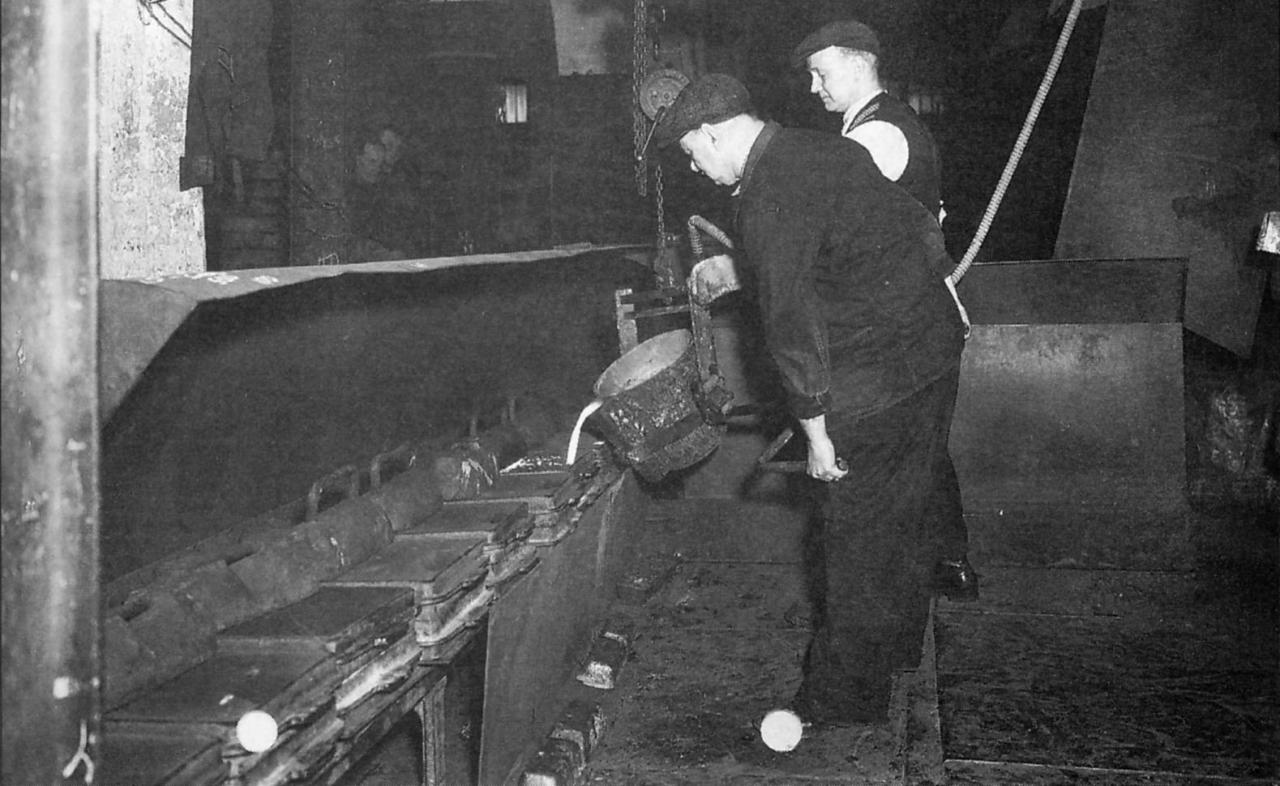
Five years ago, back 'home' in the city where I was born, in the same hospital in fact, I met the foundry man. My Grandpop lay in the hospital bed, his hands moving through the air in a similar way to that described in Prufer's poem. He'd thrust his arms forward toward the unseen furnace, pull them back and then pour the invisible steel liquid into moulds lined up along the hospital table. After hours of repeating the same actions he'd suddenly switch to rubbing his palms together, sliding the fingers on his right-hand between those on his left. When he plunged his hands into the dry bed sheets to wash off the soap, my mum said he was back home now. Standing at the kitchen sink - as he did every night after work - washing off the stains.


For five years I've been trying to write the foundry man poem. I've lost count of how many drafts I've written, how many different ways I've tried to write his story. I know the details - still so clear - are those worthy of a poem, but every attempt I have made feels wrong, unfinished. With each failed attempted I file another draft away in the filing cabinet, leave it alone and decide that maybe now isn't the right time for this poem to be written. But eventually something triggers the foundry man to rise vividly back into my thoughts and I'm compelled, almost powerless, to make another attempt.

*          *          *

Conversations with poets over the years have revealed that many have that one stubborn/ difficult poem which seems to take far longer to finish than others. After years of revisiting an idea, writing unsuccessful drafts, something finally clicks and they find their poem - exactly as they hoped it would be. So maybe this time, when I revisit the foundry man, I'll write the poem and it'll be just as I hoped it would be. 


Thank you for reading,

Lara.

Wednesday, 12 March 2014

Like a roll of Bounty in a swimming pool


Absorption. I think this can be applied to writing. I think it's important to read widely and sometimes randomly. Every writer's work is different, but it is good to digest lots of different authors to see what works for you as a reader, and as a writer. The subconscious is a funny old thing, and we really don't know quite how it all works yet. Because we aren't conscious of it. Obviously. But the things we read don't just disappear I'm sure. I'm the most random of people who will get ideas and not know where the hell they have come from, but clearly my subconscious has scurried away to find something useful and splurt it out at the right moment. I attended a workshop yesterday where the creative process was mentioned, and it was likened to a state where we could just freely relax and let our subconscious do the work for us, and for many, including me that is the case. In the right environment I can sit and write and surprise myself at what comes out. If we can get into the state of 'flow' where it comes easily and prolifically then that is an amazing feeling, almost a state of play for me.

But the subconscious needs something to work with, and this is where reading widely comes in. We might think it's trash but it's worth reading to find out why it compels people to read it. It all is absorbed into the subconscious and may come in handy in the future, if nothing else to know what's already been done, what to avoid and what gives a story teeth. Read beautiful prose, read poetry, read trash, it can bubble away in there and come up with something unique. But trust it. Your conscious is for the editing process, and that can come later, when the playing is finished.

But this doesn't just apply to reading. Like an artist learns to 'see' the world in a different way to paint it we have to look at things closely in a new way, describe things with words in a way an artist would paint a scene. To avoid clichéd

writing we have to try and find a new way of describing what we see without verging into the old purple prose. There lies the tricky bit. It's worth it when it comes together though.
It's amazing how much the subconscious can actually absorb. I'm not a puritan, a bit of rubbish is good, just so you know what's out there. I'm not sure you need to actually feed it in any other way than just exposing yourself to more. Even if it feels uncomfortable it's got to be worth something, be absorbed and give something more to your work.


So if my writing seems grammatically incorrect at times, or a bit scatty, trail off somewhere else, it's just that I've tired myself out playing too much to tidy up afterwards. Note to self: Stop being lazy.

Tuesday, 11 March 2014

What you seek is seeking you.

There's a strange circularity to learning and teaching.  Just as my daughter discovered that she would retain more information for her pending exams by teaching that information to someone else, I feel that I have learned more about poetry through teaching it to others.  It's as if there's a survival mechanism built into knowledge that ensures it will exist beyond a single mind.  In order to retain details in the long term we must, ironically, give them away.

With this in mind, I have decided to teach you about something because it's something I'd like to learn.  I have chosen Ecstatic Poetry.

The Greek ekstasis, from which the word ecstasy is derived, translated as 'standing outside oneself'.  This, to me, means that when you enter an ecstatic state, you step outside your normal framework and experience and are transported to a state which is separate from that state of mind, however temporarily.  This needn't be as extreme as a Bacchanalian frenzy, or a drug-induced stupor.  It can be that small shift in pace coupled with a flash of perspective which forces you to pause and re-read that last line, while your world moves a fraction to the left.

Bacchanale by Lovis Corinth (1896)


Paul Valery, in Edward Hirsch's How to Read a Poem and Fall in Love with Poetry, is quoted as saying, "A poet's function- do no be startled by this remark- is not to experience the poetic state: that is a private affair. His function is to create it in others."  There are a range of poetic effects at our fingertips to invoke this ecstatic state in our readers.  These tools are similar to those used in traditional prayer and hymn: the incantation of a poem in its rhythm and music, the momentary pause brought about by paradox, or the displacement of words, their rearrangement, that gives a fresh reading to a familar phrase. 

The Sufi Poets are perhaps the best known of the ecstatic poets.  And of the Sufi poets, Rumi is perhaps the most famous.  His work has a transcendental, mystic quality to it but it is grounded in nature.  In 2007, he was named the 'most popular poet in America,' - not bad for someone who was writing in the 13th century on the other side of the world. 

Having done a little research now, I find I am quite fond of Daniel Ladinsky's interpretation of Rumi's The Way Things Should (2002).  You can read the full poem online here.  Here is the part of the poem which I find induces a feeling of ecstasy in me:

Love so needs to love
that it will endure almost anything, even abuse,
just to flicker for a moment. But the sky’s mouth is kind,
its song will never hurt you, for I sing those words.

What will our children do in the morning
if they do not see us
fly?

The shift, for me, from a traditional, inspiring verse to something which is ecstatic comes with the words 'the sky's mouth'.  The words sink in up to that point but at this moment I pause.  The voice becomes not that of the poet, but of a universal humanity.  It's an invocation of universal love, or God.  In that moment, when I sense the shift from the poet's voice to something bigger, that attempt to channel the universe, I feel my own heart lift.  It's as if the poet's intention has travelled those 800 years to find me, right where I am, and remind me that I am loved.  The directness of the intention directly affects my emotional state.  This is Rumi.  This is ecstatic poetry.  I stand outside myself.