London's Underground railway system, the oldest in the world, first opened in January 1863, the start of a grand design to link the City of London with the capital's suburbs via the Metropolitan Line. There was even talk at that time that it might eventually extend to Dover and through a mooted Channel Tunnel, thereby linking Victorian London with Napoleonic Paris. What s crazy idea!
It is not recorded if passengers were advised to Mind The Gap on those early subterranean journeys between Paddington and Farringdon, using gas-lit wooden carriages hauled by steam locomotives. It was probably all rather more sedate than it became once the network expanded under the city and was electrified in the early 1900s. Throughout the first half of the 20th century, train drivers and station attendants would make verbal announcements on underground platforms, particularly in the busier stations: "train approaching", "kindly let passengers off first", "take care when alighting and boarding", "stand clear of the closing doors".
However, as the volume of people using the underground increased enormously in the post-war decades, the decision was made for safety reasons to automate the key message to the travelling public and in 1968 the pithy phrase "mind the gap" was chosen as the simplest and most effective way of focussing passengers' attention as they got on and off the tube trains. The same simple, short message was also painted on platform edges opposite where the train doors would open and it featured in poster campaigns promoting safety on the Underground.
Bereft of the man she loved, if Margaret wanted to hear her departed husband's voice, she could still go to Embankment station and wait for a train to come in, and another. She did this for five years. "Since he died I would sit and wait for the next train until I heard his voice saying "Mind the Gap, Mind the Gap". Then on November 1st 2012 he wasn't there! I was just stunned when Oswald wasn't there anymore. I inquired and I was told there was a new digital system and they could not get his voice on it."
 |
| "Mind The Gap" |
London Underground chose an AEG Telefunken digital system and the first '"Mind The Gap" message was recorded for use on the Central Line by a sound engineer, one Peter Lodge, owner of Redan Recorders in Bayswater, a station on the Circle Line. That recording still gets played today.
But Peter Lodge's is not the only voice that was used. Different lines, even different stations on the same line, have used other recordings down the years. Cue some fascinating name-dropping. For many years, the voice on the Piccadilly Line was that of actor Tim Bentinck, more properly called Timothy Charles Robert Noel Bentinck, 12th Earl of Portland, Count Bentinck of Waldeck Limpurg, but most well known for his role as David Archer in BBC Radio's long running 'everyday story of country folk'. He has been superseded by voice-over artist Julie Berry, who has to listen to herself almost daily as she lives near Barons Court tube station. Actress and voice-over artist Emma Clark was the voice of the Bakerloo, Central and Victoria Lines for decades until she discredited herself by making public some spoof recordings she had created. Transport For London (as it now is) terminated her contract forthwith.. And Phil Sayer, another actor and radio presenter, whose voice graced stations on the Jubilee, Northern and Piccadilly lines, was even accorded an obituary in the New York Times in 2016. It read: "Mr. Sayer's was not the only voice cautioning passengers to 'mind the gap', but it is arguably the most familiar one"
However, I would contend that the vote for most familiar, even most famous "Mind The Gap" voice ought to go to one Oswald Laurence. He was a RADA trained stage actor who leant his measured tones to a "Mind The Gap" announcement used by London Underground from the 1970s onwards, so although he was not a household name, his voice was heard by millions of people travelling by tube.
Oswald met general practitioner Dr Margaret McCollum while holidaying in Morocco in 1992. They married and lived together in London until Oswald's death in 2007.By the turn of the century, as noted above, many of the early Underground public announcement recordings had been replaced by newer ones, and this had happened gradually to the Oswald Laurence recording, although it was still in use on the Northern Line at Embankment.
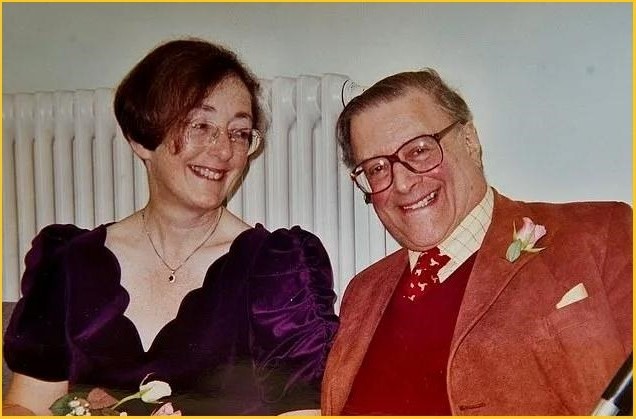 |
| Margaret and Oswald |
Margaret was disconsolate. I know people who have hung on to dusty dictaphones and redundant answering machines because they contain the voice of a departed loved one which can be played back when the need is strong. So I can understand Margaret's reaction to her sudden loss.
Every credit then to Transport For London for their sensitivity, for when Dr. McCollum made her predicament known to them, they retrieved the master recording that Oswald Laurence had made all those years ago and digitised it into the new system, so that his voice can still be heard to this day, but only on the northbound platform of the Northern Line at Embankment, advising passengers (including his widow when she chooses to be there) to mind how they go.
That heart-warming story was the catalyst for my latest poem:

Like Orpheus In Reverse
At certain times, not necessarily only gloomy ones
for on occasions the urge comes when she's sitting
in Victoria Embankment Gardens enjoying the sun
on days when she has no surgery to run, she needs
to outwit his deathly silence now she can no longer
cook him breakfast, pair his socks, rest in his arms.
Like Orpheus in reverse, she plunges underground,
three hundred feet down to the labyrinth, spiralling
if needs must as when an escalator is out of bounds
for refurbishment. So she waits quietly, expectantly
upon the northbound platform of the Northern Line
anticipating that rattle within a sooty tunnel, glints
of headlights along humming rails, shockwaves of
an ozone rush before his disembodied voice intones
mind the gap mind the gap. Eustachian tubes vibrate
and endorphins flood her brain. She minds of course
this gap between having and not. But her love stays
in flower at the very edge of darkness as long as his
voice can keep drawing her back underground to sit
on a bench and wait for a train she won't ever board.

Thanks for reading, S ;-)


