written and posted by members of Lancashire Dead Good Poets' Society

Showing posts with label gardening. Show all posts

Saturday, 20 December 2025

Robins

Top birds, robins. They don't really have red breasts, though, more a shade of dark orange wouldn't you say? And this is their season, of course, entwined as they are into our national psyche as "Christmas card pin-ups", to quote ornithologist David Lindo. 

Back in 2015, Lindo conducted a poll of the British public to establish what we consider to be our favourite birds. 60 species were long-listed, 10 were short-listed, and the clear winner with 33% of votes was the lovely robin, or Erithacus rubecula to give its official Linnaean binomial. (The barn owl came 2nd, blackbird 3rd and wren 4th.)

Lindo then requested David Cameron, who had recently won the 2015 general election, to declare the robin officially Britain's 'national bird' (as many other countries have one), but that never happened. Cameron and his government were totally consumed with infighting and unleashing the disastrous Brexit referendum. Still, until there's another countrywide poll, the robin remains the unofficial national bird, and tomorrow (21st December) is unofficially National Robin Day.  

Erithacus rubecula, Britain's unofficial national bird 
We've enjoyed a riot of robin blogs this week, affectionate and informative portrayals of this iconic little bird. I'm not going to cover that ground again (seek them out on the website). Instead, this is a personal testament.

Robins really are the friendliest of birds, not tame, but brave, inquisitive and trusting. I've known several down the years and in different gardens. They have become almost companionable, especially when I've been turning soil. 

In Bethnal Green in the early 1980s there was a robin would come and stand on the handle of my spade which I left stuck in the ground as I drank a cup of coffee during a gardening break. If I sat still and talked to him quietly, he'd dart down, having spotted a worm or grub, then return to the handle of the spade to enjoy it. I would always throw him a few biscuit crumbs for afters.

When I moved out of London to the Shire of Herts, with larger, greener gardens, robins seemed more numerous. I've been told they're fiercely territorial but I never saw any battles of the 'redbreasts'. Instead they would appear whenever I was working in the garden. It's been suggested that they regard human beings as foraging animals in much the same way that wild boar are. Robins have been observed following wild boar to take advantage of anything that might be turned up. The advantage we have over wild boar, as far as the robins are concerned, is that we are both more widespread (especially in urban areas) and more likely to positively offer tidbits to them.

My Hertfordshire robins would come right down onto the patches of garden I was digging and would take worms off my hand if I proffered them. My cat regularly accompanied me on gardening duty, would just lie and watch, under strict instructions to leave the robins be, and robins and cat co-existed quite peaceably, although she would chase other birds. I've read other instances of this being the case. 

Victorian Christmas card "pin-up"
Where I live now, I don't tend to get robins in my garden as there's not really an expanse of exposed soil, meaning my garden is not of much use to robins. (I get blackbirds, dunnocks, great tits, long-tailed tits and wrens mostly.)

However, when we go walking in the woods of Blackpool's Stanley Park, we usually take a bag of mealworms or seeds with us and quite often the robins will come down and eat out of our hands.  I'm told that this level of trust exhibited by British robins is not generally found in Europe. The difference appears to be that centuries of hunting of small birds on the continent has left them constitutionally wary of human beings. We in this country have been rewarded for our kindlier attitude to our little native birds.

This latest from the imaginarium fast-forwards through the winter months to the flush of a new spring. (I'm not sure about the somewhat jokey title.)

Reliant Robin 
he's flaming in  the new-leafed  tree
proudly puffed  up and  bright eyed
with  fresh-hatched  babies  to  feed

in some  nest  in an old  pot  or shed
should  be foraging  for  juicy  grubs
to take  back  to his speckled  brood

but  he's content  to  watch  and wait
happy  for me to  do  the  spadework
this beautiful spring garden morning


Thanks for reading. Merry Festives, everyone. See you in '26. ;-)

Sunday, 4 January 2015

Beetroot

I was born in Blackpool, the youngest by nearly seven years, into a household of three adults and three siblings.  My maternal Grandmother Phyllis, by then in her seventies, was a stabilising influence at home when both my parents worked long, anti-social hours.
By the time I was four they had taken on a large pub in St Helen’s, a heaven-sent move for us children with space for all of us to grow and play, but a massive millstone for my mother, her health failing rapidly after the move. So we relocated again, this time to a newly built pub in Maghull, near the Aintree Racecourse.
My father missed having a garden, making the most of a greenhouse on the flat roof at the back, a few pots and hanging baskets.  I always knew that he wouldn’t settle.  His green fingers craved the earth.  We put down no roots and in 1969 we headed back towards Blackpool, to The Eagle and Child at Weeton: my First Encounter of the Countryside Kind. 

My youngest brother resisted.  He hated being in a village. “Wait until you see the place,” he protested, “blink and you’ll miss it!” I was in heaven. Acres of wild, unkempt gardens, massive trees and a gaggle of geese, nesting among nettles three feet high.  For an imaginative girl, it was Paradise Found with seven weeks of school holidays stretching ahead. 

That summer my father taught me about growing, shaping and loving the land.  He dug me in and grew my roots.  The early unsettled start filled me with wander-lust and I love change and travel, but when I need to be here, in one place, it is the ground that holds me steady.  I love growing things and am blessed with a large garden.  Soon after I moved in, I met a neighbour who helped to fill the void left after Dad died. 

Ian gives me gardening tips. I buy seed that he grows to small plants in his greenhouse and we share them.  “He know his onions”, as they say and over the years I have challenged him with new legumes, butternut squash, pak choi, yellow courgettes.  We have shared successes and failures.  Recently he was very ill and confided that our interest in growing stuff has kept him going. He has helped me stay rooted, even though there have been many times that I wanted to pack up and run away.


Beetroot
They make pink-speckled, healthy cake
Grated in, replacing refined sugar.
Potent anti-oxidants, eliminate free radicals.
I like them roasted, paired with squash,
Comfort as the days grow shorter.
I haven’t grown them in my own beds,
Ian brings them from his plot.
Digs into frost hardened sod
With his solitary arm,
Spade shaft against his shoulder.
Mulches in the cow muck pellets
And covers over seed. 

Every harvest he appears at my front door,
Face and hands scrubbed pink,
New shirt, hair brushed in place.
He smiles, “’ere y’ar lass”, holding out a plastic bag
Full of dark red, woody, fragrant orbs,
Freshly lifted from the swollen ground.
I take him round my garden,
Show my progress, share tea and chat,
Then I watch him hobble home,
Resigned to disappointment,
To await another harvest
And a consolation slice of beetroot cake. 

Thanks for reading. Adele V Robinson

Sunday, 21 July 2013

The Mystery Beds

I used to worry what was under my bed.

As a child I kept monsters there, which were useful for imaginative writing even if I never actually got around to it. I turned fourteen, stopped caring about those things and then kept porno mags, cigarettes and for some reason, a particularly dark bottle of piss I'd put there one day. I had no idea that the piss could charge my phone and the porn would stop Cameron denying my human rights to view writhing women. Nope, I grew out and threw out those things before I fully got to grips with their concepts. I'm not even going to think about the amount of hugely interesting stuff currently piled under our shared bed- just awaiting a moment to be binned before it gets useful- but you can probably imagine there is a lot.

No, these days I spend much more of my time thinking about what is going on under the garden beds. They bring with them a sense of wonder, overgrown with life and teaming with critters. They may not be the racy, fantasy-like beds I chased a few years back but there is definitely less to catch and they bring a gratifying amount of post-sweat satisfaction, so I'm happy with that.

Of course, this all revolves around the concept I now have people in my life to share these things with. I've swapped chasing the women in skirts for being chased by a woman with a hoover. I'm not so much dodging my parents on the way in drunk but arranging to meet them for a picking session. The things in life change, and somehow a constant has become the garden- which happens to be a useful escape.

Yesterday, in attempt to teach our eldest nephew that chips don't grow in freezers and that tomatoes don't start out in tins, we took him with us to the allotment. There, in the sunshine, he wandered around eating raspberries, red currants, black currants and tomatoes fresh from the bush. He took wheelbarrow rides around the site just like I did when I was 4. He helped with the weeding, took delight in having dirty hands for a change and wondered at how the spiral on his little galaxy viewer was the same as the spiral on the snail crawling on his arm.

For me, the defining moment came after everyone else had gone and there was just Lara, Little J and myself left. We trundled over to the top of the garden, fork in hand, and I turned just two potato plants over. Cue excitement. Four year old hands quickly launched in- fumbling through the freshly loosened soil, spotting and plucking warm spuds from the ground- each one delivered with a "Look, there's another!".

J went home with a handful of potatoes for his tea, a belly full of fruit and a mind filled with wonder. It may sound wet but in weather like this, all the poetry you need is outside. Go grow those metaphors.

Thanks for reading,
S.

Tuesday, 10 April 2012

IT’S A MACRO / MICRO THING.

10:49:00 Posted by Lara Clayton , , , , , , 4 comments

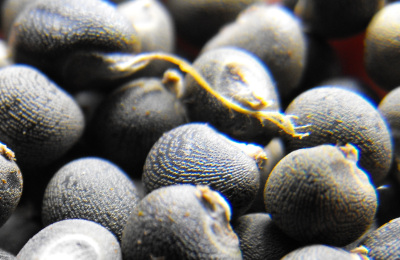
I find that poetry changes the way in which you see the world; the more you write, read and engage with poetry, the more you notice. Eyes, once immature and full of glances, learn to focus, to be steady and to be patient. Like the zoom lens on a camera, life-size is magnified. Thought, rather than being merely an okra seed, becomes a coiled woodlouse; an armoured marble; an ammonite carved into snakestone, complete with the legend of Saint Hilda.

In poetry, it is not the form or the size of the poem that determines whether it could be classified as large or small, but rather it is the subject, the thought, or the idea contained within the parameters of the form. For example, the haiku is small (with  its seventeen syllables), yet its subject is often thought, traditionally, to be great – starting with a macro view of the world and then becoming more specific (the micro view).

Often, within my own poetry, I find myself using this macro/micro technique – beginning with a large image and then zooming in on a smaller detail. It is these little, usually unnoticed, observations that create the depth and prevent the poem from being merely a backdrop. You want to surprise the reader: tell them something new, give them a different view of the world.


Recycling

Compost and soot from allotment bonfires
is forked into the freshly dug soil.

Old wardrobes and skirting boards
are cut to make raised beds.

A rusty swing frame is draped with green netting –
ready for when the runner beans start to climb.

Thank you for reading,
Lara