written and posted by members of Lancashire Dead Good Poets' Society

Showing posts with label written by Angela McCarthy-Grunwald. Show all posts

Friday, 8 August 2025

Schmetterling

They sit and suck the nectar from our Buddleia. The Buddleia that came with us, a rogue seedling in a pot, abandoned on the Blackpool house patio. The one that has blossomed into a massive bush and beautiful mess here in our garden in Scotland.

Red Admirals, Peacocks, Large Whites, Tortoiseshell (large or small - who knows), now in August. Earlier in the year, many Orange-Tip. At local nature reserves, Meadow Browns and the odd Speckled Wood.

Orange Tip butterfly
An occasional Painted Lady – or could it be one of Fritillaries – resting on the sunny house wall. By the time I have located my phone, or a camera, they have taken off, of course.

This past week, one of the Admirals or Peacocks, resting on Comfrey leaves, large and hairy and almost gone over as they are, directly in front of my window to the garden, at my desk. No food there, just sun, shelter from the winds, perhaps.

What do we know about these insects that are so often used as a metaphor for delicate spiritual beauty, as well as the transformation they undergo? 

Peacock butterfly
The Big Butterfly Count is in its last few days, recording sightings in the British Isles. You can link to its website here: big butterfly count It is one of the ways to learn more about these insects with two pairs of colourful scaly wings as they are described in one of the many dictionaries I consulted in research.

I wanted to know why the names in English and German – butter-fly and Schmetter-ling – are so different. To find that they are not. Schmetter – as in the Schmetter-ball of tennis and table tennis, a shot of such power that it is un-returnable, turned out to be one of those funny language things where the sense of a word is changed by the change of one letter. In this case, SchmetteR-ling (ling being a word-part that makes a word a noun) used to be, or should be, SchmetteN-ling: and Schmetten is a Southeast German dialect word for cream, or butter. You see the connection - the butter - in the English butter-fly? A German etymology dictionary takes this – in my mind a little disgusting – image of an insect that lands in butter or cream and creates a mythical metaphor of witches (Hexen in German) who fly around disguised as colourful insects, in order to steal butter and cream from dairy farms. Thieves, in other words. How we went from thieving flying Hexen to symbols of spiritual beauty? That would be another deep rabbit hole to dive into.

Tortoiseshell butterfly
Instead, please find below an early draft of a poem in a series titled ‘Ten things Blue’:

Butterfly

We found you | in our special place | the one with all the rocks | the wild 
plants that flower | some | when we come here on birthdays | sunshine days | 
days we just need to be here | the place where I remember | the 
Mediterranean | rocky coasts | from before

you flapped and you fluttered | never sat still long enough| for me to see you 
properly | never mind take a photograph

you kept me busy back at home | until I found you | Common Blue | not that 
common | not like a colourful dog | known to all and sundry | only the most 
common | of the blue ones | and every book about blue things | says how 
uncommon | blue | is in nature

I don’t know | but I see blue things everywhere | flowers | they stand still for 
me | to know them | Tufted Vetch | Meadow Cranesbill | Forget-me-not | of 
course | Milkwort | these too in our special place

And the Blaue Blume | could it be one of those | have I found it already


Postscript: any words you may not recognise in the blog or poem are easily googleable. Enjoy!

Angela

Friday, 12 July 2024

Arbo-real

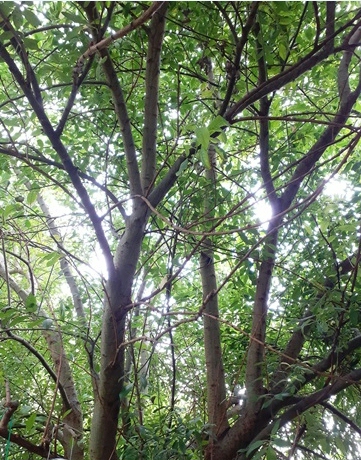
Home is where my trees are.

I can see what that sounds like: my trees? And no, I am not claiming possession. I say ‘my trees’ like people now say ‘my person’ (in a certain TV show I watch a lot). Trees are my people, my friends, my symbols of belonging.

Looking back at all the places where I have lived, I remember trees very well – and that is saying something from someone whose memory is sometimes clouded by brain-fog.

I remember the Laburnum tree outside my childhood bedroom window, Goldregen in my native German, literally translated ‘golden rain’. It stood at the corner of the house, right next to where my head would rest on my bed. I remember funny noises at night, that seemed to come out of the walls, which turned out to be birds nesting in it.


I remember the fir tree in front of the house that was planted either at my brother’s or my birth - I have photos of it being not much taller than me as a young child. I also remember my father dangerously climbing it by the time it was as tall as our two-storey house. It was Christmas time, to fix the Lichterkette (lit. light-chain) to it that, even though as a teenager, I thought it was pure kitsch, it still shone my way home in the wintry darkness, returning home late in my parents’ car – the lights were not switched off until everybody was home.

Living in cities in Germany, and then in London, there was the odd tree – like the Magnolia in Bochum Stadtpark that signified spring when its first flower opened, and some trees in Kew Gardens in London that gave me a feeling of sanctuary when I visited, but nothing close to home.

It wasn’t until I moved to Lancashire that trees came back into my life in a big way. I remember a November day in Preston when I walked to Avenham Park, for a botany project in my first year of studying herbal medicine. I found an elder tree! Sambucus nigra – a source of so much goodness, flowers, berries, even leaves, helping humans in times of need. Sadly, I found it just as a gardener yanked it out of the ground, he scowled at me when I asked why – because it was a nasty weed, he said. I was learning to know better than that, and when I began guiding walks about medicinal plants, I made sure to tell people about the Elder spirit who, if any of its body is removed without asking permission first, will bring seven years of bad luck to the thief. If only all trees had protections like that.


My favourite plants grow out of the cracks. I remember a particular Elder tree that emerged from the old red brick railway bridge across the Ribble. It grew at first horizontally out of the side of the bridge, fairly high up, then made a 90 degree turn upwards and continued vertically, in the manner most trees do. For me, it was a symbol of nature overcoming human endeavour, when left to its own devices. A symbol of hope.

It takes me back to my youth when songs like Unter dem Pflaster liegt der Strand (lit. under the cobbles lies the beach) were sung at demonstrations against US nuclear missiles being stationed on German soil during the Cold War era. I badly needed hope then that the world would continue to live and thrive at that time when World War III seemed a real possibility.

Arbo-real: resistance is real. Trees are real, across time. They are a gift to the future. The trees we planted in our new home in Scotland could outlive us. The Elder tree has pride of place, the sapling placed smack bang in the middle of what was a green desert of sileage grass when we moved in three years ago. It is now as tall as our woodshed/workshop at the other end of the garden.


It also shields the arbour – a bench with sides and a roof that we often sit in on warm(ish – we are in Scotland after all!) summer nights, with the bat detector hissing, trying to see the stars obscured by the glaring streetlights (don’t get me started, that’s another story).

I sit in it reading my new book that I picked up on holiday: ‘How I became a tree’ by Sumana Roy. If you like trees, and reading – if you got this far, I am assuming some interest in both – I can warmly recommend this book.

It is not just trees that we have planted: the huge Larch trees in the churchyard and the three Scots Pines on our daily walk are friends to me, the Giant Redwood in Mabie Forest, all are greeted by my hand, when I remember. And I feel I should mention a tree we brought here from our previous home in Blackpool, a Buddleia. A person connected to that tree, one of our lovely neighbours there, passed away recently (RIP Sandy). It was a sapling when we moved, self-seeded into one of the many pots around our patio, and we assumed that it was an offspring of the one we planted there. But when it did flower here in Scotland for the first time, it turned out to be from our next door neighbours’ tree – more reddish-purple than the one we had bought. Today, I saw a butterfly on one of its flowers for the first time this year, a Red Admiral. There is hope, and life, if only it is left to its own devices. Our garden, a wild mess, is luscious and beautiful and full of bees and bugs and birds, my idea of paradise.


I shall close with a poem that echoes some of what I have mentioned. It was first published in the Open Book Scotland anthology of 2022 titled ‘I give my word’, and I was honoured to read it at its launch at Wigtown Book Festival in the same year.

Belonging

How to make this place home?
I plant trees in the garden
and a hedge, for the bees and the ladybirds,
the song thrush, and blue tits, and the little mouse that lives in the wall.

I put up curtains and blinds, for privacy,
brighten the broad windowsill with flowers;
a prism hung from the curtain rail makes rainbows in the sunshine.

I chat with neighbours, sometimes for too long,
and try to understand why those old people talk about the graves in the churchyard so much.
My ancestors are far away now, buried by war, displaced by violence.

I want to build anew
embedding Haw and Blackthorn, Elder and Hazel
May their roots become mine, with time.


Angela McG

Wednesday, 20 January 2021

Colours: Yellow

So: (which is my favourite way of starting anything) I had lots of ideas when I signed up for a guest blogging spot on the theme of Yellow. I made copious notes, in my favourite way: a bullet point list.

And then I started feeling quite poorly, overall poorly, but also involving coughing. And once I was with it enough to properly notice this, I ordered a COVID test, online. It took some time, filling in all the pages of that form, while feeling poorly, before I got to choose how I wanted to get my test. And there it was, finally, the option: have it sent to my home. So I clicked. And then very early this morning I got a message to one of the many contact details I had to give in the first form: your test will be delivered between 10:32 am and 2:32 pm by Royal Mail. So, not knowing what to expect, I got showered, dressed (not necessarily everyday achievements for me) and even had a face mask handy next to the front door in case I had to sign something or be photographed. Being prepared for all eventualities – I call that being a good OT (occupational therapist), others may call it fussy, anxious, or negative. 

And then the slim purple parcel came through the letterbox, without needing a photo, or signature, or anything. And so I thought, I want to do the swab before I eat lunch – in case it makes me feel sick. And so I unpacked the slim parcel. And started panicking. Different bits, the swab I expected and the plastic tube that the swab would go back in, plus several bags, some with print on, a pad, a sticky label, and the 22-page booklet with instructions. I don’t know what it was, I’ve got two university degrees, but the contents of that parcel made me feel like a five-year-old in a grown up physics lecture (I am not really a physics genius to put it mildly), like I am definitely too stupid to have a test for a potentially deadly disease. At that moment, I really wished I had tried to drag myself through the walk-through test centre in a Blackpool car park yesterday (why do you have to walk if it is in a car park?).


Reading the booklet, it said to swab your tonsils for 10-15 seconds. I don’t have tonsils anymore. Mine were removed when I was five or six years old, and I have no idea where they were located before that. It also says to do this with the help of a mirror and a torch, and not to touch any of the structures before you get to the back of the throat with the swab, like the tongue, teeth, gums as this would spoil the test. It also mentions that the procedure could be uncomfortable. So, if like me you start to shake when nervous, like when you want to make sure you haven’t got a potentially deadly disease, and your maths is shaky at the best of times: how many arms do you need for swab and torch and potentially mirror, while not shaking and definitely not touching anything you shouldn’t, while counting to 10 to 15 in an orderly fashion, and presumably continue breathing throughout in order not to faint/move/touch etc. You get the picture? Oh, and all this is part of a particular order of actions, all leading to the sample being sent off for analysis correctly, and timely, and all that. First you find a priority post box by searching for it online (couldn’t I have done that yesterday when I ordered the test? I could have if they had told me about it), and find out when the last collection of the day takes place, and you make sure that you or someone from your household can get the finished sample parcel to that post box at least one hour before the last collection (why? Do they come to collect the post from such an important post box up to an hour early? Again, why?), so in my area, that’s at 4 in the afternoon. If you can’t get it there before 4, you can’t do the sample that day – but of course, you need to get the sample done and sent within 48 hours of: ordering it? Receiving it? Another thing I am not sure about. I am sure though that I can’t make it to the post box, and that my husband is working flat out until 4:30 today, so he can’t take it there – except the last collection isn’t until 5, in theory, but the instructions are clear, it has to be in the box at least one hour before last collection.

As well as all that, you have to go online to let them know that you are about to do the swab, but only if you’re sure that you are going to send it off that day. So today is not that day. Today is another day of trying not to panic about the potentially deadly disease, trying to get some good sleep in case I have the disease – sleep is so important for the immune system (!) – and of not being able to do the activity that has kept me sane in the head for almost a year now, the morning walk with the dog. Lately through rain and mud, and at times beautiful sunshine and ice and a tiny bit of snow, to see the trees and the birds and the top of Blackpool Tower, last lit up like the Electric Cowboy in red-orange lights, that was yesterday morning, but feels like longer ago already. Tomorrow will be another such day, and the day after that at least, until the hopefully negative result comes through on one of the many communication channels I have provided in that first form. By then, the dog will likely have stopped speaking to me, as the garden replaces the park, and he doesn’t like the garden when it rains like it has done all day today, and there is mud, and long grass. The rain and mud and long grass in the park are clearly of a different quality, a better quality. But tomorrow my husband will help me navigate the process and the instructions and the swab itself, and at least that part will be over and done.

And so: to say a few words (!) about the colour Yellow. It’s not one of my favourite colours, in fact when I was younger, and more prone to make provocative sweeping generalising statements, especially in social situations involving other people, I would have said I hate Yellow. I don’t know if it is age, but overall, and certainly in writing, I manage to be a little more specific and nuanced these days.

Someone told me a long time ago that the combination of black and yellow were the colours of Wahnsinn (that’s German, and could be translated as madness, or insanity, or literally: delusion sense), upon looking at a picture I had painted which was abstract and black and yellow. Not being exactly a visual artist to start, that stopped me quite efficiently.

I don’t have any yellow clothes, or its cousin, orange, except for a very large fluffy scarf, which was kind of cheerful as well as warm and covering my neck very well on a cold winter’s day, for many years. I still remember which friend I got it from (just not whether she gave it willingly or if I ‘borrowed’ it).

Another experience of yellow was that I painted a picture once (before the black and yellow one), while music was playing that was scientifically developed by calculating distance and size of the planets of the solar system from our planet Earth, producing specific tone frequencies to represent each planet. This was done by musical genius Joachim-Ernst Behrendt, a German music professor, and the CD I was listening to while painting the picture, unbeknownst to me, was the sound of the Sun. The whole picture was just yellow with a bit of white and a little orange, no shapes, and I was kind of surprised at my choice of colour (this was in the days of I hate Yellow), and intrigued when the person who had put on the CD told me what it was. I have bought all the ‘Ur-töne’ (Ur = German for original, but also kind of ancient, like Urwald means ancient forest, and is the word for jungle) CDs since, but have not had such spectacular results, probably because I have to put them on myself.

For several reasons, the colour yellow, as well as being the traditional colour for the sun in children’s paintings, also has a slightly official feeling for me. That may be because in Germany, my home country, everything relating to the Deutsche Bundespost, so post boxes, vehicles and probably buildings are yellow (It even has its own shade of post-yellow in colour charts). Fluorescent yellow coats/gilets also mean ‘official’ and ‘authority’ to me, and I have to suppress the instinct to salute and then hide in case I have done something wrong, a real mix of cultural references to authority from the two countries in which I have spent so much time. I have also noticed that alarm lights are often yellow/orange. The only ones that make me happy are those on the gritting vehicles out in winter because of snow and ice, more on that subject another time.


I should not forget to mention yellow as the colour of spring for me. Just after white (snowdrops, daisies) and of course green (leaves and shoots on everything), the yellow flowers of Ranunculus ficaria, also known as Lesser Celandine or Pilewort carpet the woodland floors, and banks of streams, and stays for quite some time. And dandelion flowers (Taraxacum officinale), these early food sources for still-drowsy bumblebees, in such numbers wherever they haven’t been poisoned into extinction. Those are the flowers in the park and in my garden that tell me spring has arrived.

One variation of the colour yellow – gold – has a positive feel for me. After not feeling very proudly German for many years, some of them spent here in England, I kind of like the Schwarz-Rot-Gold (Black-red-gold) colour combination of the German national flag now. Gold has also served me well as a comforting as well as energising colour in meditations and that kind of thing. And with that I give you, finally, the poem at the end of this long blog, it’s called Energy. As always, I would love to hear your thoughts about what you’ve read here. And, although I feel a certain tug to apologise for the length, and off-topic-ness of the first part, I will resist, in case it helps someone else navigate this one bit of these difficult times, I know it would have done that for me. 

Energy

Roots growing into the Earth
Through soles and toes and heel,
Drawing up golden warmth
Floating up the feet, knees, legs,
Saturating the belly,
Travelling up towards the heart;

Then: silver sparkling starlight streaming
Through crown,
And head and throat,
Meeting the gold waiting by the heart
Spiralling, starting slowly, together
Beginning to mingle
Until nebulae of gold with silver flecks are
Swirling through the chest
Growing vaster, whirling, spinning
In ever increasing circles
Until all of me, and then some,
Is swathed and rocked in light.


Angela McG January 2021 

Thank you for reading.

Wednesday, 15 July 2020

The Scent Of Rain

Petrichor. What kind of word is Petrichor? If you look it up, you find references to the smell of rain, and an explanation of who made up the word, and what its parts mean exactly.

But what kind of word is it? Does it fizzle in your mouth when you say it? Melt on your tongue? Make you smile in the process of moving your face to articulate it? For me, it does none of those things. It seems to shut things down rather than open them up. It is a word followed by an awkward silence. For an English-as-a-second-language person, the next question is: how do I pronounce this correctly? If you are wondering the same thing, English-first-or-whatever number-language person, it seems that this is a question most of the sites in your internet search results want to answer, even if it is not the same answer every time. Without going into too much detail on the phonetics of the word, opinions are divided where to place the emphasis, on the ‘pet’ (first syllable), or the 'i'   (second syllable), and whether to pronounce the ‘i’ like an eye or like the vowel in ‘bit’. Either way, I think it is an awkward word, not many people know what it means, how to pronounce it, or spell it.

Looking at the meaning of the two parts of the word that the scientists who made it up used, ‘petr’ comes from the Greek word petra meaning stone, and ‘ichor’ is the life blood of gods and immortals (i.e. Zeus and the gang). Quite a long way away from scent, and rain, I think.

I was thrilled when I first learned that there was a word for that smell that you get after the rain, especially if it hasn’t rained for a while. The excitement even threatened to spill over when the word appeared on a list of themes for blogs by the Lancashire Dead Good Poets (as Steve R will be able to confirm). However, it was the idea that there is a word for an experience in which I delight, that I thought maybe I was the only person who notices and enjoys in quite an exuberant fashion (I tend to think that I am the only one with many things), perhaps more than the actual word. Hence this rather lengthy piece about why I don’t like the word itself all that much.


The experience it is supposed to describe, however, is quite beautiful. It is a scent that smells green to me, that embraces many things, from the scent of flowers that seem to be shouting ‘Over here!’ to the pollinators after the rain, to the feeling of cool and somehow clean air on my skin, after a long period of heat followed by a refreshing rain that washes away heat, and sweat, and dust. I always thought that the smell came from the volatile oils in plants, like the flowers of roses, or the leaves of evergreen trees and bushes. A simple natural distillation that involves heat and water, a little like the extraction of essential oils for aromatherapy. Not so. There are different chemicals and processes involved, oils that soak into soil during drought periods, plus other chemicals released by certain plants, and bacteria. (If you want to know more, the UK Met Office page on Petrichor is a good, relatively easy to understand starting point!)

Nature is amazingly clever. It has even given humans the ability to detect the scent of rain in incredibly small concentrations. No doubt very beneficial when our ancestors were roaming the landscape in ancient times, in search of water in order to survive. Water is still a precious commodity, after everything humans have done to the planet’s climate since those days.

So, if you’ve made it this far reading, here is a piece that I wrote about another precious experience with nature that happened recently, during this pandemic. I first wrote about it in a poem, or what I think of as a proper poem. And then I changed my mind, and wrote it like a story, only it’s true and I am in it and it really happened.

Since I have only recently started writing in this format (that I think is creative non-fiction), and want to write more like that, I would be grateful for your thoughts and feedback.

Petrichor
Today, I stepped into the garden, and, ducking under the low-hanging, rain-heavy branches of next door’s willow tree that overhangs our patio, I discovered that on the inside, there is this space, surprisingly big, where even tall me can stand up without hitting my head. It is like the dome of a cathedral, reaching high up towards the light filtered by the verdant green of the willow leaves, a round space, evoking a memory of a white-domed, light-filled cathedral I once visited on a Mediterranean island. The dripping of raindrops is heard rather than felt, and the sound, or rather the far-away-ness of sound in here, makes me feel like I have stepped into a different place altogether. A place that protects and shelters me, and every being within it equally. I hear noises of little birds in the tree and around me, and I suddenly realise that not an arm’s length away, there is a small bird, perhaps a sparrow, sitting on a branch, looking at me. And then I hear a tschilp, and another, coming from high up in the cathedral tree, and that takes me back to what happened yesterday.
 
 
Blazing sun, thumping music from the other neighbours, I stepped outside for some air (!), and out of the corner of my eye spot something in one of the tubs that we collect rainwater in, an old plastic washing up bowl, and I instinctively go to investigate and grab the round wet thing in there and scoop it out of the water in which it was almost completely submerged. While I feared that the bird that it turns out to be was dead, when I whisked it from the water, I feel it moving in my hands, the whole small body being rocked by a heartbeat that feels like it may explode the tiny bird. It must be a young fledgling that has fallen out of the tree whose branches reach to just above the rainwater tubs. I can see the perfectly shaped, elliptical breathing holes at the top of the beak where it merges with the head, just below the eyes which are covered in membranes with a distinctly sickly-looking, blueish tinge, that come up from the lower edge of the eyes. These inner lids are fluttering in the rhythm of the heartbeat, which is quietening ever so slightly, and the shivers in between the beats, and every now and then the membranes withdraw, revealing the eyes briefly, only to quickly cover them up again. The little bird’s feathers are clumped together, exposing pinkish skin on its body around wings and chest. I stand on the patio, holding it in my cupped hands, in the sun, while the bird grips on to my finger, surprisingly tightly, for what feels like a bubble of time that may have been seconds, or minutes, or something much bigger than that. The thumping of the bassline of the awful music from next door is deafening, and yet the bubble that I am in with the bird in my hands leaves even that noise slightly on the outside, while I am willing the sun to dry and warm and calm the little creature that is still shaking and so wet.
 
While I am waiting for the healing power of the sun to work its magic on the little fledgling, I call out to my husband who is working inside, and when he comes to see what is going on, he soon finds a box, and furnishes it with a puppy mat as carpet, and brings a water dish that we use to feed the resident garden hedgehog, and after I deposit the bird in the box, now all zipped up eyes again, I find some dried mealworms that we put out for the birds, to feed chicks in the nest. I knock on the beak, which is, like the eyes, firmly closed, with a mealworm, but no luck, the little bird just stands, wobbles, and shakes, keeping eyes and beak tightly shut. Now indoors, the bird moves on to slowly tip forward, resting its beak on the edge of the water dish, and when I start to panic that it is not getting better, and may never do, I decide to scoop it up once more, in the hope that the contact with my hands, will somehow magically heal the poor traumatised being. Alas! the bird instantly opens both its eyes, and swivels its head from side to side, like a boxer stretching her neck muscles, preparing to continue the fight after taking a punch, and it moves to grip a different finger of my hand.
 
 
And so I carry it back outside, to the tree that it probably fell from, shooing away the dog who desperately wants to sniff it, and the bird swivels to face me, releases its bowels on my hand, flaps its wings and flutters out of my grasp, landing on the ground under the bushes. I hear more than see it, moving further into the green world it came from.
 
This morning, standing in the cathedral dome of the willow tree, I imagine that it is the fledgling tschilping away in the top, while its parent is looking at me to let me know that its little one got home ok.
 
Thank you for reading. Stay safe, and look out for nature.
 
Angela McG