written and posted by members of Lancashire Dead Good Poets' Society

Showing posts with label written by Bill Allison. Show all posts

Friday, 5 June 2026

Classical Cities

I met Steve for lunch today and promised him a short blog and a poem for this week's theme. It was a great lunch, great pizza, great talk about Rome and the Coliseum among many other things...

some of the beauty and splendour of Rome
... not so sure about the poem.

Classical Cities

The thing about cities
is that they are full of beautiful women.

High cheek lines, red velvet mouths,
white swan necks, proud breasts and slender thighs.

Auburn, black or blonde long hair
Scarves and stripes, silk and stockings.

Stylish, eye catching, head turning, beautiful women.
The older the better...

The cities that is.


Thanks for reading, Bill Allison.

Friday, 27 February 2026

Curry and My Family History

When I was in the top end of primary school in 1959 or thereabouts, I used to go to Burnden Park every other Saturday to watch Bolton Wanderers home games. Sometimes I even travelled to away games on specially provided supporters coaches. I wore my black and white bob hat and scarf wrapped up against the cold. It was always cold in Bolton. Once or twice I even got my photo in the Bolton Evening News as an avid supporter. Only fifteen seconds of fame, not the full wack of fifteen minutes.

In those days part of any well-equipped football fans’ gear was a wooden rattle. You held it above your head and whizzed it round to make a clunky noise when it seemed appropriate. Goal!!! Clunk. Clunk. Seems incredible now that all grounds let supporters in with these lethal weapons. They were banned in the 1970’s.


Mine was quite special. It was even more chunky and looked like an antique in comparison to the fashionable light weight models my mates had. Because it was indeed an antique, even a family heirloom. It had been my grandad’s who was an Air Raid Warden in the WW2 and used to tell people to get to safety.

The final piece of what every trendy young football supporter in the 1950’s needed was a flask to keep you warm. I guarded it from rattle clunks of others and opened it at half time and carefully poured it out.

“Whoa? What’s that smelly stuff?” came the fortnightly cry.

“It is mulligatawny soup” I replied. “Curry soup”

“Curry soup?” I got looks of doubt and bemusement.

“I always eat it. It comes from India. My mum was born in India.”

“Born in India?”

Looking at me with more looks of doubt and bemusement, not sure what to make of it. Cutting off their “Well you don’t look Indian” I quickly jumped in and said, “Her dad was a soldier. He took his wife, my gran, and went there with the Army after the First World War in 1919. My mum was born in Mhow in December 1920.


Funny to think now that curry is the most popular food in Britain because in those days no one had ever really heard of it. The family returned in 1932 and brought this exotic taste back with them. Where she got the mulligatawny soup from I’ll never know. In those days all you could get was Heinz Mulligatawny Soup. It was one of Heinz 57 Varieties. Probably number 57 in terms of sales and popularity.

Whether the Wanderers won or lost it always did the trick, kept me warm and because everyone else thought that it smelt horrid I didn’t have to share it.


At home she would sometimes “make” curry. This was a dish she made in a frying pan with a small amount of water, fried onions, peas, chicken, sliced boiled egg and sultanas, with rice, most people only knew about rice in rice pudding but we knew more than that. and, of course, curry powder. It was expensive and hard to get. But she got it.

She also made curried potato hash. Potato pie, no crust and curry powder. Fusion food before it was invented. She made curried pasties with what was left. For my 70th birthday I asked my sister to make some. Comfort food.

The next step on the nation’s culinary journey to chicken korma, and poppadoms was Vesta Curry.

Vesta Curry was introduced in the early 1960s and by 1970s it had become popular. It came in in a brightly coloured box and was seen as an exotic, accessible, and trendy with boil-in-the-bag beef or chicken with rice meal. Home cooked, of course, when funeral directors were thought to be the only kind of takeaways. How things have changed but you can still buy it on Amazon at £80 for 12 boxes.


Right now there are said to be more than 8000 curry restaurants and takeaways everywhere in Britain. It has been suggested that the curry industry contributes £4.5 billion annually to the British economy annually.

But back to my mum to finish with. Although she spent the first twelve years of her life in India, early years, often regarded as the most formative years of your life, she never spoke about her time there much. However apart from the curry she, along with her parents, brought back artifacts particularly paperwork that now stand as some of the most important in my collection of family history documents.

As kids, my sisters and I, used to love to look at photos of my mum and her parents in India. It must be said that their India was an expat colony where my granny and my mum lived in privilege while my granddad was away defending the Khyber Pass with the British Raj Army. Photos in the big brown cardboard albums kept in the bottom of a wardrobe in my mum’s bedroom, provided us with a glimpse of what was going on in their life, including (below) her and her friend sitting on a leopard skin that my granddad had shot dead. Not politically correct now, of course.


Amazingly there was also my mum’s school report. How documents like that have quite literally travelled across the world and ended up almost one hundred years later in Blackpool would tell a stories all of their own. It’s the photos and documents that make family history exciting. 


And I still love mulligatawny soup and- you can get it everywhere now. Waitrose, Sainsbury’s, Morrisons, Asda, Aldi, Lidl, the lot- perhaps the beginning of Britain’s love affair with curry. Try it.

Thanks for reading, Bill Allison

Friday, 30 January 2026

Vinyl Junkies

For Christmas in 2025 my sister-in-law bought me a mug with the legend “It’s Not Hoarding if it’s Vinyl” emblazoned across it. She knows me well. It now stands full of paper clips in the room I keep my vinyl hoard in.

In the Seventies I lived in Lancaster just about the time I was coming of age. My records certainly weren’t a hoard then, but they were on their way to becoming a collection. A guy I worked with, John LePage, showed me how to make a box to store records in. He said you buy four pieces of blockboard ready cut to fourteen inches square and a piece of plywood to form the back. Take them home, counter sink and screw it together. It may take half an hour to make. You can paint it if you want to.

a vinyl hoard?
Now fifty years later, I’ve got fifteen of those boxes with over a hundred albums in each. Fifteen hundred records and more. If I play three a day over the next five hundred days, I’ll probably get them all in before I go to the great record shop in the sky. Ah well- maybe. That’s some going, even in retirement, and if I take out family days, Christmas days, birthdays, holidays, football matches and time with my wife, we are up to a thousand days already. So it’s probably totally unrealistic but then again hoarding is. I am not sure I would describe myself as a hoarder but others would. Hence the mug. I try hard not to be.

But do you know what the saddest thing of the lot might be? I can remember where I got most of them from or have a good go. I can certainly have a good go at guessing. The first long playing record I ever got was The Beatles' first album “Please Please Me “. My mum and dad were separated and my sister and I got our dad to buy two LP records, one for her and one for me. They were 30/-  (shillings) each. We got him to buy us these instead of his usual selection box. My sister got “With the Beatles”. We wore them out. But guess what - I have still got mine.

When I was doing my paper round, for which I got 30/- a week- luckily. I would plan out what records I would buy next, as I plodded around in the wet, cold and snow delivering the Bolton Evening News.

So it went. I used to buy new albums then. The folk boom came. I fell in love with the music of Mr Dylan. But if you wanted to be more esoteric you could buy albums on Elektra Records but they were 32/6d. The price of being erudite. Two and six more.

You could sit upstairs on the bus going to school with an album propped up on your knee, thinking everyone is looking at me because I’ve got a Jesse Fuller album. In truth they didn’t give a shit.

Somewhere wonderful to buy vinyl was Yanks in Manchester, a subterranean cellar next to the public toilets where Len Fairclough got caught or so they say, just across the road from The Palace Theatre. It was full of deleted records from across the pond that you could buy as cheap could be. The stuff I got from there was mind blowing.

In 1990 I moved to Blackpool. Forget the Tower, the Big One, Bloomfield Road - sorry Steve - the greatest thing Blackpool ever had to offer was Saddle Records which eventually ended up in Layton. This was a goldmine. Sadly missed by me and hundreds of others I would suspect.

a vintage Blackpool record shop
I once paid £20 for a David Blue album “Stories” in a second hand record shop in Chorley. I asked the lady if she wouldn’t mind taking the price tag off. She replied that of course she would and added that I would be surprised how many people asked this, so that their partner wouldn’t notice how much the record had cost.

And so on. Don’t worry I am not going to take you through every phase and every record I have ever bought since 1963. That would take more than five hundred days for me to write and for you to read. You would probably find it pretty tedious anyway.

I might add that these days I buy albums for their cover as much as for the record itself, which, of course, could well be knackered. There is always a good chance of that. I recently bought “Have I Right?!” album by The Honeycombs for two pounds in a charity shop in Poulton for the obscurity of the album itself and the cover. The record actually plays quite well. I had also previously bought an album by The Four Pennies at the same place for the same price with the same outcome.

I have six frames specially made for album covers on the wall in my mancave. I change these regularly to show off my collection and covers. Still remember the Jess Fuller album on the bus. Don’t know who I am trying to impress anyway. Nobody comes in here. Right now they display 60’s British R’n’B albums - The Rolling Stones, The Animals, The Pretty Things, Georgie Fame and the Blue Flames Live at The Flamingo and an Alexis Korner album. The last is of interest. Some second hand dealers have realised the interest in covers. I bought this for 50p with no record in it. These are in the frames now because I put them in after I took out my Christmas albums covers. Sad bastard stuff really. Confessions of a Vinyl Hoarder indeed.

Georgie framed and friends
I have always thought that the concept of the speed of records, seventy eight, forty five and thirty three and a third rpm was a good analogy for the way the baby boomers., like me, have lived our lives. Starting at breakneck speed and coming of age as the music slows to thirty three and a third. In the poem I have taken this idea and written around it in my poem.

The last verse stops in the early seventies. It has a certain pomposity and piousness about it. Still we were without too much doubt like that in our early twenties in the early seventies. I was anyway.

The Speed of Sound

You slid it from its cardboard wrapper
as if it were a holy relic.
You cranked up the gramophone.
The needle crashed down.
The black twelve-inch record,
spun at breakneck speed.
Seventy-eight revolutions a minute.
Brittle and fast they could easily shatter

Just like the records our lives turned fast,
We were the bees’ knees and bobby dazzlers.
Jiving, crashing, rocking and rolling.
ploughing the furrows, moving through the grooves.
Baby boomers let off the leash.
We lived our lives at seventy-eight rpm.
Brittle and fast we were easy to shatter
Whole lotta shaking going on

Stored in their paper sleeves,
there they stood pleading to be heard.
You switched on the Dansette.
The diamond hard stylus never missed a beat
The black seven-inch record
spun without threatening to break
Forty-five revolutions a minute.
Loud and proud get out of the way

The speed of the records was the sound of the times.
We were razor sharp and dressed up to the nines.
Short skirts, suave suits, with scooters outside.
Our clothes and the music danced hand in hand.
More than just records they said who you were.
We lived our lives at forty-five rpm.
Loud and proud get out of our way
Talkin’ ‘bout my generation

Laminated, leaning up against a shelf
each cover looked like work of art.
Hi fi separates balanced the sound.
The cartridge revealed glorious stereo.
The black long-playing record
spun six songs a side
Thirty-three and a third revolutions a minute.
Shining and modern they were shatter proof

Cooler, calmer, career guided and minded
coming of age as the music slowed.
We had boxes of albums stacked by the wall.
Nothing is better than a vinyl collection
and buying records at the speed of sound.
We lived our lives at thirty-three and a third rpm.
Shining and modern we were shatter proof
Wish you were here.

the speed of sound
And if, after all that, you're starting to feel the urge, consider this. Think of it as a vinyl junkie hit list.

In “On the Road” Jack Kerouac offered thirty tips for aspiring writers. Many clearly are about writing itself but others are more general such as “Be open to everything” and “Be in love with your life. I am going to offer some fun filled tips for buying records, predominantly second hand ones at that. If you want to spend twenty pounds plus on buying a new copy of your favourite album that’s fine but these tips are about getting out there and hunting for fun and being open to everything, wanting to build up your record collection and most of all being in love with life. Not quite thirty still nevertheless you can add some if you want to. So let’s go.

· Never pass by a charity shop without going in to see what they might have.

· Car boots can sometimes offer something you may want.

· Always look at the collections of your family, neighbours and friends. They will have stuff in their attic they will probably be only too glad to give away.

· Consider eBay from time to time.

· Take chances on something you might not be sure about but it’s always worth a couple of quid.

· Get out of your comfort zone. Buy stuff you feel might expand your musical boundaries.

· Most importantly of all, never ever leave something you think you might want because what will be for sure if you hesitate or doubt, it will be gone by the time you have made your mind up. You have been warned!

Thanks for reading. Happy collecting.
Bill Allison

Friday, 14 November 2025

Bolton - My Home Town

Of course it’s not Bolton, Lancashire anymore. Bolton, Greater Manchester doesn’t sound as good, does it? But that’s what it is now.

I have always loved James Taylor’s “In my Mind I am going to Carolina”. It is not really a song just about Carolina, of course. It’s a song about going home. Well just not about going home because for him in the song and for me in my poem below, “Home” is a state of mind.

I spent the first twenty five years of my life in Bolton but think about it every day. I have carried some of the imagery in the poem for most of the time since. A couple of weeks ago I paid a visit home to backfill the story. Hence the poem.

Bolton town centre 1960s
Hometown

When you get off a plane abroad,
the first thing that hits you is the heat.
Bolton’s not quite like that.
It’s cold and wet.
But I want to hear the accent.
To wrap it round me like a comfort blanket.
That throaty sound found on corners when I was a kid
But in this borough of splendid diversity,
It’s getting harder to hear “Eeh by gum” or “Are’t all rite?”
Maybe it’s only found now in the traditional songs and ballads.
Bernard Bullfrog Wrigley, Bob Williamson, the Valley Folk,
singing into the microphone at a folk club
and me.

I unfolded a street map and laid it out like a quilt,
letting my fingers weave across its coloured squares.
Through the houses, streets and alleys of my past
to find a cabinet of curiosities stuffed with memories.
The Iron Church Draycott Street Scouts on Friday.
Woolworths little boys learnt to shoplift.
The Palais on Sunday night’s boys tapping up girls.
The Man and Scythe teenagers learnt to drink.
Hayward Grammar if you passed 8 “0 levels” it was a ticket out.
Last but not least a full set of Wanderers programmes,
Frank Worthington, Nat Lofthouse and Jay Jay,
scoring goals for fun down at Burnden Park
and me.

Then the town centre appeared,
as theatre scenery staging its own history.
Bolton in all its post war you never had it so good glory.
Romance and nostalgia cousins of deceit
playing hop scotch on the shadows of my youth.
Suddenly the set came crashing down like demolished mill chimneys,
to reveal endless vape stores, bookies, charity shops and takeaways
in repetition as far as the eye could see.
But look up above the hoardings and shop fronts.
Inscriptions carved into brick that reflect past glory.
Richard Arkwright, William Lever and Samuel Crompton,
crouching stone lions on the town hall steps ready to roar,
and me.

Burnden Park
For Sharon, Trish, Rosemary,
and me.


Bill Allison

Monday, 29 September 2025

GOAL!

According to Genesis 11 1-9 sometime before the Common Era, the whole earth had one language until, in the words of the Old Testament the Lord said, “Let us go down and confuse their language, so that they may not understand one another’s speech.” And if we believe it, that was that. Universal language gone. Humankind was dispersed over the face of the earth and had to create a multitude of new languages to understand each other.

In 1870s, L. L. Zamenhof, a Russian ophthalmologist, invented Esperanto, which he intended to be a universal language. It is suggested that today there may be at most 100,000 Esperanto speakers worldwide. Set against the 7 billion population of the world it could hardly claim to be universal. So that’s two attempts at a universal language that have failed.

So let’s look at a universal language that is successful. Third time lucky. A language that a very great majority of the 7 billion can and do speak on a daily basis. A language that can express elation and deflation. A language that offers extreme highs and desperate lows. A language that offers at its best poetry and at its worst doggerel. This is the language of football.


Where do we learn this language? Well like any good language it starts in the cradle whereby babes in arms are decked out in pyjamas emblazoned with the colours of mummy and daddy’s favourite football team. The seeds are planted already in boys and girls. Girls, because the women’s game is now just as important as its counterpart. Women’s football has brought a new energy, a new excitement and a new style. As kids move through nursery and primary school, they quickly pick up the phraseology of the game and by the time they have become young adults they are fluent.

It’s easy to engender discussion in footballspeak. Enter a room and ask a question. “What about the Reds then?” “Are you a Blue?” “What about the game last night?” And they are just for starters. The dialogue soon progresses to offside, penalties and VAR blunders. Individuals are named. “I am pleased for Marcus. Two goals for Barca.” ”Grealish was always a star.” “20 million quid for him. He’s bloody rubbish.” And so on well into the night.

In my poem “Football Club” I have tried to capture all these feelings and more. I wanted to write something nonpartisan that would be universally inclusive, cut out rivalry and try and ensure that just for once everyone was singing from the same, in this case, poem sheet, so to speak.

Nevertheless it’s a poem about the Blackpools, the Burys and the Blackburns. Those good Lancashire clubs that have carried the baton for so long and have been subject to the ups and downs, ins and outs, the delights of world class players and sometimes the ravages of poor management, financial disaster and owners who didn’t give a shit. The curses and insults that were hurled at the Oystons have indeed added rich and colourful language to the football lexicon.


A friend of mine took me to Charlton Athletic’s ground “The Valley” and did precisely what the poem says. He almost had tears in his eyes as he did it. Another truth that is reflected in the poem is exactly what football has done for towns like Fleetwood and Burnley where these teams have “punched far above their weight” and brought pride to the town.

The poem, of course, is addressed to the all-inclusive you but it’s really about me. One last thing about the poem itself before you read it. It’s the closed I get to audience participation. I explain that I would like the audience to join in I have a large card that says “GOAL!” and I hold it up and ask the assembled company to shout the word out when I wave the card. After a couple of goes they get it.

I often watch “Soccer Saturday” on Sky where they have a panel of pundits, Paul Merson et al, who provide commentaries on a match they can see on their screen. These guys banter between themselves and sometimes they are more entertaining than the football itself. When a goal is scored they leap up and shout “GOAL!” and the word appears in digital glory on screens behind them. So this is what I am trying to emulate in the poem. The word “GOAL!” pops up as a kind of chorus and those listening are asked to join in by shouting it out. That’s the idea anyway. You don’t need to shout it out as you read the poem. Well you can if you want to.

Football Club

When you tell them who you support,
with smirks and smiles,
and big belly laughs of derision,
“Why don’t you change?” they say.
Well it’s not that easy is it?

On Saturday you go to the ground,
sit where your dad said his dad sat before him.
He yelled at bad decisions by the ref,
welled up at league defeats and relegation
and swelled when the ball went in – GOAL!
And so do you.

From the time when you were a boy
the names and faces of previous players
hang as autographed photos in your memory,
stirring your heart and flood lighting your imagination.
Keeper to sweeper to winger to striker- GOAL!
And you can remember then all.

At Wembley collecting the trophy,
One hundred thousand voices sang in unison.
One hundred thousand sets of arms lifted the cup.
And somehow back home the cup lifted the town,
shining and bursting with pride-GOAL!
And so were you.

It’s not always cup finals and league titles.
Football clubs fortunes fluctuate like shares.
Glory days come and go.
Relegation and promotion. Go down come up.
Such is the score of the beautiful game-GOAL!
And you know it too.

But on match days’ banners fly.
Chants and expectations build up the faithful
Boys become men out on the turf.
Men become boys back on the terrace.
Forever this team- forever loyal - GOAL!
And so are you.

When you tell them who you support,
with smirks and smiles,
and big belly laughs of derision,
“Why don’t you change?” they say.
Well it’s not that easy is it?
You can’t take the grain out of the wood.


The last line is probably the most important line of all. This has been known to chuck up some surprising revelations. One of the most important scientists in the country, who often took the stand with Boris during COVID, supports Boston United. I have a friend who is a retired Prison Governor who went on marches to protest about the owners of Oldham Athletic. Delia Smith, somebody who was reckoned at one time to have sold more books than anyone one else in the history of the world, pours a great deal of her wealth into Norwich City. You go to funerals these days where attendees are often asked to wear a team shirt that the person who has passed away supported. It could be suggested and often confirmed that some people, perhaps many people, are ingrained from the moment they are born.

Just in case you are wondering. I’m ingrained with Bolton Wanderers through and through until my final whistle.


Bill Allison

Monday, 8 September 2025

When The Music Starts To Play I Want To Be Around

I taught in a High School in North Blackpool for twenty five years. By the time I regenerated- that’s retired to you- my kids were big into Dr Who and said “Daddy you haven’t retired. You’ve regenerated" and that was good enough for me. Regenerated. Wow! And indeed I have. I’ve been regenerated- that’s stopped working to you- fifteen years now. During that time I‘ve set out to do all the things I’ve been saving for years to do. Like writing for the Dead Good Blog for instance.

During those twenty five years I rose to the dizzy heights of senior management. And boy was it dizzy when I looked at those around me and listened to what they had to say about education. I also hobnobbed with the school governors when I was up there in that rarefied atmosphere, rather short of oxygen. One day I was chatting to the chairperson of said governors. Well you do don’t you, chat to them so that they know that you’re there running yourself ragged to make his school successful while he basks in glory at the top of the mountain. Wanting something to chatter about, it transpired we that were both “into” music. He was lamenting the fact that one of his favourite albums he couldn’t find on CD. This was “Twice around the Houses” by Jonathan Kelly. Not that I am a bottom polisher, but I told him that I had got said LP but not on CD. I wasn’t even sure that it was on CD then or even now. I stand to be corrected, of course, because somebody reading this is looking that up right now, I bet.


Then he suddenly invited my wife and myself to his house for a “Desert Island Discs” soiree. So when your boss invites you and your wife to his “Chair of Governor’s House", you jump up, fall in and say, of course, “Oh Yes Please!” Don’t you?

I had readily agreed to accept his kind offer. I said I was a bottom polisher. However the most frightening thing that I had to do was to tell my wife that of which I had committed her to. I knew she would hate it. But you can’t go to soirees at the boss’s house without your wife can you? It would be the height of bad manners and both social and professional suicide and I knew that she would push me off the mountain, leaving me to retire, regenerate or whatever I wanted to do. All without oxygen and no tea or anything else for a year. However after goodness knows of how many pretty pleases and promises to take her everywhere she ever wanted to go for the next fifty years or something like that, the time arrived several weeks after the invitation to go. I forget to slip in that there would be another couple there, the lady of which was also a school governor and her partner who was consulate doctor. So hey this was serious stuff.

Still the next thing to do was draw up my list of Desert Island Discs. Thankfully we only needed to pick eight, just like the BBC programme, since that would give us an epic twenty four discs to listen to and discuss anyway. 

So where to begin? I had been buying records since I was twelve in 1963. The first of which was “Blue Bayou” by Roy Orbison. It will stagger you if I tell you I have been buying, purloining, borrowing, and copying records ever since. And guess what, just like T.S. Eliot measured out his life in coffee spoons, I have measured out my life in records. I have still got them all, every single one. Sad bastard. And I can remember where, why and when I got my grubby little mitts on each one. Well actually my mitts would need to be clean wouldn’t they? I mean, come on, I’m not irresponsible.


Anyway after pondering, sweating, and sleepless nights passing, I made, at least, I wouldn’t like to say how many lists and that was, in fact, the most enjoyable thing of the whole lot because I love music. Then after a lifetime of decision and selection- right word there because my collection –rather a grand word- went back to a time I was twelve as I said. It was indeed a lifetime’s journey. I was famous for talking about music none stop. A friend of mine once said, “You’re nobody until Bill Allison has been to your house and looked over your records”. Right on! So I eventually made the CD with my selection. More of that later.

The evening approached. Like what do you wear when you go to your boss’s house, and spend an evening with him and his wife and other guests from the rarefied mountain top! ”Just be yourself”, my wife said. So I went with my jeans and trainers on. That vogue mode of mine had got me to most other places I had been to. It wouldn’t get me into Buck House or the Posh Friday Night Pubs in Poulton le Fylde. Nevertheless it was more than good enough for this night. Slick Shit Ho!

My wife looked gorgeous as she always did. I have to say it at this point she doesn’t really like music. It all sounds the same to her. Especially the music I am addicted to. Somewhere in “The Merchant of Venice”, it says that you shouldn’t trust anyone who doesn’t like music. It’s a good job that we really do love each other. I always turn the music off when she comes home.

So we drive up. Knock and are invited in. Offered sherry. Escorted into- what the Estate Agents call- a reception room. Introduced to our fellow castaways and disc jockeys ready for the Grand National of our lives. The guidelines are laid out; the male of each couple will play their selection and talk about that particular selection and why they have chosen it and what it means to them. Very much like the beloved BBC Radio programme of the same name. “Desert Island Discs”. We didn’t get round to the Bible, Shakespeare, a third book of choice or a luxury item. Maybe next time. Shame!

Anyway while we savour our sherry and limber up, here’s an hors d’oeuvres

Roy Plomley, originator and first host of Desert Island Discs
Out of interest, over 2500 episodes of Desert Island Discs have been broadcast since 1942 and they are all archived on the BBC Radio 4 site and all are available as podcasts. Pick as you please from them all above- because down here we’ve got the green light and we’re off. I was first up because well as you can guess my surname has always been the blight of my life. Allison. First for everything except the things that matter. No - just kidding. It’s always good to be first but anyway I can’t do much about that now, I suppose, can I?

Suddenly this turns serious as I talk to you about my selection as to how and why. I am a very dedicated muso. I hope that you have gathered that by now. If not you will have gathered it by the end of the article. You have to remember that the Desert Island Discs evening I am describing took place some years ago and that my selection may have changed after all these years. There was a criteria for my selection. It traced out different aspects of my life. As I said measured out, not in coffee spoons but music. But there was a method and madness in each piece of music. Let me unroll that for you now if I may. What follows is a version of what I said at the time. There was so much more to say, there always is, but time was of the essence. Are you listening comfortable? So here goes…

1 “Surf City” - Jan and Dean
First up was a 1963 hit by Jan and Dean written by Brian Wilson and Jan Berry. I remember listening to this on Radio Luxemburg, fading in and out, on my tiny transistor tucked under my sheets at home in my little box room at the top of the stairs with my mum snoring in the next room. It was all there, Californian sunshine set to high harmonies - another world, far from grimy Bolton. The chorus ran "two girls for every boy". That’ll do for me.

2 “That Would Be Something” - Paul McCartney
The Beatles changed everything. They opened the garden gate to somewhere else. Every boy in the world had a cheap guitar and a Beatle wig and thought they were going to make it. Most didn’t. But The Beatles did. However I didn’t want to play some Yeah Yeah Yeah stuff because by 1971 it had fallen apart. Everything put together falls apart. Out of the end, amongst other things though came Paul McCartney’s first solo- really solo, he played everything on it- album- 'McCartney'. It was laughed at and ridiculed at the time. But as far as I am concerned it has more then stood the test of time with some great songs. “That Would Be Something” – the whole album was more than just something. Much more.

3 “Waterloo Sunset” - The Kinks
One of the most wonderful sets of opening chords you could imagine. Instantly recognisable, everybody recognises it and sings along as the vocals start. It was one of the first songs where Ray Davies staked a claim to be a poet in a well-established English tradition and has walked that road ever since. As long as I gazed on Waterloo Sunset I was in Paradise. Say no more.

4 “Mr Tambourine Man” - The Byrds
If the Beatles opened the garden gate, Bob Dylan kicked down the front door. Sitting listening to Bob on such a joyous evening approaching midnight might not have been the best thing to do in such an esteemed gathering, so The Byrds were the next best. Another great opening. Dylan said that it was groovy because you could dance to it. He was impressed that somebody had made his music danceable to. Let’s twist again like we did last summer.

my younger self (left) and Dylanologist John Bauldie
5 “Tinker’s Blues” - Bert Jansch
“Tinker’s Blues” is a short guitar instrumental from guitar maestro Bert Jansch from his second album 'It Don’t Bother Me'. I wanted to show how important so called folk music and so called Folk Clubs were to me in the late sixties. 'Bert Jansch and John Renbourn', an album of acoustic guitar instrumentals they play together is one of my all-time favourite records- then and now. Folk Clubs were ancestors of online dating. A Famous Clancy Brothers Folk Song went “The boys won’t leave the girls alone.” Too right.

6 “Spanish Radio” - Jimmy Webb
This is a song from Jimmy Webb’s wonderful 'Suspending Disbelief' album. I guess that's what music does at its best, asks you to suspend disbelief. Well come on now-Someone left the cake out in the rain. How much suspense do you have to disbelief to get that one? Macarthur’s Park is melting in the dark. Really? Webb said if The Beatles could write about newspaper taxis and glass onions why not melting parks? Webb has written some of the most intelligent and romantic songs – if that is not a contradiction in terms- of the late twentieth century. “Wichita Lineman”, “Galveston” “Up, up and away” and plenty, plenty more. Everyone should be a Jimmy Webb fan. More cake anyone?

7 “Tom and Alexi” - Mike Heron
“When the Music starts to play I want to be around”, the title of this piece, is the opening track of the first Incredible String Band’s self-titled 1966 album. Mike Heron was the co-partner of Robin Williamson, the front men of this hippy dippy band for nearly ten years, splitting up in 1974. They were underground favourites and I fancied myself as a bit troglodyte then. Still do!

Heron should have been a superstar in his own right if all things were equal. But, of course, they never were. “Tom and Alexi” came from a solo album. It’s a song about a Russian and an American astronaut sharing a space ship pazzing around the Earth. Far from being troglodytes!

There was a method in madness picking this song. All joking apart, music can be and often is a very serious part of your life. Most of the time that’s why you listen to it. At the time I heard this song I was involved in wrangling over contact for my daughter. There’s a line in the song as these astronauts look down on the Earth –"It’s hard to be geopolitical from up here”. They had seemingly put their own vested interests and differences down on Earth to one side whilst looking down on her beauty. At the time I just wished my ex-wife and I could have done that.

8 “ The Girl from Ipanema” - Astrid Gilberto
Last but not least some Bossa Nova. Some romance on Brazilian beaches. But I guess we go back to where we started from. Two girls for every boy. Well in this case one. A sister song to “Pretty Flamingo". Springsteen does a great live version of that. Check it out.

So there it is. Eight songs peppered and flavoured with lots of others to boot. All done.

That was it. Ordeal over. I kept my job but got told off for taking too much food from the buffet. I can’t remember any of the sixteen tracks the others played. Still music was always like that. You loved yours, couldn’t understand why everyone didn’t like it and you couldn’t understand why they listened to the crap that they did. On the way home my wife reminded me of the title of a Richard Thompson song. "Never Again".

Thanks for reading. Bill Allison

Friday, 4 July 2025

Ah But

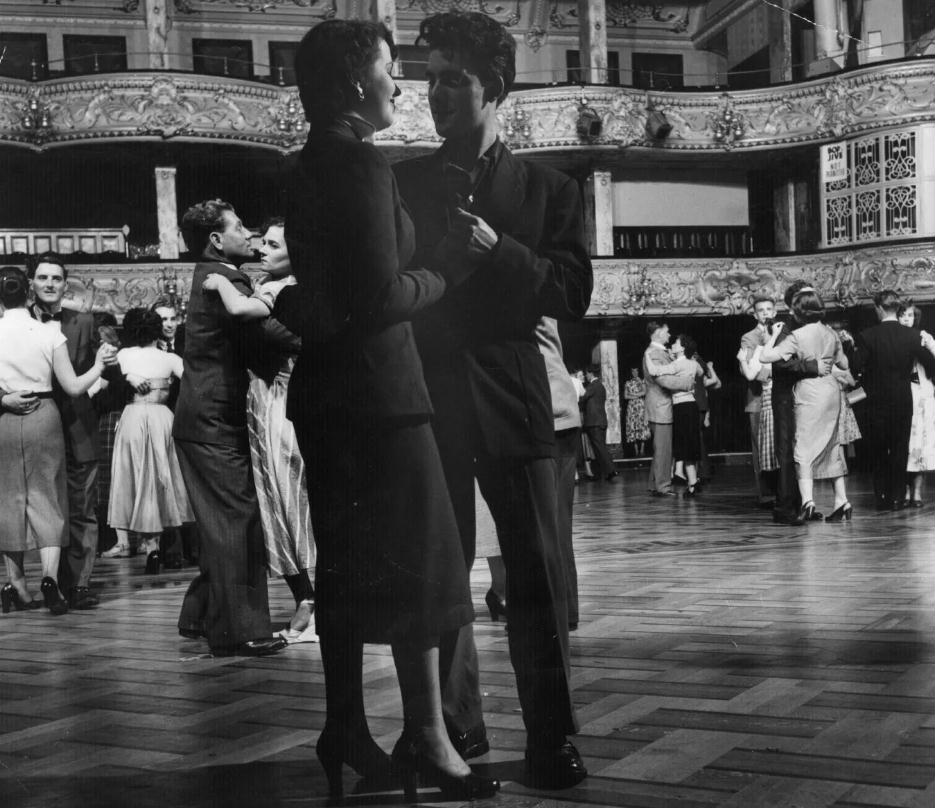
This is a piece about my Uncle Willy and Auntie Gladys. Willy passed away five years ago, however Gladys still lives in the same council house- that’s “social housing” to you and me now- that they lived in for forty five years just outside Blackpool. Before I get into what I might call “The Ah Buttery” of the article, permit me to share with you a poem. Willy was passionate about music. He had worked in the industry for over fifty years in Manchester and Glasgow before they came to Blackpool and he had the biggest record collection you could ever imagine – that’s “vinyl” to you and me now. They loved dancing and went to the Tower Ballroom every Wednesday afternoon for years, long before “Strictly Come Dancing “thought it had made Blackpool its own. They took their sandwiches, listened to the organ, watched couples dance and then took to the floor themselves. The poem is about some of those sensations and others to boot.

Blackpool Tower Ballroom, 1950s

The Pleasure Of The Next Dance

They always draw the curtains round your bed
to tell you when something is wrong.
In that understated manner doctors have, she said,
“I wanted to tell you both at the same time.
You know that we have completed a virtual colonoscopy.”
All very nice but all I want is plain and simple English.
“You have advanced cancer of the bowel.”

We won’t let Grief come up the garden path.

We will do what we have always done
in sixty years of marriage. We will dance.
Fads came and went but we always stayed in step.
We never skimped on dancing shoes.
We sambaed on sandy ballroom beaches.
We waltzed in the Viennese woods.
We smooched when no one was looking.

When Pain calls now - me and Morphine always have a drink together.

Remember that first grand dance I took you to?
I leaned across the table and looked into your eyes.
We always saw the youngster in each other’s eyes.
You were shimmering in a gold and silken gown.
I was in a tuxedo and led you onto the floor.
I slipped my arm around your slender waist.
Long, lingering and lovingly we danced and danced and danced.

The next dance will always be our first dance.

And we will be deaf when Death comes to knock at our door.

Before he died Willy asked me to look after Gladys. I said I would and I have tried to do it to the best of my ability. Five years ago as I said. It started with looking after the garden. A front garden, thirty feet long and fifteen wide. We planted daffodils in one long border to come up in Spring and marigolds in another to bloom in Summer. Marigolds were Willy’s favourite flower. Given that the back garden was the size of a cricket square, looking after it all took one working for at least one day a week, mowing the grass, trimming hedges and cutting back.

Willy played the role of a traditional, breadwinner husband. What else would he know? He organised everything, did the banking, paid the bills and dealt with whatever need dealing with. Gladys left it all to him while she kept house. What else did she know?

Since then Gladys has been alone in this “Ah But” world. Let me try and explain. For an eighty nine year old woman, who I might add, has all her marbles and can still get about, life has become very complicated at every turn and twist in the road. She rings somewhere to try and resolve something and they say “Ah but you can’t do that”.

“Ah But” is found predominantly in the administrative and bureaucratic set ups we all have to deal with. You phone and think that you have got through but then in a whirlwind of almost never ending verbal you know what, it starts. A machine tells you that they are dealing with a high volume of calls and that your call is being recorded for training purposes and your own safety cos if you abuse us we know who you are. We value your custom and your patience and by the way it would be quicker if you went to our website and downloaded the app. This would be much quicker for you and we aim to get back to you within seven working days and by the way. Have a nice day. When you have got through that lot - press one if you want…. two if you want…. I am going to put you on hold and you can listen to silly music for ten minutes and you are number sixteen in the queue, more music. Number fifteen in the queue and so on and in case you have forgotten thank you for your patience and we value your custom and remember our app.

Then after that momentous whirlwind of nonsense, you get through to a voice, a human voice and then it really starts in earnest. You state your problem and how you want to solve it and in response you get “Ah but you can’t do that.” No explanation as to why. You stutter out your problem again. They say to you again as if you are stupid,” Ah but you can’t do that.” Eventually after several phone calls, going through the whole preamble before you get to a human again, you state your problem, ask to speak to a line manager and perhaps make some progress. You politely ask for their name and make notes of time and date and feel as if you have moved forward, if albeit only a little. Recognise what I have am describing? We have all been there. Somehow you learn how to circumnavigate and eventually get what you want.

Now imagine you are an eighty nine year old lady, whose husband has done everything for her for their sixty plus years of marriage but has been gone five years, she has no computer, doesn’t know what a website is or an app or how to download anyway and everything is on line. Whatever that might mean. She feels that the world she has lived in for all this time is now unrecognisable, somewhat unfathomable and rather threatening. Perhaps she feels that she is on Mars. The “Ah But” world.

Let me give you just a couple of examples of the many she has encountered over these five years. Willy had not only loved music he was also a film buff and had a Sky subscription. She had carried on paying a direct debit of £37 a month for five years without realising it. Oh and I’ve forgotten to mention online banking. How could I do that because I take it for granted? So perhaps do we all. Actually there are probably hundreds if not thousands who don’t “do “online” banking- especially if you haven’t got a computer or a mobile phone. Oh yes and that’s something else I forgot. She hasn’t got a mobile. Think of all the things where you have to give a mobile number or the process won’t let you proceed. She doesn’t do online banking. There is no bank now in the small town in which she lives, so she travels into Blackpool on the bus to go to “her “bank to get out some real money. She refuses to use ATM’s since she doesn’t know how they work.

So eventually my caring has gone beyond the garden and into the house so to speak. I have persuaded her to discuss with me any things that come up that she doesn’t understand and now she lets me deal with these issues as well as taking her across the road to the nearest ATM because she still wants cash to pay the papers, the milk man and the shopping.


She didn’t get the Winter Fuel Allowance because she has savings that took her above the threshold. I tried to claim Pension Credit – online (!) - for her in order that she might get the Fuel Allowance next year. Supposedly there are three hundred thousand pensioners who are entitled to the Allowance but didn’t claim for it. If they go online they will find there are – and I kid you not- two hundred and forty three questions to answer. So maybe you can understand why there are three hundred thousand who don’t claim it.

So I stopped the £37 a month direct debit to Sky. Within days she received what was tantamount to a threatening letter. Why have your payments stopped? You have a contract. Start paying it again or else. So I rang them and went through the whole shebang I have described, I think, so accurately above.

When I eventually get through I try and explain that she has paid all this money over the years. The total is a staggering £2220. Gladys has worked out they owe her money and will she get it back. First of all they ask Gladys if I can speak on her behalf. I give Gladys the mobile and she agrees. I say “She doesn’t have Sky and therefore doesn’t use it”. “What about The Skybox?” came the reply.” There is no Sky Box” I say. Gladys has, in fact, disposed of it because she didn’t know what it was. The lady on the other end of the phone is confused because she admits she has never come across a case like this before nevertheless Ah But- She can’t just stop the direct debit. “Well I have I say.”

After referral to a line manager, the lady suggests I write a letter to Sky- she gives me an address- to explain the problem. So this I do in great detail, step by step, prefacing the letter with the details of Gladys’ circumstances. Eventually I get a letter back- from the Sky Customer Care Department (Wow!)- saying that they understand the problem and will terminate the account. There is no mention of a refund. The last line of the letter says that although the account is terminated and closed, Gladys will receive a further letter asking her to reinstate the payments. The letter says to ignore this. It will be generated by the computer. I hadn’t heard that one that for a long time “It’s the computer’s fault”

I forget to tell Gladys about the letter that needs to be ignored so that when I turn up at her house the next time, she has received the letter and doesn’t know whether to laugh or cry. Neither do I. However Sky was sorted- no refund- but (Ah But) Sky was sorted.

That was a few months ago and now let me tell you about the current issue we are dealing with. When I go to her house, before I start work in the garden we have a cup of tea together and catch up on our news. Now she always leaves letters official letters she has received next to where I sit and I say “What’s this Auntie Gladys?” “I’m not sure “as if to say that’s why I have left it for you. It’s a letter from her Gas Provider printed in big red letters, that’s always a sign something needs attention, isn’t it. It tells her that despite various attempts to read her Gas Meter, they have not had a response and this is now quite critical. When they obtain a reading they will be able to ascertain whether she is in credit or debit.

So I take a reading. Then ring the provider and, of course, have to go through the “long momentous whirlwind of nonsense” I described above. You can reread it now in case you have forgotten what happens or you can cut and paste it in here. After thirty minutes I get to speak to a human. Gladys gives me permission to speak to them. I then explain the situation and proffer the reading. “Ah but that can’t be correct. It’s much much lower than we estimate. You have read it wrongly.” Well actually I haven’t.


I explain Gladys’s situation and that she has no one to do this kind of thing for her. Furthermore she does not use her cooker very much, doesn’t know how to use the central heating, despite my attempts to show her how and her gas fire has been capped off several years ago as the Social Housing Agency was decommissioning gas fires in their properties. The device she uses to keep herself warm is a small electric blow heater. The Gas Office doesn’t understand this and persists in ah butting that I’ve got it wrong. They want me to do a reading again and send it in. However I am going to insist that they send someone to read the meter then there can be no doubt.

What is of great interest is that she has paid a direct debit of £50 each month over the last five years. So now we are talking about £3000, some of which could well be returned to her as a hefty refund. I told her. I said “Auntie Gladys, remember in the old days you put a shilling in the meter when the gas ran out? Eventually the man came opened the box where the money had gone in and worked out if you owed any more money or if you had paid too much he give you some shillings back?” She understood that. I said “Let’s see if you get any shillings back in your bank from this lot.” Let’s hope so. Ah but- then again. It’s a work in progress. It’s all a work in progress until the next time and without doubt there will be a next time for sure.

The “Ah But World” To us- it’s argumentative, we like to take them on and know how to do it. To the Gladys’ of this world- it is threatening and there will hundreds, if not thousands, in Gladys’ position. It’s hard to dance alone. It’s about language isn’t it? It’s all about language. All about communication- it always is. Wouldn’t it be good if we could retrain all the corporations and the “Ah Butters” in them, to use the phrase “What if?” offering positive ways out of challenges- not problems? So when they say “How can I help you? they really mean it and try their best to do it. Ah But. What if.

Bill Allison

Thursday, 20 February 2025

Movie Stills

In 1937 Tom Harrisson founded the Mass-Observation Project. He had previously conducted anthropological research in Sarawak using a variety of observational methods, noting everything that he saw or heard, to form what we might today call a data base from which he could go on to hypothesise and write up his research. On his return to Britain he suggested that the same methods might be used to record and study the everyday lives of ordinary people in Britain. He chose to base his work in the north of England industrial town of Bolton, renaming it “Worktown” for the study. Harrisson’s team of unpaid, untrained volunteer observers kept diaries, distributed open-ended questionnaires and anonymously recorded people's conversations. They considered behaviour during family life, at work, on the street and on various public occasions, including public meetings, leisure activities, holidays, sporting and religious events. The Project was brought to an end because of the Second World War. However a vast amount of material was gathered, some of which was published at the time.

In “The Town that Vanished” (2018 Worktown Publishing) Ian Robinson brought the study up to date. However the subtitle of the book, “The Rise and Fall of Lancashire’s Biggest Mill Town” speaks for itself. If the Worktown team were recording Bolton at its zenith, Robinson’s book chronicles its nadir.

The first chapter is a study of the town’s cinemas in the late thirties. In 1938 the Mass Observation Team recorded that there were a staggering 47 cinemas within a five radius of the town centre. This was a time before television. Most working class people went to cinema twice a week since the programme was changed mid-week and another film shown. It seems that there was a pecking order of cinemas. The most prestigious were known as first run cinemas which got to show the latest films on release. Other films were shown but after a three or four week period the film returned for a second run. There were then third, fourth and even five run cinemas that would screen films that had been shown around the town several times already. The prices in the lower tiers were reduced as the films moved around the town. 

Bolton Odeon
The site and seating capacity of all cinemas was recorded. The premier was “The Odeon” (above) which had 2500 seats. Working its way down the list eventually the catalogue gets to that it calls unexceptional picture houses in the outlying districts. This group of cinemas were unfalteringly called flea pits or bug huts by local people since they were allegedly infested. “The Empire” on Howard Street, “The Ritz” on Fletcher Street, “The Carlton” on Mount Street, always called “The Mount” by locals. In 1959 as a ten year old boy I lived on Mount Street.

Mount Street was the archetypal “two up, two down” street of terraced houses. No hot water and outside loo. The opening sequence of “Coronation Street” always reminds me of it. It was a long street, winding down from St Matthew’s Church at the top to “The Mount” at the bottom with St Matthew’s School on the left in the middle. I lived at Number 77 opposite the School.

To a little boy the inside of the cinema and what it showed on its silver screen seemed wonderful. I very rarely got to see films at night with my mum and dad but what I did get was Saturday morning “flicks”. Film shows just for kids. Cowboy movies. Hopalong Cassidy. Dale Arden dressed in tight space suits enough to arouse sexual feeling in little boys before they were supposed to get them.

During the film you could feel movement under your feet. It wasn’t the bugs. Seats at the front were cheaper than those at the back and so during the film you got kids, who had paid peanuts to get in, crawling under your seats to get to those at the back that offered a better view. When the film broke down, as it frequently, did the juvenile audience booed and hissed. The doors were flung open and usherettes started hoofing kids out onto the street. Wonderful indeed.

But what was more wonderful for me were the movie stills displayed in glass cases outside the cinema. These were shots taken from the films themselves often showing the highlights. There could be up to a dozen in each case. The stills in the early years of cinema were black and white with pinpoint focus and superb depth of field in a quality that a mobile phone camera can never hope to achieve. Film Noire particularly lent itself to these style shots. Black and white. Shadow and light. Evoking poignant atmosphere of dozens of exotic and secret places. On the other hand they could be scenes in down to earth locations from the Bowery to the Bronx. They all whisked you away to somewhere else.

movie stills on the foyer wall
By the late fifties most of the stills in the cases were in colour. A colour palette that looked like nothing else. Vibrant and unrealistic in contrast to the vivacity of black and white stills. Nevertheless still enticing for a little boy.

The concept “Movie Stills” is a tremendous contraction in itself. Caught on camera something that is moving and making the meaning still. Captured in the millionth of second to stand still and be evocative for all time. It has often struck me that this is what poems are. Ideas formed into words and caught to stand still and be evocative for all time.

The cinema was at its height as a place for a night out at the end of the Second World War in the late forties. I have written a drama sequence of poetry, song and dialogue for four readers which chronicle my mum’s time in and after the War. In one set of lyrics I have tried to capture some of the sensation of going to the cinema. It is in the style of the Andrews Sisters, one of the original all girl, all spice, groups. It takes place where a man, and his brother invite my mum and her friend out. They ask the girls where they would like to go. The reply comes………

Take us to the pictures,
A place where we can dream.
Take us to the movies
to watch the silver screen.

Ride us to the place where cowboys roam the range.
Red Indians live in tepees all the across the plains.
Drums beat along the river, tomahawks and the rest.
Pow wow wow and digger de dog we love the Wild West.

Chorus

Fly us to Casablanca or down to Marrakech.
Smoke rings rising from foreign cigarettes.
Film noir in the shadows as Peter Lorre stares,
shuddering in the darkness on the edge of our chairs.

Chorus

Middle Eight

Girls with ice cream trays slide down the aisles.
One movie ends and another one begins.
Frozen choc or orange pop
and off we go again.

Put us on the dance floor with Ginger and Fred Astaire.
Long legs, swirling dresses, Busby Berkeley stairs.
Champagne breakfasts, Deco nights, Hollywood glamour (more).
Handsome heroes, beautiful women, give us more, more, more.

Chorus

They must have enjoyed the film because the man later married my mum and became my dad.

So finally onto a favourite film. Well almost. But first a poem.

Afternoon Theatre

Made up and dressed as walk-ons to look fine and fancy free,
they arranged to bump into each other from time to time.
Lingering on corners until the other came into view
only then daring to reach out, touch hands and peck cheeks.

With every day as regular as well hung wall paper,
their own marriage lines were too well rehearsed to forget.
Missing their cues, waiting in the wings, they had met too late
to step out of well-worn characters and audition for new parts.

Stars in each other’s eyes for a while, albeit in their own,
for the duration of drinking tea or smoking a cigarette.
Sitting outside, making giddy conversation across the table
to find something meaningful to patch their threadbare years.

Too scared to reach for freedom, take chances or improvise,
needing to watch the clock in what was their own golden time.
Knowing type casting brought security but repetition caused pain
prompts called them back to the parts they had played for life.

When they left the stage without curtain calls or encores,
there were no keepsakes, nor ovations, nor flowers.
He caught the bus and she drove home in a round-a-bout way
not even imagining there might be others just like them. 

People have said about my poem how clever it is to incorporate all the theatrical elements and terms that it does. This was, of course, very kind of them. That was always my intention. What no one has ever said is that it seems like a rewrite of “Brief Encounter” on stage rather than on film. That wasn’t my intention but every time I read the poem now I can’t help but recall the film and that rather large clock that still stands on Carnforth Station where some of it was shot. And look at the poster below. Movie stills indeed, capturing all and everything, just like poems.

Brief Encounter Poster
Thanks for reading,
Bill Allison

Friday, 10 January 2025

Resolutions: Wishful Thinking?

I am sure that I have been making New Year Resolutions since I was about ten which probably means I have made at least fifty or more. I can’t remember a single one of them and I probably failed to meet any of them anyway.

New Year’s Resolutions are said to date back to Ancient Babylon. They also seem to have featured in Ancient Rome. Julius Caesar introduced a calendar in 46 B.C. which declared January 1st as the start of the new year. The date honoured Janus, a two-faced god, who symbolically looked back into the old year and forward into the new.

New Year’s Resolutions, as we would know them, appeared to be common by the 17th century. By 1802, the tradition of making (and failing to keep) them was common enough that people satirised the practice.

In 1813 an American newspaper featured the first recorded use of the phrase ‘New Year Resolution’:
“We believe there are multitudes who will sin all December, with a serious determination of beginning the New Year with resolutions with the full belief that they shall thus expiate and wipe away all their former faults.”

Of course, the history of making and breaking New Year’s resolutions continues to this day. Most of us will probably make one at New Year. Somehow the practice has become somewhat similar to making a wish as you blow out the candles on your birthday cake hoping, just hoping, that the wishes come true.

Words and ideas become institutionalised over time and can often move away from their original and real meaning if all be it by custom and practice. Take the word Resolution itself as defined in the Cambridge Dictionary:  the act of solving a problem or finding a way to improve a difficult situation.

That’s the last thing a wish is. We can wish to resolve all our dreams and wishes and all the problems in the world. But blowing out the candles won’t do it, neither will making a resolution on New Year’s Eve as the clocks tick around to twelve.


The real meaning of the word necessitates a plan as to how we get to the resolution. Resolution is surely a word that looks back on something that has been achieved. The suffix “re” ensures that. We can only get to a resolution if we know how to get there. And there’s the rub. We have no plans- just wishes.

The question that we perhaps should be asking is,” How I can be resolute?” Thus using a word firmly related to the semantic meaning of the word resolution itself. “What steps can I take to ensure that I reach where I want to go? How can I get to the resolution I wanted in the first place, way back on New Year’s Eve?

Take the tortoise in the Aesop’s Fable “The Tortoise and the Hare”. We all know the story. The hare taunts the tortoise whilst dashing and running and soon burning out. Meanwhile the tortoise has a plan and is resolute. I will be resolute in keeping to the plan. Slow and steady wins the race. We all need, perhaps, to have a plan that will take us to our resolution, whatever it may be and be a little more resolute in ensuring that we reach our goal. 

Resolutions apart, I'd like to share with you a poem that attempts to articulate wishes for our daughter as she leaves home to study abroad. I would suspect the feelings are universal. You want your offspring safely sprung, because they are not children anymore, far from it. Sometimes it is hard to grasp that. There will always be a part of you that sees them as tiny, fragile and innocent.

There, of course, is the rub. Nevertheless you know in your heart of hearts, they have grown, have become what kids these days, call “rock” and they will surely walk side by side with experience, sometimes for worse but mostly for better, as they become their own person. And it’s at that point they will send you the songs, the pictures, stories and poems to show they have caught the light in rainbow fashion...


Catch the Light in Rainbow Fashion

The autumn rain runs down the airport window
as we wait for the screen to show your flight.
The rain stops for a while, pooling on a ledge,
finding its own way down the pane.
Catching the light in rainbow fashion.

The flight is called and you stand to go.
You won’t look back as you walk through the gate.
It would be easier to pilot jet planes
than control emotions at this precise time.
So we’ve left a note in your backpack.

Sing us a song of what you hear.
Paint us a picture of what you see.
Tell us a story about what goes on.
Write a poem and send it home.
Catch the light in rainbow fashion.

Thanks for reading. And a week or so late, Happy Resolute New Year!

Bill Allison