written and posted by members of Lancashire Dead Good Poets' Society

Showing posts with label Happenstance. Show all posts

Saturday, 15 March 2025

Happenstance

I had absolutely no idea how I was going to tackle a blog about happenstance until I made a throwaway joke to a friend about Adele (who sings with local opera company Musica Lirica) being in a production tomorrow in Lytham St Annes - something about car men.😉

Of course, I know it's a production of Bizet's opera Carmen and I shall be there to hear Adele and company perform; (it's probably happened by the time you're reading this). But that faux ignorant play on words prompted me to think I might write an automobile-based spoof of the story of Carmen for today's post. 

Imagine my surprise, then, when I discovered that in a sense it has already been done, and rather brilliantly too, as a short film, Car Men, directed by Boris Pavel Conen, with choreography by Jiří Kylián, back in 2006. Now that is happenstance - something that happens by chance, usually with a happy outcome, and it has certainly taken me places this evening that I never expected to go.
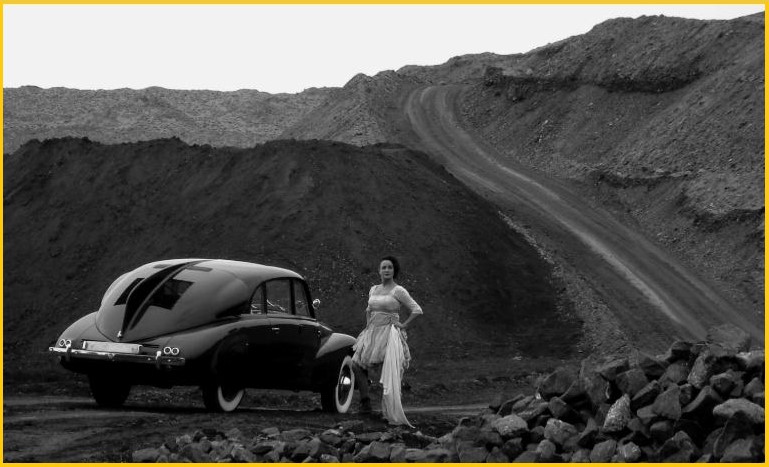
movie still from Car Men with Sabine Kupferberg as Carmen and a vintage 1937 Tatra
The film is just under thirty minutes long and was shot in black and white in an old Czech open cast brown coal mine. Obviously, I didn't even know of its existence until today, but I've tracked it down on Amazon Prime and have streamed it this evening. A series of excerpts is also available on YouTube (see end of  blog for a link).

Car Men features four highly accomplished performers, Sabine Kupferberg as Carmen, Karel Hruška as Don Jose, Gioconda Barbuto as Micalea and David Krugel as Escamillo. The music is obviously Bizet's score from Carmen (or at least a subset of it), with additional sound effects provided by Max Frick.

Sabine Kupferberg started out as a dancer with the Stuttgarter Ballet before joining the Nederlands Dans Theater with whom she performed for over thirty years. She was also the life partner of choreographer Jiří Kylián, and with him she formed Nederlands Dans Theater III specifically for dancers over forty years of age.

Karel Hruška was born in Prague and made his dancing career with the Prague Ballet before going on to found his own company in France.

Gioconda Barbuto is an internationally esteemed Italian-Canadian dancer and choreographer. She was a long-time member of Les Grands Ballets Canadiens, dancing with the company for sixteen years, and then of the afore-mentioned Nederlands Dans Theater III for eight years. Recognized by many for her exceptional versatility and magnetism as a performer and soloist, she has boldly embodied work by the most influential ballet and contemporary choreographers, including Kylián of course.

David Krügel is South African and started out as an acrobat and circus performer before gaining a scholarship to study ballet in New York. He danced for many years for ballet companies in Belgium and South Africa before joining Nederlands Dans Theater III and has more recently been Director of Programming for Hong Kong Ballet.

movie still from Car Men with the entire ballet cast cavorting to Bizet
The film is not operatic, in that there isn't much singing. All is modern dance and mime, with interpretations of scenes from Carmen set to musical selections from the score supplemented by sound effects. You don't need to know the story of Carmen in order to enjoy the film, although familiarity with the opera probably enriches the experience of watching Car Men, which is both wittily and wistfully done.

The dancers, given their pedigree, are naturally fabulous and expressive performers, the scenes are inventive and full of cross-cultural references, the sequence with Carmen as toreador and the car as bull is brilliant, and much of it has a zany quality partly due to a good deal of slapstick comedy and a speeded-up effect in homage to jerky old-fashioned silent movies.

movie still from Car Men  with Carmen not too impressed by Don Juan's advances
Of course the interpretation is a very liberal one, as the whole point is that the film is an extension of the Carmen - Car Men pun. So there are no dragoons, smugglers or inn-keepers, just the four principal characters building cars out of scrapped parts, racing each other in dream-sequence wacky-races style, and playing out the ebb and flow of their relationships, all in keeping with the comic opera mood of the original. And or course, Carmen gets run over by the spurned Don Jose. If you like imaginative film and contemporary ballet, you'd love Car Men and I urge you to check it out.

As for what Bizet might have made of it, I think he would have found it fun and rather complimentary, for he died suddenly after just a few public performances of Carmen and never lived to see it become one of the most popular operatic creations of all time.

Finally, there's no poem this week, but here courtesy of YouTube are a selection of scenes from Conen and Kylián's movie. Just click on the film's title to activate the link: Car Men  Enjoy!

Thanks for reading, S ;-)

Friday, 14 March 2025

Happenstance - It Was Meant To Be

Happenstance (noun): Chance or a chance situation especially one producing a good result.

I’ve come to the conclusion that life - mine in particular - is made up of ‘what ifs’.

What if I hadn’t written that letter? What if I hadn’t gone to that party? What if I’d been a few minutes later? What if I’d walked instead of taking the tram?

What if?
             What if?
                         What if?
                                     What if?
                                                  Things could have been so different.

A few years ago the whole family gathered to celebrate my mum’s 90th birthday. There were twenty six members of the family crammed around a long table, eating, drinking and chatting. It was a very jolly affair with speeches, cake, champagne and lots of laughter. I remember taking a moment to look around, and thinking to myself that none of us would be sitting there if my dad hadn’t become best friends with my mum’s brother.

My mum’s family had been evacuated during the war, but returned to London when mum’s brother, John, was due to start high school. He and my dad were eleven when they met during the first few weeks of term. A wicked sense of humour and a rare thirst for learning was what brought them together.

At that point my mum was nine and of no interest to an eleven year old boy. This, despite the fact that she used to hide under the table when they played Monopoly and secretly pass my dad money. According to mum, she thought her brother’s friend was ‘funny looking,’ and I think dad only stayed on the right side of her to fraudulently purchase Mayfair and win Monopoly.

Fast forward a few years and dad has called round to see John. By this time they are firm friends, spending days cycling and hiking together, going on canal holidays, discussing politics and philosophy and doing a lot of laughing. Dad is about to leave when he notices Mary hovering in the hall. She walks him to the door and watches him down the path. She sees him stop and look over his shoulder. She thinks he’s about to say something, but he turns back and opens the gate.

That night he thinks about the little nine year old who is now a rather beautiful eighteen year old, and he sits down and composes the first of many letters to this young lady, who has suddenly piqued his interest. It’s quite a formal letter. I know this because it’s now in my possession. The message is also rather hesitant, as he obviously fears rejection. There are lots of get out clauses for Mary, ‘and it will never be mentioned again.’ What he doesn’t know is that, over the years, Mary has revised her initial impression of this funny looking boy, and now thinks he’s rather handsome.

The rest, as they say, is history. They went to the cinema, they courted for two years and then they married, with John as Best Man.

my parents on their wedding day
They had three children, eight grandchildren and ten great grandchildren, and here we all were with partners and aunts, uncles and cousins, sitting around that big table, in a posh hotel nearly seventy years later.

That’s Happenstance.

Happenstance Mark ll 

1973
Hiding round the corner of the building
I’ve no intention of meeting this boy
In the coffee bar
As arranged
I’ve no interest in him,
Despite agreeing to meet him that day
Hiding, the only solution
Cowardly as it is
Crouched down
Counting off the minutes
Till I can safely go in
And he’d be gone
‘You’re here!’
He’s found me
Takes my hand,
Leads me into the coffee bar

2025
Today, in the garden
Enjoying the sun
‘You’re here,’ he says
Hands me a brew
We sip our coffees
In comfortable silence
I’m not hiding any more

                                      Jill Reidy

my own wedding day
That's happenstance too!

Thanks for reading….. Jill Reidy

Monday, 10 March 2025

Happenstance and the Surrealists

Surrealism is an art movement that began in the 1920s and is known for the creation of hybrids of words and images often generated through the experiences of happenstance, a circumstance especially due to chance. Tangible and intangible materials acquired in this way and used within the creative making process include 3-D objects, words/images found in printed material (i.e. collage) and even random thoughts (i.e. automatism writing and art making) are often juxtaposed and thrown into the mix.

The surrealists' use of ‘objective chance’ was driven by a belief in the existence of an unconscious state of mind which could only be accessed obliquely. The surrealists believed the key to finding universal truth was the unconscious mind as defined by the founder of psychoanalysis Sigmund Freud (1836-1939).

               …the store of feelings, urges, memories, and thoughts,
               outside a person’s conscious realisation.

Within my own work I most closely identify with the surrealists. I’m fascinated with creatively unlocking the unconscious and I have had a life-long appetite to collect objects as a result of happenstance.

As I recall, my first 3-D artwork created out of found objects was a sculpture made in Mr Plunkett’s eighth grade art class constructed out of rusty metal bits picked up along the nearby railway tracks. It wasn’t very big, stood about 18 inches high and was fixed to a wood base. It looked rather like a flat metal leaning tower with gap-toothed featured edges.

This set the precedence for decades of collecting random objects discovered by chance in the dirt, in the street, in second-hand shops or gifted to me (anonymous people have left things on my doorstep). I have been inspired to creatively rearrange these various serendipities transforming them into something new that sparks child-like curiosity inviting one to creatively explore – the more you look, the more you see.

A good example of this is Swell to Great that explores in a surrealistic manner the influence WW II had on the painters who formed the School of Fantastic Realism in Vienna.

Swell to Great © 2012 KEW
Artwork for Society for Art of Imagination’s 50 Anniversary Exhibition Phantesten Museum, Vienna, 2012 

Serendipitous words and images found in newspapers or magazines also become objects of creativity too such as this collage Can You See Me?

Can You See Me?  © 2011 KEW
October 2011 Exhibition Türe Sanat Galerisi, Konya Turkey

Images put onto a surface through an automatic process, without any preconceived notion is relished and according to the Metropolitan Museum in New York is a way of… unleashing the mind and challenging the rationalism of the modern world.

I have worked in this spontaneous unconscious way for many years creating drawings using white gel pen on black paper then manipulating the images on the computer in a more conscious way. I  have discussed this process in a previous blog Image (July 29, 2024).

For this article I thought I’d have a crack at unconscious automatic writing. I first tried doing it in one minute (too short), then two minutes and finally a five minute exercise. I then consciously attempted to craft the two minute piece – interesting.

Two Minute Automatic Writing Exercise © 2025 KEW


in the jungle

elephants waltz
within the tangled vines
managed by humans caught
in concrete nothingness

worms dig, moles dig
into the dry then damp
make tunnels, burrowing
underground, away from

white noise, loud bangs
tranquillity welcome


Thank you for reading, Kate 
J

Sources:
Cambridge Dictionary, 2025. Happenstance. https://dictionary.cambridge.org/dictionary/english/happenstance#google_vignette Accessed 1 March.
Libquotes, 2025. Sigmund Freud – Unconscious Quotes. https://libquotes.com/sigmund-freud/quotes/unconscious Accessed 2 March.
Rank, M.R., 2024. How the surrealists used randomness as a catalyst for creative expression. https://theconversation.com/how-the-surrealists-used-randomness-as-a-catalyst-for-creative-expression-226908 Accessed 1 March 2025.
Watson, K., 2020. Surrealism, Chance and the Extended Mind. Chapter 10, pages 171 – 188 Distributed Cognition in Victorian Culture and Modernism. https://academic.oup.com/edinburgh-scholarship-online/book/37693/chapter-abstract/332025472?redirectedFrom=fulltext Accessed 1 March 2025.
The Met, 2025. Surrealism Beyond Borders. https://www.metmuseum.org/exhibitions/surrealism-beyond-borders/visiting-guide Accessed 1 March.
Study.com, 2025. Freud and the Unconscious Mind/Definition and Theory. https://study.com/learn/lesson/unconscious-mind-psychology.html#:~:text=Sigmund%20Freud%20believed%20that%20the,memories%20in%20the%20unconscious%20mind Accessed 3 March.