written and posted by members of Lancashire Dead Good Poets' Society

Showing posts with label Musica Lirica. Show all posts

Saturday, 15 March 2025

Happenstance

I had absolutely no idea how I was going to tackle a blog about happenstance until I made a throwaway joke to a friend about Adele (who sings with local opera company Musica Lirica) being in a production tomorrow in Lytham St Annes - something about car men.😉

Of course, I know it's a production of Bizet's opera Carmen and I shall be there to hear Adele and company perform; (it's probably happened by the time you're reading this). But that faux ignorant play on words prompted me to think I might write an automobile-based spoof of the story of Carmen for today's post. 

Imagine my surprise, then, when I discovered that in a sense it has already been done, and rather brilliantly too, as a short film, Car Men, directed by Boris Pavel Conen, with choreography by Jiří Kylián, back in 2006. Now that is happenstance - something that happens by chance, usually with a happy outcome, and it has certainly taken me places this evening that I never expected to go.
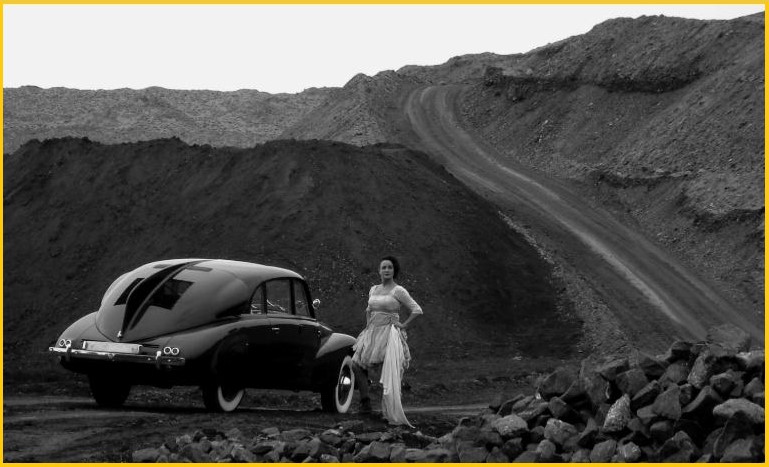
movie still from Car Men with Sabine Kupferberg as Carmen and a vintage 1937 Tatra
The film is just under thirty minutes long and was shot in black and white in an old Czech open cast brown coal mine. Obviously, I didn't even know of its existence until today, but I've tracked it down on Amazon Prime and have streamed it this evening. A series of excerpts is also available on YouTube (see end of  blog for a link).

Car Men features four highly accomplished performers, Sabine Kupferberg as Carmen, Karel Hruška as Don Jose, Gioconda Barbuto as Micalea and David Krugel as Escamillo. The music is obviously Bizet's score from Carmen (or at least a subset of it), with additional sound effects provided by Max Frick.

Sabine Kupferberg started out as a dancer with the Stuttgarter Ballet before joining the Nederlands Dans Theater with whom she performed for over thirty years. She was also the life partner of choreographer Jiří Kylián, and with him she formed Nederlands Dans Theater III specifically for dancers over forty years of age.

Karel Hruška was born in Prague and made his dancing career with the Prague Ballet before going on to found his own company in France.

Gioconda Barbuto is an internationally esteemed Italian-Canadian dancer and choreographer. She was a long-time member of Les Grands Ballets Canadiens, dancing with the company for sixteen years, and then of the afore-mentioned Nederlands Dans Theater III for eight years. Recognized by many for her exceptional versatility and magnetism as a performer and soloist, she has boldly embodied work by the most influential ballet and contemporary choreographers, including Kylián of course.

David Krügel is South African and started out as an acrobat and circus performer before gaining a scholarship to study ballet in New York. He danced for many years for ballet companies in Belgium and South Africa before joining Nederlands Dans Theater III and has more recently been Director of Programming for Hong Kong Ballet.

movie still from Car Men with the entire ballet cast cavorting to Bizet
The film is not operatic, in that there isn't much singing. All is modern dance and mime, with interpretations of scenes from Carmen set to musical selections from the score supplemented by sound effects. You don't need to know the story of Carmen in order to enjoy the film, although familiarity with the opera probably enriches the experience of watching Car Men, which is both wittily and wistfully done.

The dancers, given their pedigree, are naturally fabulous and expressive performers, the scenes are inventive and full of cross-cultural references, the sequence with Carmen as toreador and the car as bull is brilliant, and much of it has a zany quality partly due to a good deal of slapstick comedy and a speeded-up effect in homage to jerky old-fashioned silent movies.

movie still from Car Men  with Carmen not too impressed by Don Juan's advances
Of course the interpretation is a very liberal one, as the whole point is that the film is an extension of the Carmen - Car Men pun. So there are no dragoons, smugglers or inn-keepers, just the four principal characters building cars out of scrapped parts, racing each other in dream-sequence wacky-races style, and playing out the ebb and flow of their relationships, all in keeping with the comic opera mood of the original. And or course, Carmen gets run over by the spurned Don Jose. If you like imaginative film and contemporary ballet, you'd love Car Men and I urge you to check it out.

As for what Bizet might have made of it, I think he would have found it fun and rather complimentary, for he died suddenly after just a few public performances of Carmen and never lived to see it become one of the most popular operatic creations of all time.

Finally, there's no poem this week, but here courtesy of YouTube are a selection of scenes from Conen and Kylián's movie. Just click on the film's title to activate the link: Car Men  Enjoy!

Thanks for reading, S ;-)

Thursday, 22 December 2016

Curtains - I 've looked at them from both sides now,

As many of you know, I was a ballroom dancer.  Not much use for curtains in my chosen art.  You need a spacious wooden, or even flagged floor (ie Matlock Bath) but no curtains open to show you to your audience.  They sit around you, often on all four sides, so you perform, aware that you can always be seen by someone.  Adjudicators in a ballroom dancing competition, stand along any one of those sides.  You cannot ever show a bad angle, a limp wrist, miss a pointed toe or an extended neck.  Someone will see you.  There is no place to hide.

Away from the ballroom, I loved to go to the ballet or the theatre.  Always thrilled by the wonderful curtains, with their promise of excitement.  The Nutcracker has always been my favourite ballet.  The combination of fun and Christmas and the wonderful music of Tchaikovsky, is an absolute joy.  I took my daughter to see it when she was little.  I hate ballets where beautiful characters die.

I love our local Grand Theatre and wish that my reduced income would allow more than a few visits a year but hey ho.  I have been very lucky. I sing with Musica Lirica Opera chorus and in 2014 performed on the Grand Theatre stage. Two years earlier, as one of a group of creative writers invited to commemorate the Centenary of some of Blackpool's magnificent heritage buildings, I was fortunate to have a backstage tour. 

The Grand is a national treasure: One of the few remaining Matcham designed theatres. The Gaiety in The Isle of Mann is another.  Matcham used a cantilever system in his theatres, eliminating the central pillars that obscured the view of the stage. I find it extraordinary to think that many years ago, the Grand Theatre in my home town was ear-marked for demolition, to be replaced by a Littlewoods store. Local people rallied round and formed a protest group.  They saved the theatre by a combination of sheer determination and donations. The Friends of The Grand are a credit to our town. But for their efforts, those beautiful turquoise velvet curtains may never have risen again.

My own performance at The Grand was a one-night stand, in a short tour of The Merry Widow that also included performances at Settle Theatre and Lancaster Grand.  It is so exciting to stand behind a stage curtain as the music begins and see all the people in the audience. I am never nervous. Performance runs through my veins like oxygen. It is exhilarating.  This year we have done it again.  Our 'Steam Punk' styled Die Fledermaus has shown at Settle, Thornton Little Theatre and Kendal Town Hall.  I aim to behind the curtain when it rises at The Charter Theatre, Preston on 13th January. Perhaps I will see your face when it does.


The poem was written for the Walls Have Voices project although not selected for the final publication.

A Grand Embarkation

With precious tickets tight in hand,
Come congregation to the fishbowl foyer,
They climb the gilded staircase, to the circle bar.
Glass clinks on glass, punctuating conversation
Until, summoned by a distant bell
They flow and filter into Matcham’s cantilever shelves.

Some shuffle, rise and fidget,
Slipping sleeves from shoulders,
Mumbling, couching, scrunching cellophane.
They sit: arranged like luscious chocolates,
In four layers of an ornate treasure chest.

Beyond the dulling safety curtain,
Black brick walls echo whispered cues and calls.
Steel taps syncopate on stone,
Sending shivers of anticipation down spinal stairways,
Rigging ropes pulled taut by muscled arms.
Drop the backdrop from the dusty rafters.
 
House lights go down in crystal chandeliers.
A hush goes up: A gasp in unison
As ghostly hand ascends from glowing pit,
The baton poised for down-stroke.  
Currents of warm melody flow like melting ice-cream.
 
Eyes fix on full moon light,
Centred on a turquoise velvet sea.
A cacophony of kettle drums Crescendo
as the overture concludes, audience and players 
embark on a thrilling voyage into imagination.

Thanks for reading.  Have a lovely Christmas.  See you in 2017.  Adele  


Thursday, 24 November 2016

Pastiche- I get it now.

In the late 1960s and early 70s,  my study of English Literature was peppered with novels,  short stories, poetry and plays.  Each academic year I was entertained by at least two Shakespeare plays, a novel by Charles Dickens and poetry by the Romantics.  Some of the stories were familiar to me and this was because of my family’s dedication to cinema and in particular musicals. My elder sister Lesley was a keen student of ballet and tap under the tuition of Blackpool ballet mistress, Elsie Bradley.  By age fourteen Lesley danced on her points, had cameo roles in the Blackpool Children’s Pantomime and danced every Summer Season in the cast of the Tower Ballet, first as a tiny tot and eventually in quartets and duets.  She was a lovely dancer.  

In 1962, my father took licence of a public house in St Helens and unfortunately Lesley didn’t like the new ballet school, (it is hard to go from being a teacher’s favourite to the new girl), declared she hated it and that was that.  Any thoughts of a career in dance evaporated overnight and despite one sojourn in an amateur production of The White Horse Inn, she didn’t dance again.  Our love of musicals was fed by the cinematic journey.  The 1960s were awash with Broadways musicals transformed for Technicolor by Hollywood. We two sisters lapped them up.  

In 1970 I was reading aloud in English: A passage from Pygmalion by George Bernard Shaw, when suddenly the voice of Eliza Doolittle was transformed into a cockney twang.  Immediately I was playing Audrey Hepburn, the most beautiful and glamorous actress that I had ever seen. Lerner and Lowes pastiche of Shaw’s remarkable play was transformational for me.  I had already seen My Fair Lady at the cinema.  I knew every song, almost every line and I understood the nature of all the characters.  

I had started at Elmslie Girl’s Grammar School as a naturally very bright, scholarship holder with an acquired Liverpool accent and what was more of a strain for my headmistress than my, already blossoming, career in International dance.  It had been made clear to me, before I was offered a place at the school, that if the standard of my school work should deteriorate due to dancing, that the dancing would stop.  Mum and Dad were surprised that I even considered agreement to Miss Oldham’s terms but it made me all the more determined to succeed at both.  

Pygmalion was a turning point.  A working class girl in a public school, intelligent but awkward, playing the role written for me by others.  Suddenly I knew how to live in both worlds.  I became a living pastiche.  I let the school and the world of dance transform me into from ugly duckling into a swan and I soared.  Unfortunately, there is a point in every play, musical or novel when the heroine has to choose, when the pressures of living two lives become too much.  For me, academia and dance were suddenly ripped apart by a seemingly unrelated issue. My sister married.

She could no longer drive me to lessons on the Wirral every Saturday, my twice weekly practice sessions in Manchester were out of the question and gradually, my international competition career went out of the window.  By now I was living in a village inn near Blackpool and my dance partner lived in Stoke on Trent.  The only way to keep up the standard was to travel to his parent’s house every weekend by coach and return on Sunday evening. Inevitably homework suffered and I had to decide.  Despite our success in reaching the British Junior Finals at only thirteen, I had to split with John and give up competitive dance.  He found a new partner and went on to be Ballroom Professional World Champion.  By then he was 6’ 2” and as I never grew above 5’2” the split up was inevitable but at the time I was devastated and totally lost.  

I did return to dance but it was always as a shadow of the dancer that I knew I should be. I found a semi –professional partner who had a cabaret contract. It was not enough and by 16 I was qualified to teach and running a Saturday morning class for kids in the village.  I taught for a while in the South but my heart was still in competition and performance.  When my mother fell ill, I gave up completely and settled into an office.

This week I am taking to the stage in two performances of Die Fledermaus at Thornton Little Theatre. On 'Black Friday', 9 May 1873, the Viennese Stock Exchange crashed, spreading gloom and despair. The shockwaves were also felt by Vienna's theatres, which experienced falling box-office receipts. Anxious to remedy this potentially disastrous situation, theatre managements eagerly sought out productions that would attract audiences back into their establishments. Johan Stauss operetta was a pastiche of a French play adapted as a libretto.  The success of Die Fledermaus was incredible. The overture was a sensation.


Musica Lirica's Musical Director, Michael Hall and his wife Fran's styling on this production of Die Fledermaus is way out there: True to the orchestration and lyrics and music with an English translation and a thrilling ‘Steam Punk’ style. I hope that some of you will come along either this evening or tomorrow at 7.30pm. In a pastiche of my own life, I am cast as ‘The Dance Mistress’.  I have no poem to express the joy at 58 of being able to dance without tears in my eyes. Thank you both Fran and Mike for helping me to be a swan again, just for a while.

As always, thanks for reading.  Adele