written and posted by members of Lancashire Dead Good Poets' Society

Showing posts with label grief. Show all posts

Tuesday, 27 February 2024

We Are Not Amused - Let's Have A Laugh


The comment “We are not amused” is widely believed to have been said by Queen Victoria in response to an inappropriate joke or remark made by an equerry. I can’t help but wonder what the equerry actually said in front of the queen. If he was trying to make her laugh, perhaps he was shocked to discover it wasn’t acceptable. According to Queen Victoria’s granddaughter, Alice, her grandmother told her that she hadn’t said “We are not amused” at all. Alice and other young members of the royal family of the time loved Queen Victoria’s sense of fun, finding her jolly with a great sense of humour. She laughed a lot and was amused by many things, apparently. In her later years, she gave the impression of an austere woman with strict moral values. I expect that she held the moral high ground, but I think her facial expression after the death of Prince Albert showed her grief and huge sense of loss rather than austerity.

Laughing is good for us. Seeking amusement, we look for the comedy, the cheerful light-hearted recreations that will make us feel uplifted and happy. It is personal choice, we all have our favourites whether we are going out to be entertained or choosing what to have on TV. Sometimes, the really hilarious moments are self-made. This is definitely the case with my crazy family. Put me in the company of my wonderful niece and within seconds we will have sparked each other into squeals of laughter, usually about nothing, and I will be crying and rushing to the loo with comments about double strength Tena pads making me laugh even more. If her mother, my sister is with us, the hilarity is increased and the three of us are best left to it. We can’t help it. We still laugh at things that happened years ago. At my nephew’s wedding ceremony I broke the silence of a solemn moment with a very loud, giant snort. I will never live it down. I was trying not to cry and holding my breath then the snort just happened. The mirth has lasted far longer than his marriage did, sadly for him. My father had a ‘thing’ about curtains being closed correctly. Two curtains would have to meet exactly in the middle, the drapes had to be equal and the overlap had to be uniform all the way down. It didn’t matter who closed the curtains, he would have to give his finishing touch. Perfectionist. At his funeral service, my sister and I couldn’t look at each other as the curtains closed in front of his coffin. We were both thinking the same thing and finding amusement in the saddest of circumstances. It proved our resilience.

That is us. Amused and amusing at the same time, like lots of families. Queen Victoria and Prince Albert had a large family. I hope they laughed heartily at daft things and had silly moments like we do. I hope they broke the silence with a massive snort, or worse, and I hope, like us, they were amused more often than they were not.

I found this poem,

I’m not sure it it’s fact or rumour,
Queen Victoria lost her humour,
Deciding one day she refused
All attempts to be amused.

Some say it was indigestion,
Others claim that’s speculation.
I believe what’s widely known,
That she hurt her funny bone.

Phil Ward, 2012

Thanks for reading, Pam x

Tuesday, 7 June 2022

Four Legs Good - Cassie and Crombie

We’d had cats, hamsters and gerbils when the children were small. What they really wanted was a dog. When the last of the gerbils passed away, the pleas began again.  It wouldn’t be a problem, after all, I was a stay-at-home mum. Well, that’s how it looked because I was home when they were. The five days a week I spent working in the infants’ school had clearly gone over their heads. A dog. A responsibility. Another family member. My husband and I thought about it.

A lot had been going on in our family. The children had been faced with both parents having serious illnesses which had turned their lives inside out and upside down for the best part of a year. I was convinced that we weren’t both going to make it – we did, there we were and here we still are. The experience changed my attitude about some things. Should I become ill again and not survive, didn’t want the children to have a lasting memory of me, a mean mother never letting them have a dog. There were conditions, discussed between ourselves before involving the children. Firstly, no puppies. We would find a rescue dog. The chosen one had to suit everybody because it would be a family pet and looked after by all. Everyone had to feel comfortable taking it out for a walk. We studied the traits and behaviours of likely breeds and decided to approach Spring Spaniel Rescue. Before going ahead, we involved the children.

We sat round the table at tea time. Everyone had a small piece of paper, placed face down. Stay with me on this, I don’t need to explain how (daft) we are sometimes. It’s just family stuff. With much giddiness between the four of us, it was time to reveal our ‘words’, starting with the children. I had the last turn. Child 1 ‘We’, Child 2 ‘Are’, Dad ‘Getting’, Mum ‘A Dog’. Delighted, excited children.

Cassie was the perfect dog for us at that time. She was an old lady of a Springer Spaniel, thought to be ten years old, taken in by Springer Spaniel Rescue after her time as a breeding bitch ceased. They couldn’t tell us much, except she had been in sad, neglectful circumstances. The rescue centre had looked after her, restored her health and ready to be rehomed, she was ours. Love was all she needed and we had an endless supply. She was too old and infirm to chase balls or do much running about, but she loved her daily walks. Four legs nearly good. We know we gave her the best we could in her twilight years. It was heart-breaking for all of us when despite the efforts of our vet and our constant care, Cassie couldn’t recover from what we believe was a stroke and we had to say goodbye.

The level of grief was enormous. No more dogs.

The ‘no more dogs’ didn’t last very long. Our son helped a friend out by having her dog stay with us for a few days. She wanted to rehome him, but unfortunately he wasn’t a dog for us. Having him around showed me what we were missing. A compromise. We couldn’t keep this dog as he was too big and strong for me to handle, but if everyone agreed, we would approach Springer Spaniel Rescue again.

Crombie joined us as if he’d always been part of our family. Four years old and full of beans, he spun me round and round in the kennels car park before leaping into the hatchback, eager to get strapped in and make the journey to his new home. Bursting with energy and always raring to go, this was a springer behaving like a springer. Cassie had paved the way, building our confidence, preparing us for Crombie. He was a perfect dog for us, as Cassie had been, but in a different way. Springers are intelligent dogs, needing lots of exercise and challenges. Crombie, trained to Kennel Club Gold standard was exceptionally good company. Our children and later, grandchildren adored him. He must have covered every blade of grass on the field close to our house every day. He learnt his way round Dumfries and Galloway, instantly recognising where he was when we turned off the main road and followed the lane to the lodges where we like to stay. He wasn’t best friends with the vet in Kirkcudbright, but he knew he needed help and was respectful. We both whimpered with seasickness on the long journey to the Isle of Barra, but soon recovered to run on the beach. Part of the family he really was and we took him everywhere. Four legs good. Old age and infirmity began to compromise him. We knew what was coming. I couldn’t face up to it until we really had no choice.

Three years on and we still miss him, but I really mean it when I say ‘No more dogs’.

I found this,

The Power of the Dog

“There is sorrow enough in the natural way
From men and women to fill our day;
And when we are certain of sorrow in store,
Brothers and sisters, I bid you beware
Of giving your heart to a dog to tear.

Buy a pup and your money will buy
Love unflinching that cannot lie –
Perfect passion and worship fed
By a kick in the ribs or a pat on the head.
Nevertheless it is hardly fair
To rick your heart to a dog to tear.

When the fourteen years which Nature permits
Are closing in asthma, or tumour, or fits,
And the vet’s unspoken prescription runs
To lethal chambers or loaded guns
Then you will find – it’s your own affair –
But, you’ve given your heart to a dog to tear.

When the body that lived at your single will
With its whimper of welcome, is stilled (how still)!
When the spent that answered your every mood
Is gone – whenever it goes – for good,
You will discover how much you care,
And will give your heart to a dog to tear.

We’ve sorrow enough in the natural way
When it comes to burying Christian clay.
Our loves are not given, but only lent
At compound interest of cent per cent.
Though it is not always the case, I believe,
That the longer we’ve kept ‘em, the more we do grieve.

For when debts are payable, right or wrong,
A short-term loan is as bad as a long.
So why in Heaven (before we are there)
Should we give our hearts to a dog to tear?”

Rudyard Kipling 1865 – 1936

Thanks for reading, Pam x

Wednesday, 8 January 2020

What A Wonderful World

07:00:00 Posted by Jill Reidy Red Snapper Photography , , , , , 2 comments
Optimism: hopefulness and confidence about the future or the success of something

Glass half full or glass half empty? 
I’m not entirely sure how full or empty my glass is, I’m just glad there’s something in it.  On reflection, I think I’m probably a grateful optimist with pessimistic tendencies.  In other words, as I’ve probably mentioned before, I’m a terrible worrier.  Although my default setting probably leans towards optimism I can soon be blown off course by a random thought, usually a totally ridiculous one.  Sometimes optimism can set me off on a bit of a roller coaster.  

Optimism and pessimism start a conversation in my head. 

O: He’s out late but he’ll be back soon. 
P:  There’s been an accident two streets away, what if that was him, on his way home?
O: Why would he be on that street?  It’s not on his route.  Anyway, he’s always careful.  Won’t be long till he’s home.
P: Two people injured! Two males! Must be him.
O: Any minute now I’ll hear his key in the lock.
P: OMG one's got grey hair, it's him!

And so it goes on. 

When my uncle became seriously ill a couple of years ago his wife wrote emails to the family, detailing his condition and his future treatment. Reading between the lines it was obvious where the illness was heading. My mum, the eternal optimist, was convinced that her brother would bounce back to his previous healthy, funny, entertaining self.  I tried, gently, to warn her to expect the worst. I thought I had maybe got through and she would not be shocked at the final outcome.  We visited my uncle a few weeks before he died. I was extremely upset to see him so ill. My mum was still convinced he would recover.  When he finally passed away my mum couldn’t believe it.  We were all sad, but she was devastated at this unexpected loss.  She told me she thought she’d been naive.  I assured her that she’d remained optimistic throughout, and maybe that was her way of coping. 

My mum is now 91.  She’s a had a rough fourteen months, physically and emotionally, since my dad died.  On the whole, she’s remained optimistic about the future, if not always her own, certainly that of the rest of the family.  Desperately wanting to alleviate my mum’s grief, I realised, for the first time in my life, that this was something totally outside my control.  I remained optimistic that things would eventually - very gradually - get better, but I had to accept that grief couldn’t be ‘cured’ or hurried or ‘solved’.  We sat with it, talking, crying, laughing, hugging and let time pass.  And then let it pass some more.  


Although my optimism has sometimes taken a battering, I don’t think it’s a bad trait to have (even mine, with pessimistic tendencies).  Having suffered from severe depression in the past, I know that optimism is the first thing to go.  It just doesn't exist in a depressed state. Pessimism fills that void perfectly. However, in my normal state of mind, like my mum, I have an unswerving belief that I can sort out any problem - totally unfounded, I hasten to add - although we are both pretty practical people.  Give us a roll of sellotape, a needle and thread, a couple of inches of velcro, a spanner and a screwdriver and all will be solved.  Throw in a cup of tea and 'job’s a good’n.'  

I apologise for so many references to sadness and death in a blog about optimism, but I must finish with these lyrics, beautifully sung by Louis Armstrong, as played at my dad's funeral.  Family was everything to dad, and I like to think he chose this as an optimistic look towards the future of all those left behind.

                           What A Wonderful World by Douglas George  

I see trees of green
Red roses too
I see them bloom
For me and you
And I think to myself
What a wonderful world

I see skies of blue
And clouds of white
The bright blessed day
The dark sacred night
And I think to myself
What a wonderful world

The colors of the rainbow
So pretty in the sky
Are also on the faces
Of people going by
I see friends shaking hands
Saying, "How do you do?"
They're really saying
"I love you"

I hear babies cry
I watch them grow
They'll learn much more
Than I'll never know
And I think to myself
What a wonderful world

Yes, I think to myself
What a wonderful world

Oh yeah


Thanks for reading........Jill 


Sunday, 15 January 2017

Teddies and Other Animals

19:13:00 Posted by Jill Reidy Red Snapper Photography , , , , , , , , 5 comments
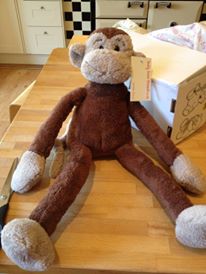
Mojo mark 1


When I was teaching I bought myself a cheap, soft toy monkey who was destined to be a dunce for the rest of his life.  The six year old children in my class decided he should be called Mojo (to go with the polar bear called Polo who already lived in the corner of the room) and set about trying to teach him the basics.  The idea was that Mojo sat on my lap, looking happy but gormless, whilst I fired a series of questions to the children gathered around me.

“4 add 1?”
“2 add 3?”
“Can you sound out ‘pet’?”
“What does ‘dog’ start with?”

And so on.

Mojo was supposed to try and answer before the children, by whispering in my ear.  Needless to say, the children were desperate to beat Mojo, whose answers were invariably ridiculous.  The result was the children had a lot of fun, learned their sounds, added up their numbers, and Mojo remained oblivious to his own ineptitude, smiling inanely from my lap and receiving a lot of sympathetic comments along the way.  He always held a special place in my heart.

I took early retirement from teaching the same year my grandson was born, and somehow (I wish I could remember how) Mojo became Rio’s favourite soft toy.  Except he wasn’t just a toy, he was much more that that.   He was a supreme comforter and as time went on, became part of the family.  Rio moved around a lot in his first few years, between his mum, his dad and us, his grandparents, and wherever Rio went, Mojo was being dragged along too.  There was no chance of sleep without Mojo for Rio to rest his weary head on.  We all had a lot invested in that monkey.

I can honestly say, one of the worst weekends of my life followed the loss of Mojo one Thursday morning when Rio was seven.  I received a distraught phone call from my daughter.  Rio had been going to his dad’s that night so whilst he was at nursery, Laurey had taken Mojo, in a bag with some clothes, to the house and, finding his dad out, had left the bag in the side entrance.  Somehow, within a few hours, Mojo, the clothes and the bag had disappeared.  If you have never had a child with a comforter – in whatever form - that goes everywhere with that child then you have no idea of the distress caused by the loss of such an item.  Not only was Rio distraught, we all were.  It was like a death, and we reacted accordingly.  The worst part was seeing Rio trying to put on a brave face.  Laurey and I held it all together while we reassured him we were doing everything possible to find Mojo, but when Rio left the room the pair of us dissolved in tears.  When Rio returned he buried his head in his mum’s lap and sobbed.  I genuinely believe he was grief stricken.

I come from a long line of capable women who think that, not only is there a solution to every problem, but that we are the ones who have that solution.  I went into problem solving mode and eventually came up with an answer we hoped would make Rio happy again.  We had researched enough to know that we couldn’t replace Mojo with a newer model.  He had become extinct a few years previously.  I spent a day, searching desperately online for a similar monkey to no avail.  The only answer was to get another monkey and adapt it to look as much like Mojo as possible.  As a competent needlewoman I was confident I could do the job, but as a grandma I knew that Rio would not be fooled.  Only recently he had cried inconsolably and then stood by the washing line as Mojo dripped dry after a much needed wash.  He’d explained that the smell of Mojo was a big part of his appeal and I’d already agreed never to wash him again. 
The original Mojo, on his travels


The new Mojo, pre-op


The new Mojo, post-op

The following day, the new monkey arrived by special delivery and at vast expense.  He had long arms and legs, a bright smile and no ears, whereas Mojo had been short limbed with only the hint of a smile and ears like Dumbo.  I had quite a job on my hands.  What worried me more than the physical transformation of Mojo was the problem of explaining away the newness, the lack of worn fabric on his head and of course, the smell.  I set to work, chopping off limbs, adding ears and altering facial features.  By the time I'd finished Mojo had been reborn.  We were just left with the problem of explaining away the obvious differences.  And this is where Mrs Peacock and the Monkey Orphanage came to the rescue.....

The letter from the Monkey Orphanage

I'm not sure whether Rio, as a bright seven year old, was totally fooled by the orphanage story but Ido remember him telling me, years afterwards, that he'd gone home that day, hidden under his bed with Mojo and cried tears of joy.  As a family we never talk about the loss of Rio's favourite monkey, it was such a traumatic event, but as I look at Mojo now and see how worn he is once again I'm sure Rio would say the 'adoption' has been a great success. 

Long live teddies and other animals, but please keep your eye on them at all times.


The day the monkey disappeared by Jill Reidy

I like to think
The day that Mojo disappeared
He’d decided he was big enough
And clever enough
To set off on his own
That he didn’t need his daddy any more
(For that’s how Rio saw himself)
And he was going on one of life’s big adventures

He took the bag
Peered around the bin
And when the coast was clear
He made a dash
Nimbly climbing the nearest lamp post
And hanging there till the bin men had finished emptying bins
The shoppers had finished shopping 
And the children had gone in for their tea

Then, swiftly, he swung from post to post
Along streets where the dark seeped in
Until he reached some open spaces
Not quite the jungle
But maybe a local park
Where he met up with the other missing toys
Who had fled their owners
For a life of freedom

That’s what I like to think

Thanks for reading     Jill


Thursday, 21 January 2016

Metaphysical - metaphorically speaking.

I think I need to offer a little explanation of my dilemma this week, dear reader.  Every three months or so, the Dead Good bloggers are asked to contribute themes for the blog and these are then compiled into a list of weekly prompts to inspire the writer.  I tend to just look at the theme for the week a few days before. Oops!  What a mistake that was this week.  The theme is 'Let's get metaphysical' and I have a confession to make... until I looked it up in the dictionary today, I didn't have a clue what 'metaphysical' meant.

Now far be it from me to cast aspersions but perhaps some of you don't know either, so lets start with a definition from the OED. 

metaphysics /noun/  the branch of philosophy that deals with the nature of existence, truth and knowledge. 

So that's as clear as mud but at least my own knowledge tells me that metaphysical is an adjective.  So what can else can I discover? Ah - apparently there were a group of poets, all writing in 17th century England, who were dubbed - wait for it ...metaphysical poets. They explored the nature of the world and human life using imagery that was deemed 'surprising' at that time.  These poets were John Donne, George Herbert, Henry Vaughan, Andrew Marvell and Richard Crashaw. I hate to admit that I have not read any of their work.

I tried a short cut.  Apparently, esteem for Metaphysical poetry never stood higher than in the 1930s and ’40s, largely because of T.S. Eliot’s influential essay “The Metaphysical Poets” (1921), a review of Herbert J.C. Grierson’s anthology Metaphysical Lyrics & Poems of the Seventeenth Century. This is a very influential essay, especially if you are interested in either metaphysical poetry or 20th century literary criticism.  It seems that in Elliot's view, these poets wrote with 'wit' and 'metaphysical conceit'.

And so I had to check and guess what? In literature, a conceit is 'an extended metaphor with a complex logic that governs a poetic passage or entire poem'.  By juxtaposing, usurping and manipulating images and ideas in surprising ways, a conceit invites the reader into a more sophisticated understanding of an object of comparison.

At last - I am getting somewhere. I do know what an extended metaphor looks like and I know that in poetry, like the grape and the grain, they are better not mixed. I also know what an extended metaphor feels like. Try this one on for size.


Lost Glove,  

I lost a glove today my love,
of deepest purple hue:
A favoured and most treasured part
of something almost new.
 
No comfort in its warmth to put
a smile upon my lips:
To keep the bitter wind from biting
at my fingertips.

I ventured out and checked my steps
in vain attempt to trace
the other half: Unite the pair,
to fill the gaping space.
 
The single sits and pleads to me,
Its calling ever sweet.
Solitary: Separate:
A glory incomplete.
 
No mate will ever touch its palm,
caress it tenderly.
No one will hold its hand or
link its fingers lovingly.
 
For solo it will stay.
A sad and fading memory,
Abandoned and apart.
Alone.
And grieving desperately.  
 
 
Thanks for reading. Adele

Sunday, 15 March 2015

Missing you

Grief is a funny thing. The psychologist tells us that it happens to each of us in stages ranging from denial, (not just a river in Eqypt) to anger and eventually to acceptance. For me grief has often been an unexpected reaction to events and most often not the death of someone close.
 
I am the youngest of four by 6 years and grew up in a bustling pub, surrounded by family, staff customers and friends. I trained as a dance teacher and leaving home at 17 to work in the South was a real wrench.  I had been away from home many times but living away was so strange. Living in a house was even stranger even though I was working over 60 hours a week, the silence at night and the detachment from the hub of my family life made me very homesick. It was my first encounter with what I now acknowledge as grief.
 
My Dad died at 83, a grand age for a man who smoked 40 a day until he was 62.  His first heart attack stopped the habit in its tracks and he completely changed his lifestyle to avoid an early departure. We didn’t grieve really, although we all miss him; we celebrated the joy of his life. Strangely, my second encounter with grief came after my divorce. It came with a sense of guilt, anger at my failure to master a skill and even more surprisingly, a sense of loss.
 
I have to stop myself here.  I just hate it when the natural order of things is disturbed.  I hate it when things go missing. I grieve the loss of the RSC black and white chevron umbrella that I bought at The Courtyard Theatre, Stratford in 2009 and left somewhere in Blackpool two years later. Oh and beautiful gloves.  I really hate losing beautiful gloves, but that is a story for another day. Today is Mothering Sunday, the day when BT tell us that more telephone calls are made than on any other special day. My Mum at 95 has had her share of phone calls, gifts, flowers and days out. This morning I drove my eldest to Preston station as he embarks on a new career. He handed me a card as he got out of the car, towering above me, (all 5’11” of three meals a day for 26 years). A hug, a smile…


When you are gone

It is a natural state. You must leave the nest,
your flight long overdue.
And yet my restless nights are filled
with anguished thoughts of “Now what will I do?” 

Last of my fledglings,
preened and packed for adulthood,
a box of nursery paintings and your toy collections,
plastic-cased and left behind.
I dread the echoes in a vacuumed life.
My folly was to think I wouldn’t mind. 

How will I cope with solitude?
Why would I bother cooking just for me?
I need the constant rumbling of machines,
the drone of game play and the late night sound of your TV.
All the years I had believed that I was here for you.
I realise now that you fulfilled the need in me. 

Symbiosis: each reliant on the other.
Had I known I’d feel like this today,
I may never have become a mother.
 
Adele V Robinson