Terza rima is a rhyming verse form, in which the poem, or each poem-section, consists of tercets (three line stanzas) with an interlocking three-line rhyme scheme: The last word of the second line in one tercet provides the rhyme for the first and third lines in the tercet that follows (aba bcb cdc ). The poem or poem-section may have any number of lines, but it ends with either a single line or a couplet, which repeats the rhyme of the middle line of the previous tercet (yzy z or yzy zz ).
I don’t know about you but my eyes glazed over half way through that paragraph. It makes sense with an example such as Robert Frost’s:
Acquainted with the Night
I have been one acquainted with the night. a
I have walked out in rain—and back in rain. b
I have outwalked the furthest city light. a
I have looked down the saddest city lane. b
I have passed by the watchman on his beat c
And dropped my eyes, unwilling to explain. b
I don’t know about you but my eyes glazed over half way through that paragraph. It makes sense with an example such as Robert Frost’s:
Acquainted with the Night
I have been one acquainted with the night. a
I have walked out in rain—and back in rain. b
I have outwalked the furthest city light. a
I have looked down the saddest city lane. b
I have passed by the watchman on his beat c
And dropped my eyes, unwilling to explain. b
(etc)
Proclaimed the time was neither wrong nor right e
I have been one acquainted with the night. e
The first use of terza rima is in Dante's "The Divine Comedy ", completed in 1320. In creating the form, Dante may have been influenced by the sirventes, a lyric poetry form used by the Provençal troubadours. He set his poem using hendecasyllabic (so well known that I’ll not bother explaining) lines which are suitable for the Italian language. Whereas in English, poets tend to use iambic pentameter which is a line of writing that consists of ten syllables in a specific pattern of an unstressed syllable followed by a stressed syllable.

Now I knew what to look for here’s an example from "The Divine Comedy ":
Tant’ è amara che poco è più morte;
ma per trattar del ben ch’i’ vi trovai,
dirò de l’altre cose ch’i’ v’ho scorte.
Io non so ben ridir com’ i’ v’intrai,
tant’ era pien di sonno a quel punto
che la verace via abbandonai.
Ma poi ch’i’ fui al piè d’un colle giunto,
là dove terminava quella valle
che m’avea di paura il cor compunto...
It doesn’t matter what it means and anyway a friend tells me that English translations don’t do the words justice.
The first occurrence of Dante’s terza rima rhyme scheme in English is found in parts II and III of Geoffrey Chaucer's poem "Complaint to His Lady ". Here’s a few lines:
Hir name is Bountee, set in womanhede,
Sadnesse in youthe, and Beautee prydelees
And Plesaunce, under governaunce and drede;
Hir surname is eek Faire Rewthelees,
The Wyse, yknit unto Good Aventure,
That, for I love hir, she sleeth me giltelees.
I just about get the gist of that and the form gained popularity as it also allowed poets to connect stanzas to one another, creating a smooth transition from topic to topic or from image to image.
As ever with forms that are transposed from one language to another e.g. haiku, they can be modified. Frost’s poem keeps to the rules but then Derek Walcott in his book length poem entitled "Omerus " (which is brilliant) takes more than a few liberties with the Terza Rima form.
All the above begs the question of whether you view rhyming verse of any sort as a help or a straightjacket.
To be fair to Robert Frost, here is the complete poem:
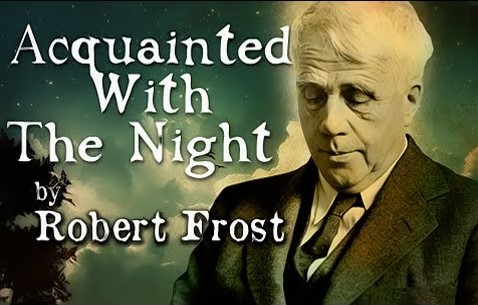
Acquainted with the Night
I have been one acquainted with the night.
I have walked out in rain—and back in rain.
I have outwalked the furthest city light.
I have looked down the saddest city lane.
I have passed by the watchman on his beat
And dropped my eyes, unwilling to explain.
I have stood still and stopped the sound of feet
When far away an interrupted cry
Came over houses from another street,
But not to call me back or say good-bye;
And further still at an unearthly height,
One luminary clock against the sky
Proclaimed the time was neither wrong nor right
I have been one acquainted with the night.
Proclaimed the time was neither wrong nor right e
I have been one acquainted with the night. e
The first use of terza rima is in Dante's "The Divine Comedy ", completed in 1320. In creating the form, Dante may have been influenced by the sirventes, a lyric poetry form used by the Provençal troubadours. He set his poem using hendecasyllabic (so well known that I’ll not bother explaining) lines which are suitable for the Italian language. Whereas in English, poets tend to use iambic pentameter which is a line of writing that consists of ten syllables in a specific pattern of an unstressed syllable followed by a stressed syllable.

Tant’ è amara che poco è più morte;
ma per trattar del ben ch’i’ vi trovai,
dirò de l’altre cose ch’i’ v’ho scorte.
Io non so ben ridir com’ i’ v’intrai,
tant’ era pien di sonno a quel punto
che la verace via abbandonai.
Ma poi ch’i’ fui al piè d’un colle giunto,
là dove terminava quella valle
che m’avea di paura il cor compunto...
It doesn’t matter what it means and anyway a friend tells me that English translations don’t do the words justice.
The first occurrence of Dante’s terza rima rhyme scheme in English is found in parts II and III of Geoffrey Chaucer's poem "Complaint to His Lady ". Here’s a few lines:
Hir name is Bountee, set in womanhede,
Sadnesse in youthe, and Beautee prydelees
And Plesaunce, under governaunce and drede;
Hir surname is eek Faire Rewthelees,
The Wyse, yknit unto Good Aventure,
That, for I love hir, she sleeth me giltelees.
I just about get the gist of that and the form gained popularity as it also allowed poets to connect stanzas to one another, creating a smooth transition from topic to topic or from image to image.
As ever with forms that are transposed from one language to another e.g. haiku, they can be modified. Frost’s poem keeps to the rules but then Derek Walcott in his book length poem entitled "Omerus " (which is brilliant) takes more than a few liberties with the Terza Rima form.
All the above begs the question of whether you view rhyming verse of any sort as a help or a straightjacket.
To be fair to Robert Frost, here is the complete poem:

Acquainted with the Night
I have been one acquainted with the night.
I have walked out in rain—and back in rain.
I have outwalked the furthest city light.
I have looked down the saddest city lane.
I have passed by the watchman on his beat
And dropped my eyes, unwilling to explain.
I have stood still and stopped the sound of feet
When far away an interrupted cry
Came over houses from another street,
But not to call me back or say good-bye;
And further still at an unearthly height,
One luminary clock against the sky
Proclaimed the time was neither wrong nor right
I have been one acquainted with the night.
Thanks for reading, Terry Q.

