I use a backpack most days of the week. My smaller one is fine for a trip to the local shop to get a few cans of Guinness, crisps, Bran Flakes and broccoli. The larger one is for the more exciting journeys up the hill into town for bread, potatoes, vegetarian stuff and broccoli etc.



So, I’m quite used to things like distribution of weight and the use of various straps. However, it’s been a while since I’ve travelled further than Lytham St Annes so I wondered what had changed over the years, with the proviso that I’m talking about a backpack i.e. a pack on my back not something that has wheels.
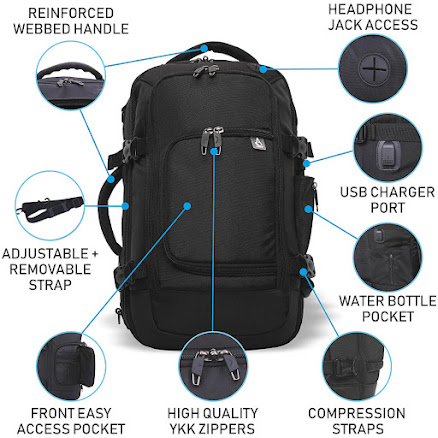
I suppose I should begin at the beginning and have a look at how backpacks have developed. Image one (above) is the type I used when I was travelling and image two (below) is one for sale in 2024.

The obvious difference is the metal frame which I seem to remember was quite a newish design at the time. It was light weight but was still an addition to what you had to carry. You could tie stuff to it to dry. The new one has some excellent features except for the two obvious ones which are baffling.
Before setting off abroad you then needed your passport. For some reason I never got round to getting a full passport for years as I could nip to the Post Office and get a one year passport on the spot. I’m not showing you the photograph.

Packing the backpack and what to put in it is an art and there are now loads of sites on line that show how to optimise the task. In fact it seems a genre in itself. The one advantage of my red backpack was that it had a separate compartment underneath for boots. When they were wet it was brilliant.
A First Aid Pack is highly recommended in those current sites and some of them would put a paramedic to shame. To my surprise they all mention packing a Swiss Army Knife, well the last time I went through Customs it was confiscated. Back in the day I think I took plasters, Anadin and Sudocrem (you can use Sudocrem for everything from putting on wounds to patching holes in shoes).
Back then the last thing you’d pack was your camera along with several rolls of film. Not a problem these days but there was a certain pleasure in putting in the rolls for development when you got home and a few weeks later trying to decipher the contents. That is also a good reason for taking a pocket notebook and pencil.
I’m fairly sure that I took Traveller’s Cheques with me but can’t remember cashing them. I only mention this now as I was surprised that they still exist and they never expire. And I’m going to use that to tell a story of when I was travelling around Finland after the person I had gone to meet there wasn’t there. I was there for two weeks and I hadn’t expected to have to spend so much money so when I got to the small town of Kuopio I had virtually run out. I still remember the surprise of the Bank Manager in Bournemouth getting a phone call from me (and that was courtesy of the Bank in Kuopio) asking if he could send me a few hundred pounds – on top of the overdraft I already had. He did it though and I was able to carry on with my trip. I still remember the superb concert hall in, I think, Lahti.

Which leads me on to another added extra I used to take on trips and that was a pocket dictionary for the country I was going to. I had got to Imatra on the Russian border and met up with some Berliners. They invited me to their cabin in the middle of nowhere and there is a lot of wonderful nowhere in Finland. All we had was a couple of bottles of whisky, a load of chocolate and a Finish/English and Finish/German dictionary. What a night that was (from what I remember).
To me that sums up the fun and adventure of backpacking. But it is also the reason I don’t go now.
I hope you don’t mind but here is a poem that I’ve used before on the Dead Good blog on Handwriting when I used it to say how much more a letter can mean rather than an email.
Touching the Past
Do not come in August
but I did
Helsinki Airport Midnight
she wasn’t there
what then
buses hostels
lakes trees
bars saunas
Berliners in a cabin
found by chance
whisky and dictionaries
I’m touching a letter from Kristina
20th September 1978
completely forgotten until now
and I’m touched by her words
and the card from Millie
do not come…
two scraps from a box
found in a cupboard
after an email from J
about rummaging her attic
I write a reply
in Times New Roman
save to her file
without creases or crossing outs
or smears of jam
down the left hand side
of the second page.
Do not come in August
but I did
Helsinki Airport Midnight
she wasn’t there
what then
buses hostels
lakes trees
bars saunas
Berliners in a cabin
found by chance
whisky and dictionaries
I’m touching a letter from Kristina
20th September 1978
completely forgotten until now
and I’m touched by her words
and the card from Millie
do not come…
two scraps from a box
found in a cupboard
after an email from J
about rummaging her attic
I write a reply
in Times New Roman
save to her file
without creases or crossing outs
or smears of jam
down the left hand side
of the second page.

Thanks for reading, Terry Q.

