written and posted by members of Lancashire Dead Good Poets' Society

Showing posts with label buttons. Show all posts

Wednesday, 10 March 2021

The Magic of Miniature

17:25:00 Posted by Jill Reidy Red Snapper Photography , , , , , , , , 3 comments

I’m not quite sure where or when my fascination with all things miniature began. 


I wonder whether it was the love of my grandma’s button tin, lining up the buttons in various combinations as pupils in a classroom, bossing the poor buttons about - a much easier job than actual teaching, as I discovered some forty years later. 


Or was it the visit to the model village, one Sunday when I was about eight? My dad worked twelve hour days, six days a week, so family trips out were a rarity, as they were for many children growing up in the fifties.  One Sunday we were all bundled into the car and driven, for what seemed like hours (I’ve just checked - it’s still there - and it was only 30 miles away), to a model village in Beaconsfield. There was great excitement as we marched around the paths like giants, gazed at the cricketers, forever destined to remain mid bowl, mid bat or halfway to a catch; and cocked our ears to listen to the church bells with a wedding in full swing, tiny bride and groom clinging to each other with fixed smiles for the photographer, bridesmaids clutching their chipped and faded bouquets. 


My brothers became bored and soon started to mess about, but I was absolutely mesmerised. Not only did I love seeing all these tiny scenes, but I actually wanted to shrink down and be in them. I wanted to tiptoe across that little bridge, pick up the miniature fishing rod and dangle it in the river to catch a tiny pot fish. I wanted to be in that school playground with the skipping rope that didn’t turn, holding hands with the children in a circle that never moved. I wanted to climb into the fire engine and switch on the flashing red light, have a nosy in the police station, run across the tiny fields and stroke the sheep.  With hindsight, I realise this was an idealised view of England and its green and pleasant land, especially when people were still living on bomb sites, rebuilding houses after the war, and residing in prefabs. Maybe this was its appeal?


I remember that day as if it were yesterday. It didn’t finish with the Model Village but continued with a visit to a silk farm in the afternoon. What a feast of a trip that was, all the more memorable for being so rare. I’m sure the last thing my dad wanted to do on his one day off was view a model village, sit in the car with a picnic and go on to a silk farm, but I did tell him, several times over the years, how much that trip had meant to me. 


I have always been an avid reader and at about this time I was reading ‘The Borrowers,’ a series of books about a family of tiny people who lived behind the skirting boards of a big house. They ‘borrowed’ things they found around the house to make clothes and furniture. Again, I was mesmerised by this magical idea and longed to find such a family in my own house. I remember dreaming that I’d shrunk and could get through the tiny door and into their miniature rooms, sit at their tables with tops fashioned out of buttons, on chairs made of matchsticks.  I don’t know what it was but I was truly hooked. 


Not long afterwards, my granddad made me a doll’s house, complete with carpets, wallpaper and even lights that switched on and off.  I spent hours redesigning the rooms, moving the furniture about and positioning the family at the piano, on an armchair or in bed. And during that time I was completely and utterly lost in that tiny world.  I kept the dolls house for years, and, when my children were old enough to appreciate it, out it came.  I had high hopes of a repeat of my fascination but it wasn’t to be. Both sons and a daughter were madly into football. Small houses were of no interest, and even I had to admit it did look rather battered and dated.  


I often took the children to the Model Village in Blackpool but I soon realised that it was more for my benefit than theirs. They were much more interested in getting an ice cream than looking at the tiny scenes, and, eventually, I had to admit defeat. 


In one final attempt to convince somebody else to appreciate the magic of miniature I bought a second-hand dolls house a few years ago for the grandchildren. At great expense I fitted it out with furniture and a little family. I intended to redecorate and lay new carpets, but like many of my projects (and even our own house) it never happened. The family could live in squalor, I hadn’t got the time nor the energy for DIY. I positioned the house in the middle of the room, everything arranged beautifully. The grandchildren came in, asked what it was, and gave the family a perfunctory shuffle around before asking if they could watch Peppa Pig on granddad's computer.


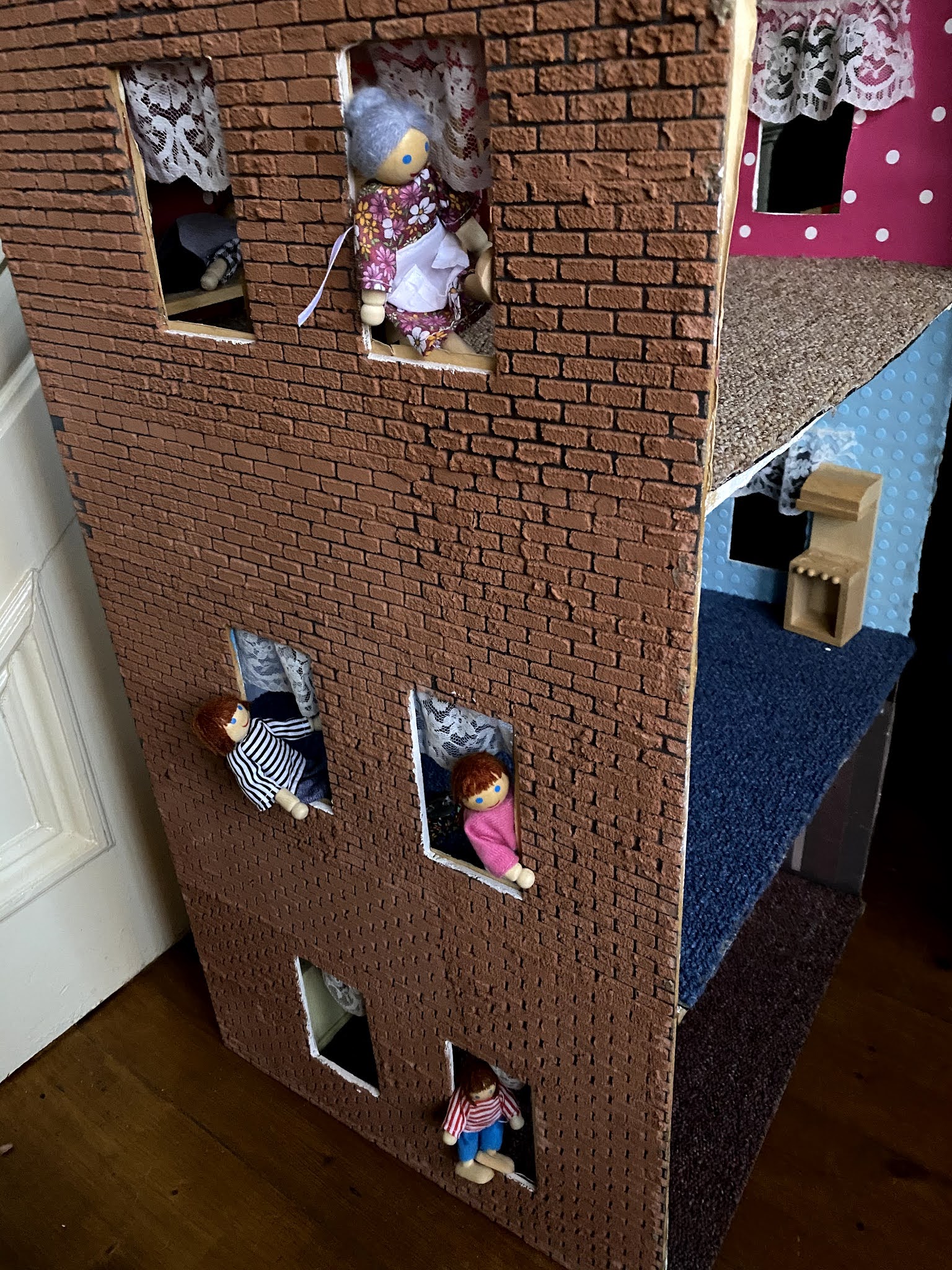


Now, I revel alone in my magical miniature world. I couldn't get rid of the dolls' house, it still sits in the corner of the room, and every so often I peer in, wondering what the little wooden family is up to.  I'm sure I heard the sound of a tiny piano the other night...


At Home with the Woods by Jill Reidy


In the middle of the night

As everybody sleeps 

Mrs Wood climbs out of bed 

And down the stairs she creeps


It’s time for more adventures 

Outside the wooden house

She pokes her head around the door 

As quiet as a mouse


Slippers on, she tiptoes out 

Her eyes and ears alert

A wrapper here, a hankie there 

Enough to make a skirt


She fills her little bag with bits 

Scattered on the floor 

Some raisins, grated cheese and crumbs 

A meal for five for sure


She hears a snore, a bed spring creaks

It’s nearly end of night

Time to take her haul back home 

Before the room gets light 


The humans rise, descend the stairs

Those mice are back, says he

I didn’t sweep the crumbs up

Now there’s nothing here to see.


Thanks for reading......Jill

Saturday, 24 October 2020

Buttons

You didn't really expect me to write about buttons did you? Good. Then this could be my shortest ever post (LOL). It's all about the poem this week, but I will just blather on a little to set the scene.

American English uses the word button to refer to a small round metal badge, usually worn on a lapel, (near the button hole, I suppose), and that's the usage I'm blogging about today. I have a treasured collection in my 'man button box' though I rarely wear them anymore. (Well, you don't, do you?)

Some of my buttons denote musical allegiances (Beatles, Jefferson Airplane Loves You, Plummet Airlines, Small Faces); others are socio-political (CND, Don't Blame Me - I Voted Labour, Rock Against Racism); one or two have an amusing shock value (Fuck Often!, Nothing Sucks Like A Vax). My favourite, from student days, is a hairy Gnasher button (as in the Beano comic). It's got moving eyes.

With less than two weeks to go to the US presidential election, metal campaign buttons proclaiming allegiance to Biden or Trump are being stamped, distributed and worn as talismans in their millions. It's a practice that goes right back to the presidential campaign of 1896 when William McKinley's team had them mass-produced to publicise his candidacy. The campaign button is the catalyst for this week's new poem...


...and here it is, bright and shiny (?) from the imaginarium:

Hej!
Your aides dished them out like glass beads to Indians.
We wore them as favours on our threadbare coats,
shiny with the promise of a better tomorrow. The price?
Our votes. The cost to you, negligible groats. It's funny
that years down the line we still seem to be paying.
Same coats, vanished hopes, more burden on our backs
because Hej! you had the chance to do good for man,
you know what I'm saying? We gave you our trust
and you plain ripped us off. I keep that rusty tin button
to remind me of the lesson. Your electoral process, well
it's a huge confidence trick and by wearing your colours
we helped delude others. I'll never be that complicit again.
And may you rot in hell, for all your misbegotten wealth.

That's all folks. Thanks for reading, S ;-)

Friday, 23 October 2020

Button Box Envy

There is something fascinating about collections of buttons...a bit like looking at precious stones. You want to rummage through them, admire them, covet them!

I used to turn out my mother's button box (actually a metal biscuit caddy) . Not only did it have buttons in it but there was always a tangle of thread, a few collar studs, some ribbon, the slide pulls from zips and sundry other items!

I buy mixed packets of buttons in one colour, for craft use, but inevitably they are seldom used as few match each other. I try to have some semblance of order in my two plastic tubs, but it doesn't always work out that way. I start with good intentions and have one box for matched buttons, either strung together or still attached to cardboard. The other box is meant for odd buttons and those that come as spare buttons when you purchase a garment. I say "meant for", as they always get muddled up!

Imagine my utter joy when, during lockdown and no sewing shops open, I found a set of eight matching buttons suitable to attach to a cardigan I'd just knitted! These buttons did not 'match' the colour, but were made from antler so co-ordinated with the Aran design. Such a relief that was, as I didn't like the idea of an unfinished project.

My piece today is about looking through button collections....


Button Box Envy

Open up your button box and let me look within
Oh ! I see lots of colours, lots of shapes - thick and thin
Ones that match tied together with coloured thread,
Or still attached in rows on labelled cardboard.
I run my fingers through the box, to see the colours bright.
Stopping to admire a glass one that twinkles in the light.
Mother -of-pearl, wood, plastic, even reindeer antler.
Two -holed, four-holed --shanked and fabric covered.
My mother's button box, I played with as a child,
To match them altogether , like in a system filed -
Also there were collar studs, press studs and zip pulls,
Jumbled altogether with bobbins, lace and ribbon.
If you come to visit, you'll love to look at my collection.
Gaze with wonder at the history - held in recollection.
Four buttons from a jacket I wore in '72.
A blazer button, much older, never to be used...
I'll never use most buttons within that box of fun,
But often find an odd one to replace a missing one.
I envy other button boxes and like to explore their depths.
So look out your own collections and find memories there.

Thanks for reading, Kath

Tuesday, 25 September 2018

Hexagons - The Patchwork Quilt


I loved needlework lessons at school. It was something I excelled in and the highlight of my week. All through secondary school I was joint top of the class with another girl who, like me, had a mother and two grandmothers, all knitters and stitchers, teaching their skills to our generation.  My Nanna Hetty used to give me a scrap of fabric and a handful of buttons to sew on. I would set them out in a pattern. It kept me busy for hours and I was very accomplished by the age of seven or eight. I also learnt to respect the sharpness of a sewing needle. No harm done.

At school, besides the curriculum stuff of making a cookery apron, a netball skirt and a pin cushion, our teacher introduced us to smocking and classic patchwork. The smocking was part of the baby dresses we made from calico and gingham. The patchwork was a bit more involved.  First we had to make hexagon shaped templates from squared paper. The six sides had to be exactly the same, so lots of careful measuring. Next, pieces of fabric were neatly folded over the hexagon side, taking care to keep the correct shape before pinning or tacking.  Each piece had to fit perfectly with another. I was very proud of mine, which became a beautiful patchwork cushion cover, later included in my exam collection.  I was equally proud of a patchwork gypsy skirt that I made for myself in the mid-seventies.

When I was told the gender of our first grandchild, I set about making a patchwork cot quilt. These days, plastic and metal templates are readily available to buy in all shapes and sizes, much easier to draw round and cut out. I chose the classic hexagon set and an assortment of suitable fabrics. Preparing the pieces was easy but hand stitching them together was more challenging for my poor eyesight. My first grandson is now three. He has a two year old cousin, a one year old brother and a sister on the way. My patchwork quilt remains unfinished, (my photo), but I will manage it, eventually, with the help of a hands-free magnifying glass.

I can relate so much to my chosen poem. It’s given me an idea for another needlework project.
 
Repairing the Heirloom
By Deborah Browning

The pattern was "spider web" -
Scraps of fabric forming hexagons,
Their paisleys, dots and plaids
Repeated until the shapes stopped,
Some incomplete, at the edge,
And over the whole a web, quilted,
Seven stitches to the inch drawing each corner
To the center.

In the patchwork I recognized pieces
Of my grandmother's gingham apron,
The apron itself cut from the skirt
Of a faded dress. Her family's clothes,
The work of her hands, for years
Were conserved. Winters passed to the scrape
Of scissors trimming those rectangles.

I trimmed a scrap of fabric from my old sundress,
Appliqued it over the threadbare original,
Bright red against worn calico.
I laid on the design by drawing needle
Across fabric, quilting the impression
That would disappear like the needle's imprints
In my fingers. My stitches met hers
And I knotted the thread of this net
That would catch another generation of small hands,
Clenching in sleep and letting go.


Thanks for reading, Pam x