written and posted by members of Lancashire Dead Good Poets' Society

Saturday, 30 July 2022

Cliffhangers

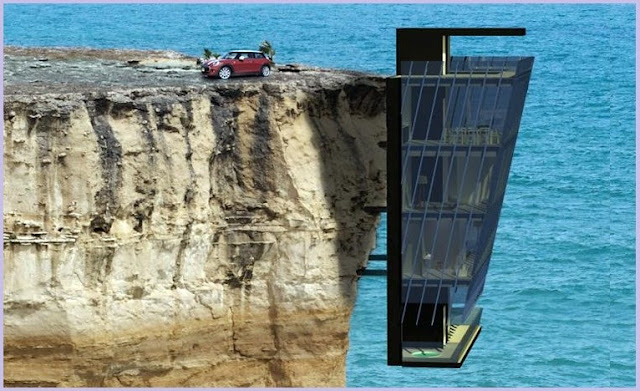
Architects must be some of the maddest people on the planet, second only to their clients probably. For what could be more 'out there'  and living on the edge in a literal sense, than a cliffhanger of a house? Two of the examples I've picked to accompany today's blog can be found in Australia and are not for the faint-hearted. They are sited in spectacular cliff-top locations (naturally) and have been designed and built, at enormous cost one supposes and with all due regard to considerations of safety and permanence, so that their owners can thrill to exclusive and stunning sea views.


They are bold statements of man's prowess, constructs that are more suggestive of a James Bond film set than cosy nests for your average 21st century nuclear family. And presumably that is the point. A cliffhanging life is its own adrenaline charge. Even cleaning the windows requires a certain abseiling facility, the ability to dangle with a mop and bucket. I hope the seabirds are friendly. And is that a diving-board on top of the 'house' below?


I'm presuming that earthquakes are not a feature of Australia's coastline, unlike in California, which was my first introduction to cliffhanging houses. If you've seen the Clint Eastwood thriller 'Play Misty For Me ' you'll know exactly what I'm talking about (and if you haven't, rectify asap). At intervals just a short turn off the Pacific Coast Highway can be found some of America's most breath-taking real estate, with views to match. Those stunning luxury clifftop houses hang like eyries above the shoreline from Monterey via Carmel to Big Sur, and one day when the San Andreas fault finally cracks (the 'big one' is overdue by half a century) they will all plummet into the sea.

British cliffhanging, typically, is much less spectacular, pretty low-key by comparison. And yet the coastal erosion of our relatively soft sandstone headlands has already caused many a cliffhanging home owner on Devon's 'rivièra ' to bemoan the cost of living on the edge. There's a parable for that, not to mention insurance premiums.


Climate change and the associated global rise in sea-levels is only going to exacerbate the problem and many more clifftop houses that have stood proud for generations around Britain's coastline are likely to go tumbling down to the shore in the next few decades. 

But enough of arrogance and gloom. Let me leave you with a new little poem that focuses on the positives:

Theia
divine madness in the moment
it's all about the letting go
as you fall so you rise
the sound of one cliff hanging


Thanks for reading, S ;-)

Wednesday, 27 July 2022

Cliffhanger

I write as someone who knows about the effects of cliffhangers on a person’s life. I was an Archer’s addict. How many Sunday mornings were ruined by the need to listen to the omnibus edition to find out what was happening in Ambridge. I thought of this immediately when I came to start writing this article. Then I wondered why I would think of the term cliffhanger. Where did the word come from? I think I’ve found out where the term first appeared in print but I’ll leave it until the end of the piece....

Surprisingly, the use of the technique has been around for many years. They were used as literary devices in several works of the Middle Ages. The Arabic literary work One Thousand and One Nights involves Scheherazade narrating a series of stories to King Shahryār for 1,001 nights, with each night ending on a cliffhanger in order to save herself from execution. Some medieval Chinese ballads like the Liu chih-yuan chu-kung-tiao ended each chapter on a cliffhanger to keep the audience in suspense.

Cliffhangers became prominent with the serial publication of narrative fiction, pioneered by Charles Dickens. Printed episodically in magazines, Dickens's cliffhangers triggered desperation in his readers. Writing in the New Yorker, Emily Nussbaum captured the anticipation of those waiting for the next instalment of Dickens' The Old Curiosity Shop; in 1841, Dickens fans rioted on the dock of New York Harbour, as they waited for a British ship carrying the next instalment, screaming, "Is little Nell dead?"


On Dickens’ cliffhangers - first seen with The Pickwick Papers in 1836—Leslie Howsam in The Cambridge Companion to the History of the Book (2015) writes, "It inspired a narrative that Dickens would explore and develop throughout his career. The instalments would typically culminate at a point in the plot that created reader anticipation and thus reader demand, generating a plot and sub-plot motif that would come to typify the novel structure."

With each new instalment widely anticipated with its cliffhanger ending, Dickens’ audience was enormous (his instalment format was also much more affordable and accessible to the masses, with the audience more evenly distributed across income levels than previous). The popularity of Dickens's serial publications saw the cliffhanger become a staple part of the sensation serials by the 1860s.

Thomas Hardy's A Pair of Blue Eyes (which was published in Tinsley's Magazine between September 1872 and July 1873) used the term when Henry Knight, one of the protagonists, is left hanging off a cliff.

Moving forward to the start of the film industry during the 1910s, Fort Lee, New Jersey was a centre of production, the cliffs facing New York and the Hudson River were frequently used as locations. For instance films such as The Perils of Pauline were made which would often end suddenly leaving actress Pearl White's Pauline character literally hanging from a cliff. But The Perils of Pauline would have been called a “serial” or “chapter play,” not a cliffhanger.


And here is the big reveal:
The word seems to have been first printed in the January 1931 edition of Variety according to the Oxford English Dictionary. But the Variety article certainly implies that the term cliffhanger was well known at the time. So, I suppose the question is at what point does a word become, well, a word?  I’ll have another look and if you read again next month who knows...

Another attempt at a haiku:

cliff walk past
fields of autumn gold
a gun fires

Thanks for reading, Terry Q.

Monday, 25 July 2022

Cliff Hanger, Puffins & More

When I do laundry, I am first a washer, then a hanger of clothes. If I was named Cliff, then I could be called Cliff Hanger or Cliff the Hanger, which sounds like an everyday object in one’s wardrobe or some medieval public executioner. I discovered that interestingly, as executions didn’t happen that often in medieval times (5th – late 15th centuries), a hangman such as our imaginary Cliff made his wage doing additional dirty jobs such as a knacker who removed dead animals from public roads and farms, a tax collector particularly of lepers and prostitutes and the beloved latrine cleaner which definitely was sloppy business in those days! Our Cliff would have most likely lived on the outskirts of town, on the fringe of society, providing services that were deemed undesirable. He would have been living on the edge.

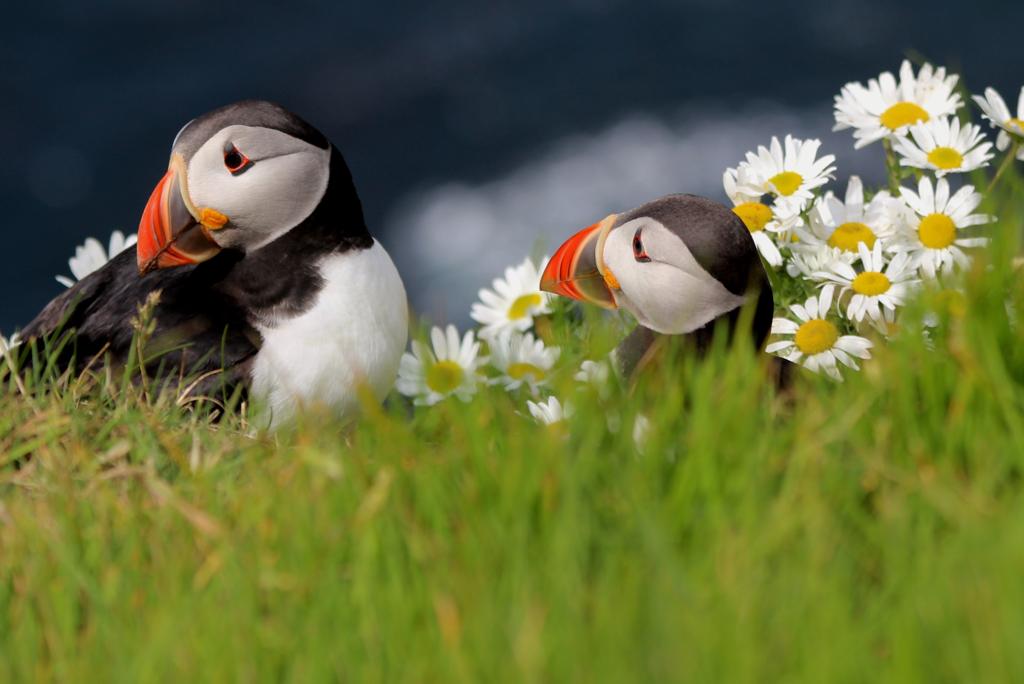
Many of our feathered friends also live on the edge, hanging about on cliffs. The puffin is one such bird, strikingly handsome. There are four different types; the Rhinoceros Auklet, the Tufted Puffin, the Horned Puffin and the Atlantic Puffin, with approximately 580,000 pairs of Atlantic Puffins residing in colonies around the UK.

Atlantic Puffins
(Image credit: Christine Cassanell)
For safety, particularly on the mainland, puffins make burrows into cliffs where they can be protected and raise their young, one puffling/chick per pair. The cliffs with their sheer jagged faces make a perfect launching pad for seabirds such as the puffins to take off, soar - then dive into the ocean below to catch their next meal; sand eels being one of the puffins’ favourite morsels on the menu.

Atlantic Puffin and Sand Eels
(Image credit: Christine Cassanell)
And what exactly are Sand Eels? They are slender, long, and eel-like but are actually a number of species of fish. According to Teaching Through Nature, adult puffins that have a puffling to feed need to catch 400 sand eels a day! Puffins depend on these fish to survive and are being put into a vulnerable position as sand eels numbers have dwindled due to human fishing activity and climate change.

To raise awareness about puffins, climate change, and environmental issues along the East Riding of Yorkshire coast, the Puffins Galore! Art Trail was hatched. This project came to fruition earlier this year when there was a national callout for artists to submit designs to decorate a 1.5 metre puffin sculpture, which if selected would be installed somewhere along the East Riding Coast from July – October 2022.

I was one of 70 artists that had their designs shortlisted with 42 of these sponsored. Nest Builders Well Spotted was kindly taken under its wing by Active Withernsea and this puffin is now located near the RNLI Lifeboat Station in Withernsea. The artworks will eventually be sold to their sponsors or auctioned off with all monies going to four different charities.

Nest Builders Well Spotted
(Image credit: Kate Eggleston-Wirtz)
This artwork explores nature (symbolised by the puffin) and humans sharing one collective nest, one home, our planet Earth which the giant bird is keeping a close eye on. The puffin is well spotted to symbolise bird watching/spotting, spots from disease and or spots/locations where one might build smaller individual homes. This bird hopes for a healthy future represented by the newly hatched puffling safe in its burrow, where humans take to heart the impact of their own nest building, represented by the houses on the puffin’s back. All species have a right to nest safely, to thrive and fly.

Here’s a poem in response to Nest Builders Well Spotted, affectionately named Spot.

Spot the Puffin
A perfect spot, Spot stands by sea
keeping watch on you and me
building our nests side by side,
some on cliffs above the tide,
some with windows, made of stone
or brick or wood, these are our homes
for big, for little, no matter how small,
one planet Earth - one house for all.

And an additional fun little ditty in response to the Cliffhanger theme.

Cliffhanger
Hang up your clothes, get ‘em off the floor
use Cliff the Hanger that’s what he’s for.
A hanger named Cliff, a wiry fella
twisted with a hook and painted bright yella.

Hang up your clothes, get ‘em off the floor.
Open your wardrobe, open its door.
Cliff is calling, a Narnian shout,
Pick up those clothes, hang ‘em right side out!

I looked at the floor at the pile of clothes.
I opened the wardrobe, stuck in my nose.
It was dark, it was dank, it smelled funny and then…

Thank you for reading. 
KEW 😃

For further information about real live puffins:
http://www.teachingthroughnature.co.uk/puffin-season-2020/puffins-bring-back-fish/
https://www.rspb.org.uk/birds-and-wildlife/wildlife-guides/bird-a-z/puffin/

For further information about the Puffins Galore! Art Trail: http://puffinsgalore.co.uk

Saturday, 23 July 2022

Summer

After eight years as a regular Saturday blogger, I'm searching for a seasonal summer slant that's not been used before. This week's record temperatures - Tropic of Bowland anyone? - might have proved newsworthy for a couple of days but are soon to be a commonplace feature of British summertime, it would seem. More concerning is that "beating Keir Starmer" and "getting Brexit re-done" (whatever the hell that means) look to be more important to the Tories than ensuring we are meeting the challenges of global warming and our legally-binding Net Zero undertaking. Let's face it, it's not been a priority of this administration, despite the UK hosting COP26; in fact we're going backwards - less on track than we were five years ago apparently - and Alok Sharma, the government's climate minister, has threatened to resign if the new PM fails to commit to a strong green agenda.

Anyway, here's my slant: Summerland. I don't know if you've seen the movie of the same name? It was released in 2020 (first year of Covid) and probably didn't get much exposure as a result, which is a shame because it's a first-rate film, an instant 'lost classic' as it were, with a great story line, terrific acting (Gemma Arterton and Lucas Bond in particular are excellent) and the cinematography is stunning. I won't spoil the plot, for do try and catch it if you can, streamed, on DVD, or whenever it crops up on your TV.

Summerland
Suffice to say the movie introduced me to the idea of the Summerland, essentially a pagan concept of an afterlife. Formalised to an extent in theosophical belief and writings (thanks to Swedenborg, Davis and Leadbeater inter alia ), Summerland would seem to represent the highest level or sphere that souls can aspire to between incarnations, before Nirvana is attained (for theosophists believe we are all on a cyclical mission to reach perfection). It is also sometimes referred to as the astral plane, a sort of sunlit upland for those who managed to live good lives before shucking off their mortal host. There is a lot more weird stuff associated with theosophy - like Sanat Kumara who is believed to be the spiritual deity governing Earth from the floating city of Shamballa, somewhere above the Gobi desert - but the movie doesn't get into that level of complexity. For researcher Alice in her cliff-top house and for blitz evacuee Frank, it simply posits the existence of Summerland, and the ability of those with sufficiently open minds to actually glimpse it in the ether as some reassurance in war-torn 1940 that existence goes on after death. Unlikely, of course, but charming nonetheless. 

Moving on back down to earth in 2022, my own 'house on the strand' (it's not actually on the sea-front but a short walk inland, as anyone who has visited will tell you), is oriented almost precisely east-west. The front faces the rising sun, which filters through the bedroom blinds on a summer morning. It's a splendid thing to wake up to, blue sky, gently warming bright air, the promise of a glorious day to come. By mid-day (give or take a seasonally-adjusted hour) the sun is right above, heading west, flooding the back garden while the front gradually becomes shadowy. It's a house of two halves. The front rooms are warm in the morning but cool in the afternoon and evening as the heat of the day intensifies; the back rooms and back garden are refreshingly cool in the morning but suffused with light and heat right through to sunset. I migrate between front and back as the mood or the need dictates. It works perfectly. Then there are the wrens.

Wrens are beautiful little birds, more often heard than seen because they are small and shy, but they have a distinctive sound and are far more populous than people think (estimated 11,000,000 in the UK). They are also territorial. I have two distinct families of them, one in the front garden and one in the back, with the house acting as a sort of buffer. Occasionally I hear the males singing at the same time, usually but not exclusively at the start of the day. It's a thrill and a highlight of summer mornings, and although I've written a whole blog and poem about this charming bird before (linked here, click on the title:  Tails Up), I thought why not do so again from a slightly different, somewhat humorous perspective?

Wren Singing
This then, in first draft, is for wrens everywhere, even though they can't read...

Wrens In Stereo
If I awake at dawn, the norm for a summer morning,
I can lie drowsy listening to the front-of-house wren
belting forth his silvery song from the magnolia tree
beneath my bedroom window, rallying all to the day.

Less distinct, being further away, the backstage wren
will join the chorus, rehearsing some mercurial lines
until he's note perfect in the shrubbery. If sometimes,
I suppose it's just by chance, their modulations chime

to great effect, I can feel uplifted by the sound, rouse
myself  to stand equidistant  along the gallery, better 
to balance both outpourings.  They're not performing 
so for me, more likely to secure their territories anew,

but what a rare delight to be showered at start of play
by wrens in stereo for ten or fifteen minutes, overture
to the quiet daily drama unfolding in a writer's house,
better by far than an intrusion of radio or breakfast tv.

Thanks for reading, S;-)

Tuesday, 19 July 2022

Summer - Making Memories


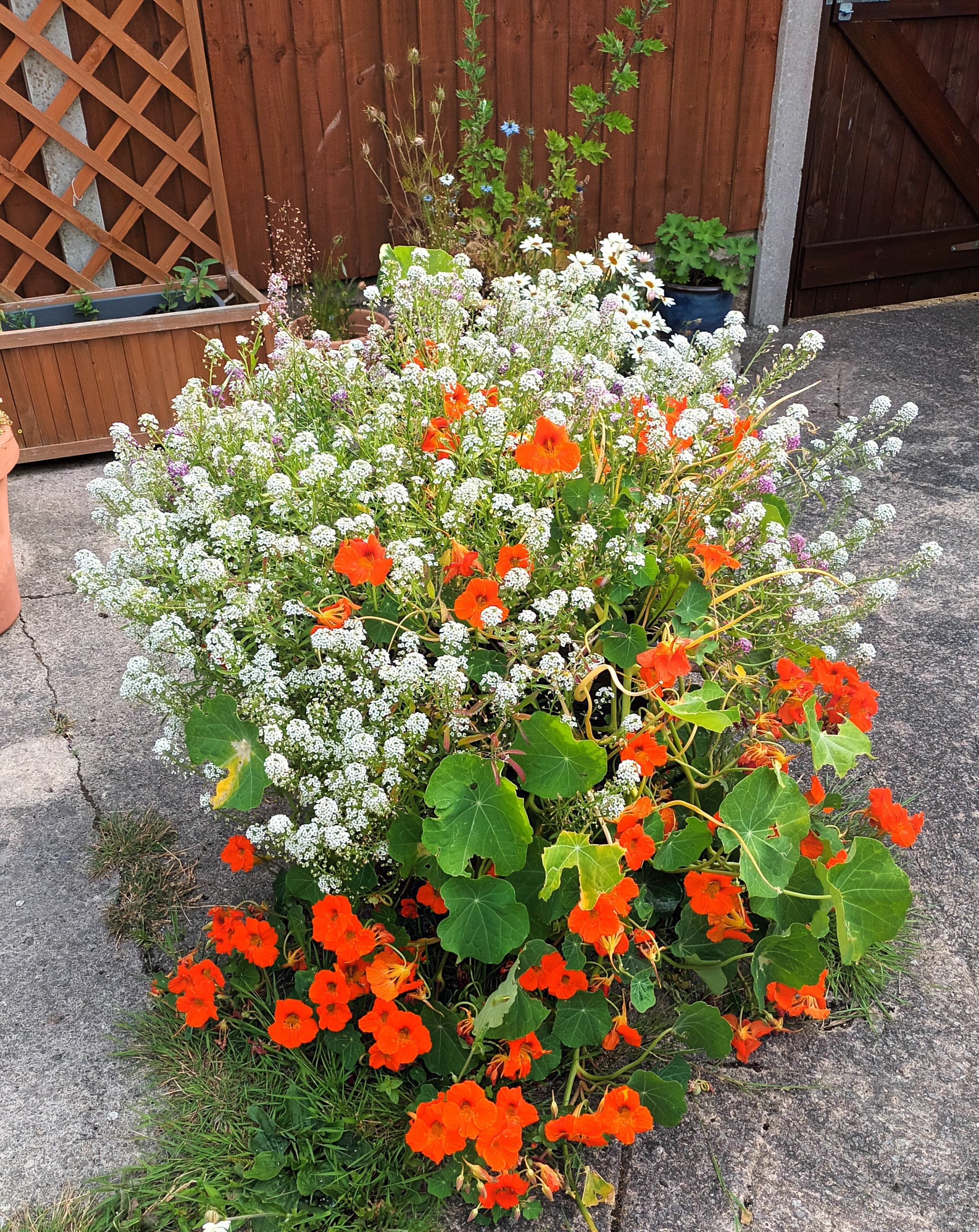
It is here, at last, the moment we’ve been waiting for. Proper sultry, summer weather of hot sun and blue skies from dawn until dusk, which is around nine-thirty, and I would like to say it goes on day after day. It won’t. I think this is two days of heatwave, then rain, possibly storm, and cooler temperatures. My house is currently thirty-four degrees and I feel sticky and uncomfortable.  The heatwave may not be completely responsible.  After two and a half years of sticking to guidelines and looking out for myself and family, Covid has got me. I tested positive at the weekend after feeling unwell for a couple of days. There are no signs of recovery yet. When it cools down, I’ll rest in the garden, admiring the fruits of my labours, especially the planter I’ve called Tangerine and White.

The summers of our youth were everlasting and full of ice cream, the park, the beach and sometimes a holiday. Our holidays tended to be spent with family, when my dad could escape from running the pub for more than two days together. It was always good to spent time with our cousins. They are in the USA now, but they lived in London and the south of England when we were all children. My sister and I loved their big garden offering lots of room to play, even space for badminton.

For years home was a pub on South Promenade. We had the beach on our doorstep. Day after day we were there, not a care in the world and not a thought for how lucky we were. Someone would be with us until I, being the eldest, was considered old enough to take us across four lanes of traffic and the tramlines. My sister would choose an ice lolly or ice cream. I loved a portion of shrimps in a tiny paper bag. I can still taste how delicious they were. Better than anything sweet.

When our children were young, summer holidays meant the long road trip to Pembrokeshire and a couple of weeks staying in a static caravan. It was owned by family members who didn’t use it during the busy months of July and August, but were very happy for us and others to enjoy it. We were so privileged. We had holidays that wouldn’t have happened if not for the generosity of our extended family. Our children, and us have great memories of those wonderful times.

Making memories is what we’ll be doing in a few weeks when we take our grown up children and all our grandchildren to have a blast at Butlin’s. It’s our treat as grandparents and a one-off. It will be fun for all of us, of course, but it is centred on giving the grandchildren a fabulous time. My grandparents used to take me to Butlin’s when I was small, before I had a sister. Now I’m the nanna. It’s my turn.

Allow me the indulgence of my favourite of Shakespeare’s sonnets,

Sonnet 18

Shall I compare thee to a summer’s day?
Thou art more lovely and more temperate:
Rough winds do shake the darling buds of May,
And summer’s lease hath all too short a date;
Sometime too hot the eye of heaven shines,
And often is his gold complexion dimm’d;
And every fair from fair sometime declines,
By chance or nature’s changing course untrimm’d;
But thy eternal summer shall not fade,
Nor lose possession of that fair thou ow’st;
Nor shall death brag thou wander’st in his shade,
When in eternal lines to time thou grow’st:
So long as men can breathe or eyes can see,
So long lives this, and this gives life to thee.

William Shakespeare 1564-1616

Thanks for reading, Pam x

Saturday, 16 July 2022

Cancel Culture

Cancel culture. What is it? Where did it come from? Should we care? I'll keep this as brief as possible.

It has become a 21st century social phenomenon, whereby a conscious 'collective' decision is made to call out and/or censor (i.e. block or remove) an individual or group or their cultural legacy (books, records, paintings, plays etc), even historical associations (place names, commemorative artefacts) from the public domain on account of association, attitude or content that the 'collective' finds unacceptable. 

As a term it appears to have gained popularity with the rise to ubiquity of social media platforms like Facebook, Tumblr and Twitter. Billions of people now have the opportunity to express and share their opinions online, to be influenced by what they read on these platforms and to gang up.

In one sense it is nothing new. Social pressure (as opposed to state diktat) has 'cancelled' artists and their works in the past - for instance the mass burning of Beatles records in America's bible belt in 1966 following the mis-reported comments by Lennon about the popularity of The Beatles compared to Jesus, or the backlash against Cat Stevens (a Muslim convert) when it was reported in 1989 that he supported the death fatwa against Salman Rushdie, after which fellow musicians stopped covering his songs, radio stations removed him from playlists, stores stopped selling his records. What is new is the scale, scope and speed of 'cancellations' in recent years, which  has been remarkable. Here's a short list of examples:

Musicians The Dixie Chicks had their career 'cancelled' after one of their number publicly criticised the President. Stores pulled their records, promoters boycotted them and fans deserted them, leaving the group out in the cold.

Film producer Harvey Weinstein had his career 'cancelled' by the MeToo movement that called him out for historical sexual impropriety. He was jailed for 23 years and has had his honorary CBE rescinded.

Author J.K.Rowling caused a bit of a stir with comments about transgender rights and gender identity. Some have accused her of transphobia. Many wanted her 'cancelled', have said they will never read a Harry Potter book again and some would even "unread the ones I've read if I could."

NFL quarterback Colin Kaepernick chose to kneel during the American national anthem as a protest against racial injustice (the start of the recent 'take the knee' movement). He was effectively 'cancelled' by the NFL for his stance and hasn't played since.

Broadcaster Joe Rogan was perceived to be putting out anti-vax propaganda on his Spotify podcasts. Various artists (including Neil Young and Joni Mitchell) withdrew their music from Spotify in an effort to get Rogan 'cancelled'. Spotify didn't ban him but they did remove a couple of episodes and fronted the rest with disclaimers.

Imperialist Cecil Rhodes had statues of himself 'cancelled' when students in Cape Town and Oxford voted to have the memorials removed on account of his historical exploitation of native South Africans.

So-called politician Donald Trump found himself 'cancelled' by both Facebook and Twitter who blocked him after he used his social media platforms to incite insurrection on 6th January 2020.

Actress Jodie Comer found there was a clamour for her to be 'cancelled' (no more 'Villanelle ') because by coincidence her boyfriend had the same name as an outspoken Trump supporter. That's as tenuous and as silly as it gets in an age of disinformation and lack of accountability.

Cancel culture is just part of the new social media maelstrom feeding frenzy that includes terms like 'snowflake', 'virtue signalling' and 'woke', all of which have gained currency in the last five years and are used pejoratively by those on the right against those on the left of the socio-political spectrum who are perceived to be the ones doing much - but by no means all - of the 'cancelling'. And while some of what goes on is little more than the equivalent of toddler temper tantrums by people who won't take the time or don't have the inclination to establish the facts and reach an informed opinion, some of it is a legitimate reassessment of the past in terms of the changing social values of the present; history up for reappraisal. However, we should be worried by some of the implications.


Of course the exponential reach of social media via mobile internet devices has widened out a complex debate around free speech, the ownership, control and manipulation of modes of communication, the accountability and responsibility of platforms for monitoring content that is posted online, as well as issues of how to spot and take down content that breaks the law (from hate speech to pornography), and to what extent it is acceptable to rewrite the past.

Someone once described television (in somewhat extreme terms) as "an open sewer running through the living room". At least it is channelled and regulated. Compared to TV, social media is more like shit being thrown at a fan! I'm not opposed to the technology. Its accessibility and universality make it a great facility if used sensibly. It's a dynamic situation that needs maturity and a degree of shaping. The fact that social media is full of fake accounts and fake news is a serious issue for our fragile democracy and the new media barons are no more to be trusted unequivocally than the old ones. Witch trials and the engendering of a lynch mentality appear to have moved online in recent years and are factors in the growth of cancel culture at both ends of the spectrum. The feverish clamour to denounce great works of art or culture just because it appears their creators had something "unacceptable" in their make-up (Beethoven was a revolutionary, Lewis Carroll and JD Salinger liked young girls, Eric Clapton supported Enoch Powell's 'Keep Britain White' stance) should be viewed with a degree of scepticism.

I would suggest the response required from platform providers and governments is open and democratic moderation, with accredited and verified users and enforceable accountability for what is posted. And when it comes to us, the masses, it would be nice to think that such a facility might in time lead to a more nuanced and intelligent debate, might broaden minds rather than narrow them, might create a more generous general public.

Talking of  'cancellations', finally that bullying, mendacious, misogynistic narcissist has been forced to resign as PM - the worst in living memory - though for a while it looked like he might be summoning "the fourteen million who voted for me" Trump-style to metaphorically storm the capital and demand he stays, except that opinion polls suggest at least half of those fourteen million have come to their senses and now realise what a total liability Johnson is. A shame it took so long.

Goodbye Boris Johnson*
Your Oxfordshire bedroom was red white and blue
You were never short of a golden guinea or two
Your school rugby team was called The Collegers
You changed mistresses when it suited you
   Gave you a smug, thuggish sort of feeling
   The joke was always on us

You had a music box played I'm The Main Man
Your favourite building was Chequers
Your favourite food was cake with champagne
Your favourite Christmas song was Little Donkeys
   Gave you a smug, thuggish sort of feeling
   The joke was always on us

Your favourite person was Alexander Boris de Pfeffel
You won Number Ten playing poker with the voters
Your favourite lie was 'I never knowingly lie'
You didn't give a shit and you never wiped your arse
   Gave you a smug, thuggish sort of feeling
   The joke was always on us

* after Adrian Mitchell's 'Goodbye Richard Nixon '. I was seriously tempted to title the poem Fuck Off Boris Johnson, but that would have strayed too far from pure pastiche. 

Thanks for reading, S ;-)

Saturday, 9 July 2022

Harlequin

My diligent research into Harlequin for this week's blog led me to conclude that at his inception he was literally 'hell king' i.e. the devil in human form, at large on earth. In that guise he populated many a medieval French and German morality play as far back as the 11th century, pranking mortals, tempting them into bad ways, and sometimes dragging their souls off to eternal damnation for their follies, a lesson to us all.

When the Italians took him up as the zany Arlecchino in the commedia dell'arte a couple of hundred years later, they emphasised the trickster part of his nature and played down the darker devilish connotations, though he does feature as a demonic presence in Dante's 'Inferno '. By the 16th century he had become a carnival joker and also acquired his distinctive mottled costume of colourful diamonds.

Harlequin with Columbine and Pierrot
Combining variously great physical agility (to tumble, cartwheel, dance) with an ability to mimic, make jokes and even perform sleights of hand, Harlequin in the theatrical entertainments developing in Italy, France and England was an increasingly comical figure, witty and mischievous, part court jester/fool, part magician and part servant and stooge. And it is no accident that he became the joker (in his lozenged apparel) in early packs of playing cards. Hell king to clowning servant: quite a transformation over seven centuries.

The most powerful and lasting legacy of the Harlequin appears to be that trademark geometric diamond pattern, derived from the traditional costume, which was originally a patchwork created out of spare scraps of cloth. It is a striking rhombus design repeating itself in a variety of bold colours (red, black, purple, green, blue, pink, yellow), sometimes in a formal sequence, sometimes more randomised. It has featured on the backs of playing cards and in the leaded lights of stained-glass windows (see below) for centuries, more recently in the 18th and 19th centuries as a graphic on the endpapers of hardback books and as gift-wrap. In the mid-20th century it finally entered mainstream fashion. Adele Simpson first popularised a harlequin print on women's clothes in 1940s America and by the 1960s it was everywhere from underwear to skirts and blouses, knitwear, ski-suits, ties, tights, trousers (Freddie Mercury sported a pair), even umbrellas and upholstery - ubiquitous harlequin.

through harlequin glass
I must concede that if ever I had the money and a Tudor (or even mock-Tudor) home, I'd have leaded lights and harlequin glass in at least some of the windows, for the wonderful effect of sunlight through those coloured lozenges. In conclusion, here's how it went down...

Harlequinade
Hell king, black masqued and sulfurous
Adulterer of wives weak in wedlock.
Rubicund player on passion's stage,
Licentious behind diamond panes.

Evolving corps of comedic culture with
Quadrilles and quick quips to shock.
Upstart with agile sleight of hand,
Immodest knave, delightful zane. 

Natty dandy, flamboyant, carnivalesque
Animus of fancy's fashionable flock.
Dissipating through ten centuries, 
Eventually just a pattern remains.

Thanks for reading, S ;-)

Thursday, 7 July 2022

Tuesday, 5 July 2022

Harlequin - A Knitted Memory


From Wikipedia – ‘The oldest versions of the word harlequin – the Middle Dutch hellekijn and the Old French hellequin, reference hell and a mean kind of demon. In the translation from French to English, the harlequin lost his demonic quality and became a clown.’

My maternal grandmother was college educated, bright and well-informed. I would doubt that she was aware of the above, but I would love it if she had been when she knitted my grandfather a slip-over in the harlequin pattern. The subtle sentiment would have suited her. She was an exemplary knitter. The colour changes of grey, bottle green, navy and maroon were perfectly matched and blended, the end result better than any shop-bought machine-made knitwear. My grandfather wore it nearly every day.

By the time I was on the scene and taking notice, Nanna had worked as a secretary, left to marry Grandad and raised a family. By now they were running a pub and later helping my aunt to run hers. They bickered constantly, only being polite to each other when they were downstairs in the bar. There was never an obvious cause for a fall-out, not to me anyway. They had an active social life as a couple, they went away on holiday or on trips and the usual things that people do. They took me to Butlin’s a few times when I was a child, often with my aunt’s extended family from Ireland. We were a close family. I remember Nanna having the upper hand and Grandad conceding in their everyday spats.

When I was older, I learnt from my aunt that Grandad had given Nanna the run around on more than one occasion during their marriage and she held him on all sorts of ultimatums. They were married for fifty-three years. Up to now, I have been unable to prove any of the misdemeanours. Everyone has passed away, so no one to ask and only me who is interested enough to have another search occasionally. Truth or fiction, it hardly matters really.

What does matter is that I adored them and I knew they loved me, and of course, my sister, too. Nanna taught me to knit, something I do all the time. I mastered crochet after she’d died, though could never do it when she tried to teach me, with more patience than she ever had for anyone else. I’ve tried harlequin pattern and I can do it, but it’s fiddly, time consuming and better off left with the lady who turned it into a work of art.

Nanna was a strong minded woman, northern grit.  She’d survived two world wars, an errant husband, the death of a three year old daughter and the death of a thirty-five year old daughter (my mum) and somehow kept going. I’ve said many times that I wish I had a fraction of her strength, and that of my great grandmother.

I have my grandfather’s rocking chair. It’s a shame that I don’t have his slip-over.

My Haiku poem,

Grandad’s rocking chair
Now lives upstairs in our house
Recovered to match,

But not re-varnished,
So my hands rest on the arms
Same as his once did,

While he read his book
Or scanned the morning paper,
Keeping to himself.

My nanna was cross,
I’d heard her berating him.
It was just their way.

I’m sure she still cared.
She knitted his slip-over
And kept tabs on him.

She kept her tongue sharp
Behind Golden Wedding smiles.
Hiding the heartbreak.

PMW 2022

(As I typed the year, I realised it is 100 years since they got married, bless them.)

Thanks for reading, Pam x

Saturday, 2 July 2022

Journey

It's been an interesting cultural and literary experience, reading Henry Miller's 'Tropic of Cancer ' and David Lodge's 'Thinks... ' side by side this last week, both so-called 'sexy' books (which really does them an injustice); the former written near the beginning of the 20th century and the latter right at its end. And I wondered if I could turn my reflections thereon into a blog that fits the given theme of  Journey . Let's give it a go - not literary criticism per se , more an assessment of how social mores changed during the course of the last hundred years.

Other start and end points might have served equally well to illustrate the journey ( 'Ulysses ' to 'Platform ' or 'Lady Chatterley's Lover ' to 'The Lemon Grove ' for instance), but I've not read any of them recently. I hope it all doesn't sound too academic or dry. I think it's fascinating, but if it's not your thing, you can always fast-forward to the poem 'From Cockermouth To Fannyfield', which is anything but.

Novels have always been indicators of what manners, morals, principles and standards pertain in a community in the age in which they are written, of what it is acceptable to relate in print...as does the way in which they get regarded by society. Spoiler alert: Henry Miller's was banned in the USA and Britain until the 1960s. 

'Tropic of Cancer ' (published in 1934) captured bohemian life in seedy inter-war Paris in the late twenties and early thirties, while Lodge, famed for his 'campus' novels, sited the action of 'Thinks... ' (published in 2001) unsurprisingly at and around the new University of Gloucester shortly before the millennium. And by 'sexy' books I mean novels in which sex features significantly, as a motivator of characters and a shaper of plot, as an implicit and sometimes explicit event in the characters' lives, and as an influence on the use of language. Even though it is not the dominant preoccupation of either work, it helps mould the topography of both books and their reception.

topography
I don't intend to summarise the plots of the two novels, more to outline their structure, style, intent and impact. The protagonist of 'Tropic of Cancer ' is unnamed, but is surely Miller himself. Probably the most exposure contemporary Britons have had to him was as Lawrence Durrell's American writer friend in 'The Durrells ', the recent TV adaptation of 'My Family and Other Animals '. Miller's debut novel is about a writer seeking to live outside of the constricting norms of society, deliberately on the edge, literally living hand-to-mouth cadging meals, money and lodging off the artistic bohemian circle in Paris while he records his observations of their lives and preoccupations (trying to earn a crust, trying to get laid, trying not to be bored) along with his own somewhat stream-of-consciousness commentary on life, Montparnasse and everything. It has a random, episodic, uncertain sense about it which mirrors the unpredictability of the low lives and fleeting loves it reflects. It is a witty and gritty creation, impressively poetic in places, both illuminating about its milieu and thought-provoking in its response to the shattering social and philosophical impact of the recent World War and its impending sequel, though is nowadays also rightly critiqued for its chauvinistic attitude towards women. But it became notorious more for the earthy frankness of the language in which it was written (including extensive use of the word cunt), than for its uncompromising non-conformist attitude, its portrayal of bohemian life and the provocative questions it posed about art, morality, society.

'Tropic of Cancer ', a brilliant piece of writing, was regarded as a daring and liberating work of fiction by the avant-garde and as decadent, obscene and pornographic by the ultimate arbiters of taste, the official censors in the USA and Britain who didn't understand it and who banned its publication or sale for decades. Here are a couple of examples (shorn of context) of why it was regarded as a "degenerate book" and "not fit to be read by decent men and women":

O Tania, where now is that warm cunt of yours, those fat, heavy garters, those soft, bulging thighs? There is a bone in my prick six inches long. I will ream out every wrinkle in your cunt, Tania, big with seed. I will send you home to your Sylvester with an ache in your belly and your womb turned inside out.

'Only a rich cunt can save me now,' he says with an air of utmost weariness. 'One gets tired of chasing after new cunts all the time. It gets mechanical. The trouble is, you see, I can't fall in love. I'm too much of an egoist. Women only help me to dream. It's a vice, like drink or opium. I've got to have a new one every day; if I don't I get morbid.'

'He gets down on his knees...he opens the little petals...and then he says - as if that weren't enough for me - then he tells me he buried his head in her muff. And when he did that, so help me Christ, if she didn't swing her legs around his neck and lock him there. Imagine a fine, sensitive woman like that swinging her legs around his neck !'

Where at one end of the century Henry Miller became notorious (especially among those who'd never read a word of his), at the other end David Lodge is approaching the status of national hero, winner of many Book of the Year awards, appointed Fellow of the Royal Society of Literature and Chevalier de l'Ordre des Arts et des Lettres no less. There are two main protagonists in 'Thinks... ', which is in part a tightly-plotted comedy of sexual manners on and around a university campus. Philandering Professor Ralph Messenger has his eyes on recently bereaved creative writing lecturer Helen Reed who resists his advances until she discovers her husband had been serially unfaithful to her and Messenger's wife is also having an affair. Despite the frequent and fairly candid sexual interludes, 'Thinks... ' is primarily an exploration of consciousness (qualia ) and the enigmatic intricacies of human desires and emotions. Although the language Lodge uses is as frank and explicit as Miller's, it would be laughable to think that any of the following (again shorn of context) would raise a disapproving eyebrow at the turn of the millennium, let alone trouble the censors:

'Well, d'you like what you see, Ralph Messenger?' I whispered hoarsely 'yes' in all sincerity, and she laughed softly and came and stood in front of me so I was staring straight at her crotch sparsely fleeced with ginger pubic hair veiling but not concealing the pinky-brown crease of her cunt.

We were shouting at each other, shouting 'Fuck me!' and 'I love you!' and moving towards some tremendous volcanic orgasm...she screamed and I howled 'Yes!' as we came together...and then there was the sound of someone knocking indignantly on the wall of the room next door and we burst out laughing.

Isabel Hotchkiss...What a lot of pubic hair she had, black and springy and densely woven, like a birdsnest, you wouldn't have been surprised to find a little white egg warm inside her labia [sighs ]. BSE and AIDS between them have made two of the greatest pleasures in life, prime beef and wild pussy, possible causes of a horrible death... sad. Domestic pussy is not what it was.

Yet it is the case that without Miller (and a few notable others) battering with literary might at the doors of stuffy propriety over decades gone by, the modern novelist's freedom to write frankly about (and our freedom to read about) such a key aspect of being human as our intimate sexual relationships might still be beyond our reach. How very fortunate we are. And if you're wondering which of the two books I enjoyed reading more, the answer is 'Thinks... '. It is a more easy-going read, amuses, dazzles and intrigues with its clever plotline in a way that 'Tropic... ' doesn't (nor was ever intended to); it's a deftly wielded scalpel versus the latter's sledgehammer to the senses; an ornate topiary garden as compared to a landfill site - and yet I value both. 'Tropic ' might be life in the rough as opposed to a polished creation, but it is a profound and affecting work still.

Okay, sensing that we are nearing some kind of denouement, here's a slice of shameless Carrie & BoJo inspired 'bucolic with a dash of the vitriolic' poetry - based on their infamous 2020 lockdown holiday and laced with innuendo - to conclude the rambling final stage of this Dead Good Saturday journey...

From Cockermouth To Fannyfield
Leaving aside Johnsons Stump and Symonds Yat,
(there's a super-injunction slapped on that...
...on the office sofa would you believe?
Never mind his wife or the ministerial code,
and his last hairdresser and her baby not even
half way safely to Canada yet), any bonkers
couple wanting a fucking holiday in the UK
during lockdown with a 4 by 4 and glamping yurt
could do worse than blaze the topographical trail
of amorous venues from Cockermouth to Fannyfield
via Titty Hill, Moisty Lane, Bushygap, Feltwell,
Twatt, Cockup, Brown Willy (oops), Honeyholes,
Tarts Hill, Wetwang, Inchmore and Snatchup.
Carry on coming, early or late, don't forget 
to shut the gate and please don't hang used 
condoms on the bushes. Watch out for 
doggers and take your rubbish home.
Why not pitch it as a working break? 
Practice run for fucking up the country. 

Because I know that there are doubters in your midst, assuming that I totally make this stuff up, I offer the following as irrefutable cartographical evidence that the truth is out there... 
...and not just those two, but all the place names cited in the poem. 😉

Thanks for reading. Stay oriented, S ;-)