written and posted by members of Lancashire Dead Good Poets' Society

Showing posts with label Kate Eggleston-Wirtz. Show all posts

Monday, 5 May 2025

Kyrielle

I’d never heard of a Kyrielle. When first trawling online to find out what it was, I discovered not only was it a French form of poetry which I’ll discuss a bit further on, but also it had been the name of an experimental metal band (2007-2010) from Stockholm, Sweden.

This band was formed by guitarist Kaz and joined by four others. They were heavily influenced by the Japanese Kei scene (something else I didn’t know about), a movement in Japan characterised by musicians sporting elaborate and androgynous costumes whilst wearing garish make-up.

Kyrielle (the Swedish metal band)
I was curious about the origins of the band’s name with its possible connection to the poetic form. I searched online to an ever continuing allusiveness of the band’s name origins falling deeper and deeper down a rabbit hole landing onto several sites of baby names, which was interesting, as I had just attended a baby shower.

Kyrielle is a primarily a girl’s name and it is derived from the poetic form written in the French Troubadour tradition that was popular during the Middle Ages. This type of poetry’s name originates from the Old French kiriele, a derivative of the Greek word kyrie, a type of Christian liturgical prayer. Kyrie Eleison translates from Greek to English as Lord, have mercy. Liturgies often repeat lines instilling a message.

The rhyming French Kyrielle is written in quatrains, with each quatrain repeating a line or phrase as a refrain, usually in the last line of the stanza. Each line is octosyllabic and three stanzas are the minimum. One can get creative with the rhyming scheme as long as the last line of each stanza is repeated i.e. aabB, abaB, aaaB, abcB .

I couldn’t find many examples of this poetic form. Some were variants on the structure with lines having more than eight syllables. Also along the way I discovered the Kyrielle Sonnet which consists of three rhyming quatrain stanzas with a non-rhyming couplet, adding another complexity.

Not much more to add on the subject, other than my own attempt at a Kyrielle. Formulating it provided its challenges and the result is a far cry from a traditional Troubadour theme (chivalry and courtly love).

Hear Her Cries

Cut from the heart of Mother’s rock,
loaded onto lorries, each block
destined for palaces and thrones
hauled away, inanimate bones

of Her bought and sold, She succumbs
to exploit, greed and beating drums
at our mercy, She grunts and groans
hauled away, inanimate bones

shout out to walking dead horses
all take stock, these arms racecourses
laid out in murderous war zones
hauled away, inanimate bones.

Thank you for reading.
Kate 
J

Sources
Britannica, 2025. Kyrielle. https://www.britannica.com/art/kyrielle accessed 4 May.
Last.fm, 2025. Visual Kei. https://www.last.fm/tag/visual+kei/wiki accessed 4 May.
Redmond, P. 2025. Kyrielle Origin and Meaning. https://nameberry.com/b/girl-baby-name-kyrielle accessed 4 May.
Shadow Poetry, 2025. Kyrielle. http://www.shadowpoetry.com/resources/wip/kyrielle.html accessed 4 May.
Shadow Poetry, 2025. Kyrielle Sonnet. http://www.shadowpoetry.com/resources/wip/kyriellesonnet.html
For Kyrielle music samples go to: https://www.reverbnation.com/kyriellebbb

Monday, 10 March 2025

Happenstance and the Surrealists

Surrealism is an art movement that began in the 1920s and is known for the creation of hybrids of words and images often generated through the experiences of happenstance, a circumstance especially due to chance. Tangible and intangible materials acquired in this way and used within the creative making process include 3-D objects, words/images found in printed material (i.e. collage) and even random thoughts (i.e. automatism writing and art making) are often juxtaposed and thrown into the mix.

The surrealists' use of ‘objective chance’ was driven by a belief in the existence of an unconscious state of mind which could only be accessed obliquely. The surrealists believed the key to finding universal truth was the unconscious mind as defined by the founder of psychoanalysis Sigmund Freud (1836-1939).

               …the store of feelings, urges, memories, and thoughts,
               outside a person’s conscious realisation.

Within my own work I most closely identify with the surrealists. I’m fascinated with creatively unlocking the unconscious and I have had a life-long appetite to collect objects as a result of happenstance.

As I recall, my first 3-D artwork created out of found objects was a sculpture made in Mr Plunkett’s eighth grade art class constructed out of rusty metal bits picked up along the nearby railway tracks. It wasn’t very big, stood about 18 inches high and was fixed to a wood base. It looked rather like a flat metal leaning tower with gap-toothed featured edges.

This set the precedence for decades of collecting random objects discovered by chance in the dirt, in the street, in second-hand shops or gifted to me (anonymous people have left things on my doorstep). I have been inspired to creatively rearrange these various serendipities transforming them into something new that sparks child-like curiosity inviting one to creatively explore – the more you look, the more you see.

A good example of this is Swell to Great that explores in a surrealistic manner the influence WW II had on the painters who formed the School of Fantastic Realism in Vienna.

Swell to Great © 2012 KEW
Artwork for Society for Art of Imagination’s 50 Anniversary Exhibition Phantesten Museum, Vienna, 2012 

Serendipitous words and images found in newspapers or magazines also become objects of creativity too such as this collage Can You See Me?

Can You See Me?  © 2011 KEW
October 2011 Exhibition Türe Sanat Galerisi, Konya Turkey

Images put onto a surface through an automatic process, without any preconceived notion is relished and according to the Metropolitan Museum in New York is a way of… unleashing the mind and challenging the rationalism of the modern world.

I have worked in this spontaneous unconscious way for many years creating drawings using white gel pen on black paper then manipulating the images on the computer in a more conscious way. I  have discussed this process in a previous blog Image (July 29, 2024).

For this article I thought I’d have a crack at unconscious automatic writing. I first tried doing it in one minute (too short), then two minutes and finally a five minute exercise. I then consciously attempted to craft the two minute piece – interesting.

Two Minute Automatic Writing Exercise © 2025 KEW


in the jungle

elephants waltz
within the tangled vines
managed by humans caught
in concrete nothingness

worms dig, moles dig
into the dry then damp
make tunnels, burrowing
underground, away from

white noise, loud bangs
tranquillity welcome


Thank you for reading, Kate 
J

Sources:
Cambridge Dictionary, 2025. Happenstance. https://dictionary.cambridge.org/dictionary/english/happenstance#google_vignette Accessed 1 March.
Libquotes, 2025. Sigmund Freud – Unconscious Quotes. https://libquotes.com/sigmund-freud/quotes/unconscious Accessed 2 March.
Rank, M.R., 2024. How the surrealists used randomness as a catalyst for creative expression. https://theconversation.com/how-the-surrealists-used-randomness-as-a-catalyst-for-creative-expression-226908 Accessed 1 March 2025.
Watson, K., 2020. Surrealism, Chance and the Extended Mind. Chapter 10, pages 171 – 188 Distributed Cognition in Victorian Culture and Modernism. https://academic.oup.com/edinburgh-scholarship-online/book/37693/chapter-abstract/332025472?redirectedFrom=fulltext Accessed 1 March 2025.
The Met, 2025. Surrealism Beyond Borders. https://www.metmuseum.org/exhibitions/surrealism-beyond-borders/visiting-guide Accessed 1 March.
Study.com, 2025. Freud and the Unconscious Mind/Definition and Theory. https://study.com/learn/lesson/unconscious-mind-psychology.html#:~:text=Sigmund%20Freud%20believed%20that%20the,memories%20in%20the%20unconscious%20mind Accessed 3 March.

Monday, 20 January 2025

Chickens and Eggs: White vs Brown

Growing up in the US, white eggs were all I knew and they demanded mandatory refrigeration. At Easter, I loved colouring them. It was a bit challenging at times making holes in the shell and blowing out the innards, however it was worth the effort as there was great satisfaction dipping these small blank canvases into pots of different coloured food dyes and seeing the surprising creative results.

When I moved to the UK in the latter half of the 1990s there was not one white egg to be found. Also, to my initial horror, I discovered that eggs were not refrigerated. I learnt to accept this and thus far, touch wood, have never been stricken with salmonella.

So why white eggs and refrigeration in the States, and brown eggs stacked on open supermarket shelves in the UK? It all comes down to the types of chickens and processing.


Of the estimated thirty-three billion chickens in the world, there are hundreds of different breeds.

In the US, the most popular chickens for meat are a cross breed between Cornish hens and Plymouth Rocks. Hybrid White Leghorns are the most popular breed for egg laying, producing the bright white eggs that I was so familiar with in my early life.

In the UK, chickens raised for meat in factory farm sheds are typically Cobb 500, Ross 308 and the Hubbard Flex – sadly dubbed the ‘Frankenchickens’ because of so many abnormalities like being so fat their legs can’t support their bodies.

Popular UK breeds producing brown eggs include Bovans Brown, ISA Brown, Lohmann Brown and the Novogen.

Until the 1970s, white eggs were popular in the UK, then fell out of fashion. Preferences are attributed to numerous factors including cultural perceptions, marketing and branding, consumer preferences and production practices to name a few.

As the brown egg has been the norm for decades, consumers were again reintroduced to the whites during the pandemic due to stock shortages. Since then, they have been on the rise with many major British retailers supplying them due to changes in poultry management requirements (i.e. beak treatment) and consideration to sustainability (carbon footprint impact). Some of the white egg producing breeds are now more suitable to raise under new legislation. As in the States, the Leghorn is a popular breed.

Production methods are different between the two countries affecting storage requirements. In the States, eggs are washed stripping them of their natural protective coating, the ‘bloom’ or ‘cuticle’. The eggs become porous and thus, it is important to refrigerate them so bacteria can’t grow and penetrate the vulnerable shell.

Also, the current federal rules do not require vaccination of hens against Salmonella (they do require testing). Major retailers have implemented their own mandates on their suppliers in regards to vaccination, however they do vary.

In the UK and most other countries, the washing of eggs is prohibited. Therefore, the coating remains on the shells and eggs are seen as protected from bacteria.


In addition, since 1998 the British Lion Quality mark (shown above) guarantees that eggs have been laid by British hens vaccinated against Salmonella Enteritidis and Salmonella Typhimurium.

Over 90% of eggs sold in the UK carry this mark. Although refrigerating eggs in this part of the world is not critical, storing in a cool place is recommended.

And now to throw in something completely different and a bit of fun regarding chickens. Several years ago I visited the Rubber Chicken Museum in Seattle. Fun fact: It has the world’s largest and smallest rubber chicken.


The Rubber Chicken Museum
at Archee McPhee

will put a smile on your face
a must see and it’s free

rubber chickens galore
in all shapes and sizes

some smartly dressed
in familiar disguises

like Santa Claus suits
although most of them be

naked as jaybirds
with no modesty

some of them squeak
some are printed on towels

they all tell the tale
of this funny old fowl

yes the Rubber Chicken Museum
at Archee McPhee

will put a smile on your face
a must see and it’s free


Thanks for reading.
Kate 
J

Sources
Archie McPhee, 2025. Rubber Chicken Museum. https://archiemcpheeseattle.com/rubber-chicken-museum/ Accessed 16 January. 

Egg Info, 2025. British Lion Eggs. https://www.egginfo.co.uk/british-lion-eggs Accessed 12 January. 

Humane League, 2025. How many chickens are in the world and the us. https://thehumaneleague.org/article/how-many-chickens-are-in-the-world Accessed 12 January 

Poultry News, 2025. White turn. https://www.poultrynews.co.uk/production/white-turn.html Accessed 12 January 2025. 

Quora, 2025. Poultry: How did brown eggs become a standard market choice over white ones in the UK? https://www.quora.com/Poultry-How-did-brown-eggs-become-a-standard-market-choice-over-white-ones-in-the-UK Accessed 12 January 2025. 

Statista, 2025. Number of chickens worldwide. https://www.statista.com/statistics/263962/number-of-chickens-worldwide-since-1990/#:~:text=How%20many%20chickens%20are%20in,13.9%20billion%20chickens%20in%202000 Accessed 12 January.


Monday, 16 December 2024

Disappearing Acts: Magicians Past and Present

"…making something disappear isn’t enough; you have to bring it back." 'The Prestige', Christopher Priest

The human fascination with things magically disappearing and then reappearing has been going on for millennia. This article is a quick romp exploring the concept of ‘disappearing’ through historical research and correspondence with contemporary magicians.

The performance of magic as we know it today began in the 1800s with thanks to innovative creative practitioners like the French clockmaker Jean Eugène Robert-Houdin.

Robert-Houdin known as ‘The Father of Modern Magic’ opened a Parisian magic theatre in 1845, making the art of illusion an entertaining spectacle, something worth paying for.

A growing hunger for all things magic spread like wildfire. Across the Channel, London performers included John Henry Anderson who opened the New Strand Theatre in 1840. In the latter part of the 1800s, partners John Nevil Maskelyne and Cooke performed mind boggling tricks at the Egyptian Hall for decades. Take note of the disappearing man in the poster.

Mahatmas Outdone! Maskelyne and Cooke (Poster courtesy of the British Library - EVAN331)
Heading west, over the Atlantic and into the 20th century, the trend for Illusionary entertainment continued. One of the most well known practitioners at that time was American-Hungarian illusionist and escape artist Erik Weisz (1874- 1926), better known as Harry Houdini; and yes, he did pinch his stage name from the French legend Robert-Houdin (as mentioned above), paying homage to his hero.

On the 7th January 1918 Houdini famously performed the ‘Vanishing Elephant’ trick in New York’s Hippodrome Theatre which involved a huge cabinet, a ‘disappearing’ elephant and twelve hefty men.

Harry Houdini, 1910 (Photograph courtesy of the British Library - 080404)
A hundred years later another American magician Ricky Jay (Richard Jay Potash) was interviewed by Tom Zito and asked what he thought about the 2006 film The Prestige, based on Christopher Priest’s novel focussing on two Victorian competitive magicians battling it out in the public arena.

Ricky Jay responded in part discussing the three acts of a magic trick:
1) The magician shows you something ordinary, like a dove.
2) The magician takes the dove and makes it do something extraordinary, like disappear.
3) The magician tops that disappearance and makes the dove reappear.

He went on to explain that "magic is all about structure…you’ve got to take the observer from the ordinary, to the extraordinary, to the astounding".

Jumping forward into the present, I recently contacted magicians actively performing. I found it enlightening to receive thoughtful insights from Martin Price (MP) and Scoop Magic (SM). Both have over 50 years-experience as illusionists and work in the North West of England. Here are highlights:

1) What and/or who inspired you to become a magician?

(MP) My parents gave me a box of magic, [a] Peter Pan set and I was hooked.

(SM) It was a combination of my dad making a coin disappear and reappear behind my ear and Paul Daniels being one of the biggest TV stars in the country when I was growing up. I was also painfully shy as a child so learning a few magic tricks helped make up for my lack of social skills, something which is common among magicians.

2) What do you think the fascination is with making things disappear, then reappear?

(MP) A magical experience.

(SM) Makes people question what is real and what is possible. If something tangible and undeniable can cease to exist in the blink of an eye, that's a real shock and it's almost a relief when it reappears. Maybe it also speaks to the knowledge we all have deep down that existence is fleeting and we are all going to disappear one day.

3) What do you think are your audience’s top favourite ‘Disappearing Acts’ that you perform?

(MP) The vanishing rabbit.

(SM) I make a dove disappear from a cage and reappear in a sweet tin held by a spectator (that always gets gasps).

4) What are your top favourite ‘Disappearing Acts’ that other magicians perform?

(MP) Lions and elephants disappear as seen in Vegas.

(SM) Paul Daniels' disappearing TV camera and his disappearing elephant are great!

Houdini's (original) vanishing elephant (Magazine courtesy of New York Public Library - b15181992 
5) Any other thoughts about being a magician magic and or the concept of ‘Disappearing’ in your profession?

(MP) Sadly many pros in the business have died or too old to perform hence they disappear only to be replaced by mainly one night wonders or Britain’s got talent folk but they don’t have the wealth of experience.

The answers to the questions speak volumes.

In researching the performance of magic, its history past and present, it is apparent that we are forever watching in wonder and baffled when something disappears - when something then reappears it has the ‘Wow!’ factor and surely that's what keeps an audience on the edge of their seats and coming back for more. Long may it continue.

"A writer’s brain is like a magician’s hat. If you are going to get anything out of it, you have to put something in it first." Louis L’Amour

To wrap it up, a random fun fact: 926 words can be made out of the word ‘Disappearing’. And now my brain has been filled, my heart is full and my eyes remain wide open. Enjoy the approaching magical festive season.

In the Magic Hat

Now you see it
Now you don’t
Now you see it


Thank you for reading! 
Kate  J 

Sources
Alta, 2018. The Pledge. The Turn. The Prestige. 

American Museum of Magic, 2024. The Birth of Modern Magic. https://americanmuseumofmagic.com/history-of-magic/ Accessed 7 December.

Bookroo, 2024. Disappear Quotes. https://bookroo.com/quotes/disappear Accessed 6 December.

British Library, 2024. Poster Image. https://imagesonline.bl.uk/asset/11637/ Accessed 7 December.

Goodreads, 2013. Louis L’Amour >Quotes> Quotable Quote. https://www.goodreads.com/quotes/794880-a-writer-s-brain-is-like-a-magician-s-hat-if-you-re
Accessed 6 December

Price, M., 2024. Email to Kate Eggleston-Wirtz 8 November.

Scoop Magic, 2024. Email to Kate Eggleston-Wirtz 19 November.

Wordmaker, 2024. Disappearing. https://wordmaker.info/how-many/disappearing.html Accessed 9 December.

Monday, 4 November 2024

A Brown Study Of Brown

A ‘Brown Study’ is a mood when one is involved in deep thought and not paying attention to anything else. I am very familiar with this, particularly when lost in the midst of creative endeavours or researching something of particular interest. Writing this article caught me in this frame of mind as I researched all things brown.

Ancient Cave Paintings of Hands at Cueva de Las Manos in Santa Cruz Province, Patagonia, Argentina ©R M Nunes/Adobe Stock
Etymology
The English word ‘brown’ has been in use for nearly a millennia. The word is derived from Middle English ‘broun’, Old English/French/Old High German ‘brun’, Norse ‘brún’ and/or Proto-Germanic ‘brunaz’ all meaning that earthy colour that falls between the yellow and red spectrum.

The Colour
Brown is one of the first colours that humans used to create imagery as evidenced in cave paintings with pigments made from clay or hematite (a heavy and relatively hard oxide mineral that produces reds, oranges, yellows and browns). Some of the brown pigments found in cave paintings were made from a clay pigment called ‘umber’ dating back to 40,000 BC. Raw umber, a dark brown clay mined in Umbria, Italy (also found in other parts of the world) produces the colour brown with a greenish grey tint whilst burnt umber (roasted umber) creates a warmer hue. The use of umber as under-painting became popular among painters in the Renaissance. It continues to be popular with artists today.

Mia, Burnt Umber Underpainting and Final Portrait, Oil on Canvas,© 2021 Julia Swarbrick
Artists use an array of different shades of brown that can be created in a variety of ways such as mixing red, yellow and blue together or adding a splash of black to orange paint. In the printing industry and those using image programmes on a computer there are two colour systems, CMYK and RGB. Using the CMYK colour system brown is created by mixing red, black and yellow.

The RGB system mixes red and green. Both of these systems were developed during the early
twentieth-century.

When identifying different variants of brown, many have been named after something i.e. coffee, chocolate, peanut, walnut, sand, fawn, saddle brown and wood. Wood brown can be defined further into types such as ash, chestnut, mahogany and hazel. All this identification is advantageous as visual imagery comes to mind when the word is spoken. One can conjure up an idea of what shade of brown something actually is without necessarily seeing it, thus improving communication between folk. Humans seem to be obsessed with description and labelling which brings us around to people named Brown.

The Surname
The practice of using surnames in England began after 1066 eventually spreading throughout Britain and beyond. It is believed that people were originally nicknamed ‘Brown’ because of the colour of their hair, eyes and/or complexion that eventually developed into a nickname or surname. In Scotland, Brown as a surname is very common. In this neck of the woods the origins could also be derived from the Gaelic ‘brehon’, meaning judge.

There are many famous people named Brown including fictional characters like Mr Henry Brown in Paddington, Emmett Brown in Back to the Future and the cartoon character Charlie Brown.

Wikipedia lists well over three hundred people of notoriety with this surname. Included in this list are several James Browns with possibly the most famous being the American singer, songwriter and dancer James Brown (1933-2006) who had hits like I Feel Good and Papa’s Got a Brand New Bag (this musical titbit is for you Steve R.).

Other lesser known James Browns in contemporary circles, who were top in their professions at the time include James Campbell Brown (1843-1910) a British chemist, Dundee architect James Maclellan Brown (c.1886-1967) and James Brown (1832-1904) a Scottish poet/essayist who signed his works J.B. Selkirk (James Brown of Selkirk).

Selection From The Last Epistle to Tammus by JB Selkirk
And as a final fun fact, ‘Brown Cow’ is not just a brown-coloured bovine that gives milk, but a previously used playful name for a beer barrel in Selkirk’s homeland.

All Things Brown

Brown study, study of brown.
Run around in a dressing gown.
Brown like a bear - brown, brown, brown,
grr, grr, grrring in a run around town.
In and out of town through woods,
the forest, nature’s neighbourhood
filled with brown dirt, plants, and trees,
chestnut, hazel - fawns and fleas.
All things brown, all things good,
like them, love them as one should.
Brown, brown, brown and just like that
my bare bear foot stepped in scat.

Thank you for reading.
Kate
J

Sources
Ancestry, 2024. Meaning of the first name Brown. https://www.ancestry.co.uk/first-name-meaning/brown?srsltid=AfmBOorbWn5AS7LM5WLIQzwW3Tqq10Pn9gVceCOkyD78j0uW-KTvU_o8 Accessed 20 October.
Britannica, 2024. Brown. https://www.britannica.com/science/brown-color Accessed 20 October.
Cambridge Dictionary, 2024. Brown Study.
https://dictionary.cambridge.org/dictionary/english/brown-study Accessed 20 October.
Canva, 2024. Everything about the color brown. https://www.canva.com/colors/color-meanings/brown/ Accessed 24 October.
Hansen, T.A., 2017. Natural Earth Paint through the Ages: The Prehistoric Era-. https://www.naturalearthpaint.eu/en/blogs/blog/natural-earth-paint-through-the-ages-the-prehistor/ Accessed 25 October 2024.
Harrington, J., 2020. How now brown cow. https://www.anchornews.org/2020/01/23/how-now-brown-cow/ Accessed 31, 2024.
Nova Colour, 2022. Understanding the Color Brown and its Shades. https://novacolorpaint.com/blogs/nova-color/color-brown-and-its-shades Accessed 27 October 2024.
Oleson, J., 2024. 128 Shades of Brown: Color Names, Hex, RGB, CMYK Codes. https://www.color-meanings.com/shades-of-brown-color-names-html-hex-rgb-codes/ Accessed 20 October.
Selkirk, J.B., 1905. Poems. R & R Clark Ltd. Edinburgh. https://upload.wikimedia.org/wikipedia/commons/8/83/Poems_%28IA_poemsselkirk00selkiala%29.pdf Accessed 25 October 2024.
Wikimedia, 2024. Poems by J.B. Selkirk.
https://upload.wikimedia.org/wikipedia/commons/8/83/Poems_%28IA_poemsselkirk00selkiala%29.pdf Accessed 25 October.
Wikipedia, 2024. List of people with surname Brown. https://en.wikipedia.org/wiki/List_of_people_with_surname_Brown Accessed 31 October.

Monday, 30 September 2024

Footsteps to Footprints

The oldest human footprints to date were discovered in 2021 in White Sands National Park, New Mexico. They are thought to be between 21,000 and 23,000 years old.


For approximately five million years our species have been walking upright. Our ancestors traded in the ability to climb trees with ease for a ground-based existence. In evolution, being bipedal has helped us in cooling our bodies’, to travel great distances, see over tall grasses and free our hands to carry tools and infants.


Approximately 3535350 steps from White Sands was where I took my own first steps. It became apparent as I grew that I walked like my father with the same spindly legs, knobbly knees and a brisk purposeful step. I have no idea what my mother’s natural gait would have been like. She had polio as a young woman leaving one leg paralyzed. Growing up I observed her daily struggles with mobility and therefore will never take for granted the ability to move about unrestricted.


Feet indeed are miraculous. How they support our bodies is mind boggling. Mine have served me well and have taken me on many incredible adventures including creative ones. 

Speaking of which, in mulling over what to do for this blog post, I stepped into the studio thinking it would be interesting to explore my feet through an artist’s lens. Firstly, I began photographing my subjects. The whole foot as an image was not nearly as interesting as concentrating on sections, although some might beg to differ. The images to me became other worldly and landscape-like.

right foot sole (i)
I have never looked at my feet so closely. The soles are thick, the thickest skin on the human body. They are glabrous (free from hair) and covered in friction ridge skin that helps to keep me from slipping when in my bare feet. This became highlighted in the magnified images. 

right foot sole (ii)
Also in the spotlight is how the skin has lost its elasticity with age. One can cry or celebrate this. I choose the latter. How fortunate I am to have walked the many miles I have thanks to these two remarkable complex appendages that have supported and balanced my body throughout my life’s journey.
left ankle
Leaving the camera behind, I picked up my number 05 Micron pen and had a go at drawing in my Moleskine sketchbook.

foot sketch
Finally, I did some foot printing and thought I would share the process in case someone might like to give it a go.

Materials: Floor Covering, Paper, Water-based Paint (Acrylic or Poster Paint), Paint Pot and/or Palette, Brush, Water Pot, Kitchen Roll or Wet Wipes.

printing on paper: step 1 mix, step 2 paint, step 3 print
I discovered the first print was too thick. The second and third printings were more successful.


And now for something completely different…

Right or Left?

Is this a giant god or myth
with head of horns, or golden crown
standing upright or upside down
on naked soles - such length, such width

stripped bare to one’s immortal skin
the Sculptor’s chiselled steps there in
for mortals uplift or descent
shapeshifting cast within cement
for hearts be still who dare repent
and pay with life in death well spent
or fall into a fiery pit
filled with Satan’s blood and spit.

Decide to step, which foot of steps
one stairwell each, two giant feet
right and left, the two shall meet
at Heaven’s gates or in Hell’s depths.

Thank you for reading.

Kate J

White Sands Footprints image credit: National Park Service
(https://www.nps.gov/whsa/learn/nature/fossilized-footprints.htm)

All other photographs credit and copyright KEW

Monday, 9 September 2024

Threads: Clever Lancashire Lads

When I think of threads, I think of Lancashire and textiles. Historically Lancashire was a perfect place to develop this industry due to its damp climate that kept cotton fibres moist and less likely to break.

The quick development of the textile industry at the beginning of the Industrial Revolution in the 1700s was largely due to some clever Lancashire lads. Three major innovators were John Kay (1704-1779) from Bury, Richard Arkwright (1732-1792) from Preston and John Mercer (1791-1866) from Great Harwood.

John Kay, Richard Arkwright and John Mercer (images: LCC Museum Service/Lancashire Archives)
John Kay invented the flying shuttle machine that allowed a single weaver to weave significantly wider fabric and it could be mechanised. Kay’s invention patented in 1733, sped up the process and also the need for spun yarn.

Flying Shuttle Machine (image: Lancashire Archives)
This is where Arkwright steps in, the man who became known as the ‘father of the modern industrial factory system’. Whilst travelling across Britain collecting hair for his wig business he met John Kay. He was so taken with Kay’s machine that he had one secretly built and then developed his own spinning frame known also as the water frame which expedited production. Arkwright also developed a rotary carding engine that became important in textile manufacturing. Not sure what happened to his wig business.

Richard Arkwright's Water Frame - Drawing 1769 (image: Lancashire Archives)
John Mercer contributed to the development of the textile industry differently. According to Vicci McCann, Archivist – Engagement Lead at Lancashire Archives:
Mercer was a self-taught chemist and particularly interested in the dying process, which led him to develop a process still used in the textile industry today called 'mercerisation'. He also practiced with 
printing early photographs with a colour wash on fabric.

Dye Samples (image: Lancashire Archives)


Samples of John Mercer Printing Photographs on Fabric (image: Lancashire Archives)
I had no idea what mercerisation was so looked it up. According to Oecotextiles it is:
a process applied to cellulosic fibres – typically cotton (or cotton-covered thread with a polyester core) but hemp and linen can be mercerised also – to increase lustre.

At the beginning of the American Civil War (1860-1865) there were 2,650 Lancashire cotton mills in Lancashire. The war had a devastating impact on the textile industry creating a Cotton Famine of the high quality raw cotton (Surat cotton was substituted at that time) causing much hardship.

The industry peaked around 1912, producing 8 billion yards of cloth. Production went into overall significant decline during WW I when cotton manufactured products could no longer be exported abroad and for other various reasons continued its downturn.

The industry did have a boost during WW II with uniforms and parachutes in high demand. The boost continued into the 1950s when a large number of people came to Britain from the Indian sub-continent and were encouraged to find work in the mills creating opportunities to increase the number of shifts and ultimately increase production.

Competition from abroad followed shortly thereafter causing Lancashire mills in the 1960s and 1970s to close at a rate of nearly one a week. By the 1980s the textile industry sadly had all but disappeared leaving empty buildings within communities needing to reinvent themselves.

In 2021 there were 158 mills still in existence in Lancashire and 93 textile mills in Pendle alone. Many of these are still vacant since closing or are not being used to their full potential. A current Pendle Council project has plans to create a ‘design code’ with the local community for the remaining Pendle area mill buildings offering hope for preservation and possible new life for many of these formidable structures.

To see an historic mill in action you can visit Queen Street Mill Textile Museum in Burnley and Helmshore Mills Textile Museum in Helmshore, both run by Lancashire County Council Museum Service.

And now for something completely different…

Threads

Make a skirt or shirt or pants
for naked snakes and elephants
and other creatures small or tall
that wear no clothes, no clothes at all
even if they’re covered with hair
essentially their butts are bare
but then who cares, they could care less
whether they wear a fancy dress
or strut about in a fancy suit
they do not care or give a hoot,
but owls hoot and owls fly
covered in feathers in the moonlit sky
as I’m dreaming of fabric, a needle and thread
dressed in pyjamas snug in my bed.

Thank you for reading.
Kate

J


Sources
BBC, 2014. Boom to Bust the Decline of the Cotton Industry. https://www.bbc.co.uk/nationonfilm/topics/textiles/background_decline.shtml#:~:text=During%20the%201960s%20and%2070s,West%20had%20all%20but%20vanished Accessed 2 September 2024.
Britain Express, 2024. Richard Arkwright. https://www.britainexpress.com/History/bio/arkwright.htm Accessed 2 September.
Eugene Textile Centre, 2024. John Mercer. https://www.eugenetextilecenter.com/john-mercer Accessed 28 August.
Lancashire County Council, 2024. John Kay and the flying shuttle. https://lancashiremuseumsstories.wordpress.com/2020/05/22/john-kay-and-the-flying-shuttle/ Accessed 2 September.
Macdonald, R., 2024. What next for borough’s 93 ‘at risk’ mills?. https://www.bbc.co.uk/news/articles/cy6898jv26wo Accessed 2 September.
Make It British, 2024. The Decline of the Lancashire Cotton Mills. https://makeitbritish.co.uk/blog/lancashire-cotton-mills/#:~:text=By%201860%20there%20were%202650,exported%20all%20over%20the%20world Accessed 28 August.
McCann, V. 2024. Email to Kate Eggleston-Wirtz, 18 June.
Oecotextiles, 2024. What Does “Mercerized” Cotton Mean?. https://oecotextiles.blog/2012/12/05/what-does-mercerized-cotton-mean/ Accessed 6 September..

Monday, 26 August 2024

Baby Animals: Language and Identification

The English language is peculiar when it comes to identifying baby animals. I have found this both fascinating and confusing. Take for example the word ‘pup’. ‘Pup’ is a shortened version for puppy. The history of the word ‘puppy’ put forward by Merriam-Webster is that it is derived from the Middle French ‘poupée’ meaning doll or toy. Middle English changed it to ‘popi’ meaning small dog particularly a woman’s pet as evidenced from this excerpt in John Caius’ book 'Of Englishe Dogges', 1576:
"Notwithstanding many make much of those pretty puppies called Spaniels gentle..."

Sunny (image credit: Kerry Duffin)
When I think of ‘pup’ my immediate thought is of a dog, however there are many different kinds of pups on this planet. Blind, furless, wrinkly newborn gerbils called pinkies transform and are called pups within seven days of birth, furry small versions of their parents.

Izzy (image credit: Kate Eggleston-Wirtz)
A pup can also be a baby agouti, anteater, armadillo, bat, bearcat, coyote, dolphin, guinea pig, hedgehog, mouse, otter and believe it or not – a shark, to name a few. There are also alternative baby identifying words for some of these animals:

Bearcat: kitten
Coyote: whelp
Dolphin: calf
Guinea pig: pig,
Hedgehog: piglet
Mouse: pinkie and kitten
Otter: whelp

Then consider a baby pangolin, a type of a pup called a pangopup. ‘Pangopup’ is a cute word and rolls off the tongue nicely like ‘porcupette’, a baby porcupine. This latter word has another French connection with the ending ‘ette’ meaning small. Then there is ‘puggle’, a baby echidna, but puggles can also be a type of dog (a pug and beagle cross first bred in the 1980s) that have babies called… well you know the palindrome.

Initially, ‘puggle’ started out as a fictitious book character named in 1979 by Tony Barber, former drummer for Billy Thorpe and the Aztecs. The character was then turned into a stuffed toy. In the 1990s, an echidna specialist saw the toy and made the connection of how it uncannily resembled an echidna baby. This specialist began using the word in her work and it caught on although according to Merrill Perlman, the word ‘puggle’ for a baby echidna is not scientifically endorsed. Echidnas are monotremes, mammals that lay eggs. Whilst in the nest they are called ‘nestlings’ and when in the pouch, ‘pouch young’. The only other monotreme is the platypus, that actually has no official baby name although ‘platypup’ has been suggested.

Moving on to feathered babies, young birds are generally called chicks but there are often more precise words i.e.

Dove or Pigeon: squab or squeaker
Duck: duckling
Falcon or Hawk: eyas
Guineafowl: keet
Owl: owlet
Puffin: puffling
Swan: cygnet or flapper

Reptiles and Amphibians have much fewer specific names for babies with the default being ‘hatchling’. There are a few that include:

Frog or Toad: tadpole or polliwog
Newt: eft
Snake: snakelet

Fish and invertebrate babies to note:

Cod: codling
Ant: antling
Mosquito: wriggler
Sea urchin: pluteus
Spider: spiderling

There are all sorts of babies, called all different things. Many have the cute factor, some not so much. I find it amazing how a lifeform starts from nothing, develops into something, knows when to stop growing then has the ability to reproduce. The wonders of nature, how extraordinary!

Jenny Clothier Eggleston c1902 (image credit: Kate Eggleston-Wirtz)
Babies

a baby hedgehog is a piglet or a pup or a hoglet
yet hogs have baby shoats and stoats have kits
kids are goats dogs have pups ponies have foals
goannas anoles and turtles dig holes lay eggs
hatching hatchlings a baby pig is also a piglet
fox babies are not called foxlets foxes have kits
like stoats ferrets badgers and rabbits rabbit
babies can be called kittens like cats and rats
rat young are also called pups pangopups
are baby pangolins amused or confused
you couldn’t make this up chicks are the
babies of parrots and a baby partridge is
a cheeper cheeping baby chickens are not
chicklings like parrots and penguins chickens
have chicks yet ducks have ducklings crocodiles
do not have crocklings they have hatchlings like
turtles when gnus have calves and cows have
calves so do whales reindeer hippopotamuses
and rhinoceroses an oyster baby is called a spat
llamas spit and have babies called cria apes have
babies chimpanzees gorillas monkeys and baboons
have infants aye-ayes have babies and infants
like us all small versions of something bigger

Thank you for reading.
Kate J

Sources
Brookfield Zoo Chicago, 2024. Facebook Blog Post, 29 July 8:30. https://www.facebook.com/BrookfieldZoo Accessed 17 August.

Columbia Journalism Review, 2024. Language Corner All the baby animal names fit to print.
https://www.cjr.org/language_corner/baby-animal-names-puppies-kittens-hedgehogs.php Accessed 19 August.

Discover, 2024. Why Babies Are So Cute – And Why We React The Way We Do.
https://www.discovermagazine.com/mind/why-babies-are-so-cute-and-why-we-react-the-way-we-do Accessed 17 August.

Macquarie Dictionary, 2024. Is ‘puggle’ the cutest baby animal name?. https://www.macquariedictionary.com.au/is-puggle-the-cutest-baby-animal-name/ Accessed 19 August.

Merriam-Webster, 2024. Puppies, Puppets, and Pupils: A Little History. https://www.merriam-webster.com/wordplay/the-word-history-of-puppy-puppet-and-pupil Accessed 20 August.

Oxford University Press, 2024. Oxford Word of the Month – November: platypup. https://www.oup.com.au/__data/assets/pdf_file/0027/108477/WotM_November_2017.pdf Accessed 20 August.

Zooborns, 2024. Baby Animal Names. https://www.zooborns.com/zooborns/baby-animal-names.html Accessed 10 August.

Monday, 29 July 2024

Image

Image: a visual representation of something.

Contemplating this word and its definition started another mind boggling experience down the cyberspace rabbit hole leading me to click upon click and page after page of reading and looking at all sorts of images and image related material including the exploration of my own image making.

Mirror Images 
Images or objects which are identical in form to another, but with the structure reversed, as in a mirror.

Everything Bright - digital image by Kate Eggleston-Wirtz
I often digitally manipulate my drawings or photographs creating mirrored images. Typically, the original drawings are made on black paper using a white gel pen or sometimes an acrylic paint pen. Then I scan it and work into it digitally. I’ll flip the image horizontally, attach it to the original image then flip it again vertically. Lastly, colour is added. Here is an example:


Parrots - digital image by Kate Eggleston-Wirtz
After trawling through my own artwork and making a new mirrored image created from a recent drawing (see above) I began thinking about mirroring the word ‘image’ and other related words which 
proved interesting. I had a bit of a play.

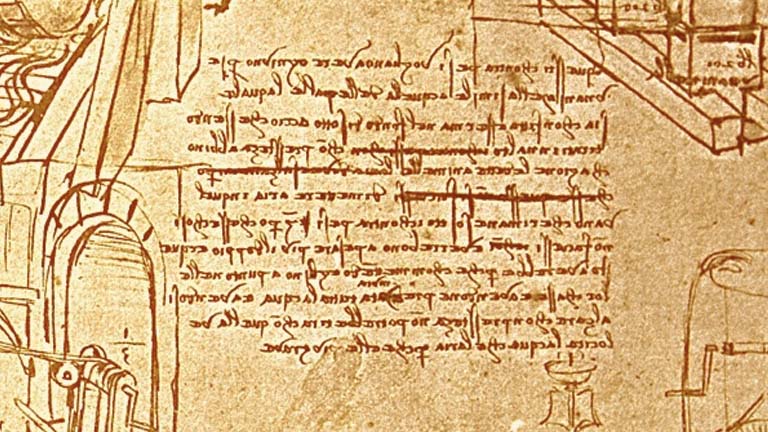
In further delving I came across mirror writing. Leonardo DaVinci (15 April 1452 – 2 May 1519) produced backwards mirror writing. One theory of why he did this was that this method would keep his hands clean. He was a left-hander and writing in the conventional way potentially would have smudged the page.

Mirror Writing - Leonardo da Vinci, Museum of Science
Iconic Images
In searching for the most iconic images, I came across a wide range of photographs representing either firsts in image capture and/or pivotal moments in history. These images stick in one’s memory, pull at heart strings and have come to represent the essence of humanity.

CNN has a list of 25 photographs ranging from firefighters raising a flag at the site of the World Trade Centre in New York after the 9/11 attacks to Alfred Eisenstaedt’s image of an American sailor kissing a woman in Times Square in celebration of the end of WWII.

Wikipedia has a list of what it classifies as the most important photographs in history. View from the Window at Le Gras (1826) by Joseph Nicéphore Niépce is considered the first photograph of nature and also the oldest surviving camera photograph. It was produced by positioning sheets of silver salts coated paper at the back of a camera obscura. Niépce called these images retinas.

Boulevard du Temple (1838) by Louis Daguerre is the earliest surviving photograph depicting people. It is a daguerreotype which is a direct positive process invented by Daguerre himself. The process was introduced to the public at a meeting of the French Academy of Sciences in Paris on 19 August 1839. Check out the shoeshine guy in the lower left.

Boulevard du Temple - photograph by Louis Daguerre
Robert Howlett’s 1857 photograph of British engineer Brunel (1806-1859) has been deemed important in the genre of environmental portraiture (showing a person in their home or workplace). It is also a fascinating representation of the Industrial Revolution. The chains are extraordinary in size and interesting in sharp contrast to Brunel’s rather insignificant watchchain hanging from his waistcoat.

Isambard Kingdom Brunel standing before the launching chains of the Great Eastern
- photograph by Robert Howlett
A final image to note in the Wikipedia list is of Muybridge’s The Horse in Motion (June 1878), precursor to motion pictures. From 1884 to 1887 Eadweard Muybridge made extensive photographic studies of motion, both human figures and animals. I first became familiar with him back in the 80s when my brother gave me a book of his images which I have used as reference material for many years.

The Horse in Motion - Muybridge
Images and Poetry
In the summer of 2022 I had a video call with friends who were at a flea market in France. They wondered if I would be interested in a pile of old photographs. If so, they said they would bring them back to the UK for me. I was so excited to receive a bag full of notable images. Here is one of the photographs and a poetic response to the young lady on the right in the front row.

Wedding Day - photograph A. Gautier
A Marrying of Alice and the White Rabbit

The billowing silk bow crowned her head
like bunny ears, as she leant on him
with doe eyes wearing a half-drawn smile
and a fine white dress.

Clasped hands placed, one over the other
lay in her lap cradled in fabric,
a crevasse formed in an avalanche
of eyelet lace cascading over the knees,

down calves cloaked in black stockings
swallowed by boots, tongues caught
in the middle of their story
with scuffed toes
and worn heels
digging holes.

Thank you for reading.
Kate
  J

Sources:
Britannica, 2024. Eadweard Muybridge British Photographer. https://www.britannica.com/biography/Eadweard-Muybridge Accessed 25 July.

CNN, 2016. 25 of the most iconic photographs.https://edition.cnn.com/2013/09/01/world/gallery/iconic-images/index.html Accessed 25 July, 2024.

Library of Congress, 2024. The Daguerreotype Medium. https://www.loc.gov/collections/daguerreotypes/articles-and-essays/the-daguerreotype-medium/ Accessed 28 July.