Everybody in Wonderland takes pills, don't they? Best estimates of the total spend on pharmaceuticals worldwide last year was a staggering 1.5 trillion US dollars, the majority of which spend was on pills; tablets not just to make us smaller or larger (like Alice), but healthier, happier - or at least less depressed, sleepier or perkier, upper or downer, more peaceful, less pained, not pregnant and on and on.

 |
| barbiturate pills |
Pills by definition are solid, so include not only tablets but any medicine in pellet, powder or liquid form encased in a solid capsule to be taken orally. Cue the possibly apocryphal story of women on the contraceptive pill who've ended up pregnant because they inserted the tablet daily in an orifice other than their mouths.
Recreational pills aside, I suppose we tend to have to take more of them the older we get. I have essential hypertension (high blood pressure) which is genetic and was diagnosed about twenty years ago. I take a low dose of the drug ramipril daily to keep my blood pressure at a normal, healthy level. Eight years ago I suffered a minor brush with fate. I thought it was a migraine as I'd never experienced one before. It turned out to be a mini-stroke. I even wrote a blog about it, which you can read here: To Be Continued The upshot was another drug clopidogrel (an anti blood-clotting agent) got added to the daily pill regime. Bless you science and the NHS.
But enough about my chemical correctives. I've recently finished reading a long (740 pages) and very detailed biography of the Australian writer Charmian Clift and I mention it here because she committed suicide aged just forty-five by swallowing a whole bottle of her husband's phenobarbital tablets.
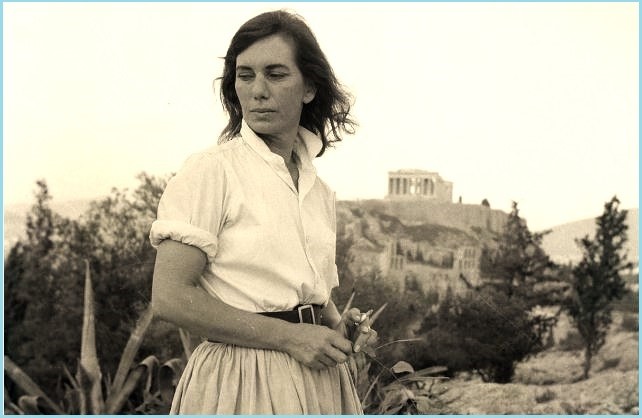 |
| Charmian Clift in Greece |
Charmian was born almost exactly a hundred years ago (August 30th 1923) into a working-class family in a little coastal town in New South Wales and always aspired to be a writer, an ambition which she duly managed to a considerable degree, though never quite to her satisfaction. Nonetheless she deserves to be recognised for the life she lived and the books that live on after her - which are in the process of being rescued from undeserved obscurity, and I am happy to champion her on her centenary.
Her first paid assignment was as a journalist on the women's supplement of the Melbourne Argus, Victoria's most popular daily newspaper, though she was writing short stories and had a novel in progress in the background. It was at the Argus that she met and fell in love with George Johnston, Australia's leading war correspondent and a published author. They had an affair which scandalised the publishing world in late 1940s Australia and ultimately led to George leaving his wife and both George and Charmian leaving the Argus. George was soon snapped up by Associated Newspapers in Sydney, they started a family and he and Charmian co-wrote a prize-winning novel 'High Valley ', as well as play scripts for ABC radio. By the end of the decade, the couple by now with young children in tow also opted to leave stuffy, provincial Australia and move to London where George's reputation secured him a posting as Associated Newspapers' European correspondent and head of their London office.
Charmian, as a proto-feminist, had high hopes of moving to England in the early 1950s but even this society she soon found was boring and prescriptive, and London was so grey and cold. Husband and wife literary partnerships are notoriously tricky ones, as we know, and with George as main breadwinner, she was always regarded by the world at large as the junior partner, Her role as wife and mother put a physical limit on her scope for creativity, she fell into the role of sounding-board for her husband's own literary endeavours, and despite the opportunities that London offered (like taking tea with T.S. Eliot for instance), she longed for a different, freer and more bohemian life for herself and her family. She was to find it in Greece, where she and George and the children moved in 1954 (first to the island of Kalymnos and later to Hydra).
It was a brave decision the couple took to step away from the safety-net of a regular journalist's salary and try and support themselves by their own writing. At least the living would be cheap and the weather decent. They planned to co-write a novel about the sponge-divers of Kalymnos and lived off the publisher's advance while working on the book. At the same time, Charmian wrote an autobiographical account of their life on the island (see further down for details). The novel about the sponge-divers was a moderate success (and was even made into a film) but life on Kalymnos was extremely basic and the family chose after a year to relocate to Hydra, where they bought a house and lived for the next decade at the centre of what became quite a famous expatriate bohemian community (comprising Leonard Cohen, Marianne Ihlen, Axel Jensen, Sidney Nolan among others).
 |
| Charmian and eldest son on Hydra |
Charmian and George wrote assiduously every morning, socialised over flagons of retsina with friends in the evening and then sometimes wrote on again into the night after the children were in bed, often fuelled by barbiturates if deadlines were looming, but their life although idyllic in one sense (they were in charge of their own destiny, Hydra was an enchanting place) was extremely taxing. Their literary works didn't do well commercially, partly due to their being unable to promote them in person in the key markets of Australia, England or the USA. George even took to knocking out 'potboiler' crime fiction under an assumed name to keep some money coming in.
Then there were personal issues. Charmian was jealous of the fact that George's writing took precedence over hers because he was the more well-established of the two and more prolific, with a string of previous books to his name. George was jealous of Charmian because he felt she was actually the better writer and because she was vibrantly attractive to men. He constantly suspected her of being unfaithful to him even though she wasn't (most of the time). He also contracted tuberculosis in 1959 while living on Hydra and suffered progressively from the condition. The task of caring for him fell of course to Charmian.
And it was George who eventually decided to move back to Australia in 1964. Charmian was devastated, for she loved Greece, loved their house on Hydra and didn't want to leave. Neither did the three children who had grown up on the island almost as native Greeks. There was a suggestion that George was prepared to sell the house, abandon his wife and go back to Australia on his own. In the end they all went, the family stayed together, but Charmian still didn't much like the country of her birth once she was back in Sydney, for it was still stuck in its boring and prescriptive rut. She also worried that she was losing her looks, that her husband had begun to hate her, and alcohol became an increasing problem. Although she wrote a well-received weekly column in the Sydney Morning Herald , Charmian was in a depressed rut of her own, and in those five years between her return to Australia and her suicide, she never completed another novel. She felt a sense of failure, like Icarus descending, and I'm reminded of those plangent lines of Joni Mitchell's (herself no stranger to a Greek sojourn): "all romantics meet the same fate someday, cynical and drunk and boring..."

Her novels from the 1960s, 'Walk to the Paradise Gardens ' and 'Honour's Mimic '(a prize if anyone can say where that title derives from) have been stubbornly out of print however for decades, though a third, 'The End of the Morning ' still incomplete and unpublished at the time of her suicide, is finally going to appear in print next year.
I Zoe/ Η ζωή (The Life)
The books which garnered her the most critical appreciation back in the late 1950s were her two beautifully written accounts of their lives first on Kalymnos ('Mermaid Singing ', its title deriving from Eliot's 'Love Song of J. Alfred Prufrock ') and then on Hydra ('Peel Me A Lotus ', named in reference presumably to Tennyson's 'Lotos-Eaters '). The good news is that they have both recently been republished. If you love Greece or just like the idea of it, these two volumes paint a brilliant picture of what island life was like in the 1950s before the advent of the international tourist. Unsurprisingly they are what connected me to Charmain Clift in the first place.

Towards the end of her days, Charmian summed up her predicament succinctly as follows: "I miss the life, and it has occurred to me in the last three years that I am infinitely more isolated and more completely marooned in an Australian suburb than I ever was on a poor and primitive Greek island. Materially I am much better off, but spiritually I sometimes feel impoverished of the gaiety and social ease of Mediterranean living. "
In her poignant suicide note she stated: "I will cease upon the midnight and no pain - isn't that something? I would quite like some flowers. " She downed with a glass of wine all of her husband's phenobarbital tablets (which he kept against the day his own degenerative tuberculosis became too much to bear) and went to sleep lying on her right side with her hands together beside her head on the pillow.
This latest poem from the imaginarium may have something of the spirit of Keats' 'Ode To A Grecian Urn ' about it but there the similarity ends.
How we marvelled in the presence of so much
beautiful pottery in one quiet Athenian museum.
Amphora, Attic cups, volute Craters and Hydria,
Oenochoe, Pelike and Pyxis, stunning Stamnos
and my favourite the squat black Lekythos, each
displayed with hand-written legend in a language
from millennia which we could as yet barely read
let alone speak - and Keats wasn't even in mind...
...though later we sought him out for such insight
as he had to share. Fifteen years into the future, I
Zoe in despair reflect on being blinded by Aegean
sun. There is no shadow there, our faults baked in
the clay for anyone to see, our feathers all unstuck,
romantic illusions buried by a cold midnight moon
and yet I miss the place, evenings at Douskos with
retsina flowing imbuing a happy weightlessness to
our fragile dreams. Sadly I fill my replica Lekythos
with Australian wine, moved again by the beauty of
its decorative design, musing that the truth we seek
seems always to be just round the curve of the vase.
 |
| George Johnston and Charmian Clift in happier times |
How could I possibly write blog on the subject of pills and not include as a musical bonus Jefferson Airplane's masterful 'White Rabbit '? Grace Slick wrote the lyrics and music, drawing on her love of 'Alice In Wonderland ' for imagery and on her love of Spanish music, 'Bolero ' in particular, for the tune. The result was stunning in 1967 and remains a tour de force today. To listen via YouTube, just click on the song title here: White Rabbit.

Keep taking the good tablets and thanks for reading, Steve :-)


