written and posted by members of Lancashire Dead Good Poets' Society

Showing posts with label Greece. Show all posts

Saturday, 28 February 2026

Curry

Curry has become a modern catch-all label for pretty much any spicy stew from Jamaica to Jakarta. The word itself is an anglicised form of the Tamil 'kari', meaning sauce, dating from British Empire days in the Indian sub-continent. As for the origins of the spicy stew itself, they go right back to the Harappan civilisation of the Indus river valley in the region of modern day Punjab, some 6,500 years ago. 

The Indus river was a 'cradle of civilisation' on a par with those of Mesopotamia, the Nile, the Yangtze delta in China, and an Andean society in Peru. These were all primarily stable agrarian communities with sophisticated building capabilities and quite advanced irrigation techniques. The primary cities of the Indus valley region were Mohenjo-Daro and Harappa itself, and it is in the excavated ruins of those cities that archaeologists found traces of both the ingredients and the cooking utensils that the Harappans used to make their various spicy sauces. 

The utensils were pestle and mortar and clay and metal cooking pots. The ingredients were locally foraged or farmed  spices such as black pepper, cardamom, cassia, cumin, ginger, fennel, mustard, saffron, tamarind and turmeric. The spices would be ground to a masala (literally 'spice blend') paste in differing combinations and then turned into a sauce by the addition of oil (usually sesame oil). This was cooking for flavour, making stews with aubergine, chicken, lamb or mango, the world's first 'curry' cuisine.

Chicken Madras in a Balti pan
When the Harappan civilisation came to a fairly rapid end around 2,000 BC because of climate change and the drying up of many of the rivers in the basin, the population migrated out east, west and south to Mesopotamia, to Egypt, to India, South-East Asia and beyond, taking their culinary traditions with them, and eventually catalysing what became the global spice trade.

The Arabs of Mesopotamia (effectively modern day Iraq) became the principle traders, going to India to buy spices to sell in the west and in turn introducing western herbs and spices like bay leaves and fenugreek to the Indians. Indian spices commanded high prices in the west and were thought of as luxury items, prices kept abnormally high by the tall tales of the traders about how difficult such exotic produce was to obtain. (For instance, cassia reputedly grew in shallow lakes patrolled by dragons, black pepper was extracted from fiery caves, cumin had to be harvested from snake-infested waters.)

spice market
Eventually the Europeans, initially Portuguese and Italians, opened up sea routes to India and the East and the overland spice road became less important. These maritime trade routes also led to other key ingredients getting added to the recipes of Indian masalas, with cloves, coconuts, mace and nutmeg incoming from Sumatra in the east, and chillis, coriander, okra, potatoes and tomatoes arriving from the west. Soon the resourceful Indians were growing the new fruits, spices and vegetables and not just importing them.

Our own national love affair with curry started back in the 18th century with the gradual British colonisation of the Indian sub-continent. The British in India developed a liking for curry and when they returned to Britain they brought that love with them. The earliest recorded use of the word in English is in a recipe of 1747 in Hanna Glasse's ' Art of Cookery Made Plain and Easy'. (I love such optimistic titles.) Hers was a fairly basic approach, but I suppose it served a purpose.

Hanna Glasse's 1747 recipe
Of course, English curries 'made the India way' rarely lived up to the magic of the original. There were a few restaurants, such as the Hindoostane Coffee House and Hooka Smoking Club that opened in London in 1810 and served authentic Indian cuisine, It even offered a takeaway service. But it was one of only a handful, catering to ex-Raj families and Indians living in the capital. For nearly two centuries we had to put up domestically with ordinary stews that had a couple of spoonfuls of Venkat's Curry Powder stirred in, and even Vesta packet curries (just add water) were not much better.

That all changed markedly after WWII, the partition of India, and India and Pakistan becoming independent. For a variety of reasons, there was an influx of people to Britain from the sub-continent. Some were displaced by geopolitical shenanigans, others had trained as chefs on ships whose useful life was being superseded by container vessels. They brought with them both the culinary skills and also the market for proper Indian food. Curry houses began to open up in many large towns and cities.

It also led eventually to a market for pre-prepared spice mixtures, the most common being garam masala, which typically comprises black pepper, cardamom, cassia, chilli, cinnamon, clove, coriander, cumin, fennel, ginger and nutmeg. The availability of such items has raised the quality of home-cooked curries immensely.  

The first curries I ever ate were at Indian restaurants in Cambridge when I was in my late teens, at the Taj Mahal and the New Bengal in Regent Street. They were probably owned and run by East Pakistanis (or Bangladeshis once the East declared separation from West Pakistan in 1972), but like the terms curry and curry house, many establishments were labelled Indian restaurants, regardless of whether they were Bangladeshi, Indian, Pakistani or Sri Lankan and regardless of the regional variety of their cuisines.

During my years at Warwick University and living in Coventry, regular visits to the Rajah were in order, and less frequently the Simla (pricier and not as good). That was in the days before Indian beer (Cobra, Kingfisher) had been invented, and Mateus Rosé was the drink of choice. 

Nowadays, such 'Indian' restaurants and takeaways proliferate across the land. There are at least twenty in and around Blackpool and I've eaten at the many of them. My yardstick dish is Methi Gosht, a lamb curry with fenugreek. It's what I ask for when I go to anywhere new, just to get  measure of the place.  

Curiously enough, of all the curries I've eaten in all the curry houses from San Francisco to Cairo, the best I ever had was at an Indian restaurant on a Greek island. This was back in 2006 at the Bombay Garden in Skiathos town.

Skiathos Bombay Garden
The holiday on Skiathos was fun, we had an apartment on a hillside overlooking the bay, the weather was great (it was mid-August), the beach was lovely (and I often shared my sunbed with a local cat), the dining was invariably outdoors, but the Bombay garden was something special. The setting was beautiful and the food was exquisite, prepared by chefs who had been brought in from Bengal, I was told by the English proprietor. It was a meal that lives long in the memory and even made it into my morning glory poem (except I haven't called it that).

Swallows
Stirring stiffly in the seams of last night's fading dreams,

(thank you Mythos beer and Skiathos Bombay Garden) I

taste spices on your sleepy smiling lips, aromas linger in
your golden hair, mementos of saffron garlanded delight.

From where I lie in bright sunlight, the sight of swallows
picking insects out of the air on another perfect morning.

I thought we might get up, shower and take coffee on our
balcony, but you have other ideas, of enjoying this bounty

beneath rumpled sheets, ask was I dreaming of concubines
- a sly tease, you're good at those, but I'm happy to comply.


Thanks for reading, S ;-)

Saturday, 19 April 2025

A Favourite Poet

Of course there are many, but in strict adherence to the brief, I'll make an 'of the moment' choice. The poet I've been reading most often in the last few months is Ruth Padel. I realise some of you may not be familiar with the name, so excuse me those who are while I furnish a few autobiographical details as background.

Ruth Padel was born in London in 1946, the eldest of five siblings, and is a great-great-granddaughter of Charles Darwin. Her father was a psychoanalyst and classicist who taught his daughter Greek. Ruth studied Greek at Oxford and wrote her Ph.D on ancient Greek poetry. (You can see why I like her already.) She has taught Greek Classics at Oxford, Cambridge, London and Princeton universities and has also studied at the Sorbonne and at the British School of Archaeology in Athens, where she lived for several years. While there, she helped in the excavation of the Royal Palace at Knossos. 

As well as teaching Greek Classics, Ruth has written several critical studies on Ancient Greek literature and how its myths can inform an understanding of the modern human psyche. She is also the author of a couple of novels. I can highly recommend 'Daughters of the Labyrinth', a fictional depiction of the holocaust in Crete after the German invasion in WWII.

In addition to her affiliation to Greece and all things Greek, Ruth also has a love of music. She has sung as a member of various prestigious chamber choirs in England and France and has has taught opera. 

Her third consuming interest is in the natural world (as befits her family lineage from Darwin). She is a keen conservationist, a Fellow of the Zoological Society and a Trustee of London Zoo.

She was the first woman poet to be nominated for the post of Oxford Professor of Poetry and she is a Fellow of the Royal Society of Literature.

All of these consuming passions naturally inform her poetry, of which there are sixteen collections to date. Although in her own words she was "formed by the nineteenth century" in terms of cultural aesthetic and scientific learning, she is a modernist in her writing, and poetry for her is the connective tissue that unites all subjects and disciplines. I find her poetry daring, erudite, imaginative and often downright sexy. 

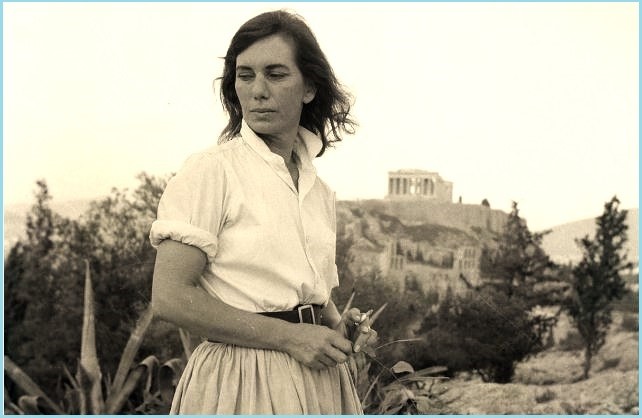
Ruth Padel
I've heard Ruth Padel read a number of times, and if you wish to do so, there are quite a few recordings out on YouTube. I most recently heard her as a guest poet at the Poetry Society's 2025 National Poetry Competition Winners Night, reading from her latest poetry collection, 'Girl'. The other guest poet was Australia's Debbie Lim and she was excellent too. This year's winner, Fiona Larkin, was judged to have submitted the best poem out of 20,000 entries. Them's the odds, folks. I didn't enter. I don't do competitions.

Obviously I'm going to share one of Ruth Padel's poems this week rather than one of my own. I've chosen my favourite poem from her 1998 collection 'Rembrandt Would Have Loved You'. That collection also includes the poem with which she won the 1996 National Poetry Competition, Icicles Round a Tree in Dumfriesshire, but I much prefer this one. I'll make no commentary. Read and enjoy.

Boulangerie
Still Life With Loaves, Seaweed And Wren
   
Whatever self is, I'd like mine to wake up with yours
While sleep is still plumping the skin,
Warm bread rising gently in the oven.
   An enamel oven, opened on a summer morning
In a village in Provence
By a woman who's never been unkind, whose children
And husband and lover have never been hurt.
   It's not that real a place.

I do know that. But for this moment of waking
I'm imagining, it holds
The warmest small patisserie in the world
   Which does its baking in a sloping village street
By the wall of the local château.
Relations with the château have always been brilliant.
There was no need for revolution, there wasn't one.
   It's all been OK, that side of things.

There are baguettes in the baguette corner
As there have been two hundred years
And will go on being, for in this village
   No worlds end. Light pours down the little street
With all promise of a hot day to come
But not yet, not yet. A street in which no girl
Has been ungenerous to her lover,
   No child mown down by alcoholic lorries,

No resistance fighter shot. And no Jew shopped
By neighbours who wanted his farm.
The Cathars and the Huguenots were fine.
   I'm going to reel back history for these bakers,
Map them on the road to Eden. Children will come in
For pain au chocolat and get it free.
Parents will come
   For newspapers, milk and a gossip

Which never knifes anyone in the back, not really,
And sun will spread through the doorway
Without alarming the profiteroles,
   Their glisten of chocolate, that delicate cream.
This stove is Delphi, navel of the world,
There's you and me in it, and maybe some other
Lucky loaves, expanding their crusts
   For the day to mutter 'We're together, it's OK'.

And if other sorts of loaf, seedcake or sparbunkle,
Think it all sounds pretty boring lying there -
Loom-weights in a loaf-museum, none of the mica-sparkle
   Of the scythe - they can fuck off elsewhere.
For whatever self is, I'd like mine to wake with yours,
Curls mixing on the pillow surprised - as if, seconds before,
The separate hairs weren't calcium and follicles
   But sweeping off on some quite different enterprise

Of being. Maybe hair dreams of being dandelion seed
Blown over rivers, gold forests, the motorway du sol.
These curls of ours can do that. Let them go helium-ballooning,
   Linked very lightly, as far as they want.
Or maybe they'd like to be seaweed
At the bottom of an East Aegean bay, swaying their tips
In sky-water whose ripples you can't see, only feel,
   A virtual reality of movement that gets the weeds excited

Very gently. A pure bit of sea, naturellement,
None of your oil slicks and rubbish from foreign yachts.
Yes, if the hairs want to have been that, they can,
   Then be glad to come back to us, as we wake
In this bakery whose warmth is not electronic but self-made.
The loaves created it. They'd like to stay all day
Half-dreaming they are apples in a loft, radiating Cézanne,
   Dapple-lit by a window so old it is ouzo,

Quite certain no roof will ever fall. No one visits them
Except a child, who'll remember all her life
The smell, the soft still light with dust along its spine,
   The silent, consenting apples.
Yet whatever selves are, I'd like mine to wake
And not only dream
With yours. Be risen loaves, not fixing to get eaten
   But to get their act together.

Loaves that are going to give themselves names
And float out into the world
Looking like people who get phoned up,
   Arrange meetings and deadlines, difficult lunches.
They'll be separate loaves paying their own bills
But all day in their soft loaf parts
Keep a patch of themselves away
   Where they woke up touching -

As a wren, I imagine, keeps the impress of eggs
Left hidden in her penny-size nest
When she darts out shopping, through the teeth
   Of hawthorn, for her list of things she needs.
Mayfly. Lacewing. And there they stay,
Those six-millimetre ovals, pressed
In the faint fawn-feather of her breast.
   No harm's coming to her eggs,

Nothing broken or planning to break. No need for a wren
To say sorry, or suffer anything but the warm spark 
Of morning, dawn-hunts among buds of Russian vine
   For that greenfly tickle on her tiny wren tongue
And the mercy of having woken touching
What she loves. Whatever love is for a wren.
And whatever self is, I'd like yours to wake,
   If it wouldn't mind, with mine.

                                                 Ruth Padel


Thanks for reading, S ;-)

Saturday, 1 June 2024

Gardens

We all love gardens, don't we? Whether that's designing, cultivating and spending time in our own or visiting some of the beautiful creations of others in public spaces or on country estates. One thing is for sure, though, the cultivating and tending part is a tough gig when you arrive at your eighth decade!

Monet in his garden at Giverny
Claude Monet (1840-1926), rightly celebrated as one of the foremost Impressionist painters, acquired a house with land at Giverny, fifty miles north-west of Paris, when he was in his mid-forties, after his first wife had died. It was to be a stable home for Monet, his children and eventually his second wife. He lived there  for the next forty years. As well as renovating the house and building his studio, he also spent decades with the help of family and friends transforming the garden into a botanical paradise in which to live and to paint. He bought more strips of land when he could afford to, and this horticultural project became a lifelong passion.

He is quoted as saying: "I am only good at two things, and those are painting and gardening. Everything I have earned has gone into this garden. Colour is my day-long obsession, joy and torment. I perhaps owe having become a painter to flowers. The more I live, the more I realise that the colours at Giverny are the most beautiful colours in the world. My garden is my most beautiful masterpiece."

If you've seen Monet's paintings you're probably familiar with his depictions of agapanthus, geraniums, irises, peonies, roses, water-lilies, willows, wisteria, garden paths, picnics under his trees, brilliant vistas. He painted the same views many times, trying to capture his impressions of the beauty around him. Of course the views were never actually the same, for the colours and light were different on each occasion. Ironically, for all his mastery of his craft, he burned many of his canvasses. Maybe that's how one preserves one's reputation for excellence! 

As he grew old, his sight began to fail him, a cruel affliction for one whose life had been all about experiencing and responding to what he saw around him. He still planned enhancements to his garden but now employed a team of gardeners to do the spadework for him. He loved nothing more than to walk around his garden, to share it with friends and visitors, to continue being inspired by its beauty. And he continued to paint under its spell, despite his failing eyesight, even enlarging his studio to accommodate the expansive canvases that he worked on during his final few fading years.

Monet's house and gardens were painstakingly restored after fifty years of neglect and became classified as a 'monument historique' in 1976.Nowadays Giverny is one of the most visited sites in France, outside of Paris. 

My own Blackpool back garden is due for a major make-over in the next few months. Out will go rotten old decking and concrete paving slabs. I want more nature, more greenery, flowers, herbs, bees and butterflies, terracotta pots, a tree  I'm trying to grow olive saplings from seed but I don't know if the climate is sufficiently conducive - that wintry west wind for instance. Like Monet in his seventies, it will have to be something I can tend to without overmuch back-breaking effort. Design is key, as is the budget. Wish me luck.

geraniums at Kythira in Greece
One thing's for sure, there will be lots of geraniums, as well as irises, lilies and roses. I'll sign off with the latest piece I've been working on.  I'm not sure if this is the poem's final flowering or not. Time will tell.

Geranium-365
Primordial and perennial, in a sun-kissed Kythira garden
from white-washed, rust-streaked tins watered at dusk,
Aphrodite's progeny branches and buds, then explodes
in profusion, red like blood, pink as passion. Incandescent

she comes once again, apparition more dazzling than flame 
from a time before earth was formed, hovering between 
the impossible and the inevitable, a fissile isotope fixing
to blow the world apart anew, shatter your flowering heart.

On a simple iron bedstead among twisted sheets we lie
savouring consummate peace, with the departing day framed
through blue shutters. By a trick of inverted light, a flush
of geranium red shafts itself across peeling walls and ceiling.

Lucretius, forefather of atomic thought, captured the effect
of her florid alchemy thus: "the heavens are all assuaged 
and pour forth torrents of light; the waves of the sea smile."  
In blue jeans you slip out to the yard, watering-can in hand.


Thanks for reading, S ;-)

Saturday, 23 September 2023

Gate

Is there any finer way to spend a September day than sitting on a sandy Greek beach beneath cloudless skies, the temperature hovering around 30C, a sound of gentle waves lapping, cold beer to hand if required and the plays of Euripides as holiday reading? Don't worry, it's a rhetorical question. The answer is no, obviously.

So that's what I've been doing, not just for a day but a whole glorious week on the island of Zakynthos, and it was in Euripides' tragedy 'Medea ' that I found inspiration for this Greek-themed Gate blog, which in anticipation of National Poetry Day will view the gate as a portal, opening to a place of refuge or sanctuary.


a Greek gate
Medea was not Greek (and that's important). She came from Colchis, in what is modern-day Georgia, on the eastern  shores of the Black Sea, and thought at the time to be the land of the rising sun. What drew her into the Hellenic sphere was the fabled adventure of Jason and the Argonauts and their expedition to seize (i.e. steal) the golden fleece from King Aeëtes of Colchis, for she was the king's daughter.

The golden fleece was a symbol of authority and kingship, and Aeëtes kept in hanging in a tree in a sacred grove protected by a dragon. Jason (great-grandson of Hermes) had been promised the throne of Iolcus by Pelias (who had usurped it from Jason's father) in return for the golden fleece. Medea, famed as a sorceress, fell in love with Jason and, on a promise from him of marriage, used her powers to help him thwart the dragon and steal the fleece from her father. She then eloped with Jason to Greece on the Argo and became his wife. 

However, Pelias reneged on the promise to hand the throne of Iolcus to Jason, so Medea once again used her sorcery to trick Pelias's daughters into murdering their father, after which Jason and Medea had to flee Iolcus and sought refuge at the court of King Creon of Corinth, where Medea bore Jason fine sons.

In time however, Jason, wanting to further aggrandize himself and better provide for his sons, sought marriage to Creusa, daughter of King Creon. (Polygamy was not unknown in Ancient Greece. They gave the word to the world, after all.) Medea was expected to just quietly accept the arrangement and put up with being turfed out of the marriage bed for the greater good of her children, but she wasn't having any of it. Cue the play by Euripides. 

Observing the classical rule of unity of time and place favoured by Greek dramatists of the 5th century BC, the tragedy of 'Medea ' plays out in the royal palace at Corinth on the day of Jason's marriage to Creusa. 

Medea laments the infidelity of Jason, the man she has done so much for, the man she has cut all ties with her own family for, the man she has effectively committed murder to support. She cannot abide  being replaced in his affections by Creusa, not just for the loss of face but for having her feelings for Jason spurned in such a fashion. Her grief is passionate.

Jason tries to persuade her that his marriage to Creon's daughter will give all of them greater security but she rejects this reasoning out of hand, for Creon has been good enough to them all for years as it is.

Creon, for his part, suspecting that Medea won't take kindly to Jason marrying his daughter and being fully conversant with Medea's reputation for sorcery, gives her notice to quit Corinth before she can cause any trouble for him or his family. This incenses Medea who realises she is being cast out not just from her husband's bed but from the life she has known in Corinth. She faces an uncertain future in exile with her sons and turns to Aegeus, King of Athens (who just happens to be visiting) to beseech him to offer her - a non-Greek and an imminent exile - sanctuary in Athens, as the city state is famed for its 'open gate' policy, its generosity to strangers and its humanitarian values. Aegeus gives his promise to Medea that she will be granted refuge in Athens regardless of any crimes she may have been guilty of. 

Jason then informs Medea that he will not allow his sons to go into exile and advises her to make some propitiatory act to persuade Creon of her good will so he will allow her to stay, but she knows from her previous conversation with Creon that he is implacable in his insistence she must leave. 

So she plots the ultimate revenge. She pretends to have reconciled herself to Jason's marriage and sends her sons to deliver two presents to the new bride, a dress and a gold coronet. Creusa puts on the dress and crown, both of which are enchanted, and soon dies of their poisonous effects and Creon, in attempting to save her, is tainted with the poison and dies too. Medea then slays her own dear sons with a knife, this act being the cruellest conceivable blow she can inflict on the husband who has betrayed her so heartlessly. She flees Corinth for the promised refuge of Athens, where if she cannot find redemption she can at least find sanctuary.

Powerful stuff, you'll agree (and the title role remains a great part for any modern day actress to play).

statue of Medea with knife
For my latest poem, I've paraphrased some of the exchanges between Medea and Jason in the form of a mobile phone text conversation (hence the crafty punning title). Let me know if you think it works. I was in two minds whether or not to condense it down into text speak but for now it can stay as is. (If reading on a mobile phone, tip sideways into landscape mode for correct alignment of the poem.)

Social Medea
M: I am wronged. You were my whole life,
What misery, what wretchedness you've 
heaped on me by taking a younger wife!
                                                                                J: Calm down woman. I'm doing what's 
                                                                                best for us all. If you hadn't raged against
                                                                                the King and Princess you could have 
                                                                                stayed on quietly in Corinth's splendid
                                                                                halls but you've really queered your pitch.
M: Filthy coward. Ungrateful bastard. After
all I've done for you. This is my reward, to
be thrown over for that bitch, banished from 
your bed and worse, to be cast into exile 
through no fault of my own.
                                                                                J: You're just too dangerous when you're in 
                                                                                this mood. Your reputation is your curse. 
                                                                                That's why none of us is safe if you stay.
                                                                                But I won't see you penniless. I'll give you
                                                                                gold to go away and the sooner the better.
M: If you think you can shack up with that
whore and make her mother of our kids in
my place you'd better think again. Fuck
you Jason. I thought you were a better man
than this but you're just like all the rest.
                                                                                J: I'm not scared of you Medea. You'd best rein
                                                                                it in. Don't spurn my offer. Take this proffered 
                                                                                purse and may good luck accompany you.
M: All right! Since I cannot win, I give in.
I will play the social game. As a token of
my acceptance of the situation, I'll send the
boys with presents for your new bride.
                                                                                J: That's my girl. I'm pleased your tide of anger
                                                                                has turned. Make a fresh start. You're still a good 
                                                                                catch. It's the best way, believe me. I'm sure you'll 
                                                                                find a way to prosper by your arts.
M: Oh, but I believe in nothing anymore 
except cruel fate for which I am no match.
Still, I shall embrace my destiny with both 
hands and a blackened heart.


Thanks for reading, S ;-)


Saturday, 26 August 2023

Pills

Everybody in Wonderland takes pills, don't they? Best estimates of the total spend on pharmaceuticals worldwide last year was a staggering 1.5 trillion US dollars, the majority of which spend was on pills; tablets not just to make us smaller or larger (like Alice), but healthier, happier - or at least less depressed, sleepier or perkier, upper or downer, more peaceful, less pained, not pregnant and on and on.

barbiturate pills
Pills by definition are solid, so include not only tablets but any medicine in pellet, powder or liquid form encased in a solid capsule to be taken orally. Cue the possibly apocryphal story of women on the contraceptive pill who've ended up pregnant because they inserted  the tablet daily in an orifice other than their mouths.

Recreational pills aside, I suppose we tend to have to take more of them the older we get. I have essential hypertension (high blood pressure) which is genetic and was diagnosed about twenty years ago. I take a low dose of the drug ramipril daily to keep my blood pressure at a normal, healthy level. Eight years ago I suffered a minor brush with fate. I thought it was a migraine as I'd never experienced one before. It turned out to be a mini-stroke. I even wrote a blog about it, which you can read here: To Be Continued The upshot was another drug clopidogrel (an anti blood-clotting agent) got added to the daily pill regime. Bless you science and the NHS. 

But enough about my chemical correctives. I've recently finished reading a long (740 pages) and very detailed biography of the Australian writer Charmian Clift and I mention it here because she committed suicide aged just forty-five by swallowing a whole bottle of her husband's phenobarbital tablets.

Charmian Clift in Greece
Charmian was born almost exactly a hundred years ago (August 30th 1923) into a working-class family in a little coastal town in New South Wales and always aspired to be a writer, an ambition which she duly managed to a considerable degree, though never quite to her satisfaction. Nonetheless she deserves to be recognised for the life she lived and the books that live on after her - which are in the process of being rescued from undeserved obscurity, and I am happy to champion her on her centenary.

Her first paid assignment was as a journalist on the women's supplement of the Melbourne Argus, Victoria's most popular daily newspaper, though she was writing short stories and had a novel in progress in the background. It was at the Argus that she met and fell in love with George Johnston, Australia's leading war correspondent and a published author. They had an affair which scandalised the publishing world in late 1940s Australia and ultimately led to George leaving his wife and both George and Charmian leaving the Argus. George was soon snapped up by Associated Newspapers in Sydney, they started a family and he and Charmian co-wrote a prize-winning novel 'High Valley ', as well as play scripts for ABC radio. By the end of the decade, the couple by now with young children in tow also opted to leave stuffy, provincial Australia and move to London where George's reputation secured him a posting as Associated Newspapers' European correspondent and head of their London office.

Charmian, as a proto-feminist, had high hopes of moving to England in the early 1950s but even this society she soon found was boring and prescriptive, and London was so grey and cold. Husband and wife literary partnerships are notoriously tricky ones, as we know, and with George as main breadwinner, she was always regarded by the world at large as the junior partner, Her role as wife and mother put a physical limit on her scope for creativity, she fell into the role of sounding-board for her husband's own literary endeavours, and despite the opportunities that London offered (like taking tea with T.S. Eliot for instance), she longed for a different, freer and more bohemian life for herself and her family. She was to find it in Greece, where she and George and the children moved in 1954 (first to the island of Kalymnos and later to Hydra). 

It was a brave decision the couple took to step away from the safety-net of a regular journalist's salary and try and support themselves by their own writing. At least the living would be cheap and the weather decent. They planned to co-write a novel about the sponge-divers of Kalymnos and lived off the publisher's advance while working on the book. At the same time, Charmian wrote an autobiographical account of their life on the island (see further down for details). The novel about the sponge-divers was a moderate success (and was even made into a film) but life on Kalymnos was extremely basic and the family chose after a year to relocate to Hydra, where they bought a house and lived for the next decade at the centre of what became quite a famous expatriate bohemian community (comprising Leonard Cohen, Marianne Ihlen, Axel Jensen, Sidney Nolan among others).

Charmian and eldest son on Hydra
Charmian and George wrote assiduously every morning, socialised over flagons of retsina with friends in the evening and then sometimes wrote on again into the night after the children were in bed, often fuelled by barbiturates if deadlines were looming, but their life although idyllic in one sense (they were in charge of their own destiny, Hydra was an enchanting place) was extremely taxing. Their literary works didn't do well commercially, partly due to their being unable to promote them in person in the key markets of  Australia, England or the USA. George even took to knocking out 'potboiler' crime fiction under an assumed name to keep some money coming in.

Then there were personal issues. Charmian was jealous of the fact that George's writing took precedence over hers because he was the more well-established of the two and more prolific, with a string of previous books to his name. George was jealous of Charmian because he felt she was actually the better writer and because she was vibrantly attractive to men. He constantly suspected her of  being unfaithful to him even though she wasn't (most of the time). He also contracted tuberculosis in 1959 while living on Hydra and suffered progressively from the condition. The task of caring for him fell of course to Charmian. 

And it was George who eventually decided to move back to Australia in 1964. Charmian was devastated, for she loved Greece, loved their house on Hydra and didn't want to leave. Neither did the three children who had grown up on the island almost as native Greeks. There was a suggestion that George was prepared to sell the house, abandon his wife and go back to Australia on his own. In the end they all went, the family stayed together, but Charmian still didn't much like the country of her birth once she was back in Sydney, for it was still stuck in its boring and prescriptive rut. She also worried that she was losing her looks, that her husband had begun to hate her, and alcohol became an increasing problem. Although she wrote a well-received weekly column in the Sydney Morning Herald , Charmian was in a depressed rut of her own, and in those five years between her return to Australia and her suicide, she never completed another novel. She felt a sense of failure, like Icarus descending, and I'm reminded of those plangent lines of Joni Mitchell's (herself no stranger to a Greek sojourn): "all romantics meet the same fate someday, cynical and drunk and boring..."   

The books which garnered her the most critical appreciation back in the late 1950s were her two beautifully written accounts of their lives first on Kalymnos ('Mermaid Singing ', its title deriving from Eliot's 'Love Song of J. Alfred Prufrock ') and then on Hydra ('Peel Me A Lotus ', named in reference presumably to Tennyson's 'Lotos-Eaters '). The good news is that they have both recently been republished. If you love Greece or just like the idea of it, these two volumes paint a brilliant picture of what island life was like in the 1950s before the advent of the international tourist. Unsurprisingly they are what connected me to Charmain Clift in the first place.


Her novels from the 1960s, 'Walk to the Paradise Gardens ' and 'Honour's Mimic '(a prize if anyone can say where that title derives from) have been stubbornly out of print however for decades, though a third, 'The End of the Morning ' still incomplete and unpublished at the time of her suicide, is finally going to appear in print next year.

Towards the end of her days, Charmian summed up her predicament succinctly as follows: "I miss the life, and it has occurred to me in the last three years that I am infinitely more isolated and more completely marooned in an Australian suburb than I ever was on a poor and primitive Greek island. Materially I am much better off, but spiritually I sometimes feel impoverished of the gaiety and social ease of Mediterranean living. " 

In her poignant suicide note she stated: "I will cease upon the midnight and no pain - isn't that something? I would quite like some flowers. " She downed with a glass of wine all of her husband's phenobarbital tablets (which he kept against the day his own degenerative tuberculosis became too much to bear) and went to sleep lying on her right side with her hands together beside her head on the pillow.

This latest poem from the imaginarium may have something of the spirit of Keats' 'Ode To A Grecian Urn ' about it but there the similarity ends.

I Zoe/ Η ζωή (The Life)
How we marvelled in the presence of so much
beautiful pottery in one quiet Athenian museum.
Amphora, Attic cups, volute Craters and Hydria,
Oenochoe, Pelike and Pyxis, stunning  Stamnos

and my favourite the squat black Lekythos, each 
displayed with hand-written legend in a language
from millennia which we could as yet barely read
let alone speak - and Keats wasn't even in mind...

...though later we sought him out for such insight
as he had to share. Fifteen years into the future, I
Zoe in despair reflect on being blinded by Aegean
sun. There is no shadow there, our faults baked in

the clay for anyone to see, our feathers all unstuck,
romantic illusions buried by a cold midnight moon
and yet I miss the place, evenings at Douskos with
retsina flowing imbuing a happy weightlessness to

our fragile dreams. Sadly I fill my replica Lekythos
with Australian wine, moved again by the beauty of
its decorative design, musing that the truth we seek
seems always to be just round the curve of the vase.   
  
George Johnston and Charmian Clift in happier times
How could I possibly write  blog on the subject of pills and not include as a musical bonus Jefferson Airplane's masterful 'White Rabbit '? Grace Slick wrote the lyrics and music, drawing on her love of 'Alice In Wonderland ' for imagery and on her love of Spanish music, 'Bolero ' in particular, for the tune. The result was stunning in 1967 and remains a tour de force today. To listen via YouTube, just click on the song title here: White Rabbit.


Keep taking the good tablets and thanks for reading, Steve :-)

Saturday, 1 August 2020

Re Collections

I've reached a difficult decision this week - not to go to Greece for a summer holiday (the first miss in years). It's been a tough call, because the temptation to go is huge.

It's not that Greece isn't a safe place. Compared to the UK's 304,000 cases and 46,000 deaths (both conservative figures as we know), Greece had only just over 4,000 cases and 206 deaths - yes, that few, you didn't read it wrong.

More people have died of coronavirus in Blackpool & the Fylde than in the whole of Greece, so I'd feel perfectly safe if I were on some sun-drenched Aegean island right now. The issues are more to do with travelling, the unpredictability of airlines and flights, doubts over the validity of holiday insurance. On balance, it seems wisest to stay in the jewel of the north this summer, to stock up on retsina, work my way through some Greek recipe books and hope we get a decent run of weather this August and September.

You may wonder what all of that has to do with collections and it's simply this, I've been 'collecting' Greek destinations for over forty years. It's the country I've visited more widely and more often than any other. I nearly retired to live there; it's almost a spiritual home. From each place I've visited I've brought back not only the happiest of memories and abundant photographs but also local pottery, just one of the things I collect.

Pottery from Crete and Paros and Rhodes
Strangely enough, I've also got a collection of hand-blown Finnish glassware, though I've never been to Finland. Less unusual, if you know my musical tastes, is my collection of West Coast concert posters from the psychedelic sixties, but then I have been to San Francisco on several occasion in reality, and many more times in my mind.

Where did it all start, this collecting lark? With stamps probably, as a boy; and those picture card series of birds and flowers and footballers that one could collect in packets of PG and Ty-phoo tea... all gone many decades since.

Of course, as you'd expect, I have other, more mainstream collections, of books and records, CDs and DVDs, football programmes and music magazines. I've even got an anorak.

I've made one other decision this week. From time to time readers of the blog have commented asking if I've published a book of poetry. No I haven't, not even a pamphlet, just occasional pieces in anthologies. So instead of a Greek holiday this year I'm going to fund publication of a selection of my poems, my first collection if you like - though there won't necessarily be a second one! There, I've said it, a declaration of intent, so I've got to do it.

I've not written a poem for this blog, but I'm working on a Rhapsody, ῥαψῳδός  (rhapsodos) in Greek, meaning the stitching of a lyric together - based on lines and ideas I've been collecting in my notebooks for a while. Instead, I'll sign off today with this photograph. Missing you!

Temple ruins on beautiful Kos
Thanks very much for reading. Have a good week and if you're a collector, happy collecting. S ;-)

Thursday, 21 April 2016

Tragedy - Greek goats love to climb trees.

Tragedy -
noun (plural tragedies)

1 - An event causing great suffering, destruction, and distress, such as a serious accident, crime, or natural catastrophe: a tragedy that killed 95 people [mass noun]: his life had been plagued by tragedy
2 - A play dealing with tragic events and having an unhappy ending, especially one concerning the downfall of the main character: Shakespeare’s tragedies
2.1 [mass noun] The dramatic genre represented by tragedies: Greek tragedy (O.E.D)

Origin - 
Late Middle English: from Old French tragedie, via Latin from Greek tragōidia, apparently from tragos 'goat' (the reason remains unexplained) + ōidē 'song, ode'. (O.E.D) 

According to Susie Dent, the attractive, dark-haired lexicologist of TV's Countdown (dictionary corner), "It is absolutely true that the word ‘tragedy’ has roots in a Greek word meaning ‘goat-song’.  Many theories have been offered to explain it. One is that Greek tragedies were known as goat-songs because the prize in Athenian play competitions was a live goat. The contests were part of worship to Dionysus, involving chants and dances in his honour. The Romans knew Dionysus later as Bacchus, god of all things ‘bacchanalian’: in other words he freed people from their normal self through madness, wine, and ecstasy".

In her book, 'What Made the Crocodile Cry?' Susie explains that sometimes the goat would be sacrificed, and a goat lament sung as the sacrifice was made. Hence the goat-song became intertwined with the Greek plays.

Others believe that in the plays themselves men and women would wear goat-costumes to dress up as satyrs—half-goat beings that worshipped and surrounded Dionysus in his revelry. Another and more interesting idea is one that was offered in the Guardian’s celebrated Notes & Queries section. In answer to why the word tragedy comes from a word for goat-song, a Mr Marcus Roome of Clapton in London wrote simply: ‘Have you ever heard a goat sing?’

Funnily enough, my sister once kept a goat called Miranda. She wasn't sacrificed, partly due to not being reared in Greece and partly because she was a pet. The thought now crosses my mind to ask, "Why do Greek goats climb trees?" Perhaps it was to avoid being sacrificed during the performance of a play. I also wonder whether the idiomatic phrase, 'acting the goat' also derived from this original root.  Etymology is a fascinating pastime, at least to the extent that it has helped me to knock out a blog in half an hour.

I won't apologise for cutting corners today.  The sun is shining and after a hectic few days helping to organise an event to commemorate 400 years since William Shakespeare died at the age of 52, I wanted to spend today, the 90th Birthday of Queen Elizabeth with my nonagenarian Mum, Dorothy and an octogenarian friend.  We had tea and cakes in the Art Deco Café in Stanley Park and allowed them to reminisce. We toasted the Queen lightly on both sides and now in keeping with the tradition of storytelling, I am getting ready to attend the debut of Liars League Blackpool.

As I can't find a recording of 'goat song' - I leave you with a limerick (freshly penned) and a picture just to prove that Greek goats really do climb trees.


If  you chance to see goats up in trees,
On the isles of The Cyclades,
the Greeks they have beaten
by not being eaten,
in plays by Aristophanes.  
 
 
That's all folks. Thanks for reading. Adele

Thursday, 31 March 2016

Building Bridges - A Real Greek Dilemma

So here is the problem. We have a ferry service that is the only physical communication route linking the town of Rio on the Peloponnese peninsula to Antirrio on mainland Greece. Charilaos Trikoupis was a 19th century prime minister of Greece; he suggested the idea of building a bridge between Rio and Antirrio. Unfortunately there were many factors that prevented the construction of such a bridge, one of which was the overwhelming cost of such a construction, as Greece was trying to get a late start in the Industrial Revolution.

The cost was not the only problem. Although the Straights of The Gulf of Corinth that the bridge would have to span was only 3km wide, opposite sides are situated on two different tectonic plates, making earthquakes in this region a very likely deterrent to building a safe bridge. There were other minor problems too (I am understating of course). Firstly, the seabed beneath the Gulf of Corinth is sand with no rocky structure and one side of the straights is subject to liquefaction in the event of a seismic event. The likely occurrence of earthquake also means that the bridge must be able to withstand a tsunami. It also has to be constructed in very deep water. Add to this, the incredibly high winds that are a feature of this area, causing a suspension bridge of this length to swing and you have barely scratched the surface of the difficulties facing designers of such a mammoth engineering project.

So now fast forward to the 1990s. The bridge has to be built. It is essential to the future of the Greek economy that there is a better way to cross The Gulf of Corinth: the ferry service is incapable of handling the volume of traffic and the journey takes 45 minutes each way. In modern day Greece there is also another dilemma that must be factored in to the equation: the stanchions of the bridge must be strong enough to withstand impact from a 180,000 ton tanker sailing at 18 knots. Oh, and there is just one more thing: the South Rion coast drifts several millimetres away from the North Antirion coast every year.

Would you like the job?  Well somebody wanted to do this and to help them they used a technique derived from studying the roots of the traditional Indian incense plant. The foundations of the bridge are constructed on top of narrow vertical poles, driven deep into the sand and then topped with gravel. Specialist machines had to be designed and built to work at depths of 65m and the stanchions were built in dry docks and towed into the Gulf.


The Rion-Antirion Bridge in Greece, opened to traffic in August 2004 and was the product of a seven-year construction project from 1998 to 2004. It is the world's longest cable-stayed bridge,
with a suspended deck of 2,252m, with four pylons, (where there are usually two) and has a reference span of 560m. Currently 10,000 vehicles cross on a daily basis. The total cost  of the project was 630,000,000 Euros. Since its completion it has won many awards for civil engineering, innovative lighting, structure and the Outstanding Project Award 2007.

So there you go. The seed of an idea, over one hundred years ago was a cause for celebration at the opening ceremony of the 2004 Athens Olympics. The man who had the idea didn't see it completed but he believed that it could be done. Others believed it could be done. They built it.

We all have bridges to build, don't we. Surely we can use this analogy for being determined: for having the strength to believe in our own ability to succeed, despite the obstacles that life puts in our path. If you think there is a gaping gulf between you and your destination, shrink it down to manageable bite sized bits. In other words, as my wonderful Dad would often advise us, "Cross your bridges when you reach them and don't meet defeat halfway."

The poem this week is from Sophie Hannah.

On Westminster Bridge

I don't believe the building of a bridge
Should be an image that belongs to peace.
Raised eyebrow or the river's hardened ridge,
It wouldn't want hostilities to cease.
Aloof on tiptoes, it deserts each side
For the high ground and, though it has to touch
Land that real lives have made undignified,
I don't believe it likes that very much.
It knows that every time we try to cross
To a new place, old grudges bind our feet.
It holds out little hope and feels no loss,
Indifferent more then neutral, when we meet
Halfway to transfer ownership of blame,
Then both of us go back the way we came.

Thanks for reading.  Adele