written and posted by members of Lancashire Dead Good Poets' Society

Showing posts with label Keats. Show all posts

Saturday, 26 August 2023

Pills

Everybody in Wonderland takes pills, don't they? Best estimates of the total spend on pharmaceuticals worldwide last year was a staggering 1.5 trillion US dollars, the majority of which spend was on pills; tablets not just to make us smaller or larger (like Alice), but healthier, happier - or at least less depressed, sleepier or perkier, upper or downer, more peaceful, less pained, not pregnant and on and on.

barbiturate pills
Pills by definition are solid, so include not only tablets but any medicine in pellet, powder or liquid form encased in a solid capsule to be taken orally. Cue the possibly apocryphal story of women on the contraceptive pill who've ended up pregnant because they inserted  the tablet daily in an orifice other than their mouths.

Recreational pills aside, I suppose we tend to have to take more of them the older we get. I have essential hypertension (high blood pressure) which is genetic and was diagnosed about twenty years ago. I take a low dose of the drug ramipril daily to keep my blood pressure at a normal, healthy level. Eight years ago I suffered a minor brush with fate. I thought it was a migraine as I'd never experienced one before. It turned out to be a mini-stroke. I even wrote a blog about it, which you can read here: To Be Continued The upshot was another drug clopidogrel (an anti blood-clotting agent) got added to the daily pill regime. Bless you science and the NHS. 

But enough about my chemical correctives. I've recently finished reading a long (740 pages) and very detailed biography of the Australian writer Charmian Clift and I mention it here because she committed suicide aged just forty-five by swallowing a whole bottle of her husband's phenobarbital tablets.
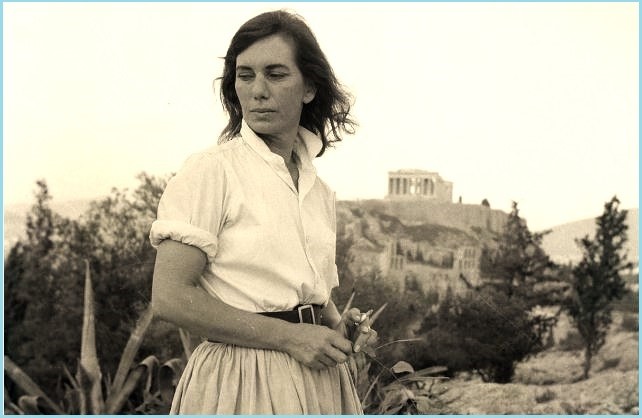
Charmian Clift in Greece
Charmian was born almost exactly a hundred years ago (August 30th 1923) into a working-class family in a little coastal town in New South Wales and always aspired to be a writer, an ambition which she duly managed to a considerable degree, though never quite to her satisfaction. Nonetheless she deserves to be recognised for the life she lived and the books that live on after her - which are in the process of being rescued from undeserved obscurity, and I am happy to champion her on her centenary.

Her first paid assignment was as a journalist on the women's supplement of the Melbourne Argus, Victoria's most popular daily newspaper, though she was writing short stories and had a novel in progress in the background. It was at the Argus that she met and fell in love with George Johnston, Australia's leading war correspondent and a published author. They had an affair which scandalised the publishing world in late 1940s Australia and ultimately led to George leaving his wife and both George and Charmian leaving the Argus. George was soon snapped up by Associated Newspapers in Sydney, they started a family and he and Charmian co-wrote a prize-winning novel 'High Valley ', as well as play scripts for ABC radio. By the end of the decade, the couple by now with young children in tow also opted to leave stuffy, provincial Australia and move to London where George's reputation secured him a posting as Associated Newspapers' European correspondent and head of their London office.

Charmian, as a proto-feminist, had high hopes of moving to England in the early 1950s but even this society she soon found was boring and prescriptive, and London was so grey and cold. Husband and wife literary partnerships are notoriously tricky ones, as we know, and with George as main breadwinner, she was always regarded by the world at large as the junior partner, Her role as wife and mother put a physical limit on her scope for creativity, she fell into the role of sounding-board for her husband's own literary endeavours, and despite the opportunities that London offered (like taking tea with T.S. Eliot for instance), she longed for a different, freer and more bohemian life for herself and her family. She was to find it in Greece, where she and George and the children moved in 1954 (first to the island of Kalymnos and later to Hydra). 

It was a brave decision the couple took to step away from the safety-net of a regular journalist's salary and try and support themselves by their own writing. At least the living would be cheap and the weather decent. They planned to co-write a novel about the sponge-divers of Kalymnos and lived off the publisher's advance while working on the book. At the same time, Charmian wrote an autobiographical account of their life on the island (see further down for details). The novel about the sponge-divers was a moderate success (and was even made into a film) but life on Kalymnos was extremely basic and the family chose after a year to relocate to Hydra, where they bought a house and lived for the next decade at the centre of what became quite a famous expatriate bohemian community (comprising Leonard Cohen, Marianne Ihlen, Axel Jensen, Sidney Nolan among others).

Charmian and eldest son on Hydra
Charmian and George wrote assiduously every morning, socialised over flagons of retsina with friends in the evening and then sometimes wrote on again into the night after the children were in bed, often fuelled by barbiturates if deadlines were looming, but their life although idyllic in one sense (they were in charge of their own destiny, Hydra was an enchanting place) was extremely taxing. Their literary works didn't do well commercially, partly due to their being unable to promote them in person in the key markets of  Australia, England or the USA. George even took to knocking out 'potboiler' crime fiction under an assumed name to keep some money coming in.

Then there were personal issues. Charmian was jealous of the fact that George's writing took precedence over hers because he was the more well-established of the two and more prolific, with a string of previous books to his name. George was jealous of Charmian because he felt she was actually the better writer and because she was vibrantly attractive to men. He constantly suspected her of  being unfaithful to him even though she wasn't (most of the time). He also contracted tuberculosis in 1959 while living on Hydra and suffered progressively from the condition. The task of caring for him fell of course to Charmian. 

And it was George who eventually decided to move back to Australia in 1964. Charmian was devastated, for she loved Greece, loved their house on Hydra and didn't want to leave. Neither did the three children who had grown up on the island almost as native Greeks. There was a suggestion that George was prepared to sell the house, abandon his wife and go back to Australia on his own. In the end they all went, the family stayed together, but Charmian still didn't much like the country of her birth once she was back in Sydney, for it was still stuck in its boring and prescriptive rut. She also worried that she was losing her looks, that her husband had begun to hate her, and alcohol became an increasing problem. Although she wrote a well-received weekly column in the Sydney Morning Herald , Charmian was in a depressed rut of her own, and in those five years between her return to Australia and her suicide, she never completed another novel. She felt a sense of failure, like Icarus descending, and I'm reminded of those plangent lines of Joni Mitchell's (herself no stranger to a Greek sojourn): "all romantics meet the same fate someday, cynical and drunk and boring..."   

The books which garnered her the most critical appreciation back in the late 1950s were her two beautifully written accounts of their lives first on Kalymnos ('Mermaid Singing ', its title deriving from Eliot's 'Love Song of J. Alfred Prufrock ') and then on Hydra ('Peel Me A Lotus ', named in reference presumably to Tennyson's 'Lotos-Eaters '). The good news is that they have both recently been republished. If you love Greece or just like the idea of it, these two volumes paint a brilliant picture of what island life was like in the 1950s before the advent of the international tourist. Unsurprisingly they are what connected me to Charmain Clift in the first place.


Her novels from the 1960s, 'Walk to the Paradise Gardens ' and 'Honour's Mimic '(a prize if anyone can say where that title derives from) have been stubbornly out of print however for decades, though a third, 'The End of the Morning ' still incomplete and unpublished at the time of her suicide, is finally going to appear in print next year.

Towards the end of her days, Charmian summed up her predicament succinctly as follows: "I miss the life, and it has occurred to me in the last three years that I am infinitely more isolated and more completely marooned in an Australian suburb than I ever was on a poor and primitive Greek island. Materially I am much better off, but spiritually I sometimes feel impoverished of the gaiety and social ease of Mediterranean living. 

In her poignant suicide note she stated: "I will cease upon the midnight and no pain - isn't that something? I would quite like some flowers. " She downed with a glass of wine all of her husband's phenobarbital tablets (which he kept against the day his own degenerative tuberculosis became too much to bear) and went to sleep lying on her right side with her hands together beside her head on the pillow.

This latest poem from the imaginarium may have something of the spirit of Keats' 'Ode To A Grecian Urn ' about it but there the similarity ends.

I Zoe/ Η ζωή (The Life)
How we marvelled in the presence of so much
beautiful pottery in one quiet Athenian museum.
Amphora, Attic cups, volute Craters and Hydria,
Oenochoe, Pelike and Pyxis, stunning  Stamnos

and my favourite the squat black Lekythos, each 
displayed with hand-written legend in a language
from millennia which we could as yet barely read
let alone speak - and Keats wasn't even in mind...

...though later we sought him out for such insight
as he had to share. Fifteen years into the future, I
Zoe in despair reflect on being blinded by Aegean
sun. There is no shadow there, our faults baked in

the clay for anyone to see, our feathers all unstuck,
romantic illusions buried by a cold midnight moon
and yet I miss the place, evenings at Douskos with
retsina flowing imbuing a happy weightlessness to

our fragile dreams. Sadly I fill my replica Lekythos
with Australian wine, moved again by the beauty of
its decorative design, musing that the truth we seek
seems always to be just round the curve of the vase.   
  
George Johnston and Charmian Clift in happier times
How could I possibly write  blog on the subject of pills and not include as a musical bonus Jefferson Airplane's masterful 'White Rabbit '? Grace Slick wrote the lyrics and music, drawing on her love of 'Alice In Wonderland ' for imagery and on her love of Spanish music, 'Bolero ' in particular, for the tune. The result was stunning in 1967 and remains a tour de force today. To listen via YouTube, just click on the song title here: White Rabbit.


Keep taking the good tablets and thanks for reading, Steve :-)

Thursday, 31 December 2015

Literary merit: Adventure beckons.

I am the youngest child of four, by a gap of seven years and born into an extrovert, bustling environment.  My eldest brother played rugby and swam for County; my sister was a ballerina: my youngest brother was a bike mad, pain in the proverbial. My parents were publicans, always pushed for time, busy in the kitchen or bar until late in the evening.  I might have been the neglected, late arrival but lucky for me ... we had Nana. No, not the large sheep dog, child-minder of AA Milne's imagined story but a real life, elderly lady called Phyllis: My maternal grandmother.  Nana lived with us.

Nana was a godsend to all of us, although she was (according to the others), very strict, I loved her. She was the eldest of three children and was fortunate.  Her parents were wealthy, so although she was born in  the very late 19th Century, she was educated and then taught dance, pianoforte, etiquette and deportment at a girl's boarding school in Windermere. At 38 and unmarried, she had a daughter, (my mother), and although she was running the family guest house in Bowness, her younger brother sent her away to London before the birth.  This was 1920: the times were changing, but unfortunately not quickly enough, for Phyllis, who had to take a post as governess to the children of the owners of a hat shop in the West End.  My mother was 'cared for' by Nun's.

Nana taught me to read.  She shared with me her love of the 23rd Psalm, Wordsworth's 'golden daffodils' and Keats Ode to a nightingale. She would take me for imagined walks, along the banks of her beloved Windermere, among the bluebells, just by looking at the picture on her bedroom wall. She loved birds, knew the Latin name of every plant and flower and laughed at chimpanzees and Elephants. We didn't have a piano then, so she would sing with me, dance with me and teach me to stand and sit up straight. Nana gave me most of the gifts that I treasure most. Best of all she gave me her time, the most precious gift of all.  I was encouraged to read everything that had literary merit. When I began reading for myself, I began a lifelong adventure.  Who knows where it will end ...


The library at Ephesus.
 
A Literary Journey
 
Opening a book is exploration
Start to read and who knows what I’ll find.
In each printed tome, each timeworn binding,
lies a snare to captivate the mind.
 
If I sit and study ancient volumes,
read adventure history and crime,
brave a New World sci-fi speculation,
dip in A Brief History of Time,
will I only browse the lives of others,
those who reach beyond the libr’y wall,
or will I grow wise,  as any elder,
eager for when destiny may call?
 
Reading takes me on a flight of fancy,
lets me live a thousand, million lives,
opens wonders of imagination,
helps me venture far beyond the skies.
 
Like the great explorers, I must travel,
seek the place where steps are seldom heard,
open up the cover of discovery.
All great journeys start with just one word.


Thanks for reading.  Adele

Sunday, 19 August 2012

Poetic Form and other ‘arse-dribble’…

By Jennifer Lane

“If poetry comes not as naturally as the leaves to a tree, then it had better not come at all”. John Keats said that, I’ll have you know. Or if you’re a closet fan of Hollywood biopics, it was uttered by a wispy Ben Whishaw. Whilst this is all very lovely, foppish, and just-lay-me-on-the-divan, it’s not always practical advice for everyday life. Keats probably never tried navigating Manchester town centre or working nine-to-five selling men’s knitwear. I’m sure he had too many clouds to gawp at.


We don’t all have the time to be lolling around, inspired; where every spilt dribble of espresso has an extra level of meaning. Whilst I’d love to be traipsing through bluebells (or even some realistic Astroturf), there aren’t many of us who can say we have a spare moment in the day.


Some might say that if you’re a poet in the busy busyness of the world, poetic form seems like a blessing.


Structure! Rhyming couplets! Enjambment! Just hook them to my veins! Having someone tell you how to formulate a poem can seem as straightforward as following the list for the weekly shop. You just have to fill in the blanks… right?


In his book, “The Ode Less Travelled”, Stephen Fry ordered legions of budding writers to embrace iambic pentameter: to take it into their bosoms and caress it like a slightly neglected, yet still loveable Labrador. But no, Stephen, no. As much as I am subject to your theatrical charms, I just can’t do it. Iambic pentameter is inarguably very impressive, and was extremely popular… about four-hundred years ago. But forcing language into this strict prescribed mould makes for stilted reading and some wincingly bad rhymes. Its painful de-dum-de-dums make me think of a Year Five literacy class, minus the promise of Play Doh.


John Donne always said that words “fetter’d in verse” are enhanced in meaning. But sometimes focusing too much on structure can leave the real meanings bedraggled and forgotten.


I am a massive fan of free-verse. I find it endlessly creative, thought-provoking and just a little bit fabulous. Mr Fry intervenes once more and labels it “arse-dribble” (a phrase which I do find a lexical dream); but this seems to be missing a point. Free verse gives free-reign to the imagination, and hey, if I want to use that twenty-seven syllable line, I bloomin’ well will!


Poetry has evolved away from the forced verse of Tudor courts. Although classic poetic form can still be appreciated in hushed gallery awe, throwing off a rigid format can give a poet more space to breathe. People are not structured – our lives are busy: overflowing. Maybe our poetry should be too.

Tuesday, 22 November 2011

Ekphrasis: A Writing Exercise

As some of you will already know (because I keep harping on about it), I spent last week at a writing residential in North Wales. This is the second time that I’ve been to Ty Newydd, and neither occasion has disappointed. Each day was loosely structured to include a writing workshop in the morning, free time in the afternoon to write / read from the vast collection of poetry books in the library, and a reading / Q&A in the evening. I was inspired. I wrote a lot. Most of which is unusable, but there are a few pieces that contain faint flecks of potential – and, for me, that makes for a fairly successful week.

The piece that follows is a written version of what I took from Tuesday’s workshop on ekphrasis. I’d experienced this workshop before (last year in fact), but it has been an exercise that I have employed regularly when I’ve been stuck, or when I have found myself regressing back to my cryptic ways. This workshop was crucial to my development and learning in the first year of my MA, and enabled me to change my opaque poetry into something that was less difficult. I hope that you find it as useful as I have found it.

* * *

The term “ekphrasis” derives from the Greek ek, “out of”, and phrasis, “speech” or “expression”. In poetry and literature it is used to describe a poem or a section of prose that translates or speaks of a piece of art; you have probably read many examples of ekphrasis without realising that you were reading an ekphrastic poem.

For example, John Keats’ poem ‘An Ode to a Grecian Urn’ uses an ancient artefact as a subject, allowing the speaker to address it directly, while also describing some of the pictures on the object’s surface. Keats used one form of art – a stimuli for inspiration – and translated it into another art form. However, it is also possible to construct an ekphrastic poem without a ‘real’ work of art (notional); Robert Browning’s ‘My Last Duchess’ is an excellent example of this. The painting that the Duke of Ferrara addresses is not real outside of the poem; it has been imagined by Browning, enabling the Duke to plausibly speak to his dead wife as if she were alive and encouraging the reader to think of her as a real person.

In recent times, photographs have become a popular focus within poetry - and despite capturing a very specific and static moment, they offer a variety of directions and options. The poet needs to make decisions, and perhaps the most crucial decision is POV: who’s eyes will we see through? who will be the speaker in the poem? Personally, I think some of the most successful ekphrastic poems are those that do something interesting with POV. For example, in ‘I Go Back to May 1937’ sees the speaker (daughter) travelling back in time to her parents graduation day (the photograph), just prior to their marriage. She wants to warn them, “I want to go up to them and say Stop, / don’t do it – she’s the wrong woman, / he’s the wrong man”. Similarly, in ‘Long Exposure’ (Neil Rollinson) the use of POV is striking; the poem steps away from the photograph and hovers more generously on the photographer. However, the speaker is a further step away from the photographer, observing his movements and the process of taking a photo. The reader is never given an exact description of the final image; we’re left to imagine the results, only able to see what the twice-removed speaker is capable of seeing / describing to us.

The Poem & the Photograph: A writing exercise

1) Find a photograph. I like to open a book like A Year in Photography: Magnum Archive at a random page and then write. However, things like weekend newspaper supplements, old photo albums, or even a Google image search can offer countless photographs – and endless sources of inspiration.

2) Consider POV. The options here are as unrestricted as your imagination will allow. You could choose a speaker who is contained within the photograph: a person, an object, a shadow. Alternatively, you could decide that your speaker is external (outside of the photograph): the photographer, a bystander, or even (as demonstrated in the Sharon Olds’ poem above) a person’s experience on viewing a photograph.
The above list isn’t extensive, it’s more of a starting point to get you thinking about the importance of POV and voice, and the way in which it can greatly influence the subsequent direction of your poem.

3) Think outside the frame. Don’t allow yourself to be restricted by what is within the picture frame. Photographs have edges, boundaries, but our minds are without such parameters. You can fill in what the snapshot hasn’t captured; the scene around the edges, the scene in front of the photo.

4) Experiment with time. It can sometimes be interesting to shift time, hypothesise about what happened 30 seconds before or after the photograph was taken and imagine what the ‘new’ photo would have looked like. Equally, this can be exaggerated to include greater time gaps; you might like to work away from a specific moment in time towards a future time, asking: Where are these people now? Are they still alive? What happened to them? (See ‘Six Young Men’ by Ted Hughes)

Thank you for reading,
Lar