written and posted by members of Lancashire Dead Good Poets' Society

Showing posts with label Threads. Show all posts

Saturday, 14 September 2024

Threads

22:12:00 Posted by Steve Rowland , , , , , 8 comments
It's high time for a holiday. I must admit to feeling a little threadbare. Therefore this will be my last Saturday Blog for a couple of weeks. Sunny Corfu has been calling for a while, so we're shortly off to relax, recharge and unravel our knotted threads, a seasonal unwind before plunging back into the fray.


I have, however, written a snippet of a poem on topic. I couldn't let you down, could I? It's a stitch up of an acrostic...

Threads (a cross-stitch poem)
Tension is most important. Build it!
Hands should be taint free. Absolve them!
Reference points must be centred. Triangulate!
Even weaving Aida is your friend. Choose her!
Always use clean needles. Never share! 
Do the actual business. Cross, back, quarter, knot! 
Secure your floss. Oops! I did warn you. All that painstaking work unravelling. Don't get cross!

Thanks for following, S ;-)

Wednesday, 11 September 2024

Threads

T and I were discussing the topic when for some reason the conversation veered off to talking about the origins of Threadneedle Street. We didn’t get very far before she said we’re losing the thread. Thanks for that intro T.

I had been thinking, as I live in Lancashire, that I’d use cotton as the subject of this blog but then got to thinking about what was used before that material and we have to go far back in human history to the Palaeolithic Era, let’s say about 50,000 years ago or more.
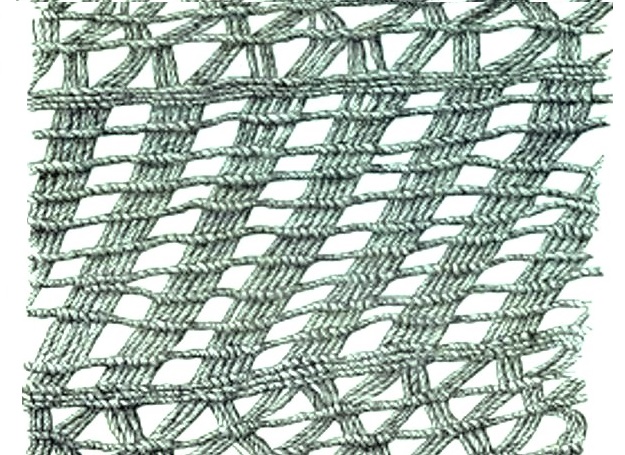
Prehistoric Twined Fabric, Ohio Valley
Archaeologists believe Stone Age people across Europe and Asia sewed fur and leather clothing using bone, antler or ivory sewing-needles and ‘thread’ made of various animal body parts including sinew, catgut, and veins. The process of making thread was simple – people made thin strips and then produced garments from them. Likewise, plants were used in the process too. Plant fibres were hand-spun into thin strips until it took the shape of a thread.

As an aside I came across the following information:
‘The very earliest evidence for clothing fabrication comes from an unlikely source: lice. Between 80,000 and 100,000 years ago, head and body lice became separate species. “This is an indication that individuals started wearing skins,” says Sarah Wurz, an anthropologist at the University of the Witwatersrand’.

As humans advanced in technology so did the type of material used to make threads advance.

Splicing Thread (image: Cambridge University)
The Egyptians were skilled at making thread from plant fibres and in using the wool and hair from domestic animals in spinning. They and the Phoenicians also pioneered the use of berries and plant matter in the manufacture of colourful and long lasting dyes about 4,000 years ago.

The Chinese and Japanese in around 3000 BCE discovered the beauties of silk fibres spun as thread and made as cloth.

In north America the Inuit, for example, used sinew from caribou for thread and needles made of bone, the indigenous peoples of the American Plains and Canadian Prairies used sophisticated sewing methods to assemble tipi shelters. Sewing was combined with the weaving of plant leaves in Africa to create baskets, such as those made by Zulu weavers, who used thin strips of palm leaf as thread to stitch wider strips of palm leaf that had been woven into a coil.

And how about this:
Tailorbirds (genus Orthotomus), such as the common tailorbird, exhibit sewing behaviour, as do some birds of related genera. They are capable of stitching together the edges of leaves, using plant fibres or spider silk as thread, in order to create cavities in which to build their nests.

Tailorbird and Nest
And just for T let’s go back to Threadneedle Street. Some believe that the name originated as Three Needle Street, first attested to in 1598, perhaps from a signboard portraying three needles, or from the three needles on the arms of needle-makers who had premises on the street. The threads and needles used by the members of the Worshipful Company of Merchant Taylors is another possibility, since the livery company's hall has been located on Threadneedle Street since 1347.

The article above relates to prehistoric times. The poem below suggests a near future time.

A Legacy of the Last Century

One of the treasures
I managed to grab,
before being evacuated,
was a handmade quilt
patches of different colours
sewn by my mother’s mother.

It fulfils its purpose
but in addition,
in a certain light,
in a certain mood,
its blues, greens and whites
remind me of Earth
as it used to be

And from this new vantage point,
both literally and figuratively,
I can make out threads
unstitched over the years
flaccid poles
flagging the end of what we knew.

Nationalism, Communism, Capitalism
primary types of isms.

I called them Prisms
in some text book or other,
a term I was rather pleased with,
which seems to have caught on,
with its hints of refracting
what was happening beneath the covers.

From my pamphlet ‘Notes on the Causes of The Third World War’ published by Indigo Pamphlets in 2020.


Thanks for reading. Comments welcomed. Terry Q.

Tuesday, 10 September 2024

Threads - A Stitch In Time


My paternal grandmother was a professional tailoress. She objected to being referred to as a dressmaker as she made clothes for everyone. Most of my childhood clothes were made by her and also, a beautiful, pink satin eiderdown for my first ‘big girl’ bed. It was beautiful and I wish I still had it. My mum and I had summer dresses in matching fabric. My dad and granddad always had smart trousers. It is sad that Nanna Hetty passed away when I was only eight years old, but from being about four or five, she’d taught me a few skills. I could thread a needle, sew a neat running stitch and sew buttons on to a piece of spare fabric. These small things sowed the seed for my future sewing abilities. At secondary school, I excelled in needlework. Over the years I’ve made clothes for myself and my daughter and made items of soft furnishings. As my eyesight worsened, it became a difficult task and these days I just sew buttons back on, mend things and sew name labels on school uniforms. From Nanna Hetty’s background, I learnt about a different type of thread than anything she had on her bobbins. It was family and the invisible thread that fastens us together, which I came to appreciate more when I started to research my family tree.


When our maternal aunt died, my sister and I, as next of kin, were tasked with dealing with everything. Amongst her belongings was a large envelope with my name on. It wasn’t private, it was open and over-filled, containing old family papers, certificates and important letters, directed to me because of my interest in family history.  Eventually, I got round to going through the contents, being very careful with delicate items. Most was self-explanatory but there was the running thread of a surname that was unfamiliar to me. Clearly, this name belonged in the family, somewhere. I needed to discover more and solve the mystery. Looking into my ancestry gave me the answers.


This year marks twenty years since I began to search online, piecing my family tree together. I have followed my paternal line to Southern Cemetery in Manchester, where upon finding a clerical error in their data input, I was able to help them to correct it and find the grave I wanted. I knew that my Nanna Hetty was orphaned as a baby as she’d told me, but I don’t know if she knew anything about her parents, in particular that her father was employed as a tailor’s assistant. That thread was definitely in her bloodline. The unfamiliar name in my maternal family turned out to be my great-grandmother’s maiden name. I’m grateful to Cheshire Births, Marriages and Deaths website for that discovery, long before I started on Ancestry.co.uk. My family tree, even now, is a work in progress. Now and again I pick up a known thread, which is often more than one person and see where it leads. These are the threads of life in my family, which will weave on into future generations.

I found this poem,


The Way It Is

There’s a thread you follow. It goes among
things that change. But it doesn’t change.
People wonder about what you are pursuing.
You have to explain about the thread.
But it is hard for others to see.
While you hold it you can’t get lost.
Tragedies happen; people get hurt
or die; and you suffer and get old.
Nothing you do can stop time’s unfolding.
You don’t ever let go of the thread.

William Stafford   1914 – 1993


Thanks for reading, Pam x

Monday, 9 September 2024

Threads: Clever Lancashire Lads

When I think of threads, I think of Lancashire and textiles. Historically Lancashire was a perfect place to develop this industry due to its damp climate that kept cotton fibres moist and less likely to break.

The quick development of the textile industry at the beginning of the Industrial Revolution in the 1700s was largely due to some clever Lancashire lads. Three major innovators were John Kay (1704-1779) from Bury, Richard Arkwright (1732-1792) from Preston and John Mercer (1791-1866) from Great Harwood.

John Kay, Richard Arkwright and John Mercer (images: LCC Museum Service/Lancashire Archives)
John Kay invented the flying shuttle machine that allowed a single weaver to weave significantly wider fabric and it could be mechanised. Kay’s invention patented in 1733, sped up the process and also the need for spun yarn.

Flying Shuttle Machine (image: Lancashire Archives)
This is where Arkwright steps in, the man who became known as the ‘father of the modern industrial factory system’. Whilst travelling across Britain collecting hair for his wig business he met John Kay. He was so taken with Kay’s machine that he had one secretly built and then developed his own spinning frame known also as the water frame which expedited production. Arkwright also developed a rotary carding engine that became important in textile manufacturing. Not sure what happened to his wig business.

Richard Arkwright's Water Frame - Drawing 1769 (image: Lancashire Archives)
John Mercer contributed to the development of the textile industry differently. According to Vicci McCann, Archivist – Engagement Lead at Lancashire Archives:
Mercer was a self-taught chemist and particularly interested in the dying process, which led him to develop a process still used in the textile industry today called 'mercerisation'. He also practiced with 
printing early photographs with a colour wash on fabric.

Dye Samples (image: Lancashire Archives)


Samples of John Mercer Printing Photographs on Fabric (image: Lancashire Archives)
I had no idea what mercerisation was so looked it up. According to Oecotextiles it is:
a process applied to cellulosic fibres – typically cotton (or cotton-covered thread with a polyester core) but hemp and linen can be mercerised also – to increase lustre.

At the beginning of the American Civil War (1860-1865) there were 2,650 Lancashire cotton mills in Lancashire. The war had a devastating impact on the textile industry creating a Cotton Famine of the high quality raw cotton (Surat cotton was substituted at that time) causing much hardship.

The industry peaked around 1912, producing 8 billion yards of cloth. Production went into overall significant decline during WW I when cotton manufactured products could no longer be exported abroad and for other various reasons continued its downturn.

The industry did have a boost during WW II with uniforms and parachutes in high demand. The boost continued into the 1950s when a large number of people came to Britain from the Indian sub-continent and were encouraged to find work in the mills creating opportunities to increase the number of shifts and ultimately increase production.

Competition from abroad followed shortly thereafter causing Lancashire mills in the 1960s and 1970s to close at a rate of nearly one a week. By the 1980s the textile industry sadly had all but disappeared leaving empty buildings within communities needing to reinvent themselves.

In 2021 there were 158 mills still in existence in Lancashire and 93 textile mills in Pendle alone. Many of these are still vacant since closing or are not being used to their full potential. A current Pendle Council project has plans to create a ‘design code’ with the local community for the remaining Pendle area mill buildings offering hope for preservation and possible new life for many of these formidable structures.

To see an historic mill in action you can visit Queen Street Mill Textile Museum in Burnley and Helmshore Mills Textile Museum in Helmshore, both run by Lancashire County Council Museum Service.

And now for something completely different…

Threads

Make a skirt or shirt or pants
for naked snakes and elephants
and other creatures small or tall
that wear no clothes, no clothes at all
even if they’re covered with hair
essentially their butts are bare
but then who cares, they could care less
whether they wear a fancy dress
or strut about in a fancy suit
they do not care or give a hoot,
but owls hoot and owls fly
covered in feathers in the moonlit sky
as I’m dreaming of fabric, a needle and thread
dressed in pyjamas snug in my bed.

Thank you for reading.
Kate

J


Sources
BBC, 2014. Boom to Bust the Decline of the Cotton Industry. https://www.bbc.co.uk/nationonfilm/topics/textiles/background_decline.shtml#:~:text=During%20the%201960s%20and%2070s,West%20had%20all%20but%20vanished Accessed 2 September 2024.
Britain Express, 2024. Richard Arkwright. https://www.britainexpress.com/History/bio/arkwright.htm Accessed 2 September.
Eugene Textile Centre, 2024. John Mercer. https://www.eugenetextilecenter.com/john-mercer Accessed 28 August.
Lancashire County Council, 2024. John Kay and the flying shuttle. https://lancashiremuseumsstories.wordpress.com/2020/05/22/john-kay-and-the-flying-shuttle/ Accessed 2 September.
Macdonald, R., 2024. What next for borough’s 93 ‘at risk’ mills?. https://www.bbc.co.uk/news/articles/cy6898jv26wo Accessed 2 September.
Make It British, 2024. The Decline of the Lancashire Cotton Mills. https://makeitbritish.co.uk/blog/lancashire-cotton-mills/#:~:text=By%201860%20there%20were%202650,exported%20all%20over%20the%20world Accessed 28 August.
McCann, V. 2024. Email to Kate Eggleston-Wirtz, 18 June.
Oecotextiles, 2024. What Does “Mercerized” Cotton Mean?. https://oecotextiles.blog/2012/12/05/what-does-mercerized-cotton-mean/ Accessed 6 September..