T and I were discussing the topic when for some reason the conversation veered off to talking about the origins of Threadneedle Street. We didn’t get very far before she said we’re losing the thread. Thanks for that intro T.
I had been thinking, as I live in Lancashire, that I’d use cotton as the subject of this blog but then got to thinking about what was used before that material and we have to go far back in human history to the Palaeolithic Era, let’s say about 50,000 years ago or more.
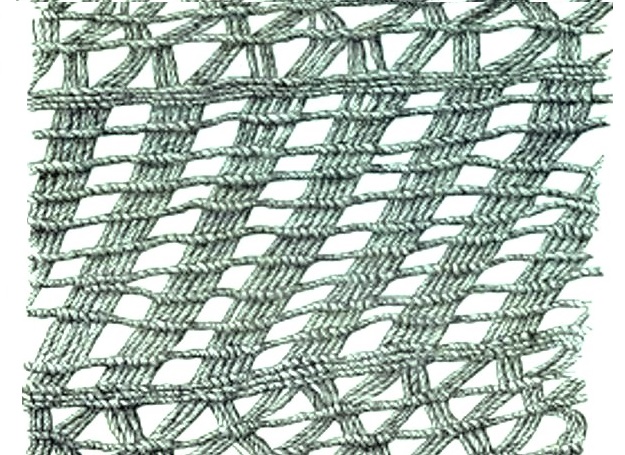 |
| Prehistoric Twined Fabric, Ohio Valley |
Archaeologists believe Stone Age people across Europe and Asia sewed fur and leather clothing using bone, antler or ivory sewing-needles and ‘thread’ made of various animal body parts including sinew, catgut, and veins. The process of making thread was simple – people made thin strips and then produced garments from them. Likewise, plants were used in the process too. Plant fibres were hand-spun into thin strips until it took the shape of a thread.
As an aside I came across the following information:
‘The very earliest evidence for clothing fabrication comes from an unlikely source: lice. Between 80,000 and 100,000 years ago, head and body lice became separate species. “This is an indication that individuals started wearing skins,” says Sarah Wurz, an anthropologist at the University of the Witwatersrand’.
As humans advanced in technology so did the type of material used to make threads advance.
 |
| Splicing Thread (image: Cambridge University) |
The Egyptians were skilled at making thread from plant fibres and in using the wool and hair from domestic animals in spinning. They and the Phoenicians also pioneered the use of berries and plant matter in the manufacture of colourful and long lasting dyes about 4,000 years ago.
The Chinese and Japanese in around 3000 BCE discovered the beauties of silk fibres spun as thread and made as cloth.
In north America the Inuit, for example, used sinew from caribou for thread and needles made of bone, the indigenous peoples of the American Plains and Canadian Prairies used sophisticated sewing methods to assemble tipi shelters. Sewing was combined with the weaving of plant leaves in Africa to create baskets, such as those made by Zulu weavers, who used thin strips of palm leaf as thread to stitch wider strips of palm leaf that had been woven into a coil.
And how about this:
Tailorbirds (genus Orthotomus), such as the common tailorbird, exhibit sewing behaviour, as do some birds of related genera. They are capable of stitching together the edges of leaves, using plant fibres or spider silk as thread, in order to create cavities in which to build their nests.
 |
| Tailorbird and Nest |
And just for T let’s go back to Threadneedle Street. Some believe that the name originated as Three Needle Street, first attested to in 1598, perhaps from a signboard portraying three needles, or from the three needles on the arms of needle-makers who had premises on the street. The threads and needles used by the members of the Worshipful Company of Merchant Taylors is another possibility, since the livery company's hall has been located on Threadneedle Street since 1347.
The article above relates to prehistoric times. The poem below suggests a near future time.
A Legacy of the Last Century
One of the treasures
I managed to grab,
before being evacuated,
was a handmade quilt
patches of different colours
sewn by my mother’s mother.
It fulfils its purpose
but in addition,
in a certain light,
in a certain mood,
its blues, greens and whites
remind me of Earth
as it used to be
And from this new vantage point,
both literally and figuratively,
I can make out threads
unstitched over the years
flaccid poles
flagging the end of what we knew.
Nationalism, Communism, Capitalism
primary types of isms.
I called them Prisms
in some text book or other,
a term I was rather pleased with,
which seems to have caught on,
with its hints of refracting
what was happening beneath the covers.
From my pamphlet ‘Notes on the Causes of The Third World War’ published by Indigo Pamphlets in 2020.
Thanks for reading. Comments welcomed. Terry Q.


