written and posted by members of Lancashire Dead Good Poets' Society

Showing posts with label etymology. Show all posts

Friday, 8 August 2025

Schmetterling

They sit and suck the nectar from our Buddleia. The Buddleia that came with us, a rogue seedling in a pot, abandoned on the Blackpool house patio. The one that has blossomed into a massive bush and beautiful mess here in our garden in Scotland.

Red Admirals, Peacocks, Large Whites, Tortoiseshell (large or small - who knows), now in August. Earlier in the year, many Orange-Tip. At local nature reserves, Meadow Browns and the odd Speckled Wood.

Orange Tip butterfly
An occasional Painted Lady – or could it be one of Fritillaries – resting on the sunny house wall. By the time I have located my phone, or a camera, they have taken off, of course.

This past week, one of the Admirals or Peacocks, resting on Comfrey leaves, large and hairy and almost gone over as they are, directly in front of my window to the garden, at my desk. No food there, just sun, shelter from the winds, perhaps.

What do we know about these insects that are so often used as a metaphor for delicate spiritual beauty, as well as the transformation they undergo? 

Peacock butterfly
The Big Butterfly Count is in its last few days, recording sightings in the British Isles. You can link to its website here: big butterfly count It is one of the ways to learn more about these insects with two pairs of colourful scaly wings as they are described in one of the many dictionaries I consulted in research.

I wanted to know why the names in English and German – butter-fly and Schmetter-ling – are so different. To find that they are not. Schmetter – as in the Schmetter-ball of tennis and table tennis, a shot of such power that it is un-returnable, turned out to be one of those funny language things where the sense of a word is changed by the change of one letter. In this case, SchmetteR-ling (ling being a word-part that makes a word a noun) used to be, or should be, SchmetteN-ling: and Schmetten is a Southeast German dialect word for cream, or butter. You see the connection - the butter - in the English butter-fly? A German etymology dictionary takes this – in my mind a little disgusting – image of an insect that lands in butter or cream and creates a mythical metaphor of witches (Hexen in German) who fly around disguised as colourful insects, in order to steal butter and cream from dairy farms. Thieves, in other words. How we went from thieving flying Hexen to symbols of spiritual beauty? That would be another deep rabbit hole to dive into.

Tortoiseshell butterfly
Instead, please find below an early draft of a poem in a series titled ‘Ten things Blue’:

Butterfly

We found you | in our special place | the one with all the rocks | the wild 
plants that flower | some | when we come here on birthdays | sunshine days | 
days we just need to be here | the place where I remember | the 
Mediterranean | rocky coasts | from before

you flapped and you fluttered | never sat still long enough| for me to see you 
properly | never mind take a photograph

you kept me busy back at home | until I found you | Common Blue | not that 
common | not like a colourful dog | known to all and sundry | only the most 
common | of the blue ones | and every book about blue things | says how 
uncommon | blue | is in nature

I don’t know | but I see blue things everywhere | flowers | they stand still for 
me | to know them | Tufted Vetch | Meadow Cranesbill | Forget-me-not | of 
course | Milkwort | these too in our special place

And the Blaue Blume | could it be one of those | have I found it already


Postscript: any words you may not recognise in the blog or poem are easily googleable. Enjoy!

Angela

Monday, 4 November 2024

A Brown Study Of Brown

A ‘Brown Study’ is a mood when one is involved in deep thought and not paying attention to anything else. I am very familiar with this, particularly when lost in the midst of creative endeavours or researching something of particular interest. Writing this article caught me in this frame of mind as I researched all things brown.

Ancient Cave Paintings of Hands at Cueva de Las Manos in Santa Cruz Province, Patagonia, Argentina ©R M Nunes/Adobe Stock
Etymology
The English word ‘brown’ has been in use for nearly a millennia. The word is derived from Middle English ‘broun’, Old English/French/Old High German ‘brun’, Norse ‘brún’ and/or Proto-Germanic ‘brunaz’ all meaning that earthy colour that falls between the yellow and red spectrum.

The Colour
Brown is one of the first colours that humans used to create imagery as evidenced in cave paintings with pigments made from clay or hematite (a heavy and relatively hard oxide mineral that produces reds, oranges, yellows and browns). Some of the brown pigments found in cave paintings were made from a clay pigment called ‘umber’ dating back to 40,000 BC. Raw umber, a dark brown clay mined in Umbria, Italy (also found in other parts of the world) produces the colour brown with a greenish grey tint whilst burnt umber (roasted umber) creates a warmer hue. The use of umber as under-painting became popular among painters in the Renaissance. It continues to be popular with artists today.

Mia, Burnt Umber Underpainting and Final Portrait, Oil on Canvas,© 2021 Julia Swarbrick
Artists use an array of different shades of brown that can be created in a variety of ways such as mixing red, yellow and blue together or adding a splash of black to orange paint. In the printing industry and those using image programmes on a computer there are two colour systems, CMYK and RGB. Using the CMYK colour system brown is created by mixing red, black and yellow.

The RGB system mixes red and green. Both of these systems were developed during the early
twentieth-century.

When identifying different variants of brown, many have been named after something i.e. coffee, chocolate, peanut, walnut, sand, fawn, saddle brown and wood. Wood brown can be defined further into types such as ash, chestnut, mahogany and hazel. All this identification is advantageous as visual imagery comes to mind when the word is spoken. One can conjure up an idea of what shade of brown something actually is without necessarily seeing it, thus improving communication between folk. Humans seem to be obsessed with description and labelling which brings us around to people named Brown.

The Surname
The practice of using surnames in England began after 1066 eventually spreading throughout Britain and beyond. It is believed that people were originally nicknamed ‘Brown’ because of the colour of their hair, eyes and/or complexion that eventually developed into a nickname or surname. In Scotland, Brown as a surname is very common. In this neck of the woods the origins could also be derived from the Gaelic ‘brehon’, meaning judge.

There are many famous people named Brown including fictional characters like Mr Henry Brown in Paddington, Emmett Brown in Back to the Future and the cartoon character Charlie Brown.

Wikipedia lists well over three hundred people of notoriety with this surname. Included in this list are several James Browns with possibly the most famous being the American singer, songwriter and dancer James Brown (1933-2006) who had hits like I Feel Good and Papa’s Got a Brand New Bag (this musical titbit is for you Steve R.).

Other lesser known James Browns in contemporary circles, who were top in their professions at the time include James Campbell Brown (1843-1910) a British chemist, Dundee architect James Maclellan Brown (c.1886-1967) and James Brown (1832-1904) a Scottish poet/essayist who signed his works J.B. Selkirk (James Brown of Selkirk).

Selection From The Last Epistle to Tammus by JB Selkirk
And as a final fun fact, ‘Brown Cow’ is not just a brown-coloured bovine that gives milk, but a previously used playful name for a beer barrel in Selkirk’s homeland.

All Things Brown

Brown study, study of brown.
Run around in a dressing gown.
Brown like a bear - brown, brown, brown,
grr, grr, grrring in a run around town.
In and out of town through woods,
the forest, nature’s neighbourhood
filled with brown dirt, plants, and trees,
chestnut, hazel - fawns and fleas.
All things brown, all things good,
like them, love them as one should.
Brown, brown, brown and just like that
my bare bear foot stepped in scat.

Thank you for reading.
Kate
J

Sources
Ancestry, 2024. Meaning of the first name Brown. https://www.ancestry.co.uk/first-name-meaning/brown?srsltid=AfmBOorbWn5AS7LM5WLIQzwW3Tqq10Pn9gVceCOkyD78j0uW-KTvU_o8 Accessed 20 October.
Britannica, 2024. Brown. https://www.britannica.com/science/brown-color Accessed 20 October.
Cambridge Dictionary, 2024. Brown Study.
https://dictionary.cambridge.org/dictionary/english/brown-study Accessed 20 October.
Canva, 2024. Everything about the color brown. https://www.canva.com/colors/color-meanings/brown/ Accessed 24 October.
Hansen, T.A., 2017. Natural Earth Paint through the Ages: The Prehistoric Era-. https://www.naturalearthpaint.eu/en/blogs/blog/natural-earth-paint-through-the-ages-the-prehistor/ Accessed 25 October 2024.
Harrington, J., 2020. How now brown cow. https://www.anchornews.org/2020/01/23/how-now-brown-cow/ Accessed 31, 2024.
Nova Colour, 2022. Understanding the Color Brown and its Shades. https://novacolorpaint.com/blogs/nova-color/color-brown-and-its-shades Accessed 27 October 2024.
Oleson, J., 2024. 128 Shades of Brown: Color Names, Hex, RGB, CMYK Codes. https://www.color-meanings.com/shades-of-brown-color-names-html-hex-rgb-codes/ Accessed 20 October.
Selkirk, J.B., 1905. Poems. R & R Clark Ltd. Edinburgh. https://upload.wikimedia.org/wikipedia/commons/8/83/Poems_%28IA_poemsselkirk00selkiala%29.pdf Accessed 25 October 2024.
Wikimedia, 2024. Poems by J.B. Selkirk.
https://upload.wikimedia.org/wikipedia/commons/8/83/Poems_%28IA_poemsselkirk00selkiala%29.pdf Accessed 25 October.
Wikipedia, 2024. List of people with surname Brown. https://en.wikipedia.org/wiki/List_of_people_with_surname_Brown Accessed 31 October.

Thursday, 31 May 2018

Appetence - seems it's all we need.

I hate to admit that the word appetence is new to me. Despite my English degree, this word has escaped my notice. I had to look it up. It wasn't in my Oxford Advanced Learner's Dictionary so before I resorted to on-line versions, I dug out my battered, Chambers Etymological and there it was, defined in all its glory: 'Appetence - n - a seeking after: desire, especially sexual desire'.

As I browsed the list of words that follow, I found, 'Appetite  - n - a natural desire: desire for food, hunger.  From Latin appetitus. See 'appetence'. There is a very interesting difference that you may have spotted - appetite is described as a 'natural' desire: appetence is not. 

Yesterday evening I was dining with my son and because I enjoy the early evening antique programmes, the TV was on in the background. When the advertisements came on, there was one that drew my son's attention. A young man and girl in her bedroom, about to have sex when her father comes to the door. The young man makes no attempt to put his jeans on - he takes some chewing gum from his pocket, sticks it in his mouth and simply says, "Hi I'm Tom." I have to say that I find this comical. My father would have murdered him and I can't imagine that he'd get a smile from the father of most young girls - at least I hope not. It was my own son's reaction to the advert that really struck me as interesting. He said, " Everything is about sex now Mum, isn't it?" 

It's true. Everything - certainly when it comes to advertising - is about sex. I would like to tell him that this is something new - but of course the advertisers will tell you that 'sex sells'. I only have to think about the publication of Fifty Shades of Grey and its subsequent success as a movie blockbuster. Sex sells. It's a fact. But it is healthy? Selling chewing gum or toothpaste to young people with the implication that it will get them a brief encounter on a train or a pat on the back from a girl's father doesn't seem healthy to me. Perhaps I am old fashioned. When I was a girl, a man in black could climb into your bedroom but at least he was only leaving a box of Milk Tray. My Dad would still have murdered him.

The advertising industry did not begin the interest in the pursuit if sexual desire - it merely tapped into it.  E L James was not the first writer to capitalise on the appetence (see I am getting the hang of this now) of the general population. We can go back to the 18th Century to the writings of the Marquis de Sade when looking for the source of the problem.

He was held in he Bastille before being moved to an insane asylum, His cell was searched and a copper cylinder was found in a crevice in the wall: it contained the manuscript of an unfinished novel called The 120 Days of Sodom or The School of Libertinage. Even when incarcerated for his extreme sexual behaviour, Sade continued his appetence with the thirteen year old daughter of his jailer. 

The once unpublishable novel has now joined the ranks of Penguin’s Classics for the first time, and its author will take his place alongside the great figures of world literature – many of whom would no doubt turn in their graves at the news that their club now counted Sade among its members. Yet many of the surrealists and great writers of the modern age have been influenced by his works. It seems that the pursuit of sexual desire has always 'sold'. 


I am not going to lecture anyone but to me the beauty of an intimate relationship is in discovery. The modern high street abounds with kinky lingerie and shops selling sex toys.  I believe that if sexual desire is corrupted by sadism it can only end badly. In the film about Sade starring Geoffrey Rush, he was denied writing materials but continued to write in his own blood on his cell walls. He would constantly shout about obscene acts until in exasperation they cut out his tongue. 

 So here I am - the new Mary Whitehouse, setting out to censor the advertisers. My son is 29 and worries about the overt sexual nature of advertising. Perhaps it's about time we all did.  As the books states, appetence, unlike appetite is not a 'natural' desire. By the way - if you have copies of Fifty Shades of Grey, please don't give them to charity shops, they have been given so many that they have to be put on pyres and burned, for the sake of future generations.

I won't apologize for the lack of a poem on the subject. I am working on it quietly - in my own time.  
 
 
Thanks for reading. Adele  


Thursday, 21 April 2016

Tragedy - Greek goats love to climb trees.

Tragedy -
noun (plural tragedies)

1 - An event causing great suffering, destruction, and distress, such as a serious accident, crime, or natural catastrophe: a tragedy that killed 95 people [mass noun]: his life had been plagued by tragedy
2 - A play dealing with tragic events and having an unhappy ending, especially one concerning the downfall of the main character: Shakespeare’s tragedies
2.1 [mass noun] The dramatic genre represented by tragedies: Greek tragedy (O.E.D)

Origin - 
Late Middle English: from Old French tragedie, via Latin from Greek tragōidia, apparently from tragos 'goat' (the reason remains unexplained) + ōidē 'song, ode'. (O.E.D) 

According to Susie Dent, the attractive, dark-haired lexicologist of TV's Countdown (dictionary corner), "It is absolutely true that the word ‘tragedy’ has roots in a Greek word meaning ‘goat-song’.  Many theories have been offered to explain it. One is that Greek tragedies were known as goat-songs because the prize in Athenian play competitions was a live goat. The contests were part of worship to Dionysus, involving chants and dances in his honour. The Romans knew Dionysus later as Bacchus, god of all things ‘bacchanalian’: in other words he freed people from their normal self through madness, wine, and ecstasy".

In her book, 'What Made the Crocodile Cry?' Susie explains that sometimes the goat would be sacrificed, and a goat lament sung as the sacrifice was made. Hence the goat-song became intertwined with the Greek plays.

Others believe that in the plays themselves men and women would wear goat-costumes to dress up as satyrs—half-goat beings that worshipped and surrounded Dionysus in his revelry. Another and more interesting idea is one that was offered in the Guardian’s celebrated Notes & Queries section. In answer to why the word tragedy comes from a word for goat-song, a Mr Marcus Roome of Clapton in London wrote simply: ‘Have you ever heard a goat sing?’

Funnily enough, my sister once kept a goat called Miranda. She wasn't sacrificed, partly due to not being reared in Greece and partly because she was a pet. The thought now crosses my mind to ask, "Why do Greek goats climb trees?" Perhaps it was to avoid being sacrificed during the performance of a play. I also wonder whether the idiomatic phrase, 'acting the goat' also derived from this original root.  Etymology is a fascinating pastime, at least to the extent that it has helped me to knock out a blog in half an hour.

I won't apologise for cutting corners today.  The sun is shining and after a hectic few days helping to organise an event to commemorate 400 years since William Shakespeare died at the age of 52, I wanted to spend today, the 90th Birthday of Queen Elizabeth with my nonagenarian Mum, Dorothy and an octogenarian friend.  We had tea and cakes in the Art Deco Café in Stanley Park and allowed them to reminisce. We toasted the Queen lightly on both sides and now in keeping with the tradition of storytelling, I am getting ready to attend the debut of Liars League Blackpool.

As I can't find a recording of 'goat song' - I leave you with a limerick (freshly penned) and a picture just to prove that Greek goats really do climb trees.


If  you chance to see goats up in trees,
On the isles of The Cyclades,
the Greeks they have beaten
by not being eaten,
in plays by Aristophanes.  
 
 
That's all folks. Thanks for reading. Adele

Tuesday, 10 June 2014

Quixotic origins

07:30:00 Posted by Damp incendiary device , , , 1 comment


eavesdropper (n.) Look up eavesdropper at Dictionary.com
mid-15c., from Middle English eavesdrop, from Old English yfesdrype "place around a house where the rainwater drips off the roof," from eave (q.v.) + drip (v.). Technically, "one who stands at walls or windows to overhear what's going on inside."


Some weeks we have subjects which are difficult in terms of insipration.  They feel like hard work.  This week, however, our subject is 'eavesdropping' and I had to look no further than the etymology of the word itself to feel inspired. 

There are some truly poetic terms in the English language which we use on a regular basis without noticing their origins and real sense.  Part of what poets aim to do is to draw those words out of the banalities of common language and help them to shine again.  Here are some examples:


Bulldoze - this comes from an earlier noun, bulldose which meant 'a severe beating or lashing', literally 'a dose fit for a bull', a slang word referring to the intimidation beating of black voters (by either blacks or whites) in the chaotic 1876 U.S. presidential election.

Dashboards - these were originally attached to the front of horse-drawn carriages to prevent the driver from being dashed by mud kicked up by the horses.

Gossamer - this was originally 'goose summer' and referred to the Indian Summers which are had in mid-November when the spiders spin frail threads across gardens and goose is eaten on St Martin's Day.


I'd argue that there is plenty of poetry in these words by themselves, once the cultural and historical sense is known.  And so much of poetry is found in the recognition of cultural tropes and customs.  Translation is as much about finding commonalities between people and places as it is about the language itself. 

Eavesdroppers are those who stand at windows, with the rain falling down from the eaves onto their heads.  That's quite enough imagery to satisfy me for today.

If you have any nuggets of etymology to share, please post them in the comments below.  If you'd like to find out more word origins for yourself, I recommend the Online Etymology Dictionary.  For many word lists, including lists of unusual words, visit Scorpio Tales.

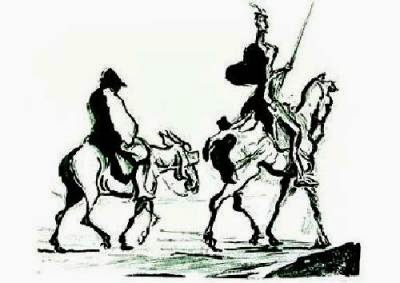
Honoré Daumier's Don Quixote