written and posted by members of Lancashire Dead Good Poets' Society

Showing posts with label vicky. Show all posts

Tuesday, 5 August 2014

Your mother was a hamster

07:30:00 Posted by Damp incendiary device , , , , No comments
This week's theme is 'stupid arguments'.   Stupid arguments are, I suppose, those which are not logically defensible.  Logical fallacies with exciting names (and confusing explanations) such as the Straw Man Fallacy, the Masked Man Fallacy or Misleading Vividness exist purely, in my opinon, to detract from the real nitty gritty arguments and instead turn a lively, hot-headed debate into a potentially violent incident.

What this terminology represents is the long and dedicated work of many individuals who refuse to be proven wrong.  They are so determined that they will come out on top that they have come up with long lists of words to show everyone else how wrong they are.  Any sort of reasoning which is based on emotions is immediately ruled out (Appeal to Emotions) as is any argument which is based on a perceived natural order (Naturalistic Fallacy).  There's Godwin's Law to prevent anyone from ever comparing another's argument to Hitler or Nazism.  And if you consider the way you see the world to be the way it actually exists, well, that's the Mind Projection Fallacy.

But to argue implies disagreement.  And disagreements frequently incur emotional charges.  Most of us, when we argue, do so with the intention of coming out on top.  We don't enter into an argument with the expectation that the other side will show us the error of our ways.  Arguments are competitive by nature, not pedagogical. 

So perhaps it's time we put the fallacies aside.  They are, after all, just another way for one person to claim supremacy over another.  Daniel Dennett has written about the nature of argument and in his book, Intuition Pumps and Other Tools for Thinking, he sets out four rules for constructive criticism which can lead to discussion rather than argument:

  1. You should attempt to re-express your target’s position so clearly, vividly, and fairly that your target says, “Thanks, I wish I’d thought of putting it that way.
  2. You should list any points of agreement (especially if they are not matters of general or widespread agreement).
  3. You should mention anything you have learned from your target.
  4. Only then are you permitted to say so much as a word of rebuttal or criticism.

I think this list is particularly useful because I know that by the time I'd completed the first three steps, I will have forgotten what I intended to criticize. 

In essense, all arguments are stupid.  If you walk through that door, you should know that the fish are ruddy herrings, that proof is a burden and the men are made of something resembling straw. 


Tuesday, 29 July 2014

Cold snap?

07:30:00 Posted by Damp incendiary device , , , , , , 2 comments
Why is it a heat wave and a cold snap?  What if we reversed it?


Polarwave

Summer slid down the piste like a shark
Hot on its trail came the cardigans,
then the wool mix socks
a ragged scarf about the neck
finally, the duvet was transferred to the sofa
that's when we knew it - Polarwave.

The blackbirds didn't see it coming
at night they would perch in the trees
as if it were still October
pining for a St Tropez sun
come morning, their Jurassic feet were glued
by frozen dew, formed hard about the twigs
like jaws of glass

The moon wore her halo at night without apology
while the sun seemed out of his depth; ill at ease
and we walked fairy footsteps outside
or slipped and bruised ourselves colourful
until, recklessly, we left the duvet on the bed
made love without our socks on
put the scarf to better use.


I hope that's helped to cool you down.  Thanks for reading.

Tuesday, 22 July 2014

My thoughts are the antlers

20:44:00 Posted by Damp incendiary device , , , , , , , 2 comments
Sorry it's a late one today.  As the sun sets on another day of salty underarms, burned lawns and panting dogs, here is an exercise (#3 to be precise) from one of my poetry workshops. 

In touch with nature

Stories and poems which include strong visual imagery are more likely to be retained by the reader.  Use visualisation to put yourself in a scene and make it vivid for yourself.  If you can see what you’re describing you’re more likely to be able to make it clear for the readers.

Exercise 3:

Write down an emotion:

 e.g. worry


Think of an animal to represent that emotion:

e.g. sparrow

Think of a scene for that animal to exist in:

e.g. garden path

Think of an action for that animal to carry out:

e.g. watching

Create your example of metaphorical nature-based imagery:

e.g. She paces at the window
       a sparrow on the garden path
       restless
       eyes searching the trees
       for the ill-fitting shadow
        

And here are some examples of superlative nature-based poetry which should inspire you to look at the details around you and capture them for your own nefarious poetic means.  Enjoy!


The moment Echo saw Narcissus
She was in love.  She followed him
Like a starving wolf
Following a stag too strong to be tackled.
And like a cat in winter at a fire
She could not edge close enough
To what singed her, and would burn her.

Ted Hughes, from Tales from Ovid (1997)


You know me as a turbulent ocean
clouded with thunder and drama.

Carolyn Kizer, from In the First Stanza


I’ll chatter metaphysics with a chimpanzee, now
                        my thoughts are the antlers of the Irish elk,
                                                the wings of flightless birds, peptides
                                                spelling out the phrase
                                                very like a whale

Brook Emery, from Very like a Whale


No lik the past which lies
Strewn around.  Nor sudden death.
No like a lover we’ll ken
An connect wi forever.
The hem of its goin drags across the sky.

Kathleen Jamie, from Skeins o Geese


http://www.birdguides.com/webzine/article.asp?print=1&a=2117

Monday, 14 July 2014

(bow)

07:30:00 Posted by Damp incendiary device , , , , , , , , 2 comments
It's been a while since I came up with a list but this week I have been going about crafting a poem in a very methodical fashion.  It's a new approach for me but having slowed down lately and as part of my gradual shift towards a more ordered life I have decided to apply my new found skills to poetry.  So I have a poem on the way but at the moment it is nothing more than a couple of pages of words and associations, imagery and rhymes.  I've thrown in a couple of lofty ideas but will try to ignore those, focusing instead on the details to see what shines amongst the ink.

Since I have this opportunity, I thought I'd use the blog post as part of the creative process.  I hope you don't mind.  It will only hurt a bit.

The poem I have in mind has, at its heart, a web.  It's a web that catches the light to appear then is blown by the wind and disappears.  So I need a list of words which might loosely relate to the wind, the web, or the garden.  I want those words to have a lightness about them too, to reflect the nature of the web and the wind.  Easy peasy.  I'm off to scan my dictionaries and thesauruseseses....please enjoy this music while I'm gone.
OK, miss me?  Here are some words:

whiff - sift - fragrant - hymn
silk - lavender - smoke - sash
weft - warp - wasp
lint - bits - string - fluff - twist
itch - tits - which -
twinkle - sprinkle - spray - rain(bow)
pin - tip - nib - dip
lofty - shaft - heat - channel

shred - tatter - fray - fingers and toes
filament - coil - glass - twist - wire - thin

veil - sail - arc - bark

trickle - slips - creep - snail - silver
seed - pin - fluff - tip - basket - pod - pip


OK, that'll do me for now.  Please feel free to pass on any words or observations that jump out at you.  I need all the help I can get!  Thank you :)

http://upload.wikimedia.org/wikipedia/commons/c/c1/Theridion.sisyphium.web.with.retreat.jpg

Tuesday, 8 July 2014

Green Orchid

Anecdotes have triggers.

Often I'll hold onto my stories, sharing them with select individuals at a time that suits me, but some stories must be told straight away, to anyone who will listen.  If all else fails and there is nobody to communicate with, individuals will begin muttering to themselves, "I can't believe that just happened...she swallowed the whole thing!" 

Then there are the anecdotes that are flourished, as if from a hat, at parties and during the 'getting to know you' stage of a friendship.  These stories come with embellishments and have likely been told many times before.  They involve flamboyant gestures and, occasionally, song. 

Parents and teachers will be familiar with the forced stories.  These are the anecdotes we tell when we are made aware that a sparse description of events is not sufficient and we dredge through the details in the hope of offering a tidbit that will impress the other just enough so that they will leave us alone.  These stories can also contain 'not-quite-truths'.  You'll hear these falling from the lips of children when they haven't completed a task, from spouses when they haven't completed a task, and criminals when they have completed a task which wasn't theirs to complete. 

The definition of anecdote is a fraught one.  Many would contend that anecdotes should be interesting or amusing however there are many who use the cover of 'anecdote' to smuggle Trojan Horses filled with dull particulars of their sleeping habits or the particular manner in which a counter assistant filled their grocery bag.  Doubtless for every hundred thousand listeners who would write this off as unanecdotal, there will always be one who wishes to pursue the story further, hanging on the details and asking whether the counter assistant had a lazy eye and a creased shirt because they might have met this shop assistant and how very interesting because their bags had been filled with great care, in particular the delicate items such as the Danish loaf which everyone knows is prone to crushing and he actually gave it a bag of its own and if that doesn't show customer service, they don't know what we're expecting and perhaps the shirt was creased because they don't believe in wasting energy on ironing when the earth is in the grip of a fuel crisis and really, when there is the capacity to produce iron-free shirts, why aren't we all wearing them...

Anecdotes, in poetry, tend to live in the narrative form.  I've mentioned before that this is the superior form and will brook no argument on this point.  As evidence, here is a portion of Two Deaths in the Bronx by Donald Evans.

TWO DEATHS IN THE BRONX 

The sodden stretches of the months of pregnancy 
Had had but one green orchid; 
That was their sole pauseful 
And suspended moment of beauty. 
He had brought it home to her at dawn 
On the day before Christmas, 

And he was a little drunken as he dropped it on her bed. 
But it was a green orchid, 
And pleased she took it unquestioningly. 
He had bought it with many more 
Hours and hours earlier for the girl, 
Who was then amusing him. 
In some way it had got into his pocket — 
Or, perhaps, it was his buttonhole. 
He had noticed it as he entered the abode of maternity, 
And with his quick sense of values 
He offered it in a tenderness. 
He would have sent her orchids every day, 
But he had no money to spare. He must live. 

He was spending the nine months with her — 
He had promised to do that — to take care of her 
Until their child was born — 
Then she would go away with the child. 


http://www.scenicreflections.com/media/581049/Green_orchid_Wallpaper/


Tuesday, 1 July 2014

Leaving Timmy down the well

07:30:00 Posted by Damp incendiary device , , , , , , , , No comments

Something Refreshing

Sitting sassy, make mine a lassi
Pass it fast, let it splash
Alabaster flash
Cat laps, getting fat
She's a terrible waitress


Inspired by Abdul's storytelling rhymes, I thought I'd write a little ditty and take the week's theme ever so literally.  It's all square windows from here on in (with grubby fingerprints on the glass). 

This week I have been taking my drinks cold, particularly tea.  As it hots up, I distract myself at work by finding new ways to quency my thirst.  So green tea, peppermint tea and licorice tea have all been made with a very small amount of hot water then topped up with ice cold water from the dispenser.  I think I find them more palatable that way.  The flavour seems more delicate when the tea is cold.

Yesterday, I inadvertently discovered lassi.  While ordering online from the takeaway, I clicked on the lassi to find out what it was.  I know I'm a lassi but didn't realise there was an edible version of the gentler (the greatest misnomer ever coined) sex.  Lassi is, I discovered, yoghurt and milk mixed together with optional flavouring.  So it's a smoothie.  Sort of.  I know this because I ordered it by accident while trying to find out what it was.  I found it delicious, Raven said it was disgusting, and I bought yoghurt today with the intention of drinking more of the stuff.  I expect to gain about 2 stone per month. 

This makes me realise that I had always focused on the 'fresh' part of 'refreshment' - as if refreshments were something light and airy, like dew or a gentle breeze.  Refreshment does, in fact include everything from caramel latte to deep fried Mars Bars. 

To recap:

Fresh: something new, different or recently created
Refresh: to reinvigorate, to renew or update
Refreshment: a light snack or drink, or to give fresh energy

I assume everyone else has these muddled definitions in their heads and it's not a(nother) sign of senility.  Someone tell me it's an integral part of poetics and not early onset Alzheimer's.  No, really.  I've drunk a lot of lassi.  And I'm not sure whether to call the RSPCA. 


http://deadgoodpoets.blogspot.co.uk/2014/06/cafe-nostalgia.html

Tuesday, 24 June 2014

Stardate: -716000

Would it make too much mess if I picked apart a sentence?  The theme this week is 'space' and I can't think the word without it being pestered by its fellows, ':' and 'the final frontier'. 

It's quite economic, as sentences go.  And it's a metaphor.  It reminds me of the way Sir David Attenborough describes locations in his voiceovers: The Sahara: a vast swathe of scorching earth.  Or Antarctica: the planet's ice box.  Something like that.  But the Star Trek quote is more evocative than that.

Being an American TV series which started in 1966, Star Trek was riding on the tailcoats of the great Westerns.  Bonanza was the top rating TV series that year, and had been for the two years before.  It was also the year that The Good, the Bad, and the Ugly was released in US cinemas. 

The American Frontier, that push westwards, since the 17th century, of Americans as they spread across the continent, was still fresh in the imagination.  New territories, ie farmland as yet unclaimed, became almost impossible to find after the 1890s.  By the 1960s the Americans were reminiscing fondly about the days of outlaws, goldrushes and, before the truth of the Trail of Tears was widely known, their dominance over the American Indians.

In 1966, the US space programme was also at the forefront of imaginations.  They had yet to walk on the moon, but the Project Gemini took astronauts into space for longer and longer periods and Project Apollo was costing the modern equivalent of $205billion with the aim of putting the first men on the moon.  Three years later, it would succeed.

Roddenberry's intentions behind the TV series are crystal clear in those first four words.  He saw space as the new Wild West and Americans as THE human race.  In the future, he imagined, John Wayne would ride through the stars, an outlaw captain writing the rules and disobeying authority, finding love on every planet and outsmarting every menace. 

This concludes my examination of that short metaphor.  And it goes to show just how much cultural punch you can pack into a few carefully chosen words.  Poetry: cultured concentrated.

Captain James T Kirk

John Wayne

Tuesday, 17 June 2014

Milestone

07:30:00 Posted by Damp incendiary device , , , , , , , , , , , , 2 comments


This week will see us reach 1,000 posts on the Dead Good Blog.  In celebration of that fact, the current bloggers will be creating found poetry using snippets from our favourite past posts. 

It goes without saying that I am just as proud of this blog today as I was in June 2011 when the first post went live.  Since then, we have seen an abundant variety of inspiring and surprising posts on poetry, for the most part, and writing in general.  I want to take this opportunity to say thank you to everyone who has ever written, or commented, for us and express my desire that the blog should stretch on for another 1,000 posts as it continues to engage readers and writers across the world.

Here is my found poem.  If you click on any line you will find yourself transported to a piece of imaginative blogging.  Enjoy!
 

Tuesday, 10 June 2014

Quixotic origins

07:30:00 Posted by Damp incendiary device , , , 1 comment


eavesdropper (n.) Look up eavesdropper at Dictionary.com
mid-15c., from Middle English eavesdrop, from Old English yfesdrype "place around a house where the rainwater drips off the roof," from eave (q.v.) + drip (v.). Technically, "one who stands at walls or windows to overhear what's going on inside."


Some weeks we have subjects which are difficult in terms of insipration.  They feel like hard work.  This week, however, our subject is 'eavesdropping' and I had to look no further than the etymology of the word itself to feel inspired. 

There are some truly poetic terms in the English language which we use on a regular basis without noticing their origins and real sense.  Part of what poets aim to do is to draw those words out of the banalities of common language and help them to shine again.  Here are some examples:


Bulldoze - this comes from an earlier noun, bulldose which meant 'a severe beating or lashing', literally 'a dose fit for a bull', a slang word referring to the intimidation beating of black voters (by either blacks or whites) in the chaotic 1876 U.S. presidential election.

Dashboards - these were originally attached to the front of horse-drawn carriages to prevent the driver from being dashed by mud kicked up by the horses.

Gossamer - this was originally 'goose summer' and referred to the Indian Summers which are had in mid-November when the spiders spin frail threads across gardens and goose is eaten on St Martin's Day.


I'd argue that there is plenty of poetry in these words by themselves, once the cultural and historical sense is known.  And so much of poetry is found in the recognition of cultural tropes and customs.  Translation is as much about finding commonalities between people and places as it is about the language itself. 

Eavesdroppers are those who stand at windows, with the rain falling down from the eaves onto their heads.  That's quite enough imagery to satisfy me for today.

If you have any nuggets of etymology to share, please post them in the comments below.  If you'd like to find out more word origins for yourself, I recommend the Online Etymology Dictionary.  For many word lists, including lists of unusual words, visit Scorpio Tales.

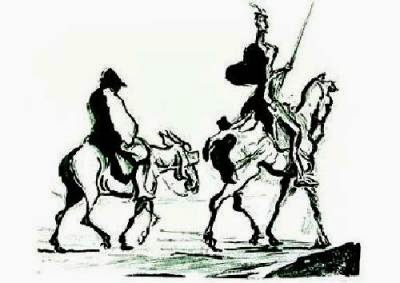
Honoré Daumier's Don Quixote

Tuesday, 27 May 2014

Iron Filings

07:30:00 Posted by Damp incendiary device , , , , , , , , 3 comments


electrons leap from atom to atom
we don’t ask to see their papers


These lines are shavings, iron filings, left on the floor after I had taken a poem through several drafts of attack.  I like the sentiment behind these lines, especially this week, given the political atrocities, but the thought was a distraction when set in a poem whose subject was the quiet moment after an argument with my daughter.  What I wanted was a sense of metal cooling.  These lines were inappropriate.


can she see yet?                                                                                  
how the silver slips through my fingers?
how I rust, unburnished? 


These lines are from the same poem.  Also discarded. The 'rust, unburnished' comes from Tennyson's Ulysses.  This was more appropriate in terms of subject but, by the time I came to the fifth draft, it didn't quite fit the narrative.  I had decided to focus on the conflict between the dark, quiet room and her heated words.  This introverted metaphysical questioning prevented the reader from directly relating to that scene.  Again, I like the lines but not in this place.

Looking back, I can also place a finger where I replaced the word 'unfathomable' with 'recondite' - following Norman Hadley's wise advice that four syllable words do not scan easily and therefore five syllable words should be kept for special occasions.  Recondite is pleasing because it sounds like a mineral and reflects the title of the poem: Among a mineral of metals base.

The title was taken from Gertrude's line in Hamlet.  It's a line which I only noticed for the first time when I saw the play in Stratford-Upon-Avon with my daughter.  It relates to a chink of morality among madness and Hamlet's tears after murdering Polonius.  This seemed appropriate. 

The poem in question has a sub-theme of metals as it was written for a competition on that theme.  In its initial drafts it was creatively arranged on the page, so that it read as three columns which could be understood separately or taken as a whole.  The feedback I received told me that this style was confusing to read and unnecessary.  The final piece is a simple poem, left-aligned, in six stanzas.  When I showed the final draft to my other half he told me he had quite liked it when it was arranged in three strands.  I reminded him that he had found this confusing to read, as had others, hence the change to a simple layout.  He thought I had lost something in conceding to my readers. 

I agree that I lost something of the elemental (if you don't mind) fierceness of the original layout when I rearranged it into a more standard page poem.  Having said that, in working those three strands into one I was able to concentrate the image into something more immediate.  It comes down to how hard I would like my audience to work.  I think they might have found the initial style more satisfying after a few readings but perhaps it's a tad rude to expect them to have to work that hard? 

What do you think?