written and posted by members of Lancashire Dead Good Poets' Society

Wednesday, 31 July 2024

Image


Have a look at the image above of the Boulevard du Temple taken by Louis Daguerre in 1839. It is believed to be the first photograph showing a living person and certainly the first most practical method for taking an image. What do you think is missing? Answer below.

In 1826, Nicéphore Niépce had first managed to fix an image that was captured with a camera of his family’s estate but at least eight hours or even several days of exposure in the camera were required and the earliest results were very crude.

Niépce's associate Louis Daguerre went on to develop the daguerreotype process, the first publicly announced and commercially viable photographic process. The daguerreotype required only minutes of exposure in the camera, and produced clear, finely detailed results.

On August 2, 1839 Daguerre demonstrated the details of the process to the Chamber of Peers in Paris. On August 19th the technical details were made public in a meeting of the Academy of Sciences and the Academy of Fine Arts in the Palace of Institute. For granting the rights of the inventions to the public, Daguerre and Niépce were awarded generous annuities for life.

Now I’m going to fast forward and look back a bit and go on a bit of a rant. In 1983 The National Museum of Photography, Film and Television was opened in Bradford. In 2011 the museum was voted the best indoor attraction in Yorkshire by the public, and it was one of the most visited museums in the north of England.


I can vouch for that as our Social Club at the hospital used to run trips there and we were guaranteed a couple of full coaches for our visits. I remember being able to do weather forecasts and read the news from autocues. Every part of the place was fascinating.

In 2016 you could see the way things were going when the decision was made to move a world famous photography collection to the V&A in London. More than 400,000 images were transferred out in an act described as cultural vandalism.

I went back there last year and was shocked at the tackiness of the place now. I’ll acknowledge that the basement holding the Kodak collection (above) is still excellent with the work of pioneers like Niépce, Talbot and Daguerre, the daylight studio, the birth of popular photography etc. But that is because they hadn’t changed anything.

It was redesigned into The National Science and Media Museum back in 2017 and the memory I have of it now is that it had been designed especially for children to run around in and bang or press buttons. The scientific and technical information available is pathetic. And now the Museum is closed for yet another make over. Open again in 2025 apparently.


And just to finish it all off it has one of the worst cafes I’ve ever been in. That’s that done.

So let’s go back to ‘Le Boulevard du Temple’ and 1838. Daguerre captured the street scene in Paris. However, due to the long exposure time required for early photographic techniques, moving subjects, such as people, did not appear in the final image. The exposure time was several minutes, and moving objects would not be captured as they were constantly in motion. As a result, the photograph shows a seemingly empty street, devoid of human figures, even though the area was bustling with activity.

Boulevard du Temple 1839

The shoeshine boy and customer
is pretty good
but what he should have done
was to ask a mate of his
to set up as an artist
canvas and easel
and the dramatic flourish
of a brush pointing to his window

but maybe that’s being
a bit picky and anyway
at that distance
it would have looked like
someone with his hand in the air
rather than a dramatic point
about the End of Art

which is always a load of
what’s probably scattered
all along the Boulevard
though it didn’t stop Painters
packed in L’Académie des Sciences
gasping exactly that
though to be fair
gasping at Daguerre’s silver coated plate
is what I do every time I see it.

First published in the French Literary Review, August 2017


Thanks for reading. Comments welcomed.
Terry Q.

Monday, 29 July 2024

Image

Image: a visual representation of something.

Contemplating this word and its definition started another mind boggling experience down the cyberspace rabbit hole leading me to click upon click and page after page of reading and looking at all sorts of images and image related material including the exploration of my own image making.

Mirror Images 
Images or objects which are identical in form to another, but with the structure reversed, as in a mirror.

Everything Bright - digital image by Kate Eggleston-Wirtz
I often digitally manipulate my drawings or photographs creating mirrored images. Typically, the original drawings are made on black paper using a white gel pen or sometimes an acrylic paint pen. Then I scan it and work into it digitally. I’ll flip the image horizontally, attach it to the original image then flip it again vertically. Lastly, colour is added. Here is an example:


Parrots - digital image by Kate Eggleston-Wirtz
After trawling through my own artwork and making a new mirrored image created from a recent drawing (see above) I began thinking about mirroring the word ‘image’ and other related words which 
proved interesting. I had a bit of a play.

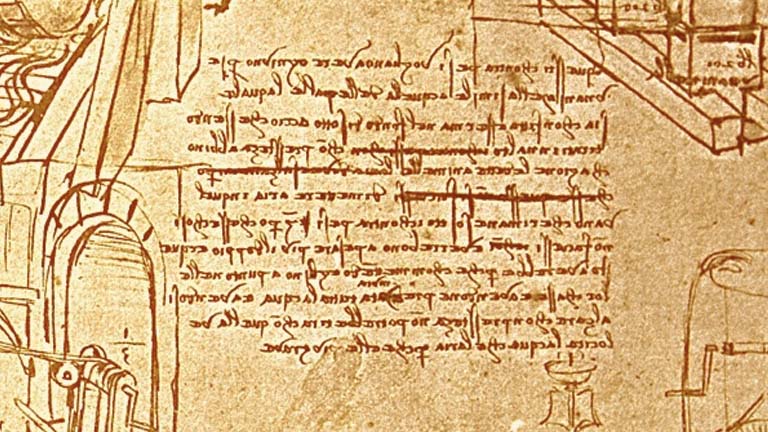
In further delving I came across mirror writing. Leonardo DaVinci (15 April 1452 – 2 May 1519) produced backwards mirror writing. One theory of why he did this was that this method would keep his hands clean. He was a left-hander and writing in the conventional way potentially would have smudged the page.

Mirror Writing - Leonardo da Vinci, Museum of Science
Iconic Images
In searching for the most iconic images, I came across a wide range of photographs representing either firsts in image capture and/or pivotal moments in history. These images stick in one’s memory, pull at heart strings and have come to represent the essence of humanity.

CNN has a list of 25 photographs ranging from firefighters raising a flag at the site of the World Trade Centre in New York after the 9/11 attacks to Alfred Eisenstaedt’s image of an American sailor kissing a woman in Times Square in celebration of the end of WWII.

Wikipedia has a list of what it classifies as the most important photographs in history. View from the Window at Le Gras (1826) by Joseph Nicéphore Niépce is considered the first photograph of nature and also the oldest surviving camera photograph. It was produced by positioning sheets of silver salts coated paper at the back of a camera obscura. Niépce called these images retinas.

Boulevard du Temple (1838) by Louis Daguerre is the earliest surviving photograph depicting people. It is a daguerreotype which is a direct positive process invented by Daguerre himself. The process was introduced to the public at a meeting of the French Academy of Sciences in Paris on 19 August 1839. Check out the shoeshine guy in the lower left.

Boulevard du Temple - photograph by Louis Daguerre
Robert Howlett’s 1857 photograph of British engineer Brunel (1806-1859) has been deemed important in the genre of environmental portraiture (showing a person in their home or workplace). It is also a fascinating representation of the Industrial Revolution. The chains are extraordinary in size and interesting in sharp contrast to Brunel’s rather insignificant watchchain hanging from his waistcoat.

Isambard Kingdom Brunel standing before the launching chains of the Great Eastern
- photograph by Robert Howlett
A final image to note in the Wikipedia list is of Muybridge’s The Horse in Motion (June 1878), precursor to motion pictures. From 1884 to 1887 Eadweard Muybridge made extensive photographic studies of motion, both human figures and animals. I first became familiar with him back in the 80s when my brother gave me a book of his images which I have used as reference material for many years.

The Horse in Motion - Muybridge
Images and Poetry
In the summer of 2022 I had a video call with friends who were at a flea market in France. They wondered if I would be interested in a pile of old photographs. If so, they said they would bring them back to the UK for me. I was so excited to receive a bag full of notable images. Here is one of the photographs and a poetic response to the young lady on the right in the front row.

Wedding Day - photograph A. Gautier
A Marrying of Alice and the White Rabbit

The billowing silk bow crowned her head
like bunny ears, as she leant on him
with doe eyes wearing a half-drawn smile
and a fine white dress.

Clasped hands placed, one over the other
lay in her lap cradled in fabric,
a crevasse formed in an avalanche
of eyelet lace cascading over the knees,

down calves cloaked in black stockings
swallowed by boots, tongues caught
in the middle of their story
with scuffed toes
and worn heels
digging holes.

Thank you for reading.
Kate
  J

Sources:
Britannica, 2024. Eadweard Muybridge British Photographer. https://www.britannica.com/biography/Eadweard-Muybridge Accessed 25 July.

CNN, 2016. 25 of the most iconic photographs.https://edition.cnn.com/2013/09/01/world/gallery/iconic-images/index.html Accessed 25 July, 2024.

Library of Congress, 2024. The Daguerreotype Medium. https://www.loc.gov/collections/daguerreotypes/articles-and-essays/the-daguerreotype-medium/ Accessed 28 July.

Saturday, 27 July 2024

Bells

With the exception of those worn by cows and those found on ships, just about every conceivable sort of bell seems to have been written about this week. Do you know what? Sorry cows, I'm going with the ships.

ship's bell - Cutty Sark
Bells have been used on ships for centuries. One of the earliest mentions of a ship's bell was that on the English ship Grace Dieu, in 1485. A few years later it was recorded that another English ship, the Regent, possessed two "wache bells". And that was originally the primary purpose of the ship's bell, to signal the progress of time and the changes of watch. In an era before chronometers, the passage of time would be measured by an hour-glass - or more strictly speaking a half-hour glass. The sand would empty from top to bottom every half hour and when the ship's boy turned the glass over to commence another half-hour, he would ring the bell to signify this.

Over time an elaborate 'eight-bell' system was developed to plot progress through a four-hour period, for all watches were four hours long. One ring of the bell denoted the watch was half an hour through, two that an hour had passed, three for ninety minutes and so on until eight bells signalled the end of a four-hour watch and the changeover of personnel to start the next watch (see below). Everyone understood the patterns and could hear them wherever they were on the ship.

standard table of naval watches
A ship's bell was usually made of brass or bronze and had the ship's name engraved or embossed upon it, and often also the date is was launched. It was traditionally the job of the ship's cook to maintain the bell in good condition. Quite often the discovery of the ship's bell was the surest way of identifying a wrecked ship, as was the case with a Portuguese armada ship found in 2016 on the seabed off the coast of Oman. The bell identified it as the Esmerelda, commissioned in 1498, part of Vasco da Gama's fleet that had been voyaging to India in the early 16th century.

But the ship's bell has always served other purposes than as a watch-marker. In a time before foghorns it was used to sound a warning to other vessels of its presence. In fact some small ships still use it for that purpose today. It is also used for ceremonial purposes. When the ship's captain or a flag officer or an important personage arrives on board or departs, the ship's bell is rung to acknowledge the event. It is also rather quaintly used as a font to baptise children born on board. 

ship's bell - unknown craft
While I was getting to grips with the eight-bell system, I began to wonder if the phrase to knock seven bells out of someone was in any way related. It turns out that as an expression it is naval in origin and means, as you might imagine, to go as far as one can (i.e. seven-eighths of the way) in inflicting a punishment without actually killing the victim. The first recorded instance I could find dates from a British newspaper, the London Examiner of 1850 and refers to an assault that took place upon an emigrant ship to Australia. It reported as follows:
'Mr Bainbridge, on returning to the vessel, was knocked down by Mr Ross, and the Captain wanted him or any of the malcontents to stand before him “and he’d knock seven bells out of them”'.

That leads on very nicely to today's new poem. Not exactly from the Imaginarium this time, it comes welling up from the deeps of the Memorium. I hope that's a word. If it wasn't, it is now. It relates to true events from the summer of 1971 that I'd not thought about for a long time, until prompted by all this writing about ships and bells.

Let's call her Maureen, for that was her real name after all. It was the summer after my A-levels and I had a holiday job washing up at a Berni Inn in Cambridge. Remember them? They were a chain of fairly up-market steakhouses very popular in the 1960s and 1970s. I worked there at lunchtime and again in the evening and because there was only an hour or so between the two sessions, I would sit out in the yard in between shifts and read a book. The work was hot, greasy and sweaty and the waitresses would sometimes buy the pot washers a beer out of their tips to keep spirits up. 

There had been a couple of attacks on women out alone at night (this was several years before the infamous 'Cambridge rapist') and so I offered to escort Maureen home after work as her house was on my own route home. Over those twenty minute walks across several weeks we got to know quite a lot about each other. She was probably twice my age, her dark hair beginning to show signs of grey. There was a sadness about her. She felt she'd missed a trick in life by not staying on at school and going to college as I was about to do. She was married to a trawlerman who was away for several weeks  at a time. They'd never managed to start a family. I suppose it was a lonely existence for her. She wanted recommendations for books to read and films to see. I offered to lend her books, go to the cinema with her, but said she couldn't. If her husband found out he'd come after me. That's when I first heard the expression to knock seven bells out of someone - me.

We'd grown quite fond of each other by the time my last stint at the Berni Inn came around. It had been an incredibly hot day and as I walked her home a huge electrical storm broke. We took shelter from the downpour under some trees at the end of her road. It was the place where we normally parted company and I would stand watching until she reached her front door safely. On this occasion we just stood there. She was sobbing, saying she was going to miss me so much, and apologising for being a mess. It was upsetting and I didn't know what to do except give her a hug, but that distressed her more and she ran off down the road in the torrential rain, lit by flashes of lightning, to her house. Of course I never saw her again. I stood under those trees for maybe twenty minutes until the rain eased off and then walked home trailing the sadness of the world.

Seven Bells
Framed like a climactic scene
from some tempestuous movie
of human love and loss...
the couple standing under trees,
in crisis, in a thunderstorm.

Drain all colour please, 
this should be black and white,
probably silent too, except for
a dramatic score, Morricone
or Mozart maybe, to chime
with the lightning flashes.

Pan in on a tear-wracked face,
make-up streaked. Is it terror
or sorrow behind her dark eyes?
And he so gauche, not knowing
where this emotional outpouring
might be going... though any
lip-reader could guess, for she's 
mouthing "miss you so much.
Sorry I'm such a mess."

Instinctively he hugs her
and distraught she turns to flee,
for who knows who might be spying?
Who'd tell the jealous husband
when he's back from the sea?
He'd knock seven bells for sure
but would the victim be 
the lover boy or wife?

He watches her run away 
through thunderclap and downpour, 
stands still in aftershock
under the trees, 
breathes in petrichor.

Pan out wide 
on a wet and empty world
as credits roll in silence:
The Waitress: Maureen
The Student: Steve
The Trawlerman: unnamed, unseen
The End.

Thanks as ever for reading. Comments/feedback always appreciated.  S ;-)

Friday, 26 July 2024

Hell's Bells

Being retired, I no longer have any pressing need to ever set an alarm to wake me from reluctant sleep - except on a Sunday, when I rise at (to me) the unearthly hour of just before 8, to get ready for my “Sunday morning job”. By 8.30, I am driving through on blissfully traffic free roads to my first ‘job’ at The Minster in Preston. As usual, the car park is busy with various young people disgorging large pieces of musical equipment from cars – and not just drums and guitars, but also all the paraphernalia associated with any Rock Band.

It promises to be another noisy, exuberant, and joyous morning of worship and my role, with the other dedicated members of my bellringing band, is to help to kick start the proceedings with our version of ‘rocking the church’ with a spot of ringing the bells. Only we don’t have to unload our equipment – our equipment is high up in the tower, which yes, will rock, ever so slightly when we get going.

Preston Minster
As we start to ‘ring up’ the bell, sometimes, not always in the right order (and I am usually to blame), I console myself with knowing that most of the local community cannot tell the difference between some basic rounds and call changes and the more complicated stuff that we ring for them. For I am on my ‘Sunday best’ attempt and ringing to the best of my ability, because what we ring is not the issue – the fact that we ring at all is what matters. We ring for the church and for ourselves and to call out to the congregation that the service will soon be starting, even though most of us are not part of the regular congregation, partly because as soon as we end our stint at The Minster, it’s straight off to the next tower to ring for their service.

If you hear the bells ring out on a Sunday, don’t be under the illusion, as I was, that it just happens. My first introduction to bellringing was when I happened to be walking past my local church one Monday evening just as they were ending their weekly practice and I went to investigate. With some confidence as a past violinist and flautist, I joined the band the following week, and echoing the sentiments of Jack Wooley of The Archers radio series, thought “after all, how hard can it be, ringing a few bells?”

The answer is "very hard indeed.” Within the first 10 minutes, I learned that becoming competent at bellringing has nothing to do with any prior knowledge of music other than an ability to perhaps pick out the sound of one bell from the cacophony of clanging. Indeed it takes weeks and months of practice just to master the basics of controlling a bell enough to stay roughly in sequence. Patting your head, rubbing your tummy, whilst standing on one leg and whistling the national anthem backwards is child’s play compared to ringing a bell.

I acknowledge that compared to most who aspire to competence as ringers, I am an extremely slow learner, still mooching around in the slow lane, often at completely at a standstill, while other newer learners whizz by me and are well on their way to mastering the challenging stuff. For me, it has been my dogged determination that has kept me going for so long. After eight years, I am still hanging on in there, on the end of a rope, chugging along, doing my best, taking part, and finding enjoyment and personal satisfaction in mastering the basics.

I can’t think of any other pastime I have undertaken that I have pursued for so long, despite long times of no noticeable improvement before managing to ring something passably. Perhaps it is the generosity and steadfast support from my fellow, far abler ringers, who I am surprised still accepting me into their fold – and this isn’t just at my home tower, but at all the others I have been to. From a laconic “well that wasn’t too bad, was it” which is high praise indeed, to a “quiet well done” accompanied by a surprised raised eyebrow, there has been as much joy from them as from myself when things have gone well. I am just grateful that in y despondent periods. when I have wobbled and wondered what folly it is to continue to pursue the elusive dream of that perfect round of a Plain Hunt peal, they have been consistent in their encouragement.

Individual motives to ring all differ slightly, but none of us is in it purely for personal gratification. We are happy to share our passion when called on by the community and ring out the bells at weddings, funerals and the annual Remembrance Sunday which brings an added layer of work to the already pressed ringers as the bells need to be ‘muffled’ as a sign of respect.

a set of muffles
‘Muffles’ are thick hand-sized leather pads, resembling one half of a pair of castanets, and are attached with straps to a bell's clapper to reduce the volume. The effect is to deaden the bell's strike note, while retaining the hum. They are only fitted to one side of the clapper and so when the bell is struck, there is an 'echo' effect as the bell strikes are alternately loud and soft.

When the bells are fitted with muffles in this way are said to be half-muffled – and the only time when they are fully ‘muffed’ is when the reigning monarch passes away. Fitting them isn’t an easy job – as I witnessed first-hand. I had wondered why our Tower Captain, who usually comes casually but cleanly dressed, had arrived wearing clothes that looked as if they had seen better days. There was a reason – a belfry, while dry, is a dirty and dusty place where copious cobwebs new and old abound, not to mention possible pigeon poo.

Accessed by a winding narrow staircase. I had read about the theory of fitting of muffle to clapper in a text book, not actually seen it done. When my tower captain heard this, she encouraged me to go along – apart from anything she needed someone there to call for help if she had a mishap.

This should have alerted me, and it was with some apprehension that I agreed to help muffle the bells at The Minster – or at least be there. Never one to go back on my word, armed with my torch and wearing scruffy apparel, once the bell ringing practice had ended, I warily followed Jo, Bell Tower Captain up the increasingly narrowing spiral steps. I began to regret my enthusiastic signing up for this the week before, when horror of horrors – once we got to the room directly above the bellringing chamber, it was not the end of the journey. This was merely the ‘Clock room’ – the bells were housed even further up – and accessed by a narrow ladder that led up a through a hatch to the bells. Halfway up the ladder, the batteries in my torch gave out – and having tried in vain to get a foothold on the ironwork cradles surrounding the giant wheels that support that the bells, I was, in truth, relieved to leave Jo, agile as a monkey, clambering happily between, over and under the ironwork cradles to muffle the clappers. The following Tuesday, we had to again ascend the heights to remove the muffles.

As well as these regular annual reasons, there is also the ringing to mark one off national events such as Royal Weddings, funerals, and coronations. I am guessing that most of us are somewhat addicted to turning up to “make a noise” as it really doesn’t need much to encourage us to get together to ring. However, while a tower of bells ringing in a basic round, with each bell successively following the one before, with perhaps a few variations, known thrown as “Call Changes” is good for most Sundays, for more important events, something more complicated is called for. These are what are known as the ‘Methods,” individually named, such as Plain Bob, Canterbury, Cambridge, Kent, and Grandsire and a rather short one that sounds like Bisto but is actually Barstow.

Plain Hunt sequence
I started with the foundation peal of  Plain Hunt, which apart from Bisto, the shortest sequence. In any Method, each bell follows a different bell every time until they get back to the beginning. If it sounds complicated – it is, at least to a learner, like myself, who might well, after much contemplation of this diagram, sort of understand the theory. However, when trying it out in practice, the ropes mysteriously seem to move much faster than when I was just watching. Add to this the sounds of the bells start alternating and within a few pulls of the rope, I am well and truly I am lost. The well-intentioned advice to “listen for your bell and put it in the correct place” is outside the capability of my ears to sift the difference in bell sounds when I am busy just trying to look as if I know what I am doing. As for “just watch the ropes and see which is the last to move”– I can’t even manage that standing in the corner with no bell to control. If I tried doing this whilst actually ringing, I think it may well end with a completely new method being invented – which as the composer, I would have the legitimate right to name “Hells Bells.”

I like to think that most people enjoy hearing church bells ringing out, and this was confirmed after the long silencing of bells during covid was ended, when a parishioner told me that she had missed the Sunday morning ringing and it was a sign of normal life returning when the bells once again “rang so joyously out.”

It reminds me of Tennyson, who penned this poem allegedly after hearing the bells of the Abbey Church being rung on New Year's Eve. This is entirely possible, given that it is an accepted custom to ring out the old year (half-muffled for its passing) and then with the muffles removed to ring to mark the birth of the new year.

Ring out Wild Bells

Ring out, wild bells, to the wild sky,
The flying cloud, the frosty light;
The year is dying in the night;
Ring out, wild bells, and let him die.

Ring out the old, ring in the new,
Ring, happy bells, across the snow:
The year is going, let him go;
Ring out the false, ring in the true.

Ring out the grief that saps the mind,
For those that here we see no more,
Ring out the feud of rich and poor,
Ring in redress to all mankind.

Ring out a slowly dying cause,
And ancient forms of party strife;
Ring in the nobler modes of life,
With sweeter manners, purer laws.

Ring out the want, the care the sin,
The faithless coldness of the times;
Ring out, ring out my mournful rhymes,
But ring the fuller minstrel in.

Ring out false pride in place and blood,
The civic slander and the spite;
Ring in the love of truth and right,
Ring in the common love of good.

Ring out old shapes of foul disease,
Ring out the narrowing lust of gold;
Ring out the thousand wars of old,
Ring in the thousand years of peace.

Ring in the valiant man and free,
The larger heart, the kindlier hand;
Ring out the darkness of the land,
Ring in the Christ that is to be.

Alfred Lord Tennyson

Some ringers believe that Tennyson was inspired by those at Hagworthingham, close to his childhood home. Any ringer can turn up at just about any tower and be welcome to join in with their practice. The trust involved is immense in tower captains taking a stranger’s words for it that they are competent to ring their bells and will not cause any damage, although they are not so foolish as to omit checking you out with a practice first. I have dropped in at a few places where no-one knows me and yet have found everyone welcoming. I always contact the tower captain first and am disappointed when some reply that they do not have enough numbers to make up a viable band on the days that I happen to be in the locality. However, I would have great trouble in adding the tower at Hagworthingham to the list that I have thus far ‘bagged’ – for the simple reason that it collapsed in the 1970s. However, the bells from the tower didn’t go to waste and were rehoused at Welbourn, near Lincoln, so I haven’t given up hope that I might one day ring one of those ‘Wild Bells.’

ringers in action
All in all, bell practice is very good way to spend ninety minutes. There is no time to dwell on any troubling things as it requires full concentration in placing our bell in the right order at the right time. It requires mental agility and this, combined with a mild cardio exercise that is well within any one’s grasp, it is no surprise that some research has shown that ringers tend to suffer less from the ravages of dementia. As we lower the bells after another satisfying practice, the bonhomie and sense of wellbeing lingers long after the bells have been silenced.

To come full circle, about six months ago, another walker happened to be passing by the same church where I was first lured by the bells. just as we were finishing up our ringing practice. As she walked down the lane, she commented “what a lovely way to spend the evening. I must tell my friends…” I suggested she do better than that and join us to “have a go,” explaining that no prior knowledge was needed and no you didn’t need to be musical. So she did… and joins the band whenever she can.

If you are nearby to a church ringing bells this Sunday – listen out for it and appreciate the people of the bell ringing world who made it happen. We are a dying breed and need more ringers and hope that reading this may encourage you to search out a tower and have a shot at it. And I may see you there…

How still the bells in steeples stand

How still the bells in steeples stand,
Till, swollen with the sky,
They leap upon their silver feet
In frantic melody!

Emily Dickinson

Thanks for reading. Comments welcomed.
Yvonne

Wednesday, 24 July 2024

Church Bells

It’s early evening, the windows are open and from across the river the sounds of church bells are drifting into my room as I start this blog. It's no coincidence as I know that tonight is practice night for the bell ringers in the tower.

About ten years ago I was given the opportunity to interview the Captain and team responsible for the lovely sound I’m hearing at the moment. Before I went up the stairs to the tower I hadn’t known the correct term for the people involved. I knew the term campanologist and had done some background work but it turned out to be a whole new world up there.


For a start there is a Captain in charge of the bell ringing team and is usually one of the more experienced members. In this particular church there is a dedicated band of bell-ringers made up of people with many levels of expertise and experience, who all give their time and talent on an entirely voluntary basis to ring for services.

They ring the bells in what is called change ringing which was invented in the 1500s. This style of bell-ringing is a mix of mild exercise, team-work, and mental challenges. They currently have 21 members ranging in age from teenagers to over 80.

To give a flavour of this typical older church here is a brief history:
First mention of bells at ...is in the Inventory of Church Goods (1552), which credits the Church with “thre bells…ij sacring bells”. Sacring bells were - and in many church still are - used during the Communion service. But the two that were at ...were probably little used after the reformation and in 1636 seem to have been given to the Minister as payment for looking after the Church clock.

In 1712 there were four bells in the tower. They were than recast into a ring of five...The five new bells were hung in a frame with space for another bell to be added later...The additional bell arrived in 1858.


The frame was strengthened and enlarged in 1926. One bell was recast, the other five retuned, and two more added to make an octave. These operations were carried out by the Whitechapel foundry, who also hung the bells on ball bearings to make ringing easier. The same foundry recast the entire octave in 1965, so that the Church continues to have a ring of bells that measure up to the glowing reputation that the bells have had since the 18th century.

I mentioned Change Ringing above and this where it gets a bit complicated. It has been described as both an art and a science, the former referring to the handling and control of the moving bell via a rope, and the latter to learning “method” ringing – the production of “bell music”.


This type of bell ringing originated in England in the 16th and 17th century when church bells were first fitted with a full wheel and swung until balanced upside down (see diagram above). The bells are swung 360° using a rope with one ringer per bell. The rope runs round the wheel and hangs down into the ringing chamber below. Each rope has a coloured woolly part called a sally which is where the ringer catches the rope. Using the rope the ringer can control the timing of their bell. This allows the sequence in which the bells ring to be altered and, with practice, continuously evolving sequences of bells to be rung.

The Captain showed me one of the patterns they use and it was baffling (see the image below). The maximum number of different changes that can be rung on five bells is 120, on six bells it is 720, on seven 5,040 and on eight is 40,320. The term Peal which is where more than 5000 changes are rung. This takes, on average, about 3½ hours to ring. Also Quarter Peals are rung regularly which consist of at least 1250 changes and takes 50-55 minutes.


If you’re interested in becoming a Bell Ringer there is the Central Council of Church Bell Ringers which is the representative body for all who ring bells in the English tradition with rope and wheel. You can find them at https://cccbr.org.uk.

By the way, and completely irrelevant to the above, I’m addicted to the Golden Age of detective fiction in the UK. One of the best writers was Dorothy L. Sayers and one of her best books was The Nine Tailors. If you read the book there is actually a point to that statement.


As for the poem I’m going down to Dorset and Thomas Hardy.

Inscriptions For A Peal of Eight Bells After a Restoration

I Thomas Tremble new-made me
Eighteen hundred and fifty-three
Why he did I fail to see.

II I was well-toned by William Brine
Seventeen hundred and twenty-nine
Now recast, I weakly whine!

III Fifteen hundred used to be
My date, but since they melted me
’Tis only eighteen fifty-three

IV Henry Hopkins got me made
And I summon folk as bade
Not to much purpose, I’m afraid!

V I, likewise, for I bang and bid
In commoner metal than I did
Some of me being stolen and hid.

VI I, too, since in a mould they flung me
Drained my silver, and rehung me
So that in tin-like tones I tongue me

VII In nineteen hundred, so ’tis said,
They cut my canon off my head
And made me look scalped, scraped and dead.

VIII I’m the peal’s tenor still, but rue it!
Once it took two to swing me through it.
Now I’m rehung, one dolt can do it.

                                          Thomas Hardy ('Human Shows...' 1925)


Thanks for reading. Please feel free to leave a comment. Terry Q.

Tuesday, 23 July 2024

Bells - Last Orders


The first bells of any significance to me must be the ones used by my father and grandfather to call ‘last orders’ and ‘time, gentlemen, please’ in their pubs. They were fixed to a post or wall behind the bar and with a firm tug on the rope, sent out a loud peal with an authoritative tone. At some point the word ‘gentlemen’ was removed and it was simply ‘time, please’, even in the Vaults. The Vaults was considered the mens’ bar, simply because no ladies would like to go in and from what I remember in my formative years, the men were not always gentlemen.

Another distinctive bell I remember from childhood is the ringing of my dad’s alarm clock. These days everything bleeps digitally from a radio or mobile phone, but this wind-up monster, which no longer works but I keep it as a treasured possession, was loud enough to wake the whole house and pub beneath – but not always my dad. I don’t know who was the genius behind the idea, but biscuit tin, yes, a metal one, a few of my marbles inside and the clock on top of the lid was louder than ever with the added power of ‘rattle’. That worked a treat.

I started secondary school at what is locally known as ‘the old Palatine’, an impressive building between Bennett Avenue and Park Road in Blackpool, which is now the University Campus of Blackpool and the Fylde College. It was great for me to return decades later and find it much the same inside, except the long corridor which stretched from one end of the school to the other now had sets of fire doors closing the length into sections. In my early school days it was open and at each end hung a bell. These two bells were monitored by duty prefects who rang them to announce the end of lessons. They could be heard all over the school and were much more efficient than the weak electric buzzers we had to listen out for in the new school twelve months later when we relocated to St Anne’s Road. The old building had character, the new one did not. The old building is still standing and is useful. The new one, demolished and rebuilt after only fifty years, or thereabouts.

I wish I knew what happened to my mother’s brass bell. It was made in the style of a lady with a tiny waist wearing a crinoline skirt. It lived on the mantelpiece for years, then, when my mum was ill and in bed, she had it close to her so she could ring it if she was alone and needed something. It is yet another thing that seemed to vanish into thin air after she died.

Here is a poem, Edgar Allan Poe, placing bells where he perceived they belonged in a life-cycle,

The Bells 

1

  Hear the sledges with the bells—
                 Silver bells!
What a world of merriment their melody foretells!
        How they tinkle, tinkle, tinkle,
           In the icy air of night!
        While the stars that oversprinkle
        All the heavens, seem to twinkle
           With a crystalline delight;
         Keeping time, time, time,
         In a sort of Runic rhyme,
To the tintinnabulation that so musically wells
       From the bells, bells, bells, bells,
               Bells, bells, bells—
  From the jingling and the tinkling of the bells.

2

        Hear the mellow wedding bells,
                 Golden bells!
What a world of happiness their harmony foretells!
        Through the balmy air of night
        How they ring out their delight!
           From the molten-golden notes,
               And all in tune,
           What a liquid ditty floats
    To the turtle-dove that listens, while she gloats
               On the moon!
         Oh, from out the sounding cells,
What a gush of euphony voluminously wells!
               How it swells!
               How it dwells
           On the Future! how it tells
           Of the rapture that impels
         To the swinging and the ringing
           Of the bells, bells, bells,
         Of the bells, bells, bells, bells,
               Bells, bells, bells—
  To the rhyming and the chiming of the bells!

3

         Hear the loud alarum bells—
                 Brazen bells!
What tale of terror, now, their turbulency tells!
       In the startled ear of night
       How they scream out their affright!
         Too much horrified to speak,
         They can only shriek, shriek,
                  Out of tune,
In a clamorous appealing to the mercy of the fire,
In a mad expostulation with the deaf and frantic fire,
            Leaping higher, higher, higher,
            With a desperate desire,
         And a resolute endeavor
         Now—now to sit or never,
       By the side of the pale-faced moon.
            Oh, the bells, bells, bells!
            What a tale their terror tells
                  Of Despair!
       How they clang, and clash, and roar!
       What a horror they outpour
On the bosom of the palpitating air!
       Yet the ear it fully knows,
            By the twanging,
            And the clanging,
         How the danger ebbs and flows;
       Yet the ear distinctly tells,
            In the jangling,
            And the wrangling.
       How the danger sinks and swells,
By the sinking or the swelling in the anger of the bells—
             Of the bells—
     Of the bells, bells, bells, bells,
            Bells, bells, bells—
 In the clamor and the clangor of the bells!

4

          Hear the tolling of the bells—
                 Iron bells!
What a world of solemn thought their monody compels!
        In the silence of the night,
        How we shiver with affright
  At the melancholy menace of their tone!
        For every sound that floats
        From the rust within their throats
                 Is a groan.
        And the people—ah, the people—
       They that dwell up in the steeple,
                 All alone,
        And who tolling, tolling, tolling,
          In that muffled monotone,
         Feel a glory in so rolling
          On the human heart a stone—
     They are neither man nor woman—
     They are neither brute nor human—
              They are Ghouls:
        And their king it is who tolls;
        And he rolls, rolls, rolls,
                    Rolls
             A pæan from the bells!
          And his merry bosom swells
             With the pæan of the bells!
          And he dances, and he yells;
          Keeping time, time, time,
          In a sort of Runic rhyme,
             To the pæan of the bells—
               Of the bells:
          Keeping time, time, time,
          In a sort of Runic rhyme,
            To the throbbing of the bells—
          Of the bells, bells, bells—
            To the sobbing of the bells;
          Keeping time, time, time,
            As he knells, knells, knells,
          In a happy Runic rhyme,
            To the rolling of the bells—
          Of the bells, bells, bells—
            To the tolling of the bells,
      Of the bells, bells, bells, bells—
              Bells, bells, bells—
  To the moaning and the groaning of the bells.

Edgar Allan Poe

Thanks for reading, Pam x

Monday, 22 July 2024

Bells

Bells are probably one of the earliest things we hear as human beings. They are one of a number of things in the parents' armoury to sooth unhappy babies. And so that merry jingle jingle is seared indelibly into the infant mind, to be encountered throughout a lifetime until the final one that tolls mournfully for us all. Yes bells....they feature in many ways throughout life. Not all will remember the school bell, rung by a proud chosen one at the beginning and end of play time. Oh what a privilege that was - one that I sadly never experienced; doomed to look on enviously at the chosen ones throughout my time at St Gabriel's primary school.

Dennis fire engine with bells
There are those old enough to remember when Fire Engines, Ambulances and Police Cars had bells. These bells seemed to serve their purpose, and indeed had a reassuring sound, signalling heroes on their way to deal with an emergency. But progress saw the introduction of sirens which serve the same purpose but can also make you jump out of your skin if you are in the immediate vicinity when they are turned on. The old emergency vehicle bells can still be experienced from the comfort of an armchair when watching some old black and white Ealing-type film....a very pleasant experience in itself if you are in your sixties.

Christmas is of course a popular time for bells. Jingle bells have already been mentioned but what do jingle bells symbolize? Not having access to Encyclopaedia Britannica, i had to resort, inevitably to that font of all knowledge Google which came up with this:
'The affluent ornamentally wore bells as a symbol of wealth and status. In old Pagan beliefs, jingle bells are used to ward off bad luck, diseases, and evil spirits. Today some motorcyclists strap small bells to their handlebars to ward off road demons."

Which was new to me. I had been looking up Solstice Bells, but all that seemed to come up was 'Ring Out, Solstice Bells' by Jethro Tull, well worth a listen, linked here:Jethro Tull on TOTP 1976 

Most football fans that exist outside the Premier League will be aware of the Pompey Chimes and the famous bell ringer of Portsmouth FC, which is a beautiful sound to accompany the beautiful game.

Pompey's bell-ringing fan
Expect a game of all bells and whistles if you visit Fratton Park. The topic of football may ring alarm bells for some readers, so I'll move swiftly on before I'm tempted to make some terrible joke about Colin Bell they'd never get.

A year or two someone at work mentioned Urbexing, something I hadn't heard of at the time. When it was explained to me, I quite fancied doing it. I'd often seen empty boarded up buildings I would like to explore but never really considered it. I knew of an empty boarded up Church in Bacup that I'd always wanted to visit and as there was someone who knew the Urbexing ropes, we decided to go there. In the event there was only one way in that didn't lead into the main part of the building but into an area where a stone staircase led up into the spire to where the bell ringers carried out their noble art. Oh how mysterious it was in that room. Cobwebs and dust everywhere gave the impression of decay, the past and sadness. A second flight of stone stairway led further up unto the spire where the bells were. There they hung, solemn and silent. These were bells that rang out every Sunday morning until for whatever reason they fell silent. Oh how tempted I was to pull one of the ropes and ring one of the bells. Regretfully I hadn't the nerve to do it. With hindsight it was a chance missed. We left the spire to the spiders the silence and the ghosts of countless bell ringers down through the years. And being up there put me in mind of one of the most famous bellringers of all. He who rescued Esmerelda and carried her to sanctuary in the bell tower of Notre Dame Cathedral in medieval Paris. Poor Quasimodo. Deafened by the bells....the bells.

Quasimodo, hunchback of Notre Dame
Robert Giddins.

Saturday, 20 July 2024

Jump

I wasn't sure I was even going to blog today...partly as I'm away and partly because the theme of Jump didn't particularly inspire me, But then I came across a reference to Oxford University's Dangerous Sports Club in Wednesday's blog on topic and decided to give it a go with a varsity slant.

My family lived in Cambridge from 1964 to 1973. I went to secondary school there and left the city to go to Warwick University, as much to get away from home as anything. But I enjoyed growing up in Cambridge, with its beautiful old colleges astride the River Cam, its plentiful green spaces, great choice of bookshops, lively student population and affordable eateries and pubs...and of course punting on the river on summer days.

Clare Bridge over the River Cam
Let me regale you first of all with an amusing and allegedly true story told me by one of my friends who did go to university in Cambridge. Note the series of stone bollards on Clare Bridge above (five on each side). The story goes than one year a group of enterprising students from Clare College managed to remove the central bollard on one side of the bridge. They replaced it with replica made of polystyrene which they had painted to look like the original. As a jolly student jape they would then gather on the bridge and pretend to push with all their might at the bollard when a punt full of tourists was about to pass under. When the 'bollard' was heaved over the parapet, the consternation of the people in the punt below was a sight to behold. The most successful execution was carried out on a punt full of Japanese tourists, who were so alarmed at the sight that they all jumped out of the punt and into the river... as the polystyrene 'bollard' floated gracefully down to the water. History doesn't record if the japing students were rusticated (look that one up).

Magdalen Bridge over the River Cherwell
Jumping off bridges was never really a thing with students at Cambridge, It's a different story at Oxford, whose students have long celebrated May Day with hymns and madrigals at sunrise followed by revelries, Morris dancing and such shenanigans. Some time in the 1960s the practice of jumping off Magdalen Bridge into the River Cherwell on May Morning was added to the traditional fun and games. Students jumped into the riven to the applause of large May Morning crowds for decades (and I'm sure members of the university's Dangerous Sports Club saw it as something of an audition) until 2005, when ten unlucky leapers were hospitalised and one person was left paralysed, for the river often runs shallow. The bridge was subsequently closed on May Morning from 2006 to 2009, which fortunately pretty much coincided with the years that my eldest daughter was a student there!

how to jump off a bridge with style
Of course that's not to say that students at Cambridge never jump off bridges, but it's not a custom and if they do, it is more in the nature of a carefully choreographed special performance event (see above).

To end with a splosh, my latest imagined weird poem...ink still wet, subject to revision etc.

Jumping Off Point
Plum dark and dog warm that eyrie,
a too safe soft spot of enervating plush
with books piled round like sea defences
against any oncoming rush of reality.

Three easy pleasing years of getting lost
in the genius worlds others have spun,
the only price to pay an occasional essay.
Shame it can't go on for ever.... but your

day of reckoning beckons, frightening
to a degree. It signifies the end of this
careless living as grant and courses both 
run dry, those cushions pulled all away.

You're on the edge now wondering how
you and your hound will manage the leap
from sofa'd seclusion to a sleeping bag
in some second-hand bookshop doorway.

Thanks for reading, S ;-)