written and posted by members of Lancashire Dead Good Poets' Society

Showing posts with label Death. Show all posts

Tuesday, 28 April 2020

The Saddest Thing

20:23:00 Posted by Jill Reidy Red Snapper Photography , , , , , , , , 1 comment


When the theme for this blog was decided many weeks ago there was no way any of us could have imagined the weird times we’re currently experiencing, and unfortunately, the theme is turning out to be rather apt. 

As I write, my family is safe, and the lockdown isn’t having too much of a detrimental effect on my sense of well being. I miss the friends and family members I can’t see, of course, and I’m desperate to cuddle my grandchildren, but in the grand scale of things I’m OK. However, needless to say, there is a lot of sadness within this unprecedented situation for many families. I know of three friends who have lost parents and been unable to gain comfort from their loved ones in the natural way, by gathering together, talking, crying, laughing, hugging. This must cause dreadful sadness, and I imagine will have repercussions in the coming weeks and months, if not years. I’ve never known a time when we’ve all felt so helpless and unable to predict what might come next. My 91 year old mum, who lived through the blitz as a child and young teen, tells me that the effects of this pandemic are on a different scale. 

I’m nearer to seventy than sixty now and consider myself to have had an extremely happy life. My 1950s childhood was free and exciting, my 1960s teens came at a time when the whole world was changing and becoming more liberal, and my adulthood has continued to be blessed by the best family and friends anyone could ask for.  However, constant happiness would be impossible for anyone to maintain for any length of time, and as if the powers that be saw me enjoying myself a little too much I was delivered the biggest dollop of depression which continues to this day, albeit now controlled by medication. Anybody who has suffered from a depressive illness knows that the feelings that accompany it are nothing like normal sadness, which is why I’m not dwelling on mental health problems, but instead thinking about the normal sadnesses that affect us in our lives. 

I’m such an emotional person that I cry at the drop of a hat. I realise that this isn’t always due to sadness, sometimes it’s empathy with another person, or reacting to something that’s particularly poignant.  Naturally, the saddest event in most people’s lives is the death of a loved one, and I’m no exception. Apart from grandparents there have been two deaths in my life that affected me greatly. One was a good friend who died far too young. I carried a sadness after his death which caused me to question a lot, and to grieve, not only for him, but for his family, with whom we’d shared years of friendship. 

Eighteen months ago my dad died. He was 92 but had been well. His death was caused by a burst aneurism and was very sudden.  Sadness overwhelmed me, not just for myself but for my mum, who was now on her own. Grief takes its own time. It can’t be hurried, it will come at you just when you think you’re doing ok, and leave you sobbing, weak and sad beyond compare.  One day, about a year after my dad’s death, I was driving to meet a friend. I was happy and excited about my plans for the day when a hearse drew out in front of me. I started to think about my dad’s funeral. I thought about his coffin, and his two sons and four grandsons carrying it into the crematorium. I thought how proud dad would have been to see them standing, straight backed, in their suits, squeezing each other’s shoulders in support, before resting him gently on the plinth at the front. Before I knew it tears were streaming down my cheeks and I could hardly see to drive. I recovered in time to meet my friend, but had to admit that I could react like that at any time with little or no warning. 

Years ago, there was an incident that probably sounds trivial in comparison.  When our daughter was about six or seven she was a really fast runner, and always did well on school Sports Day. Every year the teachers were each allocated one child to watch as the race finished.  This particular year, Laurey sprinted to the end and burst through the ribbon ahead of anybody else.  It was obvious she had won and we cheered along with other parents.  I'm not sure how it happened but I'm guessing she somehow slipped through the net and wasn't marked as either first, second or third.  If so many people hadn't come up to us to ask what had happened I would have thought we'd imagined it. All I remember is Laurey's little face, full of confusion and disappointment as the winners were announced and appeared on the podium. A huge sadness swept over me. It was nothing to do with whether Laurey had won, or come second or third, it was her first lesson in life not always being fair, and in what disappointment felt like, and that was so hard to witness.  I'm sure Laurey would laugh at me remembering this and feeling sad for her, but it's an indication of the depth of my feelings that it still upsets me now.  We got home and her dad gave her one of his football medals, which wasn't quite the same, but was some consolation in the half-hour before it was lost down the toilet.


These Things, Yes, All These Things  by Jill Reidy

It’s not always just the big things
That overwhelm us 
The illnesses and deaths
The family rifts
The emptiness
When children fly the nest
Those losses
They cause that heavy cloak  
Of sadness to descend
And yet, and yet.....

The snippet of a long forgotten tune
Carried on the breeze
The scent of woodsmoke 
That recalls an earlier time
The scrap of velvet
From the dress your mother made
A tiny faded photo
Your children, babies, 
A parma violet that dissolves 
upon your tongue

These things, yes, all these things, will tear your heart in two.


Wednesday, 8 August 2018

Goldie - and Other Fish

15:05:00 Posted by Jill Reidy Red Snapper Photography , , , , , , , 2 comments


 I’ll be honest with you; I’ve never had much interest in fish.  

Let me rephrase that (with apologies to pescatarians):  if the fish is before me on a plate with a crispy skin, a scattering of salt, a quarter of lemon and the promise of soft, fragrant flesh beneath the surface, then I’ll admit to feeling a frisson of excitement.  Other than that, fish, in my world, are neither here nor there.  Don’t get me wrong, if I actually think about fish I’m happy that they exist, and would never advocate cruelty to one, which, despite what the seasoned fisherman might say, includes catching one on the end of a hook.  I suppose there’s quite an element of hypocrisy there, and I know I would be shot down in flames by vegetarians, but in the interest of honesty, it has to be said: I find fish pretty boring.  

I’ve sat in waiting rooms with huge aquariums, and between bouts of anxiety about the appointment/interview ahead, I must admit I’ve admired the beauty and grace of some of the specimens. However, my over riding feeling is sorrow that these creatures are confined to a water filled glass box, however spacious it might be, and however well stocked with weeds and ornaments.  There are only so many circuits you can do and only so many dinky little bridges you can swim through before you want to get out, wrap yourself in a towel and get yourself a brew from the coffee machine.  Well, not quite, but you get the idea.

It was a different story with my first goldfish, whose name has sadly been confined to the depths of my diminishing sixty odd year old memory.  I loved that goldfish.  If I remember rightly, there were three, one each for my brothers and me.  I’m not sure we could tell which was which but that was no deterrent to our belief that we were the luckiest kids on earth.  Pets, apart from very small ones such as mice, fish or hamsters, or very slow ones such as tortoises, didn’t feature in our childhood.  My mum and dad had both had dogs as children but there were always tragic tales, and I don’t think either of them was prepared to go through years of  fights and loss, and the inevitable stress and sadness.  In these days of ipads and x-boxes and Macbooks and smartphones, it is probably incomprehensible to today’s youth that three tiny orange fish swimming round a glass bowl could hold such interest to 1950s children.  Granted, it was 1960 before we got a TV.

Everything changed when we went to stay with our cousins at the seaside.  We didn’t realise when we returned that it wasn’t Goldie who was happily swimming that tiny circuit in the bowl, occasionally bobbing to the surface for food, but a substitute, bought after a frantic dash round local pet shops by my dad who had been left behind to work, and was in charge of said pets.

Apparently, poor Goldie had floated to the surface one morning and was still there when my dad got home that evening.  By the time we were told the devastating news, years later, we found it hard to feel much sympathy for a fish, true ownership unknown, that had been unceremoniously dumped down the lav in 1959 and no doubt ended up at the end of the sewer as fish food himself. 

Despite my lack of enthusiasm for fish (apart from a couple of months in 1958 when, mesmerised by their activities, I lavished love and attention on Goldie and his compatriots), I realised something rather odd yesterday, as I reluctantly lay back in the dentist’s chair.  On the wall was a print that I found quite beautiful.  It was a shoal of fish (they looked like goldfish but it was difficult to tell as the whole picture was overlaid with a soothing blue wash, for obvious reasons).  I stared at it as I suffered the horror of the drill, the sprayer and the sucker and two pairs of hands pulling my mouth into hideous shapes, whilst I desperately tried not to swallow or gag.  Strangely, I found the picture quite calming.

When I got home, nursing a sore and sagging mouth, I glanced in the mirror to ascertain the damage, and noticed that I was wearing fish earrings.  Reflected in the mirror was not only my lopsided face, fish dangling from my ears, but the fish wallpaper that I’d chosen a few weeks previously – and regarded with horror by the decorator, who seemed strangely reluctant to paste it to the walls.  In the kitchen was the pack of salmon that the husband had got out for tea….

It was all getting a bit Tales of the Unexpected…..

Goldie, I’m sorry I lost interest in you after a very short period of fascination.  I’m sorry your end was undignified, and that I wasn’t there to comfort you.  And I’m sorry you ended up as fish food.  Now, Goldie, can you please RIP, wherever you are?


 My Life as A Goldfish (as told to Jill Reidy)

Round
And round
And round
And round
And round
Food
Bob up
Back down
Turn around
And round
And round
And round
And round
And round
And round


Thanks for reading, and if you've enjoyed it, please leave me a comment or a like - Jill


Sunday, 22 January 2017

Oh death, where is thy sting?

19:05:00 Posted by Jill Reidy Red Snapper Photography , , , , , , , , No comments
“Oh death, where is thy sting?”

I’m sure when this line first appeared in the bible (Corinthians 15.55, if anyone wants to check) it didn’t expect to raise riotous laughter. Before I’m accused of being cold hearted or flippant, let me elaborate. 

Many years ago, we were visiting my mum and dad with our three young children, along with my brother and his wife and their three offspring.  Six over excited children under seven in an enclosed space was a recipe for disaster.  There were drinks being spilt, toys broken, mouths yelling – it was absolute chaos.  My mum was calmly dealing with all disasters in a systematic manner, but my dad (who turned out to be the greatest granddad on earth once the kids reached about eight) was not enjoying it very much.  He’d not been well and really couldn’t stand too much mayhem.  Suddenly his voice rung out above the clatter,  

“Oh death, where is thy sting?!”

There was a short, stunned silence, whilst tiny hands stopped pouring drinks on the floor and wrestling over the Fisher Price garage, and tiny heads turned towards granddad, their mouths agape.  My dad looked a bit like he’d even shocked himself.  The adults swivelled their astonished eyes between granddad and each other.  One of us (I can’t remember who) started to snigger.   Within seconds, the room was in uproar.  We clutched our sides and roared with laughter, grandma stopped mopping for a moment and, after a slightly worried glance at granddad, allowed herself a short but unmistakeable guffaw.  The children caught the mood and joined in, without a clue what they were laughing about.  My dad looked indignant, which of course, caused even more hilarity.  Eventually, he grinned, shook his head and went upstairs for a lie down. Chaos resumed.

The husband was the one who found this funnier than anybody else.  The rest of us were pretty used to my dad and his dramatic outbursts.   Ever since that day, we’ve realised that any situation that has got out of control and unacceptable can only benefit from one of us shouting those famous words,

 “Oh death, where is thy sting?!”

The culprits at my dad's 60th birthday - singing a song I'd written to celebrate

Despite treating that quote with unbelievable irreverence, I do know death is no laughing matter.  I’ve grieved over grandparents and uncles, and a very close friend who we’d known for over twenty five years.  His wife, Mary is one of my dearest friends.  Our children grew up with their children and they are still all mates today, but sadly George died prematurely nine years ago.  He was the husband’s closest friend and we were both devastated.  However, this didn’t stop me making a cringe worthy remark only a few days after George’s funeral.  I was with Mary, chatting and laughing about George’s life and funny sayings, when there was a knock at the door.  Mary answered and came back into the room with a sombre looking man in a black suit, who she introduced as the funeral director.  We exchanged a handshake, and he turned back to Mary.  Very seriously he informed her he had brought George’s ashes, which were in an urn inside a carrier bag on the floor next to him.  With some effort, he lifted the bag and passed it to Mary, with the words, “Careful, it’s really heavy.”

Now before I tell you what came out of my mouth without a moment’s hesitation, I must first paint a picture of our lovely friend.  George was the biggest joker out there.  He was from Glasgow with a typical Glaswegian’s sense of humour (and language) and was a great one for teasing and winding people up.  Not only was George a big joker, he was also physically a pretty big guy, and one of his favourite sayings was, “I’m a fat b*****d, me,” always with a loud laugh and a poke at his stomach.  Each week he told us without a hint of irony, “The big diet starts tomorrow.”   Each week, we’d nod and know it would never happen.

So when the funeral director told Mary to be careful as George’s ashes exchanged hands, I heard myself say, “Well, he always was a fat b*****d.”

There was a stunned silence.  Everything seemed to go into slow motion.  The funeral director turned towards me with a look that combined horror with supreme distaste.  Mary clutched the urn and fixed her gaze on the floor and I wondered what on earth had possessed me.  Nobody said a word.  Mary ushered the man towards the door, whilst I contemplated jumping through the window.  As the front door closed I heard a stifled laugh. Mary burst into the room, grabbed me and hugged me close.   It seemed my rapidly composed apology was redundant.  She shook with laughter and could hardly speak, “Oh my God, Jill,” she said in her thick Glaswegian accent, “George would have LOVED that!”

I still cringe when I recollect what I said but I think Mary was right.  George would have loved the joke - and even more so my discomfort having said it.  I think about him every day and although I don’t believe in ghosts, a little part of me would like to believe it was George who possessed me that time I shocked the funeral director.

Dave and George - best mates


Dylan Thomas' poem is a favourite of mine, even more so as I get older.


Do not go gentle into that good night

Dylan Thomas, 1914 - 1953

Do not go gentle into that good night,
Old age should burn and rave at close of day;
Rage, rage against the dying of the light.

Though wise men at their end know dark is right,
Because their words had forked no lightning they
Do not go gentle into that good night.

Good men, the last wave by, crying how bright
Their frail deeds might have danced in a green bay,
Rage, rage against the dying of the light.

Wild men who caught and sang the sun in flight,
And learn, too late, they grieved it on its way,
Do not go gentle into that good night.

Grave men, near death, who see with blinding sight
Blind eyes could blaze like meteors and be gay,
Rage, rage against the dying of the light.


Thanks for reading      Jill 


Tuesday, 17 January 2017

Death - Dreaming of Loved Ones

I was only four years old when I encountered death for the first time. My lovely great-grandmother had passed away during the night. My mother held my hands and explained that Nanna Mary had died because she was too poorly to get better. The angels had taken her soul to Heaven and if we blew kisses up to the sky, she would catch them. She loved me but I would never see her again because she had gone now and I had to be brave and not cry. So that was it. No more feeding the chickens in the back garden, no more cuddles in the big chair by the fire while we shared an orange, no more throaty laughter, no more Nanna Mary.

When I was born I had my parents, two sets of grand-parents, my great-grandmother, three great-aunts and a few uncles, aunts and a cousin. The angels took my family one by one, usually without warning and by the time I reached the age of thirty everyone had passed away except a couple of aunts, an uncle, a few distant cousins and my younger sister. For years I had the desolate feeling of emptiness associated with grief as I had to accept the changes and carry on like every bereaved person does. Even now I can feel the overwhelming sadness at the memory of someone I’ve lost, yet at the same time feel blessed to have known them as part of my family. My childhood was filled with love and joy.

Some time ago, when I was being treated for a serious illness, I had a recurring dream. Dreams don’t bother me generally but this one did.

In the dream I was entering a room full of people. The main source of light came from the blazing fire in a stone hearth that everyone was sitting round. Happy and smiling, they turned to greet me, saying my name. I felt more welcome than ever before, anywhere. These lovely, warm people were my family. Some of them I’d never known because they had lived and died before I was born. My mother was elated, reaching out to me. At that point, and always then, I would realise my father was not there and I would wake up.

The dream disturbed and upset me. Perhaps it was the medication or the condition of my illness. It’s the only time I’ve considered my own mortality.  I haven’t had the dream since I recovered. I decided that my father was missing because he wasn’t going to let me die. It made me wonder what death is like. Will my departed family be waiting to welcome my soul? Will anyone blow kisses up to the sky for me to catch?

 
Most of my dear departed are at rest in Southern Cemetery, Manchester or Brooklands Cemetery, Sale. These are my own photos.


This is my favourite sonnet from Christina Rossetti.

 
Remember
 
Remember me when I am gone away,
     Gone far away into the silent land;
     When you can no more hold me by the hand,
     Nor I half turn to go yet turning stay.
     Remember me when no more day by day
     You tell me of our future that you planned:
     Only remember me; you understand
     It will be late to counsel then or pray.
     Yet if you should forget me for a while
     And afterwards remember, do not grieve:
     For if the darkness and corruption leave
     A vestige of the thoughts that once I had,
     Better by far you should forget and smile
     Than that you should remember and be sad.
 
 
Thanks for reading, Pam xx

Thursday, 13 March 2014

Revisiting

Earlier this week I read Kevin Prufer's 'Churches' in the Paris Review - it caused me to become preoccupied. While there was much to absorb and appreciate - the postcard rack is vivid and lasting - it was this stanza which plucked an unfinished poem from the archive of my mind and lay it out on the table:

In 2009, my father lay in a hospital bed 
gesturing sweepingly with his hands. 
                                  “What are you doing?” 
I asked him. “I’m building a church,” he said. 
“You’re making a church?” I said. 
                                  “Can’t you see?” he said. 
He seemed to be patting something 
in the air, sculpting something—a roof?—that floated above him. 
The hospital room was quiet and white. 
“What kind of church is it?” “I’m not finished.” 
“Is it a church you remember?” 
                                                    “Goddamn it,” he said. “Can’t you see I’m busy?”

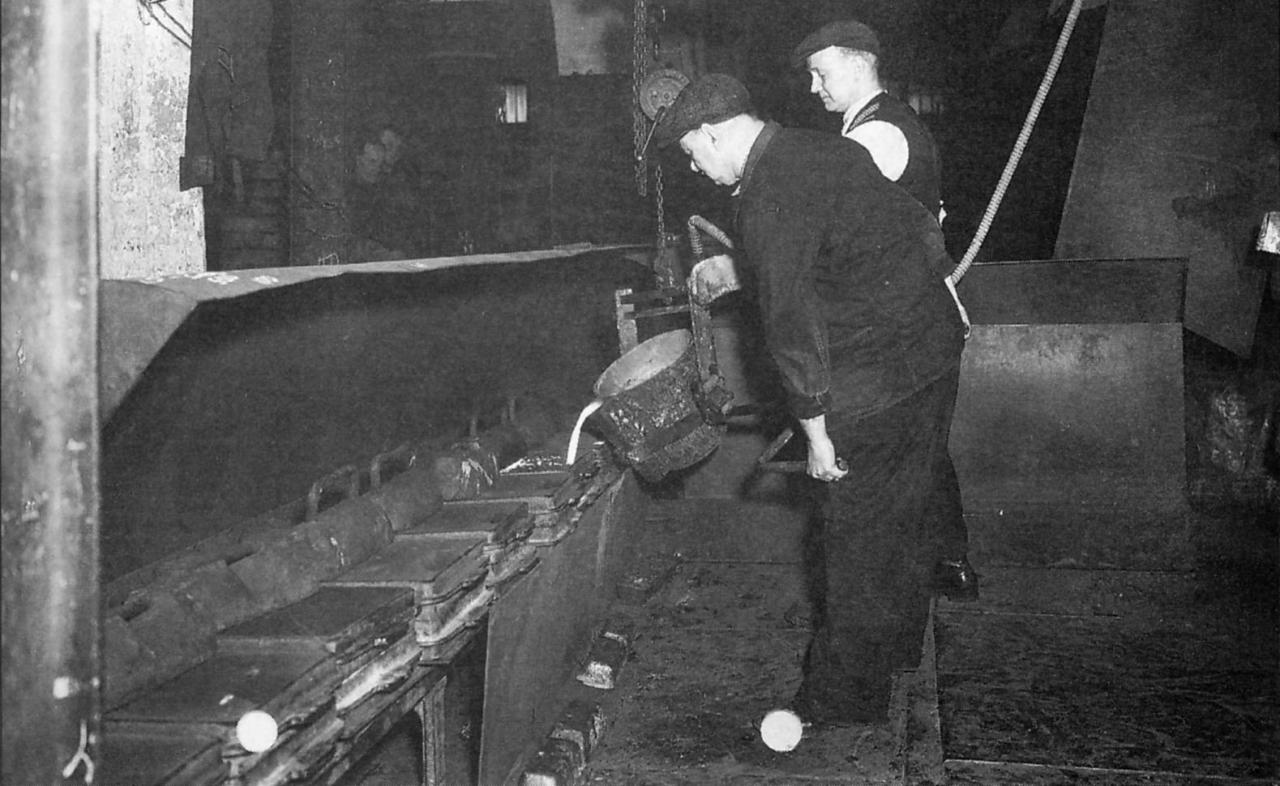
Five years ago, back 'home' in the city where I was born, in the same hospital in fact, I met the foundry man. My Grandpop lay in the hospital bed, his hands moving through the air in a similar way to that described in Prufer's poem. He'd thrust his arms forward toward the unseen furnace, pull them back and then pour the invisible steel liquid into moulds lined up along the hospital table. After hours of repeating the same actions he'd suddenly switch to rubbing his palms together, sliding the fingers on his right-hand between those on his left. When he plunged his hands into the dry bed sheets to wash off the soap, my mum said he was back home now. Standing at the kitchen sink - as he did every night after work - washing off the stains.


For five years I've been trying to write the foundry man poem. I've lost count of how many drafts I've written, how many different ways I've tried to write his story. I know the details - still so clear - are those worthy of a poem, but every attempt I have made feels wrong, unfinished. With each failed attempted I file another draft away in the filing cabinet, leave it alone and decide that maybe now isn't the right time for this poem to be written. But eventually something triggers the foundry man to rise vividly back into my thoughts and I'm compelled, almost powerless, to make another attempt.

*          *          *

Conversations with poets over the years have revealed that many have that one stubborn/ difficult poem which seems to take far longer to finish than others. After years of revisiting an idea, writing unsuccessful drafts, something finally clicks and they find their poem - exactly as they hoped it would be. So maybe this time, when I revisit the foundry man, I'll write the poem and it'll be just as I hoped it would be. 


Thank you for reading,

Lara.

Monday, 16 September 2013

My life in Death - Poem inspired by the colour blue

09:05:00 Posted by Colin Daives , , , , , , , , , 2 comments
This weeks theme is the colour blue. For some reason this poem came into my mind. I hope you enjoy it.


My life in Death
In many shadows I walk
The moon's smile showing me the way
Streets in silver highlight with whispered talk
Shivers of a long forgotten day

I miss the warmth of sunshine in my blood
Destiny deals such a heavy hand
To walk once more through the early spring bud
Hearing the brass blasts of the Salvation band

But of all the things I miss in light
The scape I still yearn to view
To look up in to an infinite sky
And blind myself with spread of blue

Monday, 9 September 2013

Bible Stories with a generous helping of Easter

09:00:00 Posted by Colin Daives , , , , , , , , , 1 comment
This week’s theme is “The Bible.” Now I am pretty certain there will be lots of argument regarding what is considered to either be the truth or fabrication. Whether stories should be seen as figurative or literal testimony.

I have my own views on the book, and before anyone wishes to cast doubt on my opinions, I have read it a number of times, as well as many supplement texts for various projects I have worked on over the years.

It is important to remember that there are two Bibles. One which deals with events that surround a life book ended by the birth and death of Jesus. The other regarding tales of the world before the son of a carpenter walk this green and pleasant land.

It is the New Testament that I find myself interested in here on this blog. In particular the death and resurrection of the Nazarene. The birth of Jesus is set in stone as the 25th of December, Christmas. His death and rise on the other hand float around.

Easter is defined as the first Sunday after the first ecclesiastical full moon that occurs on or after March 21. Which relates back to what is referred to as Pagan times.

There is a somewhat complex formula that can be used to calculate the Easter Sunday of any given year. So if you need to know when the first bank holiday will be after New Years Day in 2018, this piece of mathematics can tell you.

The easiest way to calculate all Easter Sundays is to use an Easter calculator like this one:

http://www.pauahtun.org/cgi-bin/easter.py

I have tested it and it seems to work very well. I conduced these experiments by using the years of Easters gone and checking the results against said calendar. This got me thinking.

Could I find out the date of the very first Easter Sunday? Could I determine the actual date Jesus arose from death and ascended to heaven?

A quick look on the internet, and a trawl through my own memory tells me that Christ was 33 when he succumbed to human mortality on the cross of the Romans. So, if you work on the basis that 0 (zero) AD is the year of birth then by this we can assume that 33AD would be the first Easter.

So by entering the year 33AD into the Easter Calculator we can find out the exact day of the first Easter Sunday according to the Gregorian calendar. This is important because the version of the Bible most recognised regions use is the King James Bible. The first popular English translation which was published in 1611. The Gregorian calendar is a reform of the Julian calendar. In 1582 it was seen as important to change the calendar to bring into line the celebration of Easter so that it was compliant with the time of year agreed upon by the Council of Nicaea in 325AD.

The outcome of typing in 33AD in to the Easter Calculator is the 3rd of April. Interesting, because if the first Easter Sunday, the day of the resurrection is the 3rd then that means the first Good Friday, the day of the actual Crucifixion would be the 1st of April, the day of fools.

Make of this what you will.

The Bible
Book the first
And God is vengeful
Feel his Wrath
Watch the shebear do his bidding
Bald old priest
Man of cloth used the Lords name so hateful

Jehovah the gambler
Bet the life of Jobe
Just to prove he won’t denounce you
To your first favourite
Who fell from grace
And no longer wished to live to your code

Father the deceiver
That denied the truth naked
Of your own creation
Until the woman, hungry for knowledge
Ate the apple
And opened their eyes so belated

Book the Second
And God in Loving
Forgiving those who hath sinned
Because of the word of his son
The carpenters apprentice speaks
And the almighty, now dad, becomes caring


Thursday, 25 April 2013

But thinking makes it so

08:00:00 Posted by Damp incendiary device , , , , , , , , , , 6 comments
Mr. Praline: Now that's what I call a dead parrot.
Owner: No, no.....No, 'e's stunned!
Mr. Praline: STUNNED?!?
Owner: Yeah! You stunned him, just as he was wakin' up! Norwegian Blues stun easily, major.
Mr. Praline: Um...now look...now look, mate, I've definitely 'ad enough of this. That parrot is definitely deceased, and when I purchased it not 'alf an hour ago, you assured me that its total lack of movement was due to it bein' tired and shagged out following a prolonged squawk.
Owner: Well, he's...he's, ah...probably pining for the fjords.

Poor Mr Praline.  It's frustrating when somebody misuses language in order to manipulate.

Here is how the US War and National Defence Code describes a weapon of mass destruction:

(1) The term “weapon of mass destruction” means any weapon or device that is intended, or has the capability, to cause death or serious bodily injury to a significant number of people through the release, dissemination, or impact of—
(A) toxic or poisonous chemicals or their precursors;

(B) a disease organism; or

(C) radiation or radioactivity. 
And here is how the FBI (in part) defines the same term for civilian investigations:
(A) any explosive, incendiary, or poison gas—
(i) bomb,

(ii) grenade,

(iii) rocket having a propellant charge of more than four ounces,

(iv) missile having an explosive or incendiary charge of more than one-quarter ounce,

(v) mine, or

(vi) device similar to any of the devices described in the preceding clauses;
Finally, here is how the FBI described the weapons of mass destruction used in the Boston bombings:

low grade explosives that were housed in pressure cookers...The pressure cookers...contained metallic BBs and nails.  Many of the BBs were housed in an adhesive material.  The explosives contained green-coloured hobby fuse.
As a poet I'm a fan of words with multiple meanings.  Take the word mantle.  Here's how the OED defines it:

noun

  • 1 a loose sleeveless cloak or shawl, worn especially by women: she was wrapped tightly in her mantle
  • a covering of a specified sort:the houses were covered with a thick mantle of snow
  • Ornithology a bird’s back, scapulars, and wing coverts, especially when of a distinctive colour: many gulls are all white except for dark grey mantle and wings
  • Zoology (in molluscs, cirripedes, and brachiopods) a fold of skin enclosing the viscera and secreting the shell.
  • 2 an important role or responsibility that passes from one person to another:the second son has now assumed his father’s mantle
    [with allusion to the passing of Elijah's cloak (mantle) to Elisha (2 Kings 2:13)]
  • 3 (also gas mantle) a mesh cover fixed round a gas jet to give an incandescent light when heated.
  • 4 Geology the region of the earth’s interior between the crust and the core, believed to consist of hot, dense silicate rocks (mainly peridotite): magmas erupted at mid-ocean ridges are derived from the upper mantle [as modifier]:mantle rock [mass noun]:the presence of hot mantle leads to melting at the base of the lithosphere
  • the part of another planetary body corresponding to the earth’s mantle:the lunar mantle
Mantle also works as a verb but let's ignore that for now. 
If I describe a mantle's clasp I might be talking about the clasp which holds a cloak together, the manner in which the snow clings to the roof of a building, the dire grip of inherited responsibility or the deadly embrace of a magma eruption.  
If I fancied enrolling a cliched image I could describe the starry mantle above my head.  Shakespeare used this particular image in Hamlet (back when the metaphor was still living):
But look, the morn, in russet mantle clad
Taking another step, I might employ a homophone and allude to a woman's breasts as a mantle, calling to mind breasts that are expansive (they could be used to cover something) and also resembling a mantelpiece. 
By tapping into the varied word banks of my readers I am able to tease subtle nuances from a single word which can affect the perception of a poem.  The variety of definitions for individual words in the English language is one reason why it's such a joy to employ.  But not everybody uses the OED.  Organisations, as we see above, create their own very specific definitions to apply to words which are in common parlance.  

The problem with a multitude of definitions is that the law (where many of these creative descriptions can be found) depends upon understanding of what constitutes a crime.  Beyond the simple edict that it is wrong to harm others, civilians need to be informed about what their government classifies as a crime worthy of punishment.  
The FBI definition includes in its description of WMDs: incendiary devices.  A Molotov Cocktail is an incendiary device.  Here is a video of a child making a torch with alcohol and a glass bottle.  

The FBI definition includes in its description of WMDs: a rocket having a propellant charge of more than four ounces.  Here is a WikiHow page showing you how to make fuel for your homemade rocket using 2lbs (32 ounces) of propellant.

I'm going to go out on a limb and assume the folks who are involved in the media above haven't been arrested on terrorism charges.  Are they aware that their products could be classified as weapons of mass destruction?  Are they aware that the use of such weapons carries this sentence:
...imprison[ment] for any term of years or for life, and if death results... punish[ment] by death
or imprison[ment] for any term of years or for life.
There is a man currently in prison for six consecutive life terms in Colorado for conspiring to use a plane as a WMD.  He had learned how to fly a WMD but didn't kill anyone personally.  He was in prison when the September 11 attacks took place. The judge appears to have made up their own, personal definition of what constitutes a WMD just for this case.  You begin to see the problem?
Shakespeare enjoyed playing with language.  As Colin pointed out on Monday, if he couldn't find a word that suited him he created a new word.  Many of those new words are in use today.  I like to imagine, however, that Shakespeare would be less impressed with the constant shuffling and variance of definitions which slippery authority figures use to suit their own ends.  When the law is shifting beneath your feet, who's to say which of us would maintain our freedom should the powers that be require a reason to have us disappear?


Thursday, 11 October 2012

Hair is grey and the fires are burning

11:30:00 Posted by Damp incendiary device , , , , , 3 comments


We are separated, finally, not by death but life.
We cling to the dead, but the living break away.
From Winter Song by Carolyn Kizer

Winter has a reputation for harshness.  It brings with it a dose of reality, or mortality.  We are ill equipped to face this season and the sense of endings which it drags in its cold, grey wake.  No matter how many winters we witness, how many deaths we endure, the finality maintains its capacity to horrify us.

What of the separation of which Carolyn Kizer speaks?  What of the endings which are inevitable in the tumult of living?  Disagreement, incompatibility, impracticality?  Some places we have tended, carefully, become barren.  They no longer provide the sustenance essential to life.  The ground turns hard, the landscape unwelcoming.  Do we stubbornly plough the frozen ground, thinking Spring to be on the horizon?  Or do we walk away from that place?  Can we leave it behind, knowing that not only can we never return but that some other might find that sacred place, knowing a way to tend that land which we hadn't imagined, and yield the sweet harvest which we imagined in the beginning?

Some things must end.  This is the fact.  Endings feed beginnings.  Old matter nourishes the ground, feeding the seedlings.  It is right to cling to the dead, to remember what has passed.  It is equally right that we let them go, with love, and acknowledge the elegance of the cycle.  More difficult is it to walk away from the living.  Even when the leaves have fallen, the stems become brown and brittle, we remember how the meadow looked in the height of summer, brazen and dazzling - teeming with life and possibility.

When the living break away what can we do, but trust in Winter's necessity, think on the lost loves of the dead, and rest a while, nourishing ourselves in the dark.