written and posted by members of Lancashire Dead Good Poets' Society

Showing posts with label Remembrance. Show all posts

Saturday, 26 October 2024

Poppies

Flowers. It was William Blake who wrote:
"To see a world in a grain of sand and heaven in a wild flower, hold infinity in the palm of your hand, and eternity in an hour. "

I let my back garden run a bit wild this year. The much heralded revamp is on hold. It was heaven for the insects (bees in particular) to have a range of wild flowers to enjoy, even if it all looked a bit scruffy and haphazard. 

I love wild flowers and the illustration below is a glass panel I had made for me a few years ago to hang in the conservatory, because unlike paintings or posters the colours don't get bleached by the sunshine. Stephanie Bowen is a local Lancashire glass artist with a studio, Morpheus Glass, in Wigan. 

Meadow Flowers - glass panel art by Stephanie Bowen, 2019 
Given that we are close to Armistice Day, I thought I'd focus this flower blog on poppies in particular, since the red poppy (papaver rhoeas ), or red-flowered corn poppy to give its full title, has become the symbol of remembrance for those fallen in battle, in no small part  because of the way it colonised the disturbed soil of the First World War battlefields in the wake of all that bloodshed - although there are deeper connotations as described further on.

But poppies come in a variety of species and colours (yellow, orange, purple, blue, white, pink). As with many cultural practices, the first recorded instance of poppies being cultivated and used for culinary, medicinal, recreational and religious purposes dates back to the Sumerians (in what is now southern Iraq) some time in the fifth millennium BC. They were the first to grow opium poppies (papaver somniferum ), a practice that continues to this day across the region of the Middle East and Asia, providing the world with a precariously regulated source of opium and analgesic opiates (including codeine, heroin and morphine).

From Sumeria, poppy cultivation and poppy folklore spread west around the Mediterranean and east along the silk road to China. Juglets containing opium have been found in Ancient Egyptian tombs and poppies feature in their jewellery and paintings of the second millennium BC. In Crete, Minoan culture of the same period celebrated the Poppy Goddess and later, both Greek and Roman cultures regarded the poppy as a symbol of sleep and dreams (narcolepsy - the Morpheus connection) and of death (repose in everlasting sleep). Poppies featured in funeral rites and as tokens of remembrance even three thousand years ago. There is also some evidence that other pagan religions came to regard the poppy as a symbol of resurrection.

Of course to most of us poppies are appreciated for their vibrant colour, whether growing as wild flowers in the countryside or as ornamental plants in our gardens, and the bees love them. There will be poppies as well as geraniums in my garden after the revamp.

They also retain their culinary and cosmetic uses. Poppy seeds (the non-opioid varieties) are rich in oil, calcium and protein. The oil can be used in salads and in cooking, and many bread products are baked with poppy seeds mixed in the dough or sprinkled on top. Poppy extracts feature in beauty products and are used in the manufacture of some paints and varnishes.

The poppy is the national flower of both Albania, North Macedonia and Poland and is the state flower of California. Poppy has also regained currency in the 21st century as a girl's name and several rock bands have featured it, including (with incisive Scouse humour) Liverpool's Dead Poppies.      

Girl in a Field with Red Poppies - by Frank Buchser, 1878
To conclude, here's a poem I've just written in that eternity of an hour the clocks have given back to us tonight. Its title is from a quote by Dr. Joel Warsh, an American paediatrician. In full, the quotation reads:
"Let’s raise children who can name plants and animals, not celebrities and brands. In a world full of screens and pop culture, let’s encourage our kids to connect with nature and appreciate the beauty around them. Teaching them about the natural world helps foster curiosity, responsibility, and a deeper understanding of our planet. "

Let's Raise Children Who Can Name Plants And Animals

Belcher's Factory tea room
Monday mid-morning break
women in pink nylon overalls
sit drinking tea 
at tables with plastic flowers
scrolling on their phones 
or chatting
about weekend dates or TV
when one exclaims 'there's a bird'.

A rare sight indeed.

They crowd to the dusty window
and gaze at the tiny thing
bobbing and dipping
in the gutter of the factory opposite.

'That's a pied wagtail' says the youngest
who's never seen one before
but has the book at home.
'It's probably searching for water
or insects.'

They watch its jerky little movements
with fascination until with a last flick
of its black and white tail it sails off
leaving them to stare wistfully after
without knowing why.

Come on girls! Mugs away!
That sinking feeling,
back to the production of wealth.


And so to bed, as Zebedee said...or was it Samuel Pepys? (Don't answer, I know it was the latter.)
Thanks for reading, S ;-)


Tuesday, 22 October 2024

Flowers - Bloomin' Lovely

The garden is looking sorry for itself. Chopped down for winter, the three intertwined buddleia are naked sticks protruding from the soil, shorter than the fence. They look dead, but I’m sure I haven’t killed them. I can’t say the same for the annoying bindweed that was wrapped tightly around more branches than I realised. It has disappeared for now. Springtime will see it re-emerge, ready to attack, and once again I’ll be fighting the losing battle of trying to keep it away. I’m considering training it on to some trellis somewhere at the side. It is an attractive plant, just damages other things. We’ll see. The buddleia didn’t flower very well and I didn’t see a single butterfly, though I was away for most of the summer.

I'm not a good gardener, home or away, but I make an effort and do my best. Bulbs are planted for spring. I look forward to daffodils, tulips, irises, grape hyacinths and something I’ve never heard of that looked very pretty on the box. I do this every autumn, full of enthusiasm, expecting to grow the best spring garden ever and the wonderful flowers will compensate for every ache and pain. Something is always lacking – green fingers – so, in all seasons I try to plant things that will flower nicely and look after themselves. A favourite is the Totally Tangerine geum. They come back stronger each year. There are two, in different flower beds. In bloom, one is more stunning than the other. The slightly weaker one was bought when I was feeling cross about someone connected to football and I think it shows, but it doesn’t matter now.

I love to have flowers in the house. Last week I was overwhelmed and delighted to be given beautiful roses including yellow ones for friendship from a lovely friend of many years. She didn’t know this, but things have been tough for me lately. The flowers, with their special significance, really helped to cheer me up.

I always have daffodils in remembrance of my father. When he passed away, his garden path was lines with an abundance of shades of yellow, cream and orange created by an amazing display of various daffodils. It’s nice to see them appear in my garden.

I hope I have success with poppies next year. They always look lovely, but can be so delicate that they don’t last very long.

I’ve chosen two poems,

Daffodils

I wandered lonely as a cloud
That floats on high o'er vales and hills,
When all at once I saw a crowd,
A host, of golden daffodils;
Beside the lake, beneath the trees,
Fluttering and dancing in the breeze.

Continuous as the stars that shine
And twinkle on the milky way,
They stretched in never-ending line
Along the margin of a bay:
Ten thousand saw I at a glance,
Tossing their heads in sprightly dance.

The waves beside them danced; but they
Out-did the sparkling waves in glee:
A poet could not but be gay,
In such a jocund company:
I gazed—and gazed—but little thought
What wealth the show to me had brought:

For oft, when on my couch I lie
In vacant or in pensive mood,
They flash upon that inward eye
Which is the bliss of solitude;
And then my heart with pleasure fills,
And dances with the daffodils.

William Wordsworth 1770-1850


In Flanders Fields

In Flanders fields the poppies blow
Between the crosses, row on row,
That mark our place; and in the sky
The larks, still bravely singing, fly
Scarce heard amid the guns below.

We are the Dead. Short days ago
We lived, felt dawn, saw sunset glow,
Loved and were loved, and now we lie,
In Flanders fields.

Take up our quarrel with the foe:
To you from failing hands we throw
The torch; be yours to hold it high.
If ye break faith with us who die
We shall not sleep, though poppies grow
In Flanders fields.

John McCrae 1872-1918

Thanks for reading, Pam x

Tuesday, 5 February 2019

Candles - Remembrance


Strolling around Dublin’s Temple Bar district with friends, I found myself thinking of my late Uncle Bill, a lovely Irishman and one of the pub landlords in my family. We were buddies for the whole eight years we had each other. He loved to take baby me out in my pram. When I was old enough he took me to the swings and my aunt would come along, too. Most Sunday afternoons our whole family would be together. Pubs closed on Sundays between 2 p.m. and 7 p.m. in those days and at that time we still lived fairly close to each other. I was always a Daddy’s girl, but Uncle Bill was another good playmate and had a wealth of stories to tell me. With no children of their own, my uncle and aunt doted on me and we were all thrilled with the arrival of my new baby sister. Uncle Bill died suddenly on 16th March, 1964. His rich singing voice would not be heard on St Patrick’s Day, or ever again. He is buried in his native Cork.

I was in Dublin, my first visit to Ireland, but it won’t be my last, it’s on my ‘to do’ list to go back and see more, including Cork, but it was too far away on that short break. With my head full of childhood memories of Uncle Bill, I excused myself from my company while I nipped into nearby St Teresa’s Church to light him a candle. Feeling spiritual rather than religious, I watched the flame become established, pointing heavenward, unfaltering in the still air like others around it, a tiny light expressing strength and power, a symbol of remembrance and love. I spent a few moments reflection before returning to my friends.

Sometime in my not-too-distant future I will return to Ireland and visit as much of the Emerald Isle as I can. I hope to visit Uncle Bill’s burial place. I will light a candle for him in Cork.
 
I found this poem,
 
 
Candle in the Window
 
There’s a candle in the window,
Shining with a loving light.
It’s been sitting there for years now,
It really is a lovely sight.
 
A tiny candle in the window
Burning with a light so rare,
Where the cold wind doesn’t blow,
A loving sign that someone cares.
 
A tiny flame that burns inside
The window of that tiny shack,
Like the flame that in the heart resides,
Wishing someone would come back.
 
It will burn ‘til two soul mates
Are reunited once again,
And overcome the cruel hand of fate,
And joy replaces all the pain.
 
Juan Olivarez
 
Thanks for reading, Pam x

Saturday, 10 November 2018

Unleafing Stanley Park

In a properly ordered universe I would have been at St. James' Park (home of Exeter City) this afternoon supporting Blackpool in the FA Cup, but this is not a properly ordered universe, not while the Oyston family is still in control at Bloomfield Road. The supporter boycott continues.

As an alternative, I took a walk in the park with Adele - that's Blackpool's award-winning Stanley Park (created in 1928). It was an overcast day, not untypical of the north-west in November, but at least the rain held off. I thought I'd look for inspiration for a poem, maybe even write it al fresco. Well, that last part didn't happen, but it was a relaxing hour's walk and sufficiently inspiring, I think.

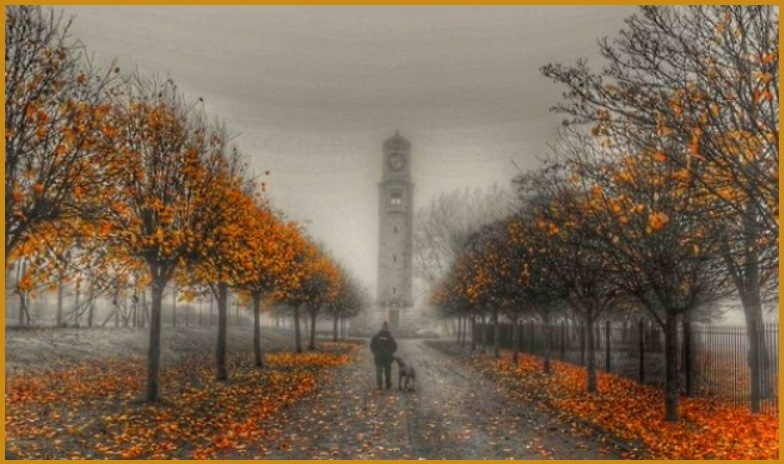
We were pursued for quite some while by a tribe of tufty grey squirrels who are so tame they expect to be hand-fed; alas we'd gone without provisions, so eventually they scampered off in disgust shaking their tails at us. There wasn't much interesting bird life in evidence; a few maggies (one for sorrow, two for joy, three for a girl, four for a pie...), some rather sorry-looking cormorants and a couple of sweet green parakeets - plus the usual suspects (gulls and pigeons aplenty). Of course there isn't anything in flower at this time of year, not in the ornamental beds nor the rose garden - so the stars of the park were the trees, rapidly unleafing, having gone a spectacular array of reds, yellows and browns.

The walk to Cocker Tower in Stanley Park
There were various commemorative artefacts to see as well - a newly unveiled remembrance bench and displays of  artificial poppies. As we walked the woodland paths I was thinking about November 1918 on this 100th anniversary of the end of the Great War, of fallen men and falling leaves and the sheer magnitude of big numbers, like the ten million soldiers who lost their lives in that conflict.

Have you ever wondered how many leaves there are on a mature tree? I looked it up on the internet when I got home, for inevitably someone has calculated this. Depending on the type and  size of tree, naturally, the number is anywhere between 20,000 and 80,000. Taking an average of 50,000, that would mean in an avenue comprised of a hundred pairs of trees, each falling leaf would represent the loss of one small but infinitely precious life during that war-to-end-all-wars, ten million hopes scattered to the winds -staggering to contemplate.

At the going down of the sun, the park's Cocker Tower (below) was illuminated with a series of images of remembrance, a moving tribute from the town to those who served and died in order that we could live free.


I've not written a new poem for this week's blog, but you're welcome to revisit the Winter Ghost blog I wrote a year ago about the Christmas 1914 football game in No Man's Land, linked here: http://deadgoodpoets.blogspot.com/2017/12/winter-ghost.html

Thanks for reading. Until next week, S :-)