written and posted by members of Lancashire Dead Good Poets' Society

Showing posts with label letters. Show all posts

Wednesday, 27 January 2021

Handwriting - It Says a Lot

07:00:00 Posted by Jill Reidy Red Snapper Photography , , , , 4 comments

1956. 


There were 40 of us squashed into a tiny classroom, all clutching our fat pencils in grubby, playground hands. Our teacher, Mrs Gorvin, stood at the front and formed a large round ‘a’ on the blackboard. As she turned and enunciated ‘a’ in a loud, clear voice I remember thinking it was the same shape as she was. We all drew ‘a’ in our rough books.  I wasn’t happy with mine and tried to rub it out with my finger. The spit didn’t help. My finger made a messy hole in the paper, and in a panic I quickly turned the page and drew another.  


Mrs Gorvin turned back to the board and formed a big fat, ‘b’.  ‘B’ she said loudly, as the chalk squeaked on the downward stroke. We all poked our tongues to the corners of our mouths in concentration, and pressed hard with our pencils on that thin, rough paper to try to replicate the letter before us. 


My First Rough Book 


It looks like I was already putting my own stamp on the letter, r 


When I taught handwriting to 5 year olds some 40 years later, everything had changed. Oh the letters were the same of course, but the teaching was quite different.  Lots of play, making shapes in sand with sticks, tracing dotted lines in books and generally getting the feel for straight lines, curves and circles.  Then we made a start. No alphabetical order, instead groups of similarly formed letters would be produced until all 26 were covered. 


I’d always been fascinated by letters, their shapes, how they got together to make words, and how the words themselves formed yet more shapes.  And you could actually read those shapes - they said something, they meant something. It was magic.


When children first learn to write freely, they are often so engrossed in what they want to say that the words become squashed together, without a finger space to be seen. Long sentences all in one word. When I moved from Y6 to Y1 I spent many puzzled hours trying to decipher these endless, spaceless meanderings until I worked out that reading the whole thing aloud, phonetically, was the answer to the problem. I’ll never forget Nicola writing about her dolly who had ‘anewperovrubernikers’* Amazingly, there were spaces between all the other words in the sentence but this was obviously just one complete item. 


Throughout childhood and adolescence my handwriting changed constantly. When I started High School it began to enjoy regular changes in size, shape, often with questionable legibility.  I’ve always kept diaries and notebooks and I remember two strange displays of affectation. I was about fourteen or fifteen.  The first was joining two words together if they had a common letter at the end of the first and the beginning of the second. For example, ‘that tent.....’ became ‘thatent’ and so on. Ridiculous with hindsight but it obviously kept me amused and saved on paper. The other phase I went through was dotting odd words in French throughout the diary entry, probably for the very same reason as above. 
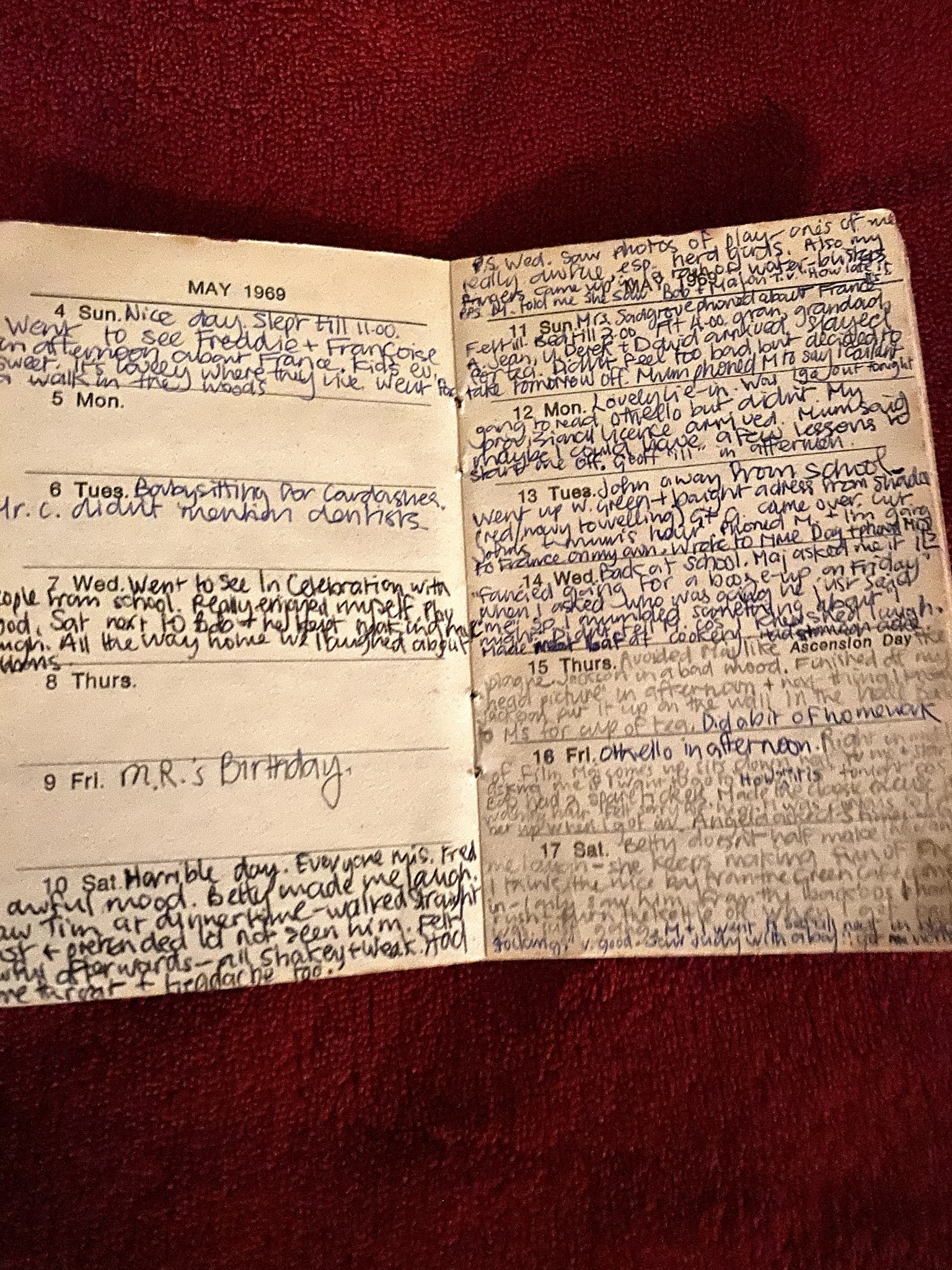


1969, my final year at school


1974 How could I write this, never mind read it??


Inevitably, in 2021, beautiful handwriting is becoming a thing of the past. Letter writing has naturally waned, due to the ubiquitous use of computers, tablets and phones.  Emails, text and messages are all relayed instantly - no need to wait for the post - and one’s reply is back with the sender in seconds.  Much as I love these digital connections I can’t help feeling a stab of regret that I’ll probably never sit down again and read a long awaited hand written letter from a friend or relative.  I have a drawer containing old letters all of which mean something to me. Each envelope is distinguishable by its unique handwriting: my dad, who wrote infrequently but always in times of trouble (mine), with his small neatly formed script.  Inside would be well thought out words of wisdom and hope, offers of help, usually financial; mum with a larger, more generous script, an envelope full of promise, the letter bursting with news from home, enquiries as to my health and well being, and lots of love; the careful print, squashed within the tiny space on the bluey from an RAF camp somewhere in Afghanistan.  How the sight of that writing reassured me. I didn’t care what was written inside (usually not a lot). My boy was still alive; then my husband, when we were apart for a few months before we married, a scribble at best, a sense of urgency, and inside, a letter full of more frantic writing, and however loving and intimate, always finishing with a flourish: ‘Up the Rovers’; and, it goes without saying, the best handwriting appears on the funny, poignant little notes and letters, left on my pillow or posted around the kitchen door by the children when they were little.  


That sound of the letterbox closing and a thud on the doormat.  What a happy memory. Now that has to be preferable to the constant pinging of a noisy mobile….


*A new pair of rubber knickers.


Handwriting Practice (with apologies to Joyce Grenfell) by Jill Reidy 


Children

Pick up your pencils 

And hold them like this - 

No, Emily, like this -

See, thumb here, finger there

That’s good

But with the point towards the paper

Start on the line and draw -

Jack! Don’t do that with the pencil!

We’ll never find it again

Start on the line and slowly

Up to the line above

Yes, that’s it Milly, brilliant!

No no no stop STOP!

Stop at the line above 

You’ve drawn on the desk now 

It’s all right, never mind

Don’t cry, Milly, it was a first attempt

You wanted a LONG line?

We can clean it off the desk

Now

Come down the line

Slowly, slowly, take your time

That’s it

Very good everybody

Oh Ollie, what’s this?

A plane? A PLANE? 

We’re not DRAWING today

Are we Ollie? 

No, we’re doing our HANDWRITING

Arent we?

Yes yes we are Ollie

I know planes make lines in the sky 

Yes Ollie chemtrails - 

But we’re making lines on paper, Ollie

No, there’s no need to rub it out 

Put the rubber down, Ollie

On the desk

Away from your book

Start on the next -

Jamie! 

What is that you’re waving about?

I know it’s your pencil

What’s that on the end of it?

Ugh 

That’s not very nice

your pencil doesn’t need to go

Anywhere near your nostril

No

Now, pencils ready? 

What, Jamie?

Wipe it on a paper towel

Careful! Katie’s jumper?

It’s OK Katie, it’s only - 

That’s it, you get a paper towel too.

Right, ready? 

Now you need a big fat -

Cece? 

Yes I did tell you all not to call each other fat but - 

No, nobody’s fat in this class but -

CECE! Its a letter, a LETTER that’s fat

Yes, letters can be fat

Wipe your eyes, Cece 

We haven’t hurt the letter’s feelings

And - everybody - draw a big fa- round circle 

To make the letter b

Well done children! 

Some lovely b’s in these books

Who can give me a word that starts with b?

Max? Oh no, we don’t say that do we?

Where have you heard that?

Yes, I know what it means but -

Yes, I know all the boys have them 

Max, you don’t need to point to - 

Right, everybody, coat’s on 

Lovely work, early playtime….


Thanks for reading.........Jill 


Monday, 25 January 2021

Handwriting

When was the last time you received in the post a handwritten letter from another person? Or when did you last write a handwritten letter to anyone else? With the advent of digital communication, emails, texts, electronic messages etc, there is now little need or requirement to do so.

I do receive one handwritten letter about 4 times a year. This is from a friend who is a Luddite and refuses to have the internet or engage in any form of digital communication. He is also fairly deaf, so speaking via a landline is tricky. His only means of regular communication with me, therefore, is to hand write a letter. I respond by mail, but always type mine, as my handwriting is not the easiest to read.

Will handwriting thus become a thing of the past, if it hasn’t done already?  I hear via teacher relatives and friends and have seen from my own involvement in schools over the years, that some children find it far easier to use their fingers and thumbs to handle and control electronic devices than they do to use a pen or a pencil.

If handwriting is uncommon today, then obviously in the past, it was the main way of communication. I buy and sell antiquarian books and I love thumbing through books and seeing inside different notes and writings from people. It can be a shopping list, a diary piece, a love note, a comment on the book, or just someone’s thoughts on life or their day.


The writing is often beautifully crafted and neatly expressed. Handwriting in years past was an art in itself, with copperplate style and pen and ink.

Handwriting can have more personal or sentimental links too.  In our family, we do not have  many photographs and so written memories are very important reminders of who a person was. I have a diary of a relative’s journey through the Lake District in the early 1900’s, which makes fascinating reading and gives a thoughtful insight into their lives at that time.

The main memory I have of my father is due to his handwritten talks and notes that he left and to which I sometimes refer when I give talks of my own, or when I am drawn to thinking about him.

Handwriting has and always will have an important place in my life, but I wonder what place it has in yours and whether it will have any place in future generations?

In honour of the theme of writing I am including a favourite poem by Seamus Heaney:


Digging

Between my finger and my thumb
The squat pen rests; snug as a gun.

Under my window, a clean rasping sound
When the spade sinks into gravelly ground:
My father, digging. I look down

Till his straining rump among the flowerbeds
Bends low, comes up twenty years away
Stooping in rhythm through potato drills
Where he was digging.

The coarse boot nestled on the lug, the shaft
Against the inside knee was levered firmly.
He rooted out tall tops, buried the bright edge deep
To scatter new potatoes that we picked,
Loving their cool hardness in our hands.

By God, the old man could handle a spade.
Just like his old man.

My grandfather cut more turf in a day
Than any other man on Toner’s bog.
Once I carried him milk in a bottle
Corked sloppily with paper. He straightened up
To drink it, then fell to right away
Nicking and slicing neatly, heaving sods
Over his shoulder, going down and down
For the good turf. Digging.

The cold smell of potato mould, the squelch and slap
Of soggy peat, the curt cuts of an edge
Through living roots awaken in my head.
But I’ve no spade to follow men like them.

Between my finger and my thumb
The squat pen rests.
I’ll dig with it.


Thank you for reading, David.

Sunday, 5 February 2017

Letters - They Can Be a Lifesaver

16:46:00 Posted by Jill Reidy Red Snapper Photography , , , 1 comment
Much as I love technology, and spend a big chunk of every day with eyes on a screen, fingers flying across a keyboard, sending the next text, email, tweet or WhatsApp message, I'm still sad at the demise of the personal letter.  There's nothing to beat the sound of a big, fat envelope landing on the doormat, the first sight of the handwritten address and the excitement of freeing the folded paper inside.

When I was about eleven or twelve, we were all asked, during a particularly boring French lesson, whether we would like a penfriend.  Most of the boys declined, grinning and shaking their heads, but several girls, including me, accepted the offer.  And so for the next few months Sabine and I corresponded sporadically, telling each other in broken French and pigeon English about our families and our hobbies.  As far as I remember it never got any more interesting than that.  Little did I think that one of Sabine’s letters would end up contributing to my sex education.

It happened like this (and I still cringe, fifty years later, when I recall the incident):  It was another boring French lesson.  We were learning about past participles, and as the teacher turned to write on the blackboard I quietly reached into my bag and drew out the letter from Sabine that had arrived that morning.  Holding it beneath the desk, I began to read it when Miss Hyde’s voice rang out from the front of the class, “Jill Carrington, what have you got there?  This is a French lessson!” she bellowed.  There might even have been a piece of flying chalk aimed at my head, which was an accepted short, sharp shock in those days.  “It’s a letter,” I stammered.  Miss Hyde shook her head in despair.  “That’s nothing to do with this lesson,” she said, holding out a hand for the offending article.  Indignantly and with some bravado, I said loudly, “It’s a FRENCH letter.” 

I wasn’t prepared for the roar of laughter from a group of boys on the cusp of puberty, looking for sexual connotation in any comment.  I was confused.  I didn’t understand why it was so funny.  Miss Hyde glared at the boys, snatched the letter and moved on swiftly.  It was only at playtime when my best friend explained to me the meaning of ‘French letter’ that the full humiliation hit me.  I don’t remember if I replied to Sabine but I do know that particular pen friendship didn’t last long after that.

Just a few of the letters I've kept over the years


Every parent has probably got a box or a drawer crammed with sweet notes from their children.  I’m no exception.  The wonky writing, the misspellings, the innocent sentiments, ‘I love you mumy I am sory I didunt meen to eat that biskit….’  Those days are now so distant, we will never get them back, but it’s a touching reminder that our children really were once cute. The missives from the children and grandchildren are probably the only love letters I've ever received.  When the future husband and I were separated for a summer at the beginning of our relationship we did keep up a fairly frequent correspondence, although his letters were filled mainly with rundowns of the latest football match, and the most romantic phrase after his signature was always a jaunty 'Up the Rovers.'  I would have been flattered, thinking it was some sort of secret message just for me, but I’ve seen it on all letters and emails since, including those to every North West NASUWT member when the husband was local secretary.  I’m not sure how many Burnley supporters subsequently defected to the NUT.

Letters have always held a special place in my heart.  My mum and dad are of a generation that thought nothing of penning several letters a week.  Between ‘O’ and ‘A’ levels I went to work in France for a few months.  This was the first time I’d been away from home for longer than a week and I was terribly homesick.  My days revolved around the postman’s regular visits – and those thin blue airmail envelopes with my mum’s inimitable handwriting on the front.  In the privacy of my room I would read, through hot, fat tears, the descriptions of the mundane family life I was missing so much.  ‘I took John to the barber’s, he cut it a bit short…… Dad and I went into Palmers Green, had a coffee and a Danish pastry in the Baker’s Oven…….Grandma and granddad called round and we walked over to Broomfield Park….we sat by the bandstand and had an ice cream…..’  For a few moments I was back with my family, amidst the arguments and laughter and the everyday.  I still have a wooden box in the attic containing a neat pile of thin blue envelopes with my mum’s handwriting on the front.  They sit alongside my eldest son's 'blueys from when he was posted to Afghanistan with the RAF.  I didn't care what they said, I just cared that he was still alive to send them.

My dad’s letters have always had a more philosophical slant.  No descriptions of haircuts or visits to the park, these are letters full of advice, sympathy, condolences, usually after an upsetting split with a boyfriend, problems with bringing up three young children (‘they’ll grow up..’) and once, notably, when I was going through a particularly distressing depression and could see no light at the end of the tunnel ('..hang on in there, it WILL get better.' It did).  That letter, written from the heart by a fellow sufferer, is in a drawer next to my bed, crumpled, creased and smudged with tears.  It’s almost too painful to read now that I've come out the other side.

My grandma and granddad were married for nearly fifty years.  They obviously loved each other to have stayed together so long, but I never saw any obvious signs of affection.  My granddad was the stereotypical henpecked husband, with grandma nagging him most of the time.  So it was a surprise when the house was cleared after their deaths and a large pile of love letters was found, mainly scribbled on the backs of old envelopes or beneath shopping lists.  The notes, mainly from granddad to grandma, and only occasionally reciprocated, were touching in their simplicity.  Fifty years of reassuring grandma that despite her damaged childhood and its repercussions for the rest of her life, she really was lovable and loved.

I'm hoping that when our house is eventually cleared after the husband and I have passed away the children will find our letters and shed a tear at that romantic phrase at the end of each letter, 'Love Dave, Up the Rovers.' 


A short haiku this week, which I hope conveys the feeling of receiving a personal letter.

The Letter by Jill Reidy

The thud on the mat
Eyes note script, envelope rips 
Anticipation


Thanks for reading        Jill


Tuesday, 31 January 2017

Letters - Much More Than Pen Friends

I can’t remember the last handwritten letter I received, not counting notes in Christmas cards. The speed and availability of social media and email has replaced all that wonderful personal touch. Occasionally I get an envelope stylishly addressed by the neat hand of a cousin in Virginia. The contents will be a printed copy of family news, fairly short with a few photos placed in the text, the same thing sent to various people. Of course, I love it and read about the events across the pond with joy. Many miles separate our branches of the family tree, it’s great to be in touch but it’s not the same as a handwritten letter. We live in electronic times. My replies or ‘letters’ are always email.


Letters were my world for a while in my mid-teens. I was horrified to learn that we had to move and to Cheshire of all places. It didn’t make sense. There we were, all happy living in Dad’s dream come true, a pub on Blackpool prom, when out of the blue his services were required elsewhere and we all had to go.  My reaction was outbursts of tears, tantrums, slamming doors, and refusing to leave my friends and my school.  I begged and pleaded with him to speak to the brewery, the man at the top, whatever his name was, and get the stupid idea stopped. His expertise was needed in Cheshire, but we might come back, eventually. I tried another tack. The move would disrupt my schooling. We were halfway through the fourth year, preparing for my ‘O’ levels, I needed to stay put, so I would move in with my best friend. This was the best idea I’d ever had in my life, at this point. It was perfect. We could carry on going ice-skating together on beat nights and youth club on Fridays and I would continue to study hard, her mother would make sure of it. No. It wasn’t happening. My world came crashing down and I, with loud protests declaring complete hate for Cheshire and all who had brought his about, had no choice but to pack my belongings ready for the move. It was March. I was streaming with a heavy cold, as if the ordeal wasn’t miserable enough. We stopped for a meal on the M6 at Knutsford services and I tearfully called my friend from a payphone.
 
 It had been decided that we would write to each other, often, and we did. Letters went backwards and forwards between Blackpool and the place in Cheshire from myself and four others on a regular basis. Turquoise ink on bright orange, pink or lime green paper, such was the fashion. We used fountain pens and recorded our daily lives, news from school, family news, gossip about who’s in trouble for what. We wrote about our favourite music, pop stars, television, fashion and everything that filled our lives. The letters were my lifeline into the world I’d been forced to leave behind. They were so much more than just friends keeping in touch. I didn’t settle in our new place. I didn’t fit in at school, where everyone was ‘mod’ and into soul music, Ben Sherman shirts and two-tone fabric skirts. I was all prog rock, jeans, lacy blouses and beads. My family moved back to Blackpool after a few months. Nothing to do with me being rebellious, I promise. Dad had done whatever needed doing and the family could settle back into normality. I kept the letters for years after that and how I wish I still had them now. What an illustration of the lives of our mix of teenage girls in 1971, our opinions, worries, our hopes. We all went separate ways as we grew up and two of those friends have now passed away. I remember them all with fondness. Our letters kept us together when I was absent and to be included at that time meant a great deal to me.

As for Cheshire, I have returned to the town and the pub as an adult. It’s very nice, no teenage angst.

In later years, I was staying with my family in Virginia and loved to receive letters from my father. His beautiful handwriting on thin, air mail paper brought me news from home. And later still, when he was in the USA and I was here, our pale blue letters to each other flew the Atlantic on a weekly basis. I’ve kept all those.

I found this poem by Hugh McMillan
 
Here is a letter
come across the ocean
over the back of a world
curved like a whale.
I unwrap it, like tissue,
and sentences spill out,
as though the seal on a jar has broken,
coils of cornflower blue
on paper thin as shell.
 
I saw a sailor’s valentine once
in a museum in Nantucket Sound,
a mosaic of broken scallop
glued in a compass rose.
‘Writ from the heart’ it said.
Words come best like that:
in ink or blood,
when the source is from a major vein.
 
I read, and understand this much:
if ink sees off time and miles, then so must love.

                                                                                                       Hugh McMillan
 
Thanks for reading, Pam x