written and posted by members of Lancashire Dead Good Poets' Society

Showing posts with label Handwriting. Show all posts

Tuesday, 30 April 2024

This Writing Game - Where Does It Start?


I’ve always had ‘this writing thing’, ever since I could hold a pencil and form letters, which was long before I started school. My mother taught me the alphabet in upper and lower case, how to write the letters and the different sounds they made, called 'phonics' now.  I was lucky to have my mother at home to do this sort of thing with me, and, although I was almost constantly the new girl at various schools due to frequently moving pubs with my father’s work, I had a good education. There was a lot of emphasis on producing good handwriting in my primary schools. An entire lesson could be spent practising until each letter was perfect and sat correctly placed along the lines in the writing book. I took pride in this, so much pride that my personal signature flourishes were frowned upon and deemed completely unnecessary. Individuality was not encouraged.

Books were a thing, too. My mother was an avid reader and she read my books to me. I was determined to read for myself and proved to be a quick learner when I started school. I’m from the ‘Janet and John’ era of the late ‘50s. I don’t think the ‘h’ in John ever gave me or my classmates a problem. We accepted what we were told, John says John. I remember being ready for my next reading book then having to wait longer because I kept mistaking ‘clothes’ for ‘cloths’. The things I still carry round in my head sixty-odd years after the event! No wonder I’m a bit bonkers. Anyway, I was moved up and continued going from strength to strength.

I was aged seven and in my last year of infant school when I was introduced to Enid Blyton’s Secret Seven and The Rilloby Fair Mystery by some books that were given to me. I reached the end of the book and would go straight back to the beginning and read it again. I couldn’t get enough of Enid Blyton but her books were discouraged by schools. Both parents bought me books regularly. I must have been so indulged, but I was always reading and the more I read, the more I wanted to write. The seed was sown. It took a long time to grow.

I lost my main mentor when my mother passed away. Things can be ‘meant to be’, though, and upon leaving secondary school I was encouraged by my English teacher to keep writing, so I did. Life takes unexpected turns and leads us down unfamiliar paths, mistakes are made, lessons are learned and we move on. That makes it sound simple and straightforward when, as we all know, it very much isn’t.  Personal ambition was never far away. The writing game, it’s just there, we have to do it, even if it is something for ourselves, like a journal, it’s compelling. I hope someone reading this understands and agrees with me. I’m sure I’m not alone.

Creative writing continues to be my passion. I might get round to finishing ‘that novel’ or it might stay as it is, half of it on a shelf, the rest in my laptop. I loved writing it. I loved seeing a published short story in print. If that’s as good as it gets, I’m happy. It happened.

My poem, a tongue-in-cheek look at the future of education.  I’m glad that my grandchildren are learning handwriting and basic skills that I can relate to.

An Alternative Education

The 3 Rs soon to be redundant
Computer-led kids will be abundant
With all information mega-quick
It only takes a scroll down and click
No need for any conversation
Included in their education.

Last year’s reception class have all gone
And taken a leap up to Year One
To drag sticky fingers on iPad screens
And work out what technology means.
Will this be their basic foundation
Instead of formal education?

Numeracy, or let’s call it Maths
Has rules to follow specific paths
Beginning with learning how to count
Then adding up and sharing out.
One click away from calculation
Takes away their education.

The infants are learning to use a pen
It’s not a skill they’ll need again
For a future spent staring on-line,
Social activity in decline
With hardly any interaction,
So they won’t need our education.

When did this digital preference start?
Oh why no poetry learnt by heart?
‘Spell check’ becomes their favourite teacher
With ‘Grammar check’ an added feature.
The only future expectation,
A self-taught on-line education.

PMW 2015

Thanks for reading, Pam x

Saturday, 30 January 2021

Handwritten In The Style

I was born to be a doctor: good manners, compassionate nature, analytical mind, almost illegible handwriting. 

But then at age eight I found myself in old Miss Davy's junior school class. (I say old; she must have been fifty if she was a day.) She took it upon herself to coach my ink-stained fingers into producing perfect joined-up copperplate script - and I was lost to the medical profession for ever ;-)

A doctor writes...
We all know GPs and medics as a whole are renowned for their difficult-to-decipher script. How pharmacists must have cursed before typewritten prescriptions became standard issue. If I try hard I can just about make out most of what is being explained in the doctor's note above but the challenge of trying to read poorly-fashioned hand-writing gave me an idea for today's poem, which also draws on my current reading matter, A.J. Ayer's seminal treatise 'Language, Truth and Logic '.

A Doctor Writes


(Deciphered):
I recommend a daily dose of logical empiricism
-  take one grain of salted truth
   dissolve in aqueous humour
   and let it sink in.
Resolve to be better tomorrow
    but
    if wayward fantasies persist repeat
    as instructed above until
Conscience and judgement are clear.
                          
                           Signed...

Thanks for reading. Stay healthy, S ;-)

mens sana in corpore sano

Wednesday, 27 January 2021

Handwriting - It Says a Lot

07:00:00 Posted by Jill Reidy Red Snapper Photography , , , , 4 comments

1956. 


There were 40 of us squashed into a tiny classroom, all clutching our fat pencils in grubby, playground hands. Our teacher, Mrs Gorvin, stood at the front and formed a large round ‘a’ on the blackboard. As she turned and enunciated ‘a’ in a loud, clear voice I remember thinking it was the same shape as she was. We all drew ‘a’ in our rough books.  I wasn’t happy with mine and tried to rub it out with my finger. The spit didn’t help. My finger made a messy hole in the paper, and in a panic I quickly turned the page and drew another.  


Mrs Gorvin turned back to the board and formed a big fat, ‘b’.  ‘B’ she said loudly, as the chalk squeaked on the downward stroke. We all poked our tongues to the corners of our mouths in concentration, and pressed hard with our pencils on that thin, rough paper to try to replicate the letter before us. 


My First Rough Book 


It looks like I was already putting my own stamp on the letter, r 


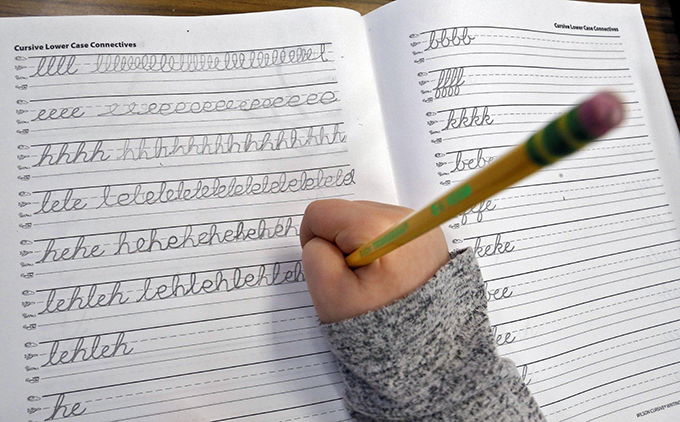
When I taught handwriting to 5 year olds some 40 years later, everything had changed. Oh the letters were the same of course, but the teaching was quite different.  Lots of play, making shapes in sand with sticks, tracing dotted lines in books and generally getting the feel for straight lines, curves and circles.  Then we made a start. No alphabetical order, instead groups of similarly formed letters would be produced until all 26 were covered. 


I’d always been fascinated by letters, their shapes, how they got together to make words, and how the words themselves formed yet more shapes.  And you could actually read those shapes - they said something, they meant something. It was magic.


When children first learn to write freely, they are often so engrossed in what they want to say that the words become squashed together, without a finger space to be seen. Long sentences all in one word. When I moved from Y6 to Y1 I spent many puzzled hours trying to decipher these endless, spaceless meanderings until I worked out that reading the whole thing aloud, phonetically, was the answer to the problem. I’ll never forget Nicola writing about her dolly who had ‘anewperovrubernikers’* Amazingly, there were spaces between all the other words in the sentence but this was obviously just one complete item. 


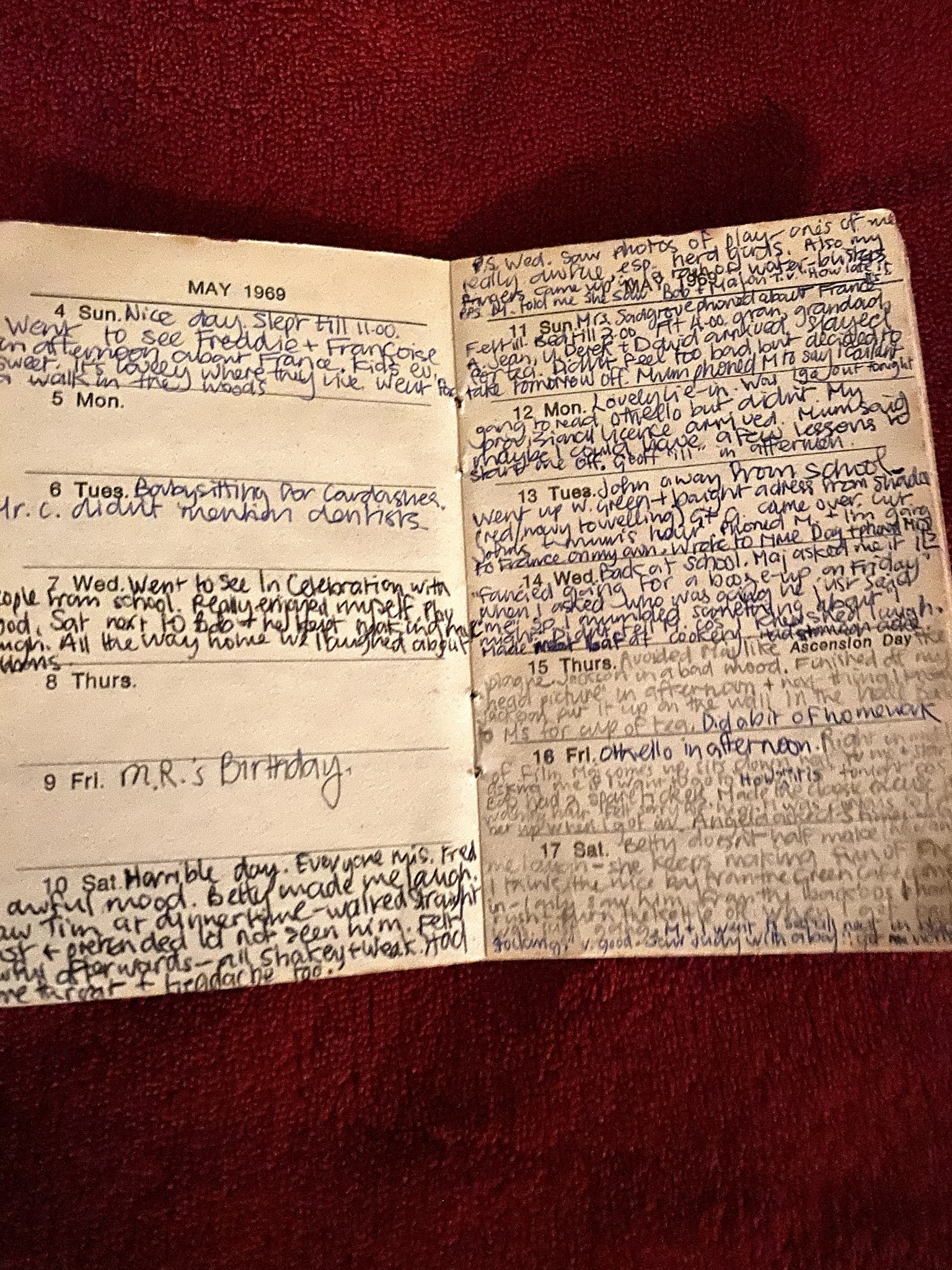
Throughout childhood and adolescence my handwriting changed constantly. When I started High School it began to enjoy regular changes in size, shape, often with questionable legibility.  I’ve always kept diaries and notebooks and I remember two strange displays of affectation. I was about fourteen or fifteen.  The first was joining two words together if they had a common letter at the end of the first and the beginning of the second. For example, ‘that tent.....’ became ‘thatent’ and so on. Ridiculous with hindsight but it obviously kept me amused and saved on paper. The other phase I went through was dotting odd words in French throughout the diary entry, probably for the very same reason as above. 


1969, my final year at school


1974 How could I write this, never mind read it??


Inevitably, in 2021, beautiful handwriting is becoming a thing of the past. Letter writing has naturally waned, due to the ubiquitous use of computers, tablets and phones.  Emails, text and messages are all relayed instantly - no need to wait for the post - and one’s reply is back with the sender in seconds.  Much as I love these digital connections I can’t help feeling a stab of regret that I’ll probably never sit down again and read a long awaited hand written letter from a friend or relative.  I have a drawer containing old letters all of which mean something to me. Each envelope is distinguishable by its unique handwriting: my dad, who wrote infrequently but always in times of trouble (mine), with his small neatly formed script.  Inside would be well thought out words of wisdom and hope, offers of help, usually financial; mum with a larger, more generous script, an envelope full of promise, the letter bursting with news from home, enquiries as to my health and well being, and lots of love; the careful print, squashed within the tiny space on the bluey from an RAF camp somewhere in Afghanistan.  How the sight of that writing reassured me. I didn’t care what was written inside (usually not a lot). My boy was still alive; then my husband, when we were apart for a few months before we married, a scribble at best, a sense of urgency, and inside, a letter full of more frantic writing, and however loving and intimate, always finishing with a flourish: ‘Up the Rovers’; and, it goes without saying, the best handwriting appears on the funny, poignant little notes and letters, left on my pillow or posted around the kitchen door by the children when they were little.  


That sound of the letterbox closing and a thud on the doormat.  What a happy memory. Now that has to be preferable to the constant pinging of a noisy mobile….


*A new pair of rubber knickers.


Handwriting Practice (with apologies to Joyce Grenfell) by Jill Reidy 


Children

Pick up your pencils 

And hold them like this - 

No, Emily, like this -

See, thumb here, finger there

That’s good

But with the point towards the paper

Start on the line and draw -

Jack! Don’t do that with the pencil!

We’ll never find it again

Start on the line and slowly

Up to the line above

Yes, that’s it Milly, brilliant!

No no no stop STOP!

Stop at the line above 

You’ve drawn on the desk now 

It’s all right, never mind

Don’t cry, Milly, it was a first attempt

You wanted a LONG line?

We can clean it off the desk

Now

Come down the line

Slowly, slowly, take your time

That’s it

Very good everybody

Oh Ollie, what’s this?

A plane? A PLANE? 

We’re not DRAWING today

Are we Ollie? 

No, we’re doing our HANDWRITING

Arent we?

Yes yes we are Ollie

I know planes make lines in the sky 

Yes Ollie chemtrails - 

But we’re making lines on paper, Ollie

No, there’s no need to rub it out 

Put the rubber down, Ollie

On the desk

Away from your book

Start on the next -

Jamie! 

What is that you’re waving about?

I know it’s your pencil

What’s that on the end of it?

Ugh 

That’s not very nice

your pencil doesn’t need to go

Anywhere near your nostril

No

Now, pencils ready? 

What, Jamie?

Wipe it on a paper towel

Careful! Katie’s jumper?

It’s OK Katie, it’s only - 

That’s it, you get a paper towel too.

Right, ready? 

Now you need a big fat -

Cece? 

Yes I did tell you all not to call each other fat but - 

No, nobody’s fat in this class but -

CECE! Its a letter, a LETTER that’s fat

Yes, letters can be fat

Wipe your eyes, Cece 

We haven’t hurt the letter’s feelings

And - everybody - draw a big fa- round circle 

To make the letter b

Well done children! 

Some lovely b’s in these books

Who can give me a word that starts with b?

Max? Oh no, we don’t say that do we?

Where have you heard that?

Yes, I know what it means but -

Yes, I know all the boys have them 

Max, you don’t need to point to - 

Right, everybody, coat’s on 

Lovely work, early playtime….


Thanks for reading.........Jill 


Tuesday, 26 January 2021

Handwriting - Don't Lose the Basics


I used to take pride in my handwriting, though these days it is limited to a shopping list or a quick note. I’ve received many compliments for my ‘beautiful handwriting’ which may have started with my interest in calligraphy.  I’ve enjoyed the privilege of doing the place cards for weddings and formal functions as my reputation grew. Over the years my style has changed and become a bit scruffy, to say the least and it’s probably down to lack of use. I can’t blame it on the lymphoedema.

Handwriting was an important lesson at school. My childhood was spent learning how to correctly form individual letters, how they sat on the line, which were tall and which were not.  We practised on specially lined paper, using a fountain pen or a dipped ink pen, after a pencil had been mastered sufficiently for the approval of the teacher. How the letters linked together into what we called ‘real writing’ followed the specific rule of the pen not leaving the paper mid-word, so a character ending below the line would need to be looped back to the line to form the next one. This was the way we were taught and we had to adhere to it. Individual style came later.

My secondary school exercise books, which I still have, show my various experiments in handwriting with some comments from teachers – ‘Do this again in blue or black ink’ (my preferred turquoise Quink was an individual step too far)  ‘This is not an art lesson. No more unnecessary flourishes’.  Eventually I settled into something like a Chancery script and quite far removed from the cursive handwriting I’d grown up with. I think I still write like that.  I used my calligraphy skills to copy a couple of my favourite sonnets which I hung on the wall in matching frames. They need re-doing with ink fit for purpose; another little job on my lockdown ‘to do’ list.

I’m helping out with some home-schooling for my eldest grandson. He’s only five and missing school, which he loves. I really feel for him. He needs his teacher, his peers and the dynamics of his classroom activities. For now he’s got Nanna’s old-fashioned teaching skills coupled with bags of patience, I hope. He is a whizz kid at maths and number work. He needs some encouragement with handwriting. Yesterday was handwriting day, just when he wanted to play. I have lessons emailed to me by my daughter for him to work on with my help. It wasn’t long before I thought I was reciting a Joyce Grenfell sketch.

‘Sit still, dear.’

‘Move to where you can see, then.’

‘Try to keep hold of your pen.’

In an effort to keep things fun, I got the easel out, chalk-board facing, plenty of chalk and words for him to sound out and write on the board. That went well, he was focused and I took a photo to send to his mum. Not much actual handwriting done, never mind. After a play-break, I found him something about dinosaurs on BBC Bitesize KS1. I think it was a science lesson. He enjoyed the interaction with that so much that he had to do it twice. He already knew how to ‘scroll and click’. Of course he did, silly me, he is Year One. We’ll return to his proper school work and do some handwriting another day. There’s no substitute for basic skills.

I wrote this poem a few years ago. Forgive me if you've heard it before. 

An Alternative Education


The 3Rs soon to be redundant

Computer-led kids will be abundant

With all information mega-quick

It only takes a scroll and click.

No need for any conversation

Included in their education.


Last year’s reception class have all gone

And taken a leap up to Year One

To drag sticky fingers on IPad screens

And work out what technology means.

Will this be their basic foundation

Instead of formal education?


Numeracy, or let’s call it Maths

Has rules to follow specific paths,

Beginning with learning how to count

Then adding up and sharing out.

One click away from calculation

Takes away their education.


When did this digital preference start?

Oh why no poetry learnt by heart?

‘Spell check’ becomes their favourite teacher

With ‘grammar check’ and added feature.

The only future expectation,

A self-taught on-line education.


The infants are learning to use a pen.

It’s not a skill they’ll need again

For a future spent staring on-line,

Social activity in decline

With hardly any interaction,

So they won’t need our education.


PMW  2015


Thanks for reading, take care and keep well. 

If you're home-schooling or trying to occupy infants, keep smiling. They love you.  Pam x