written and posted by members of Lancashire Dead Good Poets' Society

Showing posts with label The Beatles. Show all posts

Saturday, 11 July 2026

Moustaches

By the summer of 1966, the Beatles had grown weary of the worldwide phenomenon they had become, the claims that such unprecedented levels of fame made upon them, and the dehumanising effects of touring in particular. They played their last live concert on 29th August 1966 in San Francisco and vowed never again.

Tired of being four fresh-faced mop-top caricatures to be screamed at, chased, mauled and treated like public property everywhere they went, following their return to England they decided to disappear for a while, distance themselves from the maelstrom of Beatlemania, and reset.

Step one was to grow moustaches (see below). Acquiring facial hair was a straightforward and symbolic move away from their cute boyband image. They were all in their mid-twenties by now anyway, and the current interest in and vogue for Edwardiana clothes and styling made the adoption of this more mature look an obvious one. 

moustaches on parade
It's telling that all four of them made the same move, as did many in their close support group, and then many of their male fans. It became a badge of Beatle brotherhood for a period of a few months in 1966 going into 1967.

Step two was to pretend - at least to themselves - that they weren't The Beatles anymore but an entity that became known as Sgt. Pepper's Lonely Hearts Club Band, based on the brass bands that had played at weekends and on special national occasions in those municipal bandstands that had sprung up in Britain's parks through Victorian and Edwardian times.

The new LP was to be a concept  album of sorts, a very loose one in musical terms, allowing Lennon, McCartney, Harrison and Starkey to adopt personae, literary and musical masks that freed them to an extent from what had gone before. In reality, only the title track, its reprise and a few connecting snippets lived up to that initial vision. 

They were photographed for the album artwork in March 1967 decked out in band regalia and sporting moustaches just as their Edwardian musical predecessors may have done (though The Beatles had longer hair). They appeared on the front cover of the LP not as The Beatles but as members of Sgt. Pepper's Lonely Hearts Club Band, clutching a variety of appropriate brass and woodwind instruments. There was even a sheet of cardboard cut-outs included with the LP that fans could snip round and put on, including badges, epaulettes and a moustache. (Its tabs got rather soggy after a couple of wears.)

part of a photoshoot for the Sergeant Pepper LP cover
The LP was released at the beginning of June. For a brief, shining moment in the summer of 1967 we could all play along with the game. It was the Summer Of Love and happiness reigned all around. 'Sgt. Pepper...' was hailed as a revelation and a revolution. It was proclaimed a masterpiece. It went on to become one of the most famous and iconic records of all time. It certainly freed The Beatles from their past - though I still prefer its predecessor 'Revolver' for sheer ground-breaking genius.

What is interesting to me is that by the time of the press launch party for the album, at Brian Epstein's London mews flat in May, weeks before the LP hit the shops, Paul McCartney had already shaved his moustache off (see below). He had been the first to grow one (ostensibly to hide a scar from a riding accident he had in1966) and then to encourage the others, for reasons explained above. But why to jettison it so soon while the other three retained theirs for months? Maybe Jane Asher held the key.

May 1967 Pepper press launch party
John was the next to shed his and by the time of filming Magical Mystery Tour that autumn, only George and Ringo were still sporting the moustaches to which they'd obviously become very attached.

After the four of them went to India in 1968, then there was stubble and beards - but that's another story.

While I've been working on this blog, my lovely eight year old Dell Inspiron laptop has been encountering problems: no space left on the C drive even after I've moved all my pictures and documents to detachable pen drives and run disk clean-up and space optimisation software. I put it down to all the increasingly complex functionality that has been arriving in recent Windows updates.

Anyway, long story short (and nothing to do with moustaches), I decided to turn to the wisdom of the interweb to see if there were any other tricks to identify and then uninstall unnecessary files. I typed into Google 'How to get rid of...' and before I'd got any further it bounced straight back with what are clearly the top two searches, in a kind endeavour to save me typing anything more.

Those top two searches?  1. How to get rid of cellulite and 2. How to get rid of your wife.

I thought wow! There's a poem in that. And here it is. I nearly called it 'Trouble And Strife' but it's now:

Meet The Googles*

Want to know the main concerns
of modern married folk in their forties?
Same as always, it seems.

I typed 'How to get rid of...'
into my trusty search engine and presto...
the top two most frequent requests are:

'How to get rid of cellulite'
and 
'How to get rid of your wife'

If ever there was a contemporary 
encapsulation
of that age old divide

the battle of the sexes
and how it's plied,
you have it right there.

* in the honourable tradition of Meet The Beatles, Meet The Fokkers etc.

As a musical bonus, here's a link to a Beatles song that might have been on the Pepper LP except it got released as a single. Of course it references barbers and shaving and the video has those moustaches. . Just click on the song title: Penny Lane

Thanks for reading, S ;-)

Saturday, 31 May 2025

Journals

Journal: It appears there are several definitions. The first and most commonly used defines a  newspaper, (true to the French root word jour - day - and its offspring noun journaliste) or magazine. The second denotes a diary or private record of daily events, observations and thoughts. There is a third, more obscure definition, relating to that part of an axle or shaft that rests on bearings. If you're interested in mechanics, feel free to look it up, but here we're sticking with newspapers and diaries.

Not counting a number of what are called 'freesheets', the UK's national daily news publications currently number eleven. The oldest established is The Times (1785) and the most widely read is The Sun (1.2 million copies daily). Some even have the word daily in their names (Express, Mail, Mirror, Star and Telegraph). For the sake of completeness, the other national dailies are the Financial Times, Guardian, I and Morning Star. Then there is a host of daily newspapers at a regional or local level, like the Blackpool Gazette (for which I write a monthly football column during the season). 

Of course, not all news journals are daily. The titles listed above actually only appear on week days, but most of them also have a weekly companion, featuring the word Sunday in their names. The exception is the Observer, which also happens to be the longest established (1791).

Beyond newspapers, there are also hundreds of journals, more usually called magazines or periodicals, that are published sometimes weekly but usually monthly, devoted to specific areas of general interest. such as aviation, cars, cookery, fashion, gardening, geography, history, knitting, music, photography, politics, sailing, science, and various sports too numerous to mention.

Finally under the first definition come the rather more high-brow journals devoted to specialist rather than general interests, where university academics publish research papers, unveil discoveries, debate theories, intellectualise in refined ways about arcane or leading-edge knowledge of astronomy, chemistry, linguistics, literature, medical science, physics or whatever floats their cranial boats.

journal entry
However, what I really want to write about is journal as in diary, or as the French would call it, journal intime as opposed to agenda or engagement calendar. I have kept one at various times in my life. I've destroyed them all, just as Ted Hughes burned Sylvia Plath's last diary shortly after she committed suicide.

Many famous people  have had their journals made public (often after their death). Among the earliest was the  English diarist Samuel Pepys, who kept a dairy of his daily life from 1660 for ten years (it runs to over a million words). Then there was Daniel Defoe, whose 'Journal Of The Plague Year' recounts the awful events of 1665/1666. The latter is not a true journal, given that Daniel was only five years old at the time of the Great Plague, but it is based on the contemporary diaries of his uncle Henry Foe.

Over the last few hundred years, the journals of many famous artists, authors, politicians, scientists and society figures have been published, and not always posthumously, from Dorothy Wordsworth and Charles Darwin to Captain Scott, Virginia Woolf, Anne Frank, Winston Churchill, Nelson Mandela and Edwina Currie. They differ from autobiographies and offer interesting insights into the authors and their milieu. if one has the inclination and the luxury of time to read them.

I mentioned the poet Sylvia Plath just now, and it was Cynthia Kitchen's blog about a favourite poet (or two) that made me home in on Plath - and by extension Ted Hughes. Sylvia Plath wrote a diary from January 1st 1944 (aged eleven) until her death in February 1963 (aged just thirty). The early volumes of diaries remain unpublished and are currently housed at Indiana University in Bloomington, for research purposes. Her adult diaries, commencing in 1950 when she became a student at Smith College and covering the next dozen years, were first published in abridged form in 1982 as 'The Journals of Sylvia Plath'. They were edited by Frances McCullough, with Ted Hughes as consulting editor. Hughes withheld two diaries from that publication, in addition to the final diary that he claimed to have destroyed because it contained passages he didn't want her children to have to read. Eventually, the two withheld diaries were yielded up and in 2000, the publication of 'The Unabridged Journals of Sylvia Plath', containing 50% previously unpublished material, was hailed as a true literary event, giving as it did a fascinating insight into the woman, the writer and her ultimately tragic life.

posthumously published diaries
For anyone unfamiliar with the tangled web that was the relationship between Plath and Hughes, here's a quick overview. Sylvia Plath was born in Boston, USA in 1932. She was a bright and precocious young lady (IQ of 160) who started writing poetry aged eight. At eighteen, she went to college to study Literature, developed a habit of self-harming and made her first attempt at committing suicide. She won a scholarship to come to the UK and study at Newnham College, Cambridge. She met Ted Hughes at a party in February 1956. They admired each other's poetry. Hughes was a couple of years older than her, had studied English at Pembroke College, Cambridge and had just had his first work published. They were married four months after they met. As Plath put it:
"We kept writing poems to each other. Then it just grew out of that, I guess, a feeling that we both were writing so much and having such a fine time doing it, we decided that this should keep on."

They moved to America for a couple of years and Plath taught briefly at her alma mater, while Hughes taught at the University of Massachusetts, but returned to the UK in 1959 and bought a flat in London. 1960 had all the hallmarks of a propitious year. Hughes published 'Lupercal' a prize-winning poetry collection, their first child was born, and Plath published 'The Colossus', her first poetry collection. 

By 1961, Sylvia was confiding that she was in an abusive relationship, and that Ted's physical violence towards her. caused her to miscarry her second pregnancy. That summer they bought a house in rural Devon, where their second child was born at the beginning of 1962. They had let their London flat to a couple of writers, David and Assia Wevill and soon Hughes was embroiled in an affair with Assia (with whom he was also to have a child). Plath's reaction was to try and commit suicide again by deliberately crashing her car. Ted and Sylvia separated in the autumn of 1962 and she moved back to London with her two small children to rent a flat in Primrose Hill, in a house that W.B. Yeats had formerly occupied.

The winter of 1962–1963 was one of the coldest on record in the UK. It was dubbed The Big Freeze. In her tiny flat Sylvia went into a burst of creativity, completing a novel and most of the poems that would comprise the posthumous collection 'Ariel', but the flat was a miserable place, the pipes froze, the children—now two years old and nine months—were often sick, and the house had no telephone. She sank into a deep depression. Her novel, 'The Bell Jar', was published in January 1963 and was met with critical indifference. She wrote to Hughes in early February saying she was planning to return to the USA with her children. Maybe she was hoping that would bring him back. He did visit her, but clearly it didn't go well. By then he was already in a relationship with another woman in addition to Assia. In fact he was with this third amour on the night Sylvia decided to take her own life.

On the morning of Monday 11th February, with her children still sleeping soundly, she sealed herself in her kitchen, with towels and tape to stop the fumes from spreading to the rest of the flat, turned on the gas oven and put her head deep inside it. 

cancelled passport
As Plath lay dying in her freezing Fitzroy Road flat on that Monday morning, barely a mile away on the other side of a snow-covered Primrose Hill, the Beatles commenced  recording their debut LP 'Please Please Me' at Abbey Road studio 2. They laid down the whole album in a single long day, fuelled by milk to keep their voices functioning, and finished late in the evening. A leading Beatles chronicler (whose first wife, I was told, also committed suicide) later wrote: "There can scarcely have been 585 more productive minutes in the history of recorded music" 

Ever since I've known that two such culturally significant events - a bright beginning, a sad ending - happened so very close together in space and time, I've been fascinated by the fact. I've been mulling over the possibility of writing a poem that imaginatively ties the two events of that singular day together, and now I've realised the opportunity, with the slightest sprinkling of poetic licence.  I hope I've succeeded. You'll be the judges of that.

A Singular Day (11th February 1963)
Milk bottles stand forlorn sentinels
on a doorstep at 10 am as the Beatles plug in,
first take of the day: There's A Place.

Some dark tragedy begins when pipes,
passion, hopes freeze. 23 Fitzroy Road also
home to WB Yeats, a blue plaque attests.

Does she, too, cast a cold eye, Medea like,
then decide to spare her babies her fate, even as
icy talons grip her wearied heart?

Do You Want To Know A Secret?
What horrors that final journal could spill,
a truth too awful to tell. Misery.

She seals the room with deliberation,
turns on that slow, monoxide hiss and lays
head deep within the stove as peace

comes dropping slow, a woozy whirling
blackness into the run-out groove of eternity,
earthbound, no more play.

Over the hill, barely a snowy mile away,
the Beatles tear into A Taste Of Honey, and how
Sylvia had loved her bees,

those messengers between gods
and men, symbolic of a rustic idyll that proved
illusory, happiness beyond reach.

All afternoon, shocked friends come
and go, woeful witness to this quiet drama,
some wracked by tears, some with guilt

while in Abbey Road the Beatles
power on though Chains, Anna  and Hold Me Tight.
They're shredded, getting very near the end.

A bottle of milk hastily downed,
one last Twist And Shout belted out
at full throttle. Job done

...except for reverberations in the ether of 
Love, Love me do. The Beatles board their train
to Lime Street. A hearse negotiates the wintry night.

Sylvia Plath and child 
As a footnote, Ted Hughes didn't write another poem for three years after Sylvia's death, but as her widower, he became the executor of his wife's personal and literary estates. Assia Wevill also committed suicide by gassing herself and her child some six years later. Ted Hughes eventually remarried and  became Poet Laureate.

Thanks for reading, S :-(

Saturday, 24 May 2025

Good Day Sunshine

We have been so lucky with the weather recently, enjoying successive weeks of non-stop sunshine. Hottest May ever in the UK since records were a thing, apparently. It's been fabulous, and when it's like this there is no finer place (outside of Greece) than the jewel of the north. However, that magical sequence appears to have ended overnight and if the meteorological auguries are to be believed, our fine run of sunshine has been sacrificed on the altar of a great British tradition, the wet May Bank Holiday weekend. Sorry folks.

Talking of records, I can remember sitting in my parents' Vauxhall Victor in the muddy carpark of some National Trust property on the equivalent May Bank Holiday Monday back in 1970. It was pouring with rain and I'd elected to stay in the car rather than look around Old Tudorpile Hall (or nonesuch), so I could listen to the first complete play-through of the Beatles' 'Let It Be' LP on the car radio. In a sense the Beatles were already history, having officially split earlier in the year, but they still managed to fill the car with audio sunshine on a miserable, wet day.

Of the four, McCartney and Starr were always the sunniest Beatles. Lennon was complex, sometimes dark despite the wit, often cynical. Harrison could be dour and moody. But Paul and Ringo were the upbeat half of the quartet, Ringo because he was always so easy-going, Paul because he was charming (if prone to arrogance), more light weight than John and of a naturally sunny disposition. 

I suppose it was natural, therefore, that when the Beatles had a two-week break in the middle of recording songs for their second LP 'With The Beatles', it was the pair of Paul and Ringo who, with their girlfriends, took off for Corfu in September 1963, leaving the upswelling madness of Beatlemania behind for some unmolested relaxation in the Greek sunshine. It was McCartney, after all, who had written the song "I'll Follow The Sun" when he was still in his teens, though it wouldn't feature on a Beatles record until 1964.

Ringo Starr, Maureen Cox (obscured), Jane Asher and Paul McCartney in Corfu (1963)
The photograph above was taken by Lucy Hill, a friend of Jane Asher, at a restaurant in Paleokastritsa, Corfu on the 20th of September 1963. It was the first time either Ringo or his girlfriend Maureen Cox had been abroad, and it's remarkable to think that Jane Asher was only seventeen at the time.

That excursion gave them a taste for Greece and in 1967, at Lennon's urging, they all four travelled back to Greece with their partners with the intention of buying themselves an island retreat. Based in Athens for the duration, they visited several prospective small islands before deciding on one and had gone as far as arranging the financing when they took against the idea of the Greek military junta which had just seized power in the land, and the project was quietly dropped.

Other sunny Beatles songs of note include McCartney's wonderful  "Good Day Sunshine" from 'Revolver', of  which you'll find an audio link a the foot of this blog, Harrison's sublime "Here Comes The Sun" from 'Abbey Road' and (finally) Lennon's "Sun King" from the same LP - all mood-enhancing tributes to the light source that sustains us.

As a Beatle-related segue into the next part of the blog, these lines of Lennon's from "I Am The Walrus"
"Sitting in an English garden waiting for the sun..."

Over these last sunny weeks, I've noticed a regular visitor to my back garden. He's a marmalade cat who gets in via a hole in the fence, heads to his favourite spot and suns himself in perfect contentment, disturbed only when I go out to hang up some washing. He's like a shaggy sun king.

the Sun King (a visitor)
It has been known for decades that genetics are responsible for the distinctive colouring of marmalade cats (also called ginger or orange tabby), but exactly where in the genetic code had evaded scientists until recently, when two teams of scientists at Kyushu University in Japan and Stanford University in the US solved the mystery and revealed all in scientific papers published simultaneously this month.

What the teams found was that in the melanocyte cells responsible for giving a cat its skin, hair follicles and eyes their colour, one gene, ARHGAP36, was much more active. By comparing the DNA from dozens of cats with and without marmalade fur they found that those with ginger colouring had a section of DNA code missing within this ARHGAP36 gene. Without this DNA the activity of the ARHGAP36 is not suppressed i.e. it is more active. The scientists concluded that the gene instructs those melanocytes to produce lighter pigment. 

It also helps to explain why most marmalade cats are male, for ARHGAP36 is carried on the X chromosome. Male cats like other mammals have an X and a Y chromosome, which carry different genes. As it is a gene found only on the X chromosome, in this case controlling the pigment production, then one missing piece of DNA is enough to turn a cat fully ginger. By comparison, female cats have two X chromosomes, so the DNA would need to be missing in both chromosomes to increase lighter pigment production to the same extent. Fascinating.

I've written two new poems for you this week:

What The SPF!
How old is your sunshine?
Did you ever wonder?
I'll tell you...

Approximately eight minutes 
and twenty five seconds 
from the surface of the star
till it touches down
on your warming skin.

What happens before it's emitted 
is way more complex, 
incandescent nuclear fusion,
a massive H-bomb, giver of life.

That's twice as long as it would take
a volley of ICBMs from say Russia
on an insane nuclear mission
to wipe us all out, bringer of death
in a radiance of suns.

Kudos then to South Africa
and Ukraine, the only countries 
to have possessed and relinquished
nuclear bombs. It can be done.


Marmalade Buddha
There is a cat who comes and sits
quietly in my garden, doesn't seem
to mind the weeds, just suns himself
in a favoured patch, looks as wise as
an old marmalade buddha, knows
that the moment is everything, so
live for it - but mind that stranger
when he comes to hang out clothes.


And as if all of that wasn't enough, here's a link to The Beatles   performing: Good Day Sunshine

Thanks for reading. Happy holidays, S ;-)

Saturday, 4 January 2025

Rock And Roll Music

Just let me hear some of that rock and roll music
Any old way you choose it
It's got a back beat, you can't lose it
Any old time you use it
It's got to be rock and roll music
If you want to dance with me.

Those are lines from 'Rock and Roll Music', one of the tracks on Beatles For Sale, released sixty years ago just in time for the Christmas market. Of course, it wasn't one of their own compositions. Chuck Berry had written and released the song back in 1957, the year that John Lennon and Paul McCartney commenced a musical partnership (in the Quarrymen) that was destined to change the world in 1964, a sort of annus mirabilis (wonderful year) in so many ways. More on that later.

Beatles For Sale was, however, the group's second LP in a year (and in fact their fourth in just under two years - the sort of recording and release schedule that would be unthinkable nowadays), so only eight of the fourteen tracks were originals, the balance being favourite covers that had been part of their repertoire during those Hamburg residencies of 1960 and 1961

Surprisingly, Beatles For Sale has its detractors, seemingly because nearly half the material is cover versions, in comparison to A Hard Day's Night earlier in the summer, which had been their first LP to feature all original Beatles compositions. 

The Beatles' excuse, as if one was needed, was that 1964 had been such an intense year for the Fabs (as they were becoming known), what with touring the UK, Europe and 'conquering'  America, making a feature film, writing a book of poetry (in Lennon's case), that they just hadn't had the time to write half a dozen additional songs for Beatles For Sale. (It must also be remembered that they chose not to include the contemporaneous hit single 'I Feel Fine' c/w 'She's A Woman' on the LP because they wanted to give their fans value for money.)

Beatles For Sale album cover photoshoot, Hyde Park 1964 (Robert Freeman)
Commentators have added that the LP's artwork, photographs of the group taken by Robert Freeman in Hyde Park, makes them look somewhat world-weary, and the ironic title for the album (surely Lennon's suggestion) encapsulated their frustration at being seen as 'product' as the downside of becoming a global phenomenon, theories which have contributed to a sense that Beatles For Sale is somehow below par in the group's canon. All I can say is that those detractors really need to listen to the record with fresh ears. It's time for a revaluation.

Some of you will be familiar with Philip Larkin's wryly ironic poem about the social changes in motion at the beginning of the Sixties. (I'm supposing he named it after an earlier poem by John Dryden celebrating London's survival in 1666 after the twin threats of plague and fire). 

Annus Mirabilis
Sexual intercourse began
In nineteen sixty-three
(which was rather late for me) -
Between the end of the Chatterley ban
And the Beatles' first LP.

Up to then there'd only been
A sort of bargaining,
A wrangle for the ring,
A shame that started at sixteen
And spread to everything.

Then all at once the quarrel sank:
Everyone felt the same,
And every life became
A brilliant breaking of the bank,
A quite unlosable game.

So life was never better than
In nineteen sixty-three
(Though just too late for me) -
Between the end of the Chatterley ban
And the Beatles' first LP.

                                               Philip Larkin (1967)

Larkin pinpoints 1963 as the crucial year, but for me personally 1964 was the momentous one, for all of the following reasons. As mentioned earlier, it was the year in which the Beatles became a global phenomenon (starting with their appearances on the Ed Sullivan Show in the USA in February), the year in which Labour ended thirteen years of Tory misrule, the year in which I stepped up from Junior to Secondary school (and from short trousers to long), the year of our family's move from industrial Peterborough to academic Cambridge, the year in which I first went to bed with a girl (see my poem 'Stephanie Re-Maps The Stars'), the year when it began to seem that all was change for the better and all things were possible. Optimism was boundless and the Beatles, ensconced in EMI's Abbey Road studio number 2, were busy laying down the soundtrack of our unshackling.

Beatles For Sale recording session, Abbey Road 1964 (Robert Freeman)
I think that's one of the reasons why Beatles For Sale, released at the end of my own annus mirabilis, remains one of my favourite Beatles records, right up there with their best LPs. I'm pleased they chose to give needle time to those cover songs, as a reminder of their roots, and of what a terrific beat group they were. But that record also provides the first hints of them transitioning into the complex artists they would become, a foretaste of that brilliant run of recordings from Rubber Soul to Revolver and Sgt. Pepper's Lonely Hearts Club Band

Beatles For Sale opens with one of the strongest trio of songs on any of their albums in 'No Reply', 'I'm A Loser' and the sumptuous 'Baby's In Black' (all essentially Lennon compositions). It's followed by John's infectious rendition of 'Rock And Roll Music', the Paul McCartney's ballad 'I'll Follow The Sun', another top notch cover by Lennon of 'Mr Moonlight' before the side closes with a ridiculously rocking rendition by Paul of 'Kansas City'.

Admittedly, side two with its country and western influence dips slightly after the opener 'Eight Days A Week', including as it does the obligatory George Harrison and Ringo Starr vocal spots, but 'Words Of Love' and 'I Don't Want To Spoil The Party' are great songs, the rockabilly Carl Perkins covers are inspired and the musicianship is excellent throughout. Beatles For Sale has so many wonderful memories for me and still gets played to death annually in the run up to Christmas and New Year. It's long been a family tradition to play it while the Christmas tree is being decorated, and I've been listening to it in the gym for several days in a row recently as well. 

As Derek Taylor wrote in the sleeve notes: "There's priceless history between these (LP) covers. When in a generation or so, a radio-active cigar-smoking child picnicking on Saturn asks you what the Beatles affair was all about...just play the child a few tracks from this album and he'll probably understand."
       
Beatles For Sale album cover photoshoot, Hyde Park 1964 (Robert Freeman)
I've no new poem for you this week. Instead, for what it's worth, gentle reader, here are my top ten albums of 2024, as trailed in the musical advent calendar I posted daily on Facebook in December (along with musical clips):

01 Natural Magick - Kula Shaker
02 Moon Mirror - Nada Surf
03 Why Is The Colour Of The Sky? - Bananagun
04 Iechyd Da - Bill Ryder-Jones
05 In This City They Call You Love - Richard Hawley
06 12 - White Denim
07 Half Cut - Sarah Gillespie
08 Daniel - Real Estate
09 Across The River Of Stars - Beachwood Sparks
10 Here In The Pitch - Jessica Pratt

Finally, as an audio bonus, that song: Rock And Roll Music as performed by The Beatles. Enjoy!

Thanks for reading. Happy New Year, S ;-)

Saturday, 4 November 2023

Twilight (Of The Gods)

The Beatles released their 'final' 45rpm single this week. "Now And Then " came out in a blaze of worldwide promotional glory on Thursday backed by their very first single "Love Me Do " from sixty-one years ago. So when I needed an angle on the blog theme of twilight, I found one readymade - the last hurrah of the greatest music group of the modern age (bar none). 

All that remained for me to do was to listen to the final single a good dozen times, shed an emotional tear while watching Peter Jackson's stunning accompanying video, and then order my thoughts for your benefit and mine.

Written and demo'd to tape by John Lennon in 1977, it wasn't a song he considered worthy of a place on the last two albums he recorded ('Double Fantasy ' and 'Milk And Honey '). Years after his death "Now And Then " was handed over by Yoko Ono on a cassette tape that also included demos of "Free As A Bird ", "Real Love " and "Grow Old With Me ", (the last of which had made it onto 'Milk And Honey '). The plan of the three surviving Beatles was to work all the unreleased Lennon demos into fully-fledged Beatles songs to accompany their 1995 'Anthology ' retrospective, one song per each of the three parts of the project. In the end the recording quality of the "Now And Then " demo was deemed unusable, though George Harrison was also quite scathing about the song.


Nearly thirty years later, with huge advances in software sophistication, and George Harrison no longer with us, bless him, to object, Paul McCartney has picked up the final part of the trilogy again, written a few new words, created a better bass part and a slide guitar break in the style of Harrison to add to his and Harrison's 1995 acoustic guitar parts and Ringo has re-worked the drums, all on top of a much clearer rendition of Lennon's piano and vocals, plus there are strings orchestrated by Giles Martin (son of the Beatles' famous producer).  So it's a Beatles record because all four appear on it, and it's better than "Free As A Bird " and "Real Love " to these ears, a pleasant rock ballad but nothing brilliant, not like real Beatles records were when half of them were not in their eighties and two of them weren't dead. 

For McCartney it's probably closure of sorts after all the post-Beatle acrimony between himself and John. That's it really, an epilogue or epitaph or eulogy for the twilight of the Gods, the very best popular music ensemble of all time, one that helped shape our culture and our lives for the better - and we still have all that music. And it has been a nostalgic couple of days. Just watching the official music video that accompanies the release is a moving experience: Now And Then Music Video


The Beatles blazed for the decade that was the 1960s and for me, their true goodbye was, fittingly enough, "The End ", captured in seven takes at EMI Studio Two in July 1969, the final proper song on the final proper Beatles' LP 'Abbey Road '. They knew it, even if we were reluctant to take the hint.

I'm not providing a new poem this week. I'm still gestating 'Before And After Beatles', I'm afraid. In lieu here are links to five of my previous Saturday blogs devoted to the best group ever. Click on the bold titles to activate. You're welcome.😊

Beatlemania Was Born In Blackpool (from December 2014): Beatlemania

Revolver - Tomorrow Never Knows (from August 2016): Revolver Redux

Red Letter Day (from February 2017): When I'm Sixty-Four

Lonely Hearts (from June 2017): Phoenix Like

Take Three Birds (from October 2021): Norwegian Wood

I'll leave you with a quote from Paul McCartney that will be echoed by millions, myself included: 
"How lucky was I to have those men in my life."

Thanks for reading, S ;-)

Saturday, 16 April 2022

Three Days That Changed The World

I've ducked out of writing about an obvious three days that changed the world - the crucifixion to the resurrection of Jesus of Nazareth - partly because I have a problem with the idea of the resurrection, and partly because the dates themselves are an irresolvable point of contention. The events, which it can be argued gave rise to a great world religion (as evidenced by global acts of remembrance this week-end), happened around the time of the Jewish Festival of Passover, in early April between the years AD 29 and AD 34. No scholarly research has an irrefutable claim to be more precise than that. 

I've chosen instead to highlight a different and more recent three days that changed the world, namely The Beatles' appearances on the Ed Sullivan Show. We can be precise about those dates: not three consecutive days, but three consecutive Sundays: 9th, 16th and 23rd February 1964. In light of John Lennon's 'infamous' remark from a couple of years later of The Beatles being "more popular than Jesus now" (more on that below), I thought it an interesting parallel to draw.

The Ed Sullivan Show aired on CBS every Sunday night and was at the time the most popular American entertainment programme with an average audience of 24 million viewers. Brian Epstein, manager of The Beatles, knew that if his group was to 'break' America, then exposure on the medium of the moment was necessary. The Beatles' early singles had not taken off in the States. EMI's US subsidiary had passed on the opportunity to release them. 'Love Me Do' got ignored completely and 'Please Please Me', 'From Me To You' and 'She Loves You' were licenced out to small independent labels and sank without trace. 

Finally Epstein managed to persuade EMI's subsidiary Capitol to release the next one 'I Want To Hold Your Hand' at the end of 1963 as a lead-in to the television appearances he had negotiated. By the beginning of February 1964 'I Want To Hold Your Hand' had hit the top of the US charts and a week later The Beatles were performing live on the Ed Sullivan Show to an estimated audience of 73 million people (nearly half the viewing nation) - a ratings record and a generation-defining event. Urban myth has it that crime statistics for the night were the lowest for years. Their second appearance the following Sunday attracted nearly as big an audience of 71 million viewers and those two programmes are still in the top three all time tv audiences in the USA, being surpassed only in 1983 by the final episode of M*A*S*H. The third appearance on 23rd February didn't draw quite so big an audience as by then half the teenagers in the country were in their garages forming Beatle-inspired pop groups! 

The Beatles as first seen by millions on US tv screens
That last point was not an entirely facetious one. In the wake of the shock of President Kennedy's assassination less than three months earlier, the USA had been in something akin to a collective depression, a state of mourning and disorientation that sucked the joy out of life and sapped the nation's natural optimism. Those appearances by The Beatles on the Ed Sullivan Show single-handedly (OK, eight-handedly) gave the country its joy back, lifting not just teen spirits from coast to coast. The nation went into catch-up mode and within a month The Beatles held the top five spots in the US Billboard singles chart (those earlier 45s finally getting airplay and sales), another record that's never been broken. Young Americans did form bands directly as a result of seeing The Beatles. They also got caught up in the whirlwind of Beatlemania, bought the merchandise, grew their hair, became less parochial in outlook, and made almost a religion out of their fascination with the group and its music - and that embrace of The Beatles by America was what catapulted them to global fame and changed the world for the better in the process. So had they really become "more popular than Jesus"?

What John Lennon actually said, in an interview with Maureen Cleave of the Evening Standard in March 1966, was: "Christianity will go. It will vanish and shrink. I needn't argue about that; I'm right and I'll be proved right. We're more popular than Jesus now; I don't know which will go first - rock'n'roll or Christianity. Jesus was all right but his disciples were thick and ordinary. It's them twisting it that ruins it for me." His remarks were mis-quoted and misinterpreted in the American press which led to a series of Beatle-record bonfire events in the southern bible belt at the start of the group's final US tour, a temporary blip on their staggering rise to unparalleled planetary fame and popularity.

Okay, in complete contrast to the happy vibe of Beatlemania, I offer my second poem catalysed by the wicked war being waged by Putin in Ukraine - another event with a claim to having changed the world in the last few weeks.

Of all the Ukrainian cities Putin has targeted to date, the southern Black Sea port of Mariupol has been the hardest hit, pounded relentlessly by Russian artillery and surrounded by advancing Russian troops. The majority of its buildings have been destroyed, the civilian population has been living for weeks in cellars and basements, without electricity or running water. Thousands have been allowed to flee along occasional humanitarian corridors and the stories they tell are heart-rendingly awful. Thousands more have been killed in what clearly constitutes the worst war crime in Europe since WW II. Thousands remain trapped, starving, facing an uncertain fate in what has been described as "hell on earth"  Ukrainian forces have been holding out bravely but are short of ammunition and it is feared Mariupol is about to be the first city since the invasion to fall into Russian control. 

bullet-riddled Mariupol city sign
It is very hard for us to comprehend the evil that can foist such suffering and devastation on innocent people. It is equally difficult for us to imagine the depth of fear and misery that living through war entails. The horror is so vast it's not easy to get to grips with. So the poem focuses right down on a few specifics as befits this week-end, and in doing so seeks for a shaft of something positive in the bleakness. 

Easter In Mariupol
No eggs this Easter in Maria's city, 
not a chicken left alive. And God,
where is he to be found today? In
the thin smile of a starving child
clutching a dirty rag rabbit? Maybe,
for innocence has a power to touch
even a steely heart toting an AK-74,
a soldier and orphan holding hands
in the starkness of this earthly hell.
Hope treads on fragments of shells.

As a musical Easter egg, here's a link to Julian Lennon singing his father's famous song for the first time in public recently at a concert for Ukraine. Click on the title to play: Imagine


Thanks as ever for reading my stuff, S ;-)

Saturday, 25 December 2021

Mementos

I'm up with the Christmas robin and Ho! Ho! Ho! This is the first time in my seven years at the Saturday blog face that I've been required to post something on Christmas Day. The stocking, the presents, turkey and trimmings will have to wait then, as coffee and duty calls. 😉

My first five Christmases were hot and sunny affairs, for I was born and spent my early years in Nigeria, West Africa. Christmas cards from England depicting snowy scenes struck me as incredibly strange as a child. I remember stockings and presents but I have no idea what Christmas dinner consisted of; goat stew and yam probably, or maybe roast duck as my dad kept a few in a big enclosure in the garden. I'm guessing Father Christmas drank palm wine and the reindeers got corn-on-the-cob, though we had neither chimneys nor fireplaces. My mum made Christmas sweets. Her fudge was the stuff of legend. We played carols on a wind-up gramophone.

Relocated to England from my sixth Christmas onward, it took me a while to see the real appeal of cold, fog, snow, turkey with sprouts and white Christmases (which seemed to descend on the frozen inhabitants of East Anglia with chilling predictability year on year).

Anyway, enough of the moaning, I am now fully acclimatised. After all, this post is supposed to be about mementos so let me tell you about the Radio Times. We got our first television set (rented in those days from Robinsons Rentals) in November 1963. I remember it quite clearly as it arrived in the week that John F Kennedy got assassinated and Doctor Who first aired. My dad started buying the Radio Times shortly afterwards and that's how I knew The Beatles were going to be on TV, both on Juke Box Jury and in concert from some improbable northern outpost like Blackpool or Manchester. Yeah! Yeah! Yeah! Happy days...

a yellowing memento from 1963
He didn't go on buying the Radio Times for very long because soon the daily newspapers were printing detailed TV schedules and recommending interesting programmes to their readers (the TV critic had been born). And yet he would go on to insist on purchasing it once a year at Christmas from 1964 right into the new millennium, so that the family (in its various changing configurations) could peruse and plot their festive viewing. Picking up a Radio Times at Christmas is a tradition I continue in his memory. 

I mentioned Christmas cards earlier, a fashion that really took off in England in the 1840s, coincidentally shortly after the introduction of the penny postage stamp - though in retrospect perhaps it wasn't such a coincidence after all, but an example of the fine entrepreneurial spirit of Victorian England. My parents used to receive hundreds of them and would string them up as part of their Christmas decorations, another habit I was happy to acquire in turn for a few decades. Of course our transition to a more digital world has meant fewer people send and receive physical Christmas cards these days but I am happy with the two dozen or so I send and receive.

It's a curious tradition if one stops to think about it. How many Christmas cards are themselves like mementos of relationships that are rarely remembered or celebrated  beyond that once a year communique? 

The earliest documented Christmas card was handmade by one Michael Maier and was sent to James I in 1611 bearing the greeting: "To the most worshipful and energetic lord and most eminent James, King of Great Britain and Ireland, and Defender of the true faith, with a gesture of celebration of the Birthday of the Lord, in the most joyful fortune, we enter into the new auspicious year 1612." I wonder what he was after! It's housed in the Scottish Records Office.

However, I recently came upon what appears to be a much older specimen of Christmas artwork. 😁

the First Pre-Christmas
That one is for all my conspiracy-theory loving acquaintances to get excited about, and pretty much runs me dry on the memento theme, so it's on to to the poetic bit, and then I can unwrap a present or two with a clear conscience.

Back at the end of July the weekly blog theme was Sestina but I nimbly swerved the challenge by cheekily writing about Retsina instead, given that it was a very hot Saturday and difficult to concentrate on the intricacies of such a complex poetic form. However, I made a promise that I would write a sestina one day, perhaps when the weather was a little cooler; so before the year outruns me, that promise is fulfilled here in appropriately seasonal guise, although yet another composition in the narrative mode from which I'm trying to break free!  

I must say that when I started to write it I had no idea where it would go. It's perhaps a little dark, but then peace on earth and goodwill to all men is not universally guaranteed. I'll also throw in a couple of caveats. The first is that I found the rigid, circulating and repetitive formula of the sestina construct hugely constricting, even more so than a pantoum or villanelle  - but hey, job done. The second is that I reserve the right to change the poem if/when improvements come to mind. But for now, here it is. Cheers.

Christina
Al-Assad's criminal carpet bombing of Homs city shattered all
that represented family, home and happiness for her.  Now she
flees with thousands of the ragged dispossessed,  often wishes
she had died along. Seeing your parents and husband killed for
the vanity of an ideologue leaves a lasting bitter taste.  But this
child, growing wondrously within, is her imperative, Christmas

conceived, best present from the man she loved. Last Christmas
together, a precious time in retrospect, but civil war changed all
to darkness and despair. During cold nights in open country this
hunted band that dare not show itself by day has made sure she
can stay the pace,   her new family now.  The young look out for
the old, strong for the weak, humanity in action.   All she wishes

is that the nightmare will end, Syria is no longer a friend, wishes
to escape its border for a safer haven anywhere, and a Christmas
next year maybe with baby. Southwards into Lebanon is out, for
civil war has forced that country also to its knees,  a free-for-all
with people of her faith no longer secure. It's to Europe then she
turns her face, finds a first resting place in a refugee camp.  This

is not the life she dreamed of as a girl,  all gone wrong.  And this
is not the wife she expected to be, widowed at thirty, but wishes
can't turn back events.  Morning star and morning sickness, she
greets them each lonely dawn, waits to be processed. Christmas
in a Christian land would be some solace. It drags out so long all
hope begins to drain away despite the firstborn she clings on for.

Her tiny girl enters the world in some Bulgarian transit-camp for
asylum-seekers wanting west. With her mother's good looks, this
means officials try to buy the baby for adoption,  pointing out all
the benefits of a better future for a rescued child. And she wishes
she had the will to resist, but can't even afford to buy a Christmas
gift for her little daughter,  so what hope of providing more?  She

lets them remove the baby on the promise of a visa, knowing she
will regret that separation for ever but believing she has acted for
the best.  Her child will grow up German or Dutch, and Christmas
will be a happy time in another loving family for the little girl. This
she tells herself each night as she slips into tented sleep. If wishes
could solve statelessness, hopelessness, constant hunger, cold. All

All she wishes for this Christmas
a few restorative days of warmth, some peace,
a tiny glimmer of hope about her future's lease.


Thanks for reading. Merry Festives everyone, S ;-)

Saturday, 16 October 2021

Take Three Birds

There's a sub-theme threading through this week's outpouring on the topic of: This Bird Has Flown. The clue is animal with Norwegian connections (to paraphrase the popular parlour game Twenty Questions) - but don't worry if  you've not the faintest idea what I'm talking about, as all will be explained herein. I hope you'll forgive my use of the avian familiar in the title. Here goes, in chronological order.

Bird number one is Marianne Ihlen, sometime consort of Leonard Cohen, who immortalised her in the song "So Long, Marianne." I blogged about Cohen and the Greek island of Hydra some months ago but I didn't do justice at the time to his muse - so here in brief is Marianne's story. (By the way, despite what Leonard sang, her name is pronounced with four syllables as "marry anna".)

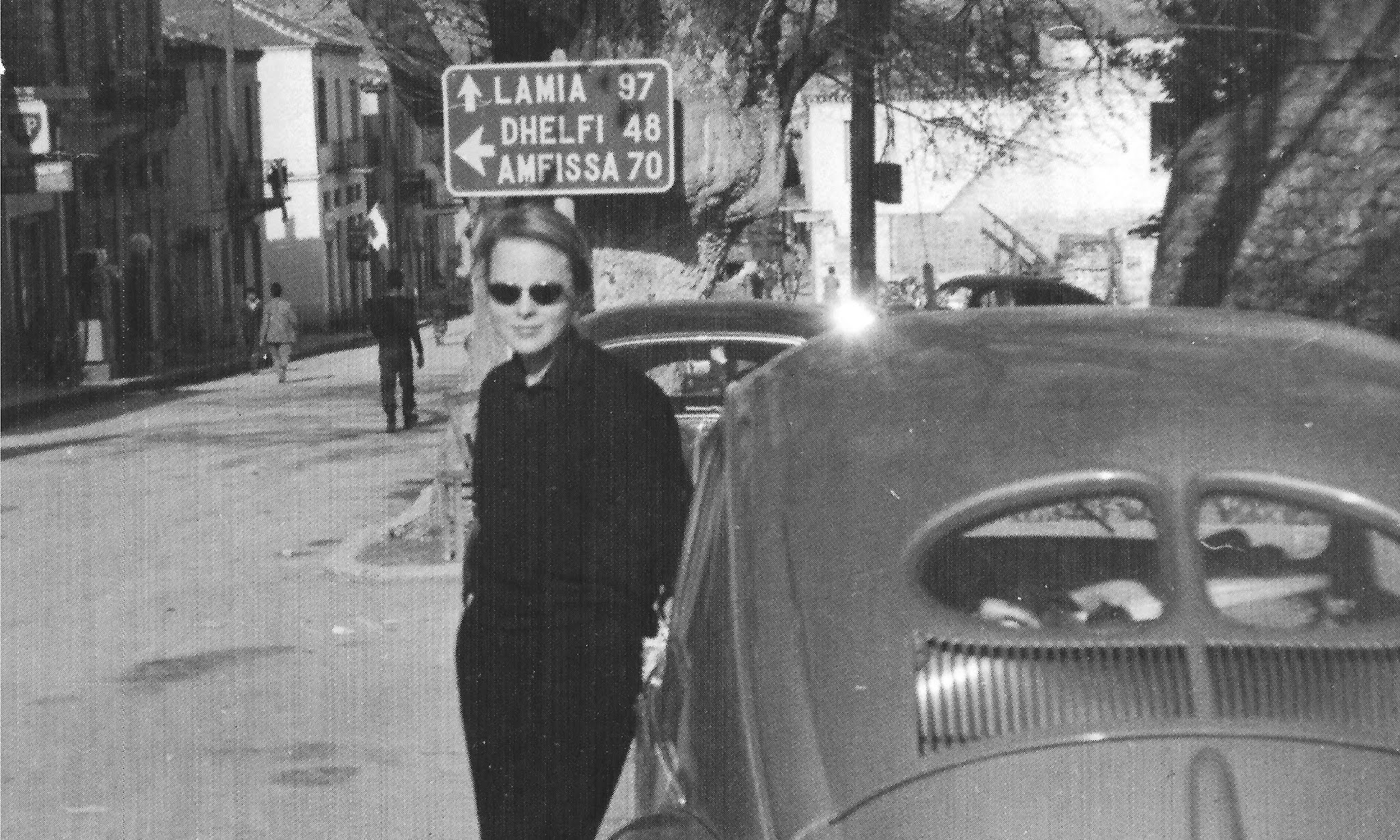
Marianne on her way from Oslo to Athens
There was possibly no place in the world as bourgeois and boring as Norway in the 1950s, the ghost of Ibsen haunting its sluggishly respectable towns and cities, even Olso, where Marianne Ihlsen grew up. Her parents' marriage was not a harmonious one. Her father was a lawyer and authoritarian. Life was difficult at home. Her father wanted her to become a lawyer in his footsteps, or maybe a doctor. Marianne knew that she wanted to escape, to find something more rewarding than her parents' lifestyle had to offer, possibly somewhere that offered broader horizons than Norway's stifling conservatism and gloom.

Enter Axel Jensen, writer, bohemian, slightly unhinged, certainly one of a kind at that time. She fell in love with him and together they decided to flee Norway in late 1957 in search of a different way of living. Against her parents wishes and certainly behind their backs she pooled her savings with those of Axel, and boldly cut her ties with everything she had known. Taking only what they could carry with them into their new life, they crossed by ferry to Hamburg, bought an old VW car in Germany and set off to drive down through Europe with Greece as their destination, for Axel had friends who had made it to Athens and who wrote enthusiastically of the sun and sense of freedom to be found in the south, 2,000 miles from home.

It was a brave decision for a twenty-two year old Norwegian girl to make and one from which there was no turning back. Within weeks they were living in a little house on the island of Hydra, a short ferry hop out of Athens. It was there that she spent the next ten years (until the military coup of 1967), the place where she raised her son, where she was abandoned by Axel and where she lived with Leonard Cohen, who arrived on the island in 1960.

She said that what she found on Hydra was the chance to be herself, to style her life without the strictures of the old country. She didn't know it, but she was in the vanguard of a change about to sweep the western world.  

Bird number two was never explicitly named, but found fame nonetheless through another popular song, John Lennon's exquisite  "Norwegian Wood" off the Beatles' sixth LP 'Rubber Soul'.

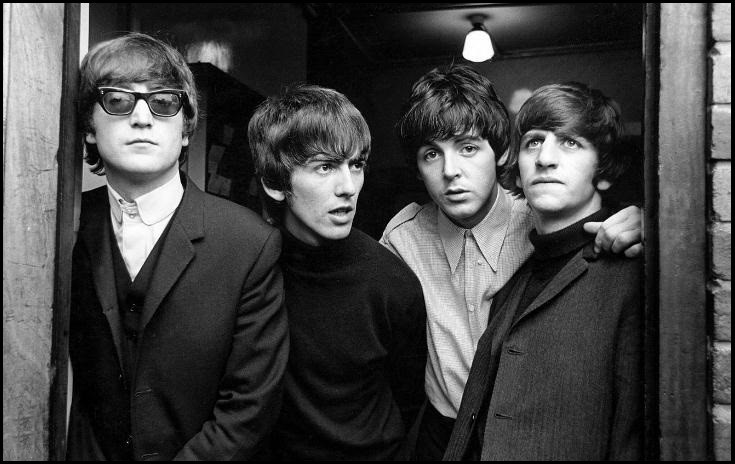
the Beatles from the photoshoot for their Rubber Soul LP cover
"Norwegian Wood" was sub-titled "This Bird Has Flown", an unusual enough departure in itself for a Beatles' song. It recounts in enigmatic tones a liaison of sorts that Lennon had with a young woman, thought by many to be the London Evening Standard journalist Maureen Cleave; enigmatic because the Beatle was married to Cynthia and they had a young son. Norwegian wood is a reference to pine panelling, becoming very popular with swinging London's trendsetting flat-dwellers, as the vogue for all things Scandinavian took hold in the mid-'60s.

Maureen Cleave was certainly a personal friend of Lennon and even had an influence on his development as a song-writer. In his own words: "She once asked me 'Why don't you ever write songs with more than one syllable?' So in "Help!" there are two- or three-syllable words and I very proudly showed them to her and she still didn't like them." From 1964 onwards he came to regard her as the epitome of the more articulate, cultured audience he would like the Beatles to reach out to. She has always stated (perhaps truthfully but disingenuously) that in all her encounters with Lennon he never made a pass at her; and Lennon claimed diplomatically that he could not recall whom the song was about. Make your own minds up. You know the tune, so sing out loud (air sitar optional)...

Norwegian Wood (This Bird Has Flown)
I once had a girl,
Or should I say she once had me?
She showed me her room,
Isn't it good, Norwegian wood? 

She asked me to stay
And she told me to sit anywhere,
So I looked around
And I noticed there wasn't a chair.

I sat on a rug,
Biding my time, drinking her wine.
We talked until two
And then she said "it's time for bed."

She told ne she worked
In the morning and started to laugh.
I told her I didn't
And crawled off to sleep in the bath.

And when I awoke,
I was alone, this bird had flown.
So I lit a fire,
Isn't it good, Norwegian wood?

                             John Lennon (with Paul McCartney), 1965


Bird number three, if you hadn't already anticipated it, is the Norwegian Blue, subject of Monty Python's timeless comedy classic. To enjoy it one more time, click here >>> That Parrot Sketch

Finally, a new short poem tenuously on theme, concerning all those poor souls (far too many of them across the famine-stricken swathes of the world), who haven't eaten for a long time and who don't know where their next meal is coming from.

Cutting Up Food
What a simple, graceful task
that was, almost unthinking,
when we still had livelihoods
and knives and forks
and food.

Now it's almost unthinkable,
muscle-memory in empty hands
shrinking daily like our stomachs,
thinning like parchment,
turning to sand.


Have a good week and t
hanks for reading my flights, S ;-)

Saturday, 17 April 2021

Take Four Northern Men...

...from a provincial city on the slide since the mid-1950s, a dirty city hammered by Hitler's bombers and then side-stepped in the post-war reconstruction. Liverpool, once a great seaport, was losing trade incrementally to container terminals and air traffic, its infrastructure was crumbling (the overhead railway and the corporation tram network were both closed down in 1957), unemployment was rising sharply, and opportunities were few - a situation which reached its nadir with the Toxteth riots of 1981, prompting leading government ministers to urge Margaret Thatcher to commit Merseycide, to abandon the working class of Liverpool to a fate of "managed decline" rather than waste taxpayers' money on the "stony ground" of the north-west! Scousers have a lot to hate the Tories for, but at least at that critical period on the city's timeline, Thatcher dispatched one of her party's more sympathetic politicians northwards to understand and address the problems of urban decay and disaffection. It was a turning point in the fortunes of the area. A quarter century later, Liverpool would be named European City of Culture for 2008 and millions of tourists would visit it annually - partly because of what Heseltine's intervention kick-started, but largely because of those four  Northern Men  of the blog's title: John, Paul, George and Ringo.

Here they are, pictured below with their wives, girlfriends and the Maharishi Mahesh Yogi, at a transcendental meditation week-end retreat in north Wales in the summer of 1967.  Ponder the scene for a minute. It's a seriously atypical undertaking for a bunch of Northern Men, don't you think? Bucking a stereotype, wouldn't you say? 


What it doesn't show (off-page, 200 miles away) is their real guru, Brian Epstein, dying of an accidental overdose of sleeping pills mixed with alcohol that same week-end.. Some wheels were about to come off. As John Lennon reflected on Epstein's demise: "I knew that we were in trouble then. I was scared. I thought 'We've fucking had it!'"

Of course they hadn't, because they'd already made it in ways unimaginable to most northern men. They were about to embark on a magical mystery tour through the western counties, then on a sojourn to Rishikesh in India which would prove one of their most fruitful exercises, allowing them to write a wealth of new songs that would appear on albums nearly (but not) called 'Music From A Doll's House', 'Everest' and 'Get Back'. And even after they had renounced their Beatlehood at the end of the 1960s, they went on to cement a reputation as the biggest, the best, the most influential, most loved and most missed worldwide musical phenomenon of the 20th century (and maybe much of the 21st as well). It's quite extraordinary. So how and why did something so utterly transformative come out of a dour, done and dusted northern city? Well, all was not as stereotypical as it seemed...

Yes, this band of musical brothers were Northern Men, but dour, inarticulate, uncultured proto-beings, (a view of Northerners still held by many well into the 1980s per the views of Tory magnates outlined above), they certainly were not. Neither were they the four scruffy working-class lads from Liverpool of popular press fiction. 

Two of them (Lennon and McCartney) came from what would be considered middle-class backgrounds, from aspirational families living on green suburban streets, albeit families touched with grief, for both of their mothers died young while the boys were still in their teens. In an age before TV, they read books, they wrote poetry. Three of the four (Harrison among them) went to Liverpool grammar schools and one of the three (McCartney) even briefly toyed with the idea of going to university and becoming a teacher.  

But Liverpool had something no other English city (not even London) had in the late 1950s, an umbilical sea-link to the USA, the home of blues, country, jazz and rock'n'roll - and our four Northern Men lived for that music, brought over on 78s and 45s from across the Atlantic by the seamen of the city. They weren't alone. Liverpool, always a musical hotbed because of its large Irish immigrant community (Harrison, Lennon and McCartney all had ancestors across the Irish Sea), was full of young men swapping reading for listening to rock'n'roll, neglecting their studies, blagging cheap instruments from their parents, forming skiffle bands, playing at house parties. Some even forewent writing poetry and prose for writing songs - and that was what first set Lennon and McCartney and their Beatle brothers apart from all the other wannabees on Merseyside, that and their tenacious desire to follow in the footsteps of their American idols, to live the dream of becoming musicians rather than dockers, milkmen, plumbers or teachers.

That they had to quit Liverpool to complete their apprenticeship and forge their magic, in a city and a country still regarded with deep hostility by many in the UK, was an irony that should not be overlooked, and another significant bucking of stereotypes. Between August 1960 and December 1962 the Beatles played over 250 nights in the music clubs of Hamburg, sometimes turning in several sets a night. Their time in Germany was the making of them, for on their return to Liverpool they were not just streets but miles ahead of the competition and ready to take the sedate UK music scene by storm (and then the world).

The next step was not so easy, getting a recording contract, for all the record labels were in London and their executives had a collectively dismissive attitude to anywhere north of Watford. However, the persistence of another atypical northerner, their business manager Brian Epstein, eventually found them a home on EMI's comedy label Parlophone Records - and the rest really is history, just desserts for the Beatles, whose articulate wit, energy, lyricism, belief in equality and social change, endless creativity in song, on film, in books, saw them dismantle just about every prejudice concerning Northern Man that there was. They were at the forefront of a cultural shift in the 1960s, talismans of a post-war technicolour renaissance that saw no boundaries, that embraced experimentation, that exposed every stereotype for the lazy characterization it was. We still have so much to thank them for. 

I've no new poem to add to this week's blog, though 'Before And After Beatles' is germinating somewhere in the compost of the imaginarium; and an earlier poem, 'Beatlemania Was Born In Blackpool', remains the most read of all Dead Good Blogs. You can link to that one: here

Instead, I leave you with a musical footnote, a link to the song Lennon wrote about the Maharishi on that Indian sojourn. Just click on the title: Sexy Sadie (2018 remaster)


Thanks for reading. Keep bucking stereotypes, S ;-)