written and posted by members of Lancashire Dead Good Poets' Society

Showing posts with label Words. Show all posts

Tuesday, 15 April 2025

A Favourite Poet - Too Many to Mention


Poetry books are in abundance on my book shelves and bedside table. I love poetry. I love words, artistically shaped into meaningful phrases. I wish I had the talent to do it better and I keep trying, but I think I peaked some time ago. My head is packed with stress and nonsense which I hope will eventually spill out and evaporate, giving me back some clarity and concentration, and something to write about.

As for choosing or having a favourite poet, for me, it’s like music and depends how I feel. They all have a place.

I suppose we all start as children, learning nursery rhymes and progress into poetry from there. My first poetry book must have been A Children’s Garden of Verse by Walter de la Mare. It’s a slim, hardback, well-used and dog-eared, still knocking around my house somewhere amongst my saved children’s books. I enjoy sharing books with the children at school. I often choose something that tells the story in rhyme, like Dr Seuss and ask the class if anyone can guess what word is next. I like to make it fun. I’ve borrowed a poetry book for children by Michael Rosen which my elder grandson enjoyed. I recently introduced him to my poem about Blackpool Tower, written a few years ago. He was arguing about when it was built, how long it took and I couldn’t convince him that it was less than a hundred years, so out came the book with the poem in it. I read the poem out aloud, not letting on that I’d written it until the end, when I showed him the name. Now he knows that I’m a published poet, I might have gone up in his estimation. I’m not just Nanna, who makes delicious muffins.

When I was a child, we had to learn poems or verses off by heart. It was part of English and usually set as homework to recite to the class. No escape. Here’s a favourite,

From Home-thoughts From Abroad by Robert Browning.

Oh, to be in England
Now that April’s there,
And whoever wakes in England
Sees, some morning, unaware,
That the lowest boughs and the brushwood sheaf
Round the elm tree bole are in tiny leaf,
While the chaffinch sings on the orchard bough
In England – now!

Later it was Shakespeare’s sonnets and Chaucer’s Wife of Bath from the Canterbury Tales.

My fondness for Dumfries & Galloway began with a visit to the birthplace of Robert Burns when we were on holiday near Ayr. Our first stay in the area was never going to be enough and over the years we may have traced his steps from Alloway to Ecclefechan and back again many times, visiting his various homes and his resting place in Dumfries. I wrote this some time ago,

You captured my heart with your words of romance,
I would have embraced you, if given the chance.
We might have been lovers and perfect soul mates,
What a shame I was born two centuries late.

John Betjeman, Simon Armitage, Maya Angelou and Lemn Sissay are all dear to me. How wonderful to see the work of Lemn Sissay displayed as artwork on the side of a Huddersfield University wall, and another in Manchester. We haven’t met, but I feel like I know him through his life story and his daily quatrains, and I want to hug him and say, “Look, at that! Look how far you’ve come!”

I have met Manchester poet, Mike Garry. His poetry still takes my breath away and I’ve seen him many times. The first time was 2012 at the Brewery Arts Centre in Kendal when he was on with John Cooper Clarke. Mike Garry, totally different to JCC, with an equal talent that blew me away. Read him, go and see him, listen to him on YouTube.

Dr John Cooper Clarke, he’s gone from strength to strength. Punk poet in the 1970s to GCSE and A-Level Curriculum inclusion now. Clever, witty and great in concert, with all his handwritten poetry on loose sheets of paper. That’s how it was in Kendal. I wonder if he ever got my Terza Rima?

When Manchester became Mad-chester.

Those of the time embraced every word,
Listening in wonder to John Cooper Clarke,
The Bard of Salford who had to be heard.

Rapid from the mouth and skinny and dark,
‘Evidently Chickentown’, effing good,
He’s magic with words, bright as any spark.

His wholesome description meant that we could
Smell the inhabitants of ‘Beezley Street’,
Rich mixture of urban decay and blood.

Life, humour and truth, a picture complete
And painted with colourful language that
Reaches all listeners not just the elite.

So thanks, JCC, I know where I’m at,
Laughing out loud at the poem called ‘Twat’.

PMW 2012

I haven’t got a definite favourite. I’ve missed lots out and there are people I know through open-mic and similar formats who write some terrific poetry and make me want to snap all my pencils.

This is a long blog, but thanks for reading, Pam x

Tuesday, 4 October 2022

Are Songs Poetry? - Yes


 Are songs poetry?

 That’s a broad question and something that my late friend and poet Christo Heyworth had an ongoing gentle debate with. It was concerning the songs of the Moody Blues, both Christo and I being ‘experts’ on their work. I was ‘yes’ because I find the lyrics to most of their songs poetic, depending on the writer, and all of their albums contain a poem by the late Graeme Edge, drummer and a founder member of the band. Graeme’s poems were performed or recorded as the spoken word set to music and often by Mike Pinder. Graeme’s poems which became actual songs include ‘I’ll Be Level With You’ from the Octave album. I showed Christo my prized copy of one of Graeme’s poetry books. As for songs being poetry, he was a definite ‘no’. I couldn’t persuade him otherwise, but we had some great conversations about it at poetry evenings. We discussed other things too, like the paintings of L.S.Lowry and Christo’s visits to poetry events in Much Wenlock, Shropshire. Christo was always excellent company with lots of interesting topics to share. I wonder what he might have thought of my other poetic song choices.

The lyrics of The Smiths, Morrissey, Oasis, Liam and Noel Gallagher, I can read as poetry. Their creative use of language appeals to me and really makes me listen. Liam’s ‘Paper Crown’ and Morrissey’s ‘Every Day is Like Sunday’ are just two examples of what would be a very long list. I was about sixteen when I first saw Raymond ‘Gilbert’ O’Sullivan on Top of the Pops singing ‘Nothing Rhymed’. There he was, an odd looking bloke with an over-sized cap, sounding a bit like George Formby. He captured my attention with the poetry of his words.

Not all songs can work as poems but poems can work as songs, and I don’t just mean The Song of Hiawatha by Longfellow – I can still recite the part I had to learn by heart in the first year of high school, but I’ll spare you that. I will complain that schools don’t include learning poetry by heart or even reading a whole book, from what I can gather. Anyway, that aside, Robert Burns wrote ballads and sang them, ‘My Love is Like a Red, Red Rose’ and ‘Auld Lang Syne’, two that come to mind.

Radio DJ and musician, Mike Read, wrote music to accompany some of John Betjeman’s poems. Quote from Wikipedia, “…Thirty of these songs were recorded by artists including Cliff Richard, David Essex, Gene Pitney and Marc Almond for the 2006 various artists’ album Words/Music, and subsequently re-released in 2008 as a double CD titled Sound of Poetry. Read’s production of the musical ‘Betjeman’ based on the above has occasionally been staged for charities, including the Royal Marsden Hospital and Children with Leukaemia.”  One of my favourites is David Essex singing Myfanwy.

With an apologetic nod to Christo, though I'm sure he wouldn't mind and would even expect it, I'll finish where I started with the Moody Blues. This time, John Lodge with 'my song', and to me, a poem.


One More Time to Live  -  John Lodge

Look out of my window
See the world passing by
See the look in her eye

One more time to live and I have made it mine
Leave the wise to write for they write worldly rhymes

And he who wants to fight begins the end of time...
For I have riches more than these

Desolation
Creation
Tell me someone why there's only confusion
Evolution

Tell me someone that this is all an illusion
Pollution
Tell me someone
Saturation

Tell me someone
Population
Annihilation
Revolution

Tell me someone why this talk of revolution
Confusion
Tell me someone when we're changing evolution
Illusion

Tell me someone
Conclusion
Tell me someone
Starvation

Degradation
Humiliation
Contemplation
Changes in my life

Inspiration
Elation
Changes in my life
Salvation

Changes in my life
Communication
Compassion
Solution

Look out on the hedgerow
As the world rushes by
Hear the birds sign a sigh

One more tree will fall how strong the growing vine
Turn the earth to sand and still permit no crime
How one thought will live provide the others die
For I have riches more than these

(From the album Every Good Boy Deserves Favour, 1971)


Thanks for reading, Pam x
Saturday, 23 April 2022

Collage Poetry #3

If Lancashire Dead Good Poets' Society still ran writing workshops, I think that  Collage Poetry  would have made an excellent theme. Regrettably it doesn't, but here's one you can all try at home.

Materials: one pair of scissors, plain backing paper, glue, a supply of surplus printed matter - I raided my Council recycling card and paper sack, which was nearly full as I only put it out once a month, (stone - optional).


Preparation: cue some suitable music (Beethoven's 7th works for me), drink a glass of wine,  and start cutting out words at random from a selection of magazines, newspapers, brochures, fliers - different fonts, colours, shapes, until you've got a sizeable pile. (How many is enough? You'll know. If you need to cut out more later, do so.) 

Process: lay all the words out, again quite randomly, on a broad, flat surface (table-top, rug, floor), drink another glass of wine and just scrutinise them all for a while. Next, summon up the spirits of the muses (Μούσες in Greek), Erato in particular (being the goddess of lyric poetry and collage-making), to inspire and direct your selection of a group of words from among the set. Try out various permutations of the selected words until they make a semblance of sense, bringing in additional words from the original set as necessary. When you are satisfied with the sequence, glue the words to the backing paper in the form of your collage poem. Thank the goddess(es), wash your hands, drink another glass of wine and marvel at the result.    

Result: I give you Paper, Scissors, Stoned...


Thanks for reading my recycled rubbish, S;-)

Monday, 18 April 2022

Collage Poetry #1

Collage

The art of making a picture with various materials or objects…
stuck onto a larger surface.

Poetry

A piece of writing in which the words are arranged in separate lines,
often ending in rhyme, and are chosen for their sound and for the
images and ideas they suggest.

Considering these two definitions put forward by the Cambridge Dictionary, Collage Poetry to me is the art of making a piece of writing whereby words are cut out or made out of different material. These elements are then put together creating new images and meaning whilst considering visual shape and the symbolism of individual or a combination of words to evoke feeling and/or an idea. The symbols/text can be arranged on separate lines but not necessarily so.

Collage and writing poetry have both been part of my creative practice for many years. I have incorporated text into my assemblage and collage artworks i.e. from magazines and newspapers as a background. If I collage words to make a poem, I first write the poem then find words or letters that are appropriate. I’ve never created collage poetry in a somewhat random sense and thought this blog was an excellent opportunity to have a go.

I chose the BBC Wildlife Magazine, August 2006, for this exercise selecting a headline from 21 different pages.


I then chose the first word of each headline and started exploring creatively. I followed this by cutting out the last two words and had a bit of a play.

Finally I cut out all the words from the headlines and made attempts to create some writing that made some sort of sense. I didn’t put pressure on myself to use all the words. The first end result I believe was influenced by current tragic world events.


The second one turned out to be a bit of fun...


The third one, well, I'll leave that up to the reader:


I found the outcome really interesting and thought I'd have another go with the BBC Wildlife Magazine, July 2006. I carried on with the same process using 15 headlines this time.


My first attempt at making a poem yet again turned out to be seemingly influenced by events in Eastern Europe.


Since I used wildlife magazines and the given text, it's no surprise that nature-themed poems were also an outcome. 


Finally, I collected all the leftover words from both headlines, separated them out and categorised them by nouns, verbs, adverbs etc. which led me down a Google rabbit hole and revisiting lessons in grammar rediscovering words like determiners (five types), conjunctions, articles amongst others. This mess of individual words taken out of their original context and the exercise of separating them out by function highlighted what role the words had to play in making meaning. It was helping to make sense of a giant puzzle. The cut out words both inspired and directed ideas, whilst my past experience and intuition played a part in selecting, grouping and assembling. During the process the lack of certain words available also affected how the poems were constructed.


Here are the final results.


Just like fitting in that last piece to complete a challenging jigsaw, producing these poems has been very satisfying.

Thank you for reading. KEW 😀

Thursday, 5 September 2013

It sits in the middle and knows

08:00:00 Posted by Damp incendiary device , , , , , , 3 comments
On Saturday, we Dead Good Poets met for our monthly workshop.  After a fun word game which involved coming up with the most inventive similes (I failed but not miserably as I now have lots of stolen similes - mwah ha ha), David Riley read an excerpt from Seamus Heaney's Seeing Things (XVIII).  The excerpt was written in tercets with a little internal rhyme and, if memory serves, contained ten syllables per line.  The aspect of the poetry which we all observed was the way Heaney managed to allude to magic throughout his narrative of a visiting rope seller without ever overtly naming it.  The devil was very much in the details. 

For our main writing exercise, we set about trying to write short poems in a similar style to Heaney's, i.e. we would have a list of things to include but we should never name them, rather use the details to allude to their existence.  To this end we started by making lists.  I asked everyone to give me one fictional character, location, object and type of magic.  Here are the results:

Fictional characters
  • Mr Pickwick
  • Batman
  • James Bond
  • Raffles (the gentleman thief)
  • Willy Wonka
  • Mr Rochester
  • Madame Bovary
  • Heathcliffe
  • Miss Marple
Locations
  • Blackpool
  • Hogwarts
  • Hawaii
  • Andromeda
  • Canada
  • Glasgow
  • The Restaurant at the End of the Universe
  • Coney Island
  • London
Object
  • Chainsaw
  • Blue John Stone
  • Paintbrush
  • Dagger
  • Football
  • Cigarette Lighter
  • Fish Tank
  • Book
  • Quill
Type of Magic
  • Witchcraft
  • Black Magic
  • Close Up Magic
  • Numerology
  • Necromancy
  • Conjuring
  • Wizardry
  • Kaballah
  • Tarot

As I then distributed these in order this meant that someone had to write a poem about a gentleman thief with a dagger on Andromeda using numerology.  Someone else was forced to write a poem about James Bond in Hawaii with a paint brush and close up magic.  Everyone rose to the challenge magnificently, weaving the details in with humour (references to the insertion of a three inch Harris had us in stitches) and beauty (the blood red maple leaves in the Willy Wonka necromancy poem were especially vivid).

There was some talk that I had rigged this challenge as I ended up writing about Miss Marple in London with a quill and tarot.  It does seem a particularly favourable set when compared to Batman at Hogwarts with a piece of Blue John and black magic but the poem which that latter set instigated was so creative that I think I might have preferred something more challenging. 

As I'm not going to be at the open mic event on Friday, I thought I'd share my effort from the workshop.  If you would like to use this exercise to create some poetry, please do.  We'd love to read your work in the comments box.


Divine Mystery

In Whitechapel, hell clings to brick and stone
Grim residue like smog that never lifts
Blue populace wades, ankle deep in death

Behind a window's bubble-spotted eyes
Bone-handled orphans rest in caskets lined
With velvet.  Feathered pens and vessels, cracked.

A desk, marked deep and faded as the day
Is strewn with cups and wands, lovers and wheels
A form, ancient and present, points to change.

Her fingers at the deck, old woman smiles
Reeking of gin and smoke, wrapped tight in tweed
A body's surfaced and she knows the hand.


Monday, 3 June 2013

Words and Actions

Words and Actions

With a sword in the wrong hands
Only one man will be slain
A pen in the hands of misguided views
Will cause many families pain

One man holding a gun in the mall
And a hundred shoppers bought it
Scribble out hate filled ideology
Generations suffer the forfeit

With a missile fired from long range
Thousands of homes turn to rubble
A few keyboard click on a blog
An entire race of people is in trouble

With Surgeons knife and skill in hand
One baby can be saved
With words to tell this story's tale
Many more are saved from the grave

Words or weapons, tools or pros
Hope or death, Crow or Dove
The Choices made by those with power
Can be the difference between hate and love

Wednesday, 12 September 2012

YAWPING


As many of you know, three months ago I decided to take a break from the blog in order to focus on my MA poetry portfolio. I am pleased to say that said portfolio is now finished, prettily bound and sitting on a desk waiting to be marked. Therefore, with little more than nail biting and worrying to endure over the coming weeks, I’m now in a position to return and start blogging again.

When I discovered the theme for my first week back there was definitely a small sigh of despair. I’ve always been a keen and varied reader but, somehow, comic books have never really made it onto that reading list.

Sunday, 11 December 2011

A Very Noisy Blog

07:56:00 Posted by Damp incendiary device , , , , , , , 2 comments
by Colin Davies


When I offered to write a blog for the Blakpool Dead Good Poets Society, they said ‘yes please’. Cool, I thought. Then they said, ‘can you write one about poetry and sound?’

I, of course, agreed. Then I got to thinking about it. You see, I used to work with sound, I was a hi-fi salesman. Esoteric equipment with values beyond most peoples means with the soul purpose of delivering the ultimate sound to the audiences ear.

So suddenly I wasn’t thinking about the onomatopoeia values of words to add a sense of drama or sound scape to an action of literally painted vista. I was thinking about sound itself, the essence of noise and rhythm, muisc.

I found myself considering such songs as Joe le Taxi, Vanessa Chantal Paradis 1987 hit. I don’t speak French, I also don’t understand it being spoken to me, yet the sound of the words, the tone of her voice, with the rhythm made it a pleasant experience to hear.

This lead me to look at other words where the sound was more important than the meaning. Disney has a couple of very good example with ‘Supercalifragilisticexpialidocious’ and ‘Hakuna Matata’

Just the sound of these words is enough to convey an idea. You don’t need a meaning, just a pleasing sound.

I decided to type in the words ‘Sound Poem’ into Google and found this entry in Wikipedia.

“Sound poetry is an artistic form bridging between literary and musical composition, in which the phonetic aspects of human speech are foregrounded instead of more conventional semantic and syntactic values; "verse without words". By definition, sound poetry is intended primarily for performance.”

This got me thinking again. I can see that there is much discussion over this form, this discipline, this school of writing and yet I find the idea so simple, liberating and fun.

Spike Milligan would touch on this style is some of his writing. ‘In the land of the Bumbly Boo’ and the ‘Ying Tang Song’ have wonderful sounds that aren’t describing anything as such, just being noises.

So to me a Sound Poem is one that just allows the audio aspects of the words to be the focus. It could be a language you don’t understand, or some invented words that are put together for the Phonetic flow that they deliver to the listener. Which ever way you look at it, writing in pure sound may look easy but it requires a certain focus to find the most important element of such a piece of work, the rhythm.

If you set about writing such a verse, and you negate the rhythm, the outcome can be nothing more that a random set of letters, characters thrown on a page. By placing a structure over the top and sticking strictly to the time signature, you can create something that can touch people on a level beyond mere words, and influence then on a higher plane than any music.

These hypnotic lines entrance and entertain. They completely and utterly allow the audience to superimpose their own meaning, attach their own emotional bond, it becomes theirs and theirs alone.

So, by taking all this on aboard, I present to you a sound poem from my heart, to yours.

What’s out there?

Chicka chicka chook
Lokra nonti sood
Blimble lushby kethtra ong
woota, homthga, jaykma, tong


Colin presents the Listen Me Alice show on Impact Radio every Sunday night from 10pm.

Tuesday, 6 December 2011

A Recipe for Sound

05:00:00 Posted by Lara Clayton , , , , , , , , , 5 comments
I would describe myself as a page poet. By this, I mean that my poems work better on the page than they do at a microphone. I am not a performance poet and, more importantly, I don’t aspire to be one. I’m instinctively shy and just convincing myself to stand in front of a room full of people is challenging, then asking me to read poetry is even more difficult. But I do it. I stand at the microphone and read my page poems. I do it because it’s always good to do something that frightens you – throws you outside of your comfort zone – and when you survive, it makes you realise that you can be stronger than your greatest fears.

I’m a page poet that likes sound. That cares as much about how my poetry sounds as the way it looks on the page. I don’t just look, but I listen as well. I read aloud as I’m writing, feeling the lines rolling off my tongue and changing anything that doesn’t ‘sound right’. However, regardless of how much I like sound, it needs to work in conjunction with the overall meaning. It can add strength and emphasis to a poem. But on its own it will never add the depth and the multitude of layers that I love within poetry.

I can use sound to give a poem a specific feeling. I can manipulate assonance or alliteration, not only to accentuate a line but, also, to impart harshness or softness. If I consider syllables – stressed and unstressed – and place them in a given order, then I can create rhythm. If I use a string of monosyllabic lexemes in short lines, then I can create the illusion of speed, haste, panic. Therefore, I would argue that sound is as important to poetry as a line break – although probably not as important as the connotative meaning of individual words.

Recently, my mind (usually in the early hours of the morning) has been thinking about a new analogy for poetry. Like a simile it can allow you to think about things in a different way, and this can often enable you discover something new, something that you hadn’t considered before...

Poetry is like cookery. You start off by following recipes, weighing everything out and following each step. Then once you’ve mastered the basics you begin to experiment: taking what you’ve learnt from the recipes and applying it to something new. You learn the rules before you start to break them.

Cookery is about balancing ingredients, while poetry is about balancing words – with all their meaning, sound and power. If you get the balance wrong, it creates something that is inedible. For instance, it doesn’t matter how much you love spices, with all their autumnal colours and vibrant scents, if they’re used without a degree of skill then you’ll create something that fails to function as a meal. The very same philosophy is applicable to sound. It doesn’t matter how much you love sound, if you don’t achieve the right balance with poetry’s other ingredients then ultimately the poem will fail to fulfil its full potential.

Poets should be aware of sound, should employ sound techniques, and should care about the overall sound of their poem. But, equally, sound should be used like a spice: with care and caution.

Thank you for reading,
Lar

Thursday, 6 October 2011

HAPPY NATIONAL POETRY DAY!

It's a good job you made it here today. This is a free service aimed at ensuring that nobody is left wanting when the question is asked: "What did you read on National Poetry Day 2011?"

Perhaps it's because I turned it into a (terrible) song but this portion of The Walls Do Not Fall by Hilda Doolittle is one of the few I can recall on demand.

But we fight for life,
we fight, they say, for breath,

so what good are your scribblings?
this - we take them with us

beyond death; Mercury, Hermes, Thoth
invented the script, letters, palette;

the indicated flute or lyre-notes
on papyrus or parchment

are magic, indelibly stamped
on the atmosphere somewhere,

forever; remember, O Sword,
you are the younger brother, the latter-born,

your Triumph, however exultant,
must one day be over,

in the beginning
was the Word.


Hilda Doolittle (1946)


I have always been partial to that phrase: In the beginning was the Word. Most likely this is a throwback to a Catholic upbringing. It reminds me of the church social club on a Sunday afternoon and pestering those around me with the same question again and again: "What is the word?" Of course nobody could tell me what that word was but hearing that phrase convinced me that there was a word, an idea made communicable, that would unlock some essential key to existence. This, in part, is why I write.

Another favourite poem of mine, because Regina Spektor embedded it in a song, is Fevrale by Boris Pasternak:

February. Get ink, shed tears.
Write of it, sob your heart out, sing,
While torrential slush that roars
Burns in the blackness of the spring.

Go hire a buggy. For six grivnas,
Race through the noice of bells and wheels
To where the ink and all your grieving
Is muffled when the rainshower falls.

To where, like pears burnt black as charcoal,
A myriad rooks, plucked from the trees,
Fall down into the puddles, hurl
Dry sadness deep into the eyes.

Below, the wet black earth shows through,
With sudden cries the wind is pitted,
The more haphazard, the more true
The poetry that sobs its heart out.


You can hear it read in Russian here: http://www.youtube.com/watch?v=pf4FQxILI1I

My partner's father has been learning Russian for some time and he assures me that the English translation does not accurately portray the emotions of this poem. Hearing it read in Russian, I have to agree. So much about the way language is used in poetry is about an emotional connection to the words and a feeling for the sounds. It is close to music I think.

The poetry that matters to me is the poetry that forces me to stop. Both of these pieces had the power to do that to me. Ideas flow so easily through the brain when they are familiar. Living by the sea I appreciate how something as spectacular as an ocean can become commonplace when seen every day. Occasionally, however, the light is just right or the wind gentle enough that I remember the vastness of the water, the strength of a single wave. In this analogy poetry is elemental. It is the light or the wind which forces us to stop and notice an ocean; forces us to open our eyes and see something essential.

Tuesday, 13 September 2011

Love Letter

08:32:00 Posted by Lara Clayton , , , , , , 7 comments

Writers and poets have written letters for centuries; declarations of their love scribed on parchment, sealed inside an envelope and sent. But in a world that is progressively dependent on technology, is the tradition of letter writing – or more specifically the expression of love – under threat? Perhaps the more complicated aspects of life blind us, distort that which is simple. With our lack of sight we lose our way, and forget how to listen to the faint murmurs of heart.

For in a world that is reliant on the material (things of monetary worth), and which favours the concrete over the abstract, the concept of ‘love’ has become a cliché. As modern poets, we fear being clichéd, thus perhaps a part of us fears the subject of love... It would seem far easier to write of pain and sorrow – of a breakup, of the darkness in our minds – than to write about the joy.

I, myself, have only written a fraction of poems that could assert to have ‘love’ as their theme. And they are self-conscious, clumsy stanzas – worried of straying into a clichéd landscape: saying too much (flouting Grice’s Maxim of Quantity), only being able to speak in hyperbole (flouting Grice’s Maxim of Quality) and resulting in a poem of obscurity (flouting Grice’s Maxim of Manner). Therefore, I tend to find myself avoiding the subject of love – or tripping ‘head over heels’, if I dare to venture too near...

However, this week’s theme (‘Priceless Words’) made me think of love – and the letters that allow it to be preserved for years to come. Perhaps spending a week in Devon with my Nan has made me sentimental – but as she retold stories about her and my Grandpa’s holiday in the Lake District, it was impossible not to be moved. They were stories I’d never heard before, stories that only my Nan could tell and for me, at least, they are priceless.

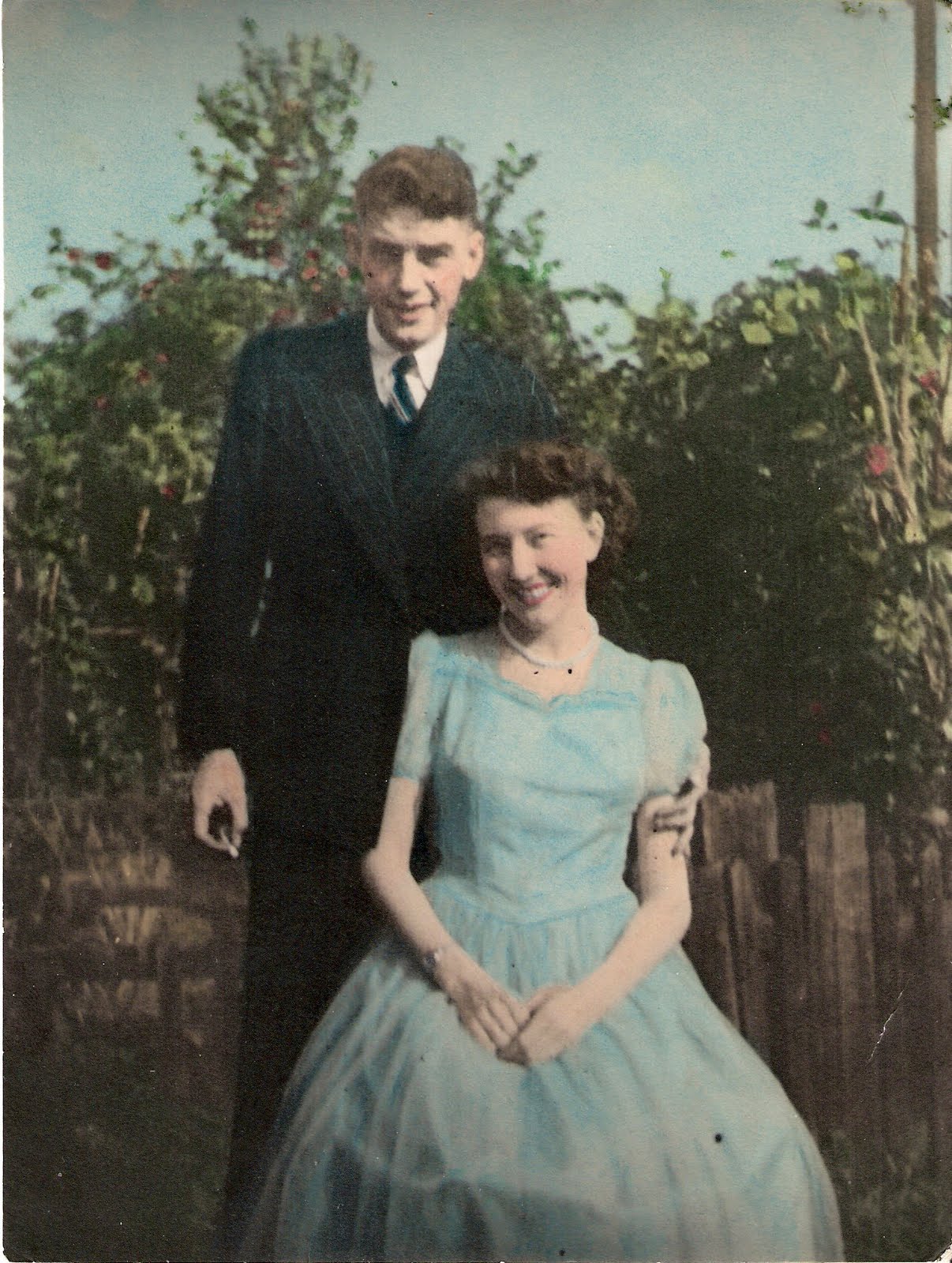
I could conclude this blog post with one of Keats’ letters to Fanny Brawne, or Lord Byron’s declarations to Countess Teresa Guiccioli – in fact there is a multitude of love letters to quote from – but I’ve chosen instead to share a letter that my Grandpa wrote to my Nan while they were courting. My Nan, at the time, looked after the children of a doctor and his wife. She went with them on holiday for two weeks to the Durley Hall Hotel, Bournemouth – and my Grandpa wrote to her daily.

(15.07.1949) Friday 9.PM.

Hello my Sweetheart.

Thank you again for another letter, if the postman missed me one morning I would run him all round Coventry.

You ask me what I have been doing, well, I’ll let you into a secret, I am being miserable all the time. Don’t think I am blaming you, darling, because just think how nice it will be when you come back. I think it will have been worth it, don’t you?

Look darling, don’t bother to buy any presents because no one expects any, also don’t bother about Robert because it is his birthday in August, so it will be as well to wait for that. We can buy him something then. You know I don’t want you to buy me anything, as long as you love me that is all I shall ever want, darling.

Well, my sweetheart, we have got the first week over so the next one shouldn’t be too bad. I’m looking forward to a week tomorrow darling, are you!

Don’t worry about the camera, sweetheart. I’m sure it is alright, it has never let anyone down yet. I’ve booked up for Skegness on the Friday, I hope that will be alright for you. I wanted to book for the Monday, but as usual I was too late.

Have you decided what you are going to wear to come home in? Also, what you are doing about your case?

I think I shall go to the Forum tomorrow night, but I don’t suppose I shall enjoy it as I won’t be able to put my arm around you and feel your head on my shoulder. By the way, what do you mean about saving you a lot of kisses, you know I haven’t anyone else to give them to and what’s more I don’t want to give them to anyone else. You had better buy yourself at least six sticks of lipstick because you will need that many for Saturday alone.

But no joking sweetheart, I do love you more than I can tell and next Saturday is the only day I have been looking forward to since you went away. Will you marry me darling?

Well sweetheart, that is all for now so night, night and God Bless you, darling

all my love

George

P.S. Hurry Home.

Even after death words have the power to survive – to speak a voice that we thought we’d never have the opportunity to hear – and for that reason, words can be some of the most priceless (and precious) things in our lives

Thank you for reading,

Lar


Monday, 12 September 2011

Worthy.

I’ve spent most of the last week in Devon. I’ve spent time there pondering many things, exploring much of England’s glorious countryside and, in a moment of money saving madness, joined the National Trust.

Strangely, I feel it was quite cheap- the initial outlay- at a most reasonable £23.50 for the year (being a young person and all). If I park my car in the Lake District, I have pretty much made my money back- I consider this a win.

Some of Britain’s best loved countryside is protected ‘by my membership fees’, along with the residencies of many great writers. Hill Top (Beatrix Potter), Coleridge’s Cottage, Wordsworth’s house and Lewis Carroll’s birthplace are all places I plan to visit this year, for free, but I’d say that all of these places are only really of interest to me for the ‘celebrity value’. I love wandering around and just looking for clues as to what might have inspired them, what the thought process could have been.

As many of you know, since graduating I have continued working at the newsagents (a family business). I like it, if only for the reason that it constantly challenges my perceptions of people. After my time off, I’m looking forward to going in today. The kids are back at school so no doubt, by lunchtime, someone will have challenged me on something English related- being ‘shit and pointless’ or whatnot. This annoys the hell out of me- I always bite.

The thing is, I don’t know how many youngsters are reading today. I gather they are reading magic fiction but poetry, I really don’t know. I gave a paper lad the full rundown on approaching a poem the other day. I knew the poem he was doing and without doing his coursework for him, he should do all right from that. The trouble I find with them all is the constant resistance, even the sixth formers. Constantly the point comes up that it doesn’t matter anymore, it is time bound, irrelevant and this too, is a major bug bear.

I’ll conclude then, by questioning the actual nature of this issue, the seeing the point- the connection. We have all seen films based on Shakespeare, we have all read modern day fairytales, new takes on themes and so, if the words of the past are ‘irrelevant’, why are we still using them today? The worth of a word is not something you can rate, I would argue it is the meaning that carries the value anyway, and so is it not how we move on from the past- learn?

I’m sitting beside a pile of now redundant TV magazines- free supplements liberated from returned Sunday papers. These magazines are redundant just days after I got them so have quickly become worthless words. The pile of poetry, the bookshelf straight facing me or those words passed on in childhood- they’ll be with me again tomorrow- I’d call those kinds of things ‘Priceless’.

Thanks for reading,

S.